I have developed quite an interest in the asymmetrical arrangement of fruit on the backrest of the so-called Cattedra di San Marco in Venice which I have argued in an upcoming article in
the Journal of Coptic Studies is the original Episcopal throne of Alexandria.
Order article
here.
Let me say right off the bat that I don't understand why physical object and 'holy relics' are treated differently than manuscripts.
Most scholars speak about 'the testimony of Josephus a first century Jew' when the earliest MANUSCRIPTS of Josephus only date to the thirteenth century.
They don't see any problem with this state of affairs. They acknowledge that a series of scribes copied out an original lost (Aramaic?) text of the Jewish War which happens to preserved in almost ten very different forms in ten very different languages.
It only stands to reason that OUR version of Josephus is the correct one (after all our ancestors were better, smarter, more virtuous than the ancestors of other people). Yet even without this concession there can be no doubt that there is a basic FORM to the narrative which remains consistent throughout the ages.
In the same way, I have demonstrated in my forthcoming academic article that core ideas associated with the Episcopal throne of Alexandria have remained very consistent over time. The idea for instance that God's presence was understood to have resided on the seat. The image of Paradise is also connected with the throne, so too the four living hiyyot of Ezekiel and the seraphim of Isaiah etc.
The point is that EVEN if my arguments as to a very early date for THIS Episcopal throne are not accepted the idea that the manufacturers of the relic HAVE TO BE UNDERSTOOD to have modeled it after something which existed much earlier.
Indeed it's not as if the Alexandrian church went to IKEA and 'shopped around' for the latest design for the most holy object in their most holy church.
Can you imagine the Pope of the day asking the ancient equivalent of a furniture salesman 'what the latest trend in cathedra?' and the salesman's response
'Oh, beanbag chairs are really hot right now. That and chairs with images of trees of Paradise and the four hiyyot.'
'Oh I like that one. Do you have it in alabaster? ...'
No we have to treat the throne of St. Mark the way textual critics employ the earliest surviving remnants of the Evangelist's gospel. The problem of course is that everything about the study of early Christianity is directed by myopic 'textual critics' and 'Patristic scholars.' Yet as I have said time and time again this wholly Protestant approach to Christianity ignores the essential mystery element not only of the Coptic tradition but ALL ancient Christian faiths.
Luther may have felt comfortable divorcing the New Testament from the mysteries but we shouldn't if we want to understand the original Christian faith (and not be governed by the ignorance of Germans).
Indeed if I could digress even if Grabar's very late date for the throne is accepted - i.e. sixth century it is about the same date that my friend David Trobisch attributed to the Codex Sinaiticus in a private conversation with me. He accuses these 'textual critics' of the same thing they accuse me of doing - viz. choosing the earliest possible date for their discoveries (in their case the date of the catena of Eusebius).
In any event I am not alone in moving up the very late date which Grabar - an expert in BYZANTINE RELICS assigned the throne. As I note in my article others have connected the object to the Passio Petri Sancti which explicitly identifies the chair as being in use in the early fourth century but which IMPLICITLY assigns a date of the early to mid third century for the same throne (see my article).
Grabar's problem was of course that he saw the top piece of the throne as being established at the same time as the rest of the carvings - something which virtually EVERY Italian scholar has rejected ever since given the clean break between the top piece and the throne. In other words, someone removed what was originally represented in the 'crown' portion (a solar disk?) by cutting through the alabaster and refashioning it to reflect something more 'orthodox' - viz. a cross and the four evangelists.
In any event, I have argued very consistently that the throne is the 'missing link' in Alexandrian Christianity, not only because it necessarily has to be understood to have been used in the mysteries of the tradition (cf. To Theodore) but also that St Mark's throne MUST be connected with the enthronement at the end of St. Mark's gospel.
Of course all we have available to us to reconstruct the original ending to this Alexandrian text is Clement's confirmation that there was an enthronement in the conclusion AND Irenaeus' open statement that 'those of Mark' apparently had such an enthronement but it argued for an earthly enthronement (see previous posts).
Now as I have believe that the Gospel of Mark mentioned in To Theodore necessarily was connected with the Diatessaron tradition I find Aphrahat the Persian's citation of the Diatessaron's last words as reflecting 'something like' the original ending of Mark which Irenaeus was objecting to. The ending cited by Aphrahat read:
I am with you till the world shall end. For Christ sits at the right hand of His Father, and Christ dwells among men
Of course there is going to be someone who objects and says - how the hell did the resurrected Christ end up in Alexandria so quickly after the Passion? The answer is to look at Epiphanius testimony that the Valentinians (and other heretics?) gave a period of eighteen months between the Passion and the Assumption.
In other words if - as I have demonstrated in my book - that the Alexandrian tradition held that the Resurrection took place on a Sunday March 25 - the only year that fits is 37 CE (according to Finegans' Handbook of Biblical Chronology). To this end I have developed in great detail in the Real Messiah that 'Mark' Agrippa ended up getting enthroned as the messiah with clear references to the gospel narrative eighteen months after this (i.e. August 38 CE)
in Alexandria.
You'll have to read my book to see if you 'buy' into my argument. Don't dismiss it before you actually hear what I have to say!
Now as I see it the throne of St. Mark is a living testimony - manufactured either AFTER the original enthronement or - if you can accept a stretch of logic - the original throne appropriated from the great synagogue of Alexandria mentioned by Philo as residing in the very spot where the Church of St. Mark later stood.
I have already developed these arguments elsewhere so I needn't repeat them here.
So what about the throne of St. Mark made it so significant that later generations of Nicene Christians would want it occultated? The obvious answer was that it – like the testimony of Dionysius cited by Athanasius – could be used to support conservative voices in Alexandria against the recent establishment of a doctrinal creed at Nicea. In other words, we should expect that the Cattedra di San Marco should say something which Arians could hold up as proof of their particular understanding of Christ being a created creature, that there was a time when Christ did not exist and all the things which the Nicean Church Fathers found so contentious was established by a testimony older than Arius, older even than Dionysius and the ‘Origenist’ Patriarchs of the city. If our suspicions about the original Episcopal throne of St. Mark are correct, it could have been used to support the claims that the Tradition says that the Church of Alexandria always believed these things thus proving once and for all that the beliefs of Alexander and Athanasius represented utterly alien doctrines completely incompatible with the faith of its original Evangelist.
So now it becomes crucial to re-examine what historical information we can gather about the relationship between the throne and the Episcopal tradition at Alexandria. Legend has it that when Theonas was deciding whom he should place on the throne of St. Mark in his stead Jesus appeared to him in a vision and said “you who water well the spiritual garden, give the garden to Peter the presbyter so he can water it and come and rest with your fathers.’ The next day we are told “the archbishop said to Peter “Have courage, my son and be strong and work well the garden of your Lord” and the text concludes with the words “after these things Saint Peter was seated on the throne of the high priesthood by the decree of God Almighty.” It is noteworthy that on our surviving Cattedra di San Marco we find an unmistakable image of the Garden of Eden, completely with ‘tree of life’ and four rivers of Paradise. As we already demonstrated elsewhere the “tree of life” which appears on the backrest of the throne contains a coded Aramaic phrase embedded in its branches. The tree appears to have been deliberately rendered asymmetrically. There are five main branches which come off of the main trunk of the tamarisk with more branches and more fruit appearing on the right side than on the left. When we take the total number of fruit on each of the five branches and covert that number into the corresponding letter of the Hebrew alphabet we end up with the Aramaic phrase ‘the ninth vision.’
Why is this so significant? In previous research we proved that the encoded reference to ‘the ninth vision’ can only be to the last in a series of nine revelations given to the prophet Zechariah in our Biblical canons. The counting of nine visions in Zechariah has been thoroughly proved by Marie-Joseph Lagrange and as we shall demonstrate here has ancient witnesses in Alexandria to support it. The ‘ninth vision’ of Zechariah appears at chapter 6 verse 11 of this book where we hear of an unfolding vision of the paradoxical future enthronement of the high priest AND the king on the messianic throne. The Greek text used by the Alexandrian establishment reads:
And thou shalt take silver and gold and make crowns and put one on the head of Jesus, the son of Josedek the high priest, and say to him, Thus saith the Lord Almighty, Behold a man! his name is Anatole underneath him he shall spring up. And he shall build the house of the Lord. And he shall take authority and sit and rule on His throne; and there shall be a priest on His right hand, and a peaceable counsel shall be between them both.
A little later we will bring forward the curious emphasis in our surviving sources that the Popes who sat in this throne of St. Mark were understood to be both crowned high priest AND ruler of the Egyptian Christian community. In our initial paper we also successfully demonstrated that the idea of this person was the Anatole – the risen solar Logos - is reflected in various images which adorn the side and back of the throne. Yet at the time we did not spend enough time explaining the significance of this ninth and final vision of Zechariah and how it was originally connected with the Alexandrian Episcopal order.
Marko Jauhiainen notes that the original Hebrew text of Zechariah makes plain that this visionary experience “refers to one person who serves as both a priest and king.” The Hebrew says there will be a Priest on the Messiah’s throne. Two people will in effect rule as one person. We should emphasize that Zechariah is not speaking of a high priest or ruler in his age. The act of crowning here is purely symbolical. We should note that in the present, Zerubbavel has already been made secular ruler, but there is no ENTHRONED AND CROWNED High Priest. Because of this, Zerubbavel is not fully King. The High Priest is crowned as a symbolic act for the future. Then it can be said that the Anointed KING called the Shoot or Anatole WILL COME in the distant future. Then the crown is put away. This Priest is not himself a crowned High Priest, and neither is Zerubbavel a crowned King. The crowns mentioned in Zechariah’s prophesy are for the distant future. Then it can be said that the Anatolê WILL COME in the distant future who is both anointed king and high priest. This King will rebuild the Temple.
Despite recent attempts to argue that Zerubbavel was the subject of Zechariah’s revelation the tradition interpretation of Jews was that the Sprout/Anatole figure was a future royal messiah. This is confirmed in the testimony of the Targums which render the original Hebrew as:
Behold the man whose name is the Messiah will be revealed and he shall be raised up and shall build the temple of the Lord. He shall build the temple of the Lord and he shall assume majesty and he shall sit and rule upon his throne. He shall build the Temple of the Lord, and he will bear the radiance, and shall sit and rule upon his throne, and there shall be a high priest on his throne, and there shall be a counsel of peace between the two of them.
There can be no doubt that this visionary experience, the ninth in a series of such ‘visions,’ foretells events which will be revealed in the future. This is particularly emphasized in the Alexandrian text which concludes with the words
“and the crown shall be to them [emphasis mine] that wait patiently … and this shall come to pass, if ye will diligently hearken to the voice of the Lord your God.”
Clearly the Jewish messiah had not yet appeared at the time Zechariah received this ‘ninth vision.’ Nevertheless there can be no doubt that the time the Cattedra di San Marco was established by an original Alexandrian messianic community which understood that the revelation of Zechariah 6:11f had already been fulfilled. It is difficult to make sense of this claim as – at least at first glance – there doesn’t seem to be any grounds for understanding that Jesus somehow ended up in Alexandria in order to take part in his own enthronement. Of course if we take a closer look at the Hebrew inscription on the front of the throne we must immediately recognize that this is not what the earliest generations of Alexandrian Christians were claiming. The throne was not a ‘throne of Jesus’ but as we see quite clearly a chair established for St. Mark and his successors to sit enthroned over the see of Alexandria. Once this historical detail is sorted out it is the reference to the ‘ninth vision’ which seems to be mistaken. After all, everyone knows full well that Jesus rather than St. Mark was the messiah of Christianity. We are so sure of this fact that when we hear the Arian controversies of the fourth century we necessarily take for granted that the argument over the ‘the creation of Christ’ necessarily dealt with primordial events rather than more recent ones.
Yet if we stand back from our certainty for a moment and listen to a contemporary prayer on behalf of the current Coptic Pope we can’t help but hear an echo of the ‘ninth vision’ of Zechariah. Consider the standard petition on behalf of the current Papal figure:
We ask You, O Son of God, to keep the life of our patriarch, His Holiness Pope Shenouda III, the high priest; confirm him upon his throne.
Yes to be certain the idea that the Patriarch was ‘high priest’ went as least as far back as Origen – but emphasize the seemingly incompatible idea of an enthroned high priest unless it derives its origins from the ninth vision of Zechariah? If hearing the prayers of the Copts on behalf of their spiritual leader aren’t enough to encourage us to continue to investigate this topic more fully there is also the standard issue portrait of this ‘high priest’ enthroned on his ‘chair of St. Mark’ to raise our eyebrows (see plate). The Patriarch is usually depicted sitting on the contemporary throne of St. Mark (much bigger than the Cattedra but still adorned with images of the cherubim and many common features). This ‘high priest’ is appears less like a Jewish high priest than a Jewish king. He wears headgear which resembles a crown and holds a scepter in one hand and a cross in the other. If we did not know already that he is identified as a ‘high priest’ it would be most natural to think of him as a worldly monarch.
Of course this is the very point. The bishops in the later period at least seemed to possess this mingling of temporal and worldly power. We know very little about the bishops of Alexandria before the time of Athanasius but as T D Barnes notes “he maintained the popular support which he enjoyed from the outset and buttressed his position by organizing an ecclesiastical mafia” wielding “a power independent of the Emperor which he built up and perpetuated by violence.” Furthermore as Barnes adds that “if the violence of Athanasius leaves fewer traces in the surviving sources than similar behaviour by later bishops of Alexandria like Theophilus, Cyril and Dioscorus the reason is not that he exercised power in a different way, but that he exercised it more efficiently.”
THE TESTIMONY OF THE THRONE OF PAUL BISHOP OF ANTIOCH
It would be reassuring if we could somehow argue that the Nicene bishops of Alexandria somehow represented an aberration from the peaceful example of previous generations nevertheless such a case is hardly forthcoming. Demeterius seems to have been the initiator of violence against Clement and Origen. The Arians showed no less violence against their orthodox opponents from their stronghold at Boucalia than what we see with Athanasius. Indeed as Haas notes Boucalis was an “extramural region … inhabited by herdsmen and brigands whose lawlessness was proverbial” and that these “shepherds and herdsmen of Boukalia were notoriously rough characters, known for assaulting travelers, murdering one another and, on at least one occasion, breaking out into open rebellion against the Roman authorities.” These robbers were often employed by Arian bishops as policemen to rough up their orthodox opponents. In other words, none of the messianic character of the one prophesied in the ‘ninth vision’ of Zechariah was lost on the subsequent Patriarchs of the city. Their behavior might have been at odds with the meek, loving character attributed to Jesus in the gospel but it certainly was ‘messianic.’ After all Jews had long envisioned their messiah as appearing as a truly dreadful figure, one who would execute judgment on the sons of men.
As such there can be little doubt that the successors of Alexander represented a watered down version of the realization of Zechariah’s ‘ninth vision.’ They embodied the living synthesis of ‘high priest’ and ‘king’ in one person. It is difficult to trace the concept of Patriarch back through the shadowy third century yet there are enough hints there to suggest that something of this concept was already there. For instance, almost any book on the Coptic tradition will tell you that the Patriarch Heraclas is the earliest known Patriarch to have been given the title of Father. Yet few people it seems start putting all the pieces together. If you take that picture of that crowned Alexandrian man sitting a throne and holding a scepter and realize that he was called ‘Father’ by a religious tradition which so-identified its Most High God, it is impossible not to see what is being suggested here. Something has happened to the man that was once a mortal like everyone else. A profound and mysterious transformation must have taken over his person finally establishing him as the living representative of the heavenly Father. Indeed a number of American missionaries to Egypt at the turn of the twentieth century make clear that contemporary Coptic Christians viewed him as nothing short of an ‘earthly Christ.’
This understanding is spelled out in Rena L Hogg’s memoir of her father John’s missionary activity in the Coptic heartland. As she notes the Egyptian Christian community in that period was quite open in the veneration of their Popes as “an Earthly Christ, High Priest, Head, and King of the Coptic Church.” This understanding is confirmed by many other western visitors in the period. The whole idea of a division between an earth Christ and a heavenly Jesus seems to echo the heresy of Paul the bishop of Antioch among other notable ‘heretics.’ Of course as we already noted the enemies of Arius “first associated him with Paul of Samosata” and Harnack and others uphold these claims. Indeed Paul was best known for putting forward the idea that ‘Jesus’ was a spirit which came down from the Father in order to inhabit a ‘Christ from below.’ As Hugh Ross Mackintosh notes Paul’s belief was centered around the idea that “the Logos from above inspired him and wrought in him as a quality though not in essential or personal form.”
As the Empire crumbled in the middle of the third century, Antioch and Alexandria were for a time cut off from one another. Paul of Samosata procurator ducenarius eventually became Paul the bishop of the important see of Antioch. Syria and eventually all of the Empire became embroiled in a controversy involving his application of a traditional theological distinction between the ‘heavenly Jesus’ and the earthly ‘Christ from below.’ As Eusebius demonstrates for us what at first glance seems to be a mere ‘theological abstraction’ actually develops around the ‘otherworldly authority’ of the Episcopal throne. Paul the ‘arch-heretic’ is identified as having prepared
for himself a tribunal and lofty throne, — not like a disciple of Christ—and possessing a 'secretum,' — like the rulers of the world—and so calling it, and striking his thigh with his hand, and stamping on the tribunal with his feet—or in that he rebukes and insults those who do not applaud, and shake their handkerchiefs as in the theaters, and shout and leap about like the men and women that are stationed around him, and hear him in this unbecoming manner, but who listen reverently and orderly as in the house of God—or in that he violently and coarsely assails in public the expounders of the Word that have departed this life, and magnifies himself, not as a bishop, but as a sophist and juggler … [who] trains women to sing psalms to himself in the midst of the church on the great day of the passover, which any one might shudder to hear, and persuades the bishops and presbyters of the neighboring districts and cities who fawn upon him, to advance the sameideas in their discourses to the people. For to anticipate something of what we shall presently write, he is unwilling to acknowledge that the Son of God has come down from heaven. And this is not a mere assertion, but it is abundantly proved from the records which we have sent you; and not least where he says 'Christ is from below.' But those singing to him and extolling him among the people say that their impious teacher has come down an angel from heaven. And he does not forbid such things; but the arrogant man is even present when they are uttered.
It is not hard to see what is going on here even if much of contemporary scholarship is not up to the task to sort out the details for us.
As Robert McQueen Grant notes as ducenarius Paul received a salary of 200,000 sesterces and
“as a procurator he possessed a bodyguard, a tribunal with a throne and a private council chamber.” When Zenobia set out to conquer Syria he threw not only his own lot but that of the Christian Church of Syria behind her. In short he operated as a kind of king of Syria in the manner in which we see associated with his Alexandrian counterparts over a half century later. Yet most curious of all he sharply differentiates ‘the earthly Christ’ from Jesus the divine Logos “refusing to allow psalms addressed to ‘our Lord Jesus Christ’ to be sung in Church. For in his words
“the Logos was greater than Christ, for Christ became great through Wisdom. Logos is from above … Christ is a man from here.”
So what am I suggesting through my bringing forward the example of Paul of Antioch? I don’t think enough attention has typically been given to the epistemological difficulties when attempting to reconstruct the beliefs of ‘heretics’ like Paul or Arius. The Church Fathers were more than just ‘biased’ eyewitnesses; they were for the most part actively encouraging misinformation about their subjects. This is why in spite of initial observations that similarities might have existed between various heretics and heretical groups, the differences between these schools of thought are inevitably exaggerated. Above all else the argument that authors particular brand of orthodoxy represents the only faithfully preserved tradition from the time of Jesus is the end game of every report. To this end, nothing would be more dangerous to Alexander, Athanasius and the advocates of the recently invented doctrinal compromise at Nicea than allowing Arius’ claims of an Alexandrian tradition centered at Boucalis to go unchecked. The truth was of course that the Nicene position was absolutely ludicrous. Were they suggesting that there wasn’t an Alexandrian tradition? Were they claiming that Dionysius already held the beliefs of Nicea BEFORE Constantine twisted the arms of the various bishops who assembled in Asia Minor almost a hundred years after his reign? Indeed Athanasius’ arguments against the Arian claims of perpetuating the faith of Dionysius are often even more preposterous than this. At one point Athanasius claims that it is obvious that Arius couldn’t be placed beside Dionysius because Dionysius was never anathematized by the Church and Arius was!
The point of all of this of course is that because the winners write history the Nicene Church Fathers are able to frame the entire discussion of their opponents in such a way that they all look like overly imaginative selfish collection of individual schismatics. Scholars end up putting a handful of charged fragments associated with each ‘enemy of the Church’ – already developed within a biased polemic – under a microscope and (gasp!) end up confirming the Nicene portrait of a contemporary world filled with theological variance and instability where the officially sanctioned Creed is the only rock to anchor oneself with. The contemporary reality must have been quite different. In spite of all the ultimately nonsensical theological terms developed by theologians over the years and taken over by naïve scholars there was likely a common understanding of the relationship between a ‘heavenly Jesus’ and an ‘earthly Christ’ and their successors in the contemporary Church. Paul and Dionysius, Lucian and Arius and countless other ignored figures in the period preserved an understanding of the bishop as a quasi-messianic regional governor whose authority raised the eyebrows of secular leaders already from the time of Celsus. The hold that these men had over their flock was not based on the power of arms but an ancient superstition rooted in the seemingly abstract mysticism of the ‘heavenly Jesus’ mingling with an ‘earthly Christ’ albeit now transferred to an apostolic succession of Patriarchs sitting in the same ‘magical’ Episcopal seat.
Indeed there can be no doubt of the ancient superstitious reverence that ancient Christians had toward their religious masters. It is mentioned as early as the writings of Celsus of Rome (c. 140 CE) and continued down to the witness of American evangelical missionaries in Egypt. While scholarship has managed to make out the barest of details as to the manner in which ancient Alexandrian patriarchs were SELECTED almost nothing has been written on the enthronement ritual at Boucalis. This is why the reference to the ‘ninth vision’ on the back of the Cattedra di San Marco is so significant. It tells us to look to Zechariah 6:11f in order to piece together the original mystical symbolism. While we have yet to uncover and examine the earliest Christian interpretation of this scriptural passage from all that we have seen it should be self-evident that the understanding would revolve around the idea that ‘Jesus’ the heavenly ‘high priest’ became one with the men who sat on this Episcopal throne and ruled‘at their right hand.’
The idea is surprisingly already present in the earliest prayers associated with Dionysius still read by the Copts on his feast day (November 17):
O God, who hast enlightened thy Church by the teaching of thy servant Dionysius: Enrich us evermore with thy heavenly grace, and raise up faithful witnesses who by their life and doctrine will set forth the truth of thy salvation; through Jesus Christ our Lord, who liveth and reigneth with thee and the Holy Spirit, one God, now and ever
The idea that Jesus was understood to ‘live’ and ‘reign’ with the Patriarch of Alexandria can be seen as further confirmation of the influence of Zechariah 6:11f. The Greek text of this canonical text makes reference to the name ‘Jesus’ in the course of its visionary understanding of a messianic figure who is both high priest and king. While it might seem the most implausible of explanations to us today, it can be established quite convincingly that the normative way of interpreting this passage in earliest Christianity was that Jesus was the ‘heavenly high’ priest who eventually became reconciled with or ruled with someone else who was the prophesied messiah of the Jews.
Of course this is not what we and our European ancestors have been instructed is the truth about Christ in Christianity. However it was a well established fact that early Christians including many of the most notable representatives at Alexandria developed a system of TWO ADVENTS for Christ. The story of Jesus described in the gospel was understood to represent only the first stage of the process of the revelation of Christ. Jesus was often identified as a priestly forerunner of the tradition Jewish conception of a royal messiah of David who would come after him. This emphasis of two anointed ones – one a high priest, the other a king – finds echoes in the Qumran texts and the surviving writings of the Karaites. As we shall see the idea was developed in Christian circles with this utterly mystical interpretation of the ‘ninth vision’ of Zechariah (Zech 6:11f) clearly as its foundation. To this end it will finally explain why the words appear on the backrest of the throne. It is confirming to those who know that Jesus sat on the throne alongside the Patriarch.
THE CONCEPT OF ‘JESUS THE HEAVENLY HIGH PRIEST’
So let’s go back to the original words of the Greek text of Zechariah used at Alexandria:
put [a crown] on the head of Jesus … there shall be a priest on [the messiah’s] right hand, and a peaceable counsel shall be between them both.
There can be no doubt that these words were interpreted by early Christians to mean that Jesus of the gospels was a ‘heavenly high priest’ who sat at the right hand of power after his resurrection. If we wanted to follow the idea in texts and traditions which are familiar to us the place to begin is the canonical Epistle of the Hebrews. It is here that the idea of Jesus as enthroned high priest finds its clearest expression (cf 5:5 – 19, 6:20, 7:23 – 28). And where did the author get his ultimate inspiration? Robert Kraft makes clear that he sees many “parallels to the Zechariah visions.” Yet this is especially true of the ‘final vision’ which begins in chapter six, verse eleven.
Above all else Jesus represents for the author of Hebrews a ‘high priest’ in the heavens (Heb 3:1), the spirit which directed Moses to establish the house of Israel (3:3). Indeed Hebrews explicitly identifies Jesus as a ‘great’ heavenly ‘high priest who has passed through the heavens” (4:14) a description which must have interested the Patriarchs of Alexandria and Antioch. Indeed we see Dionysius speak of God, the Father, as “the well of all that is good: while the Son has been described as the river which proceeds from Him.” In other words, the concept of ‘Jesus’ wasn’t limited to a particular individual who lived in Galilee over two thousand years ago. ‘Jesus’ was quite literally a primordial being – an angel or heavenly power – which existed with the Father until he sent him on an important mission at the beginning of the Common Era. While most of us have developed a post-modern sense of what Jesus was – viz. a real person who preached a message of love before being crucified at Jerusalem – it is important to note that the earliest voices in the Church would have viewed such a conception as utter heresy. In almost all the earliest Christian witnesses including those who were adopted by the Catholic Church IESOUS above all else represented a mystical power cryptically mentioned in the Law of Moses.
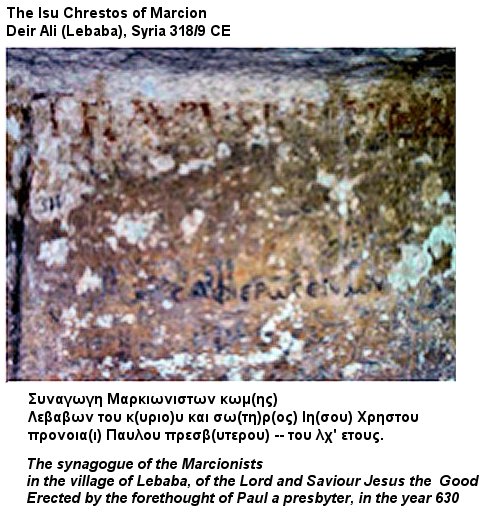
We begin with the example of Marcion. Once we get over the habitual fumbling of his name (Marcion is a diminutive form of the name ‘Mark’) we can begin to identify the tradition for what it is. As Hippolytus notes it was commonly assumed among many that ‘Marcion’ was one and the same with the Mark the Evangelist. The Marcionite community venerated only one gospel text written by ‘Mark’ which was likely a longer form of our canonical gospel of Mark, something akin to a Diatessaron in the name of the apostle. The Marcionites held that Jesus was a heavenly being who came from heaven to announce the messiah and transform the physical nature of humanity into something better. He only appeared to have corporality but various narratives in the gospel reveal his true ethereal nature (viz. where he passes through crowds, when people are healed by touching his ‘garment,’ when he walks on water). The Marcionites like the aforementioned third and fourth century heresies were accused of harboring ‘Jewish ideas’ because they emphasized that the real messiah had to be a warrior king. Yet most significant of all Marcionites held that their ‘Mark’ sat on a throne to the left of Jesus or Paul.
As shadowy as the Marcionite tradition is we only get slightly better information out of a community identified in the writings of Irenaeus (c. 180 CE) as ‘preferring the Gospel by Mark’ and “separating Jesus from Christ, alleging that Christ remained impassible, but that it was Jesus who suffered.” [AH 3:11:7] The beliefs of these followers of Mark are usually distinguished from the Marcionites owing to their peculiar emphasis on mysticism and kabala. We have shown elsewhere that the writings associated with this heretic ‘Mark’ mentioned in the writings of Irenaeus match perfectly with things said in Clement of Alexandria’s Stromata Book 6. The natural corollary of this body of evidence would be that Irenaeus’ Mark is only a garbled recounting of the early Alexandrian tradition associated with the Apostle. Indeed Clement’s understanding in the Letter to Theodore that the Evangelist Mark was for the Alexandrians of the late second century a ‘mystagogue’ who arranged the gospel at Alexandria according to a secret doctrine of gnosis fits perfectly in this milieu.
To this end then we can begin to see the Marcionites and the early Alexandrian adherents of Mark emphasizing a very mystical interpretation of the name Jesus. Jesus was for both communities an angelic power appearing in human form at the beginning of the Common Era to reveal a profound secret hidden since the creation of the world. Irenaeus tells us a little later in the same book that they held “that Jesus was the Son, but that Christ was the Father, and the Father of Christ, God; while others say that [Jesus] merely suffered in outward appearance, being naturally impassible.” It is noteworthy as we have already seen that almost from the time of Clement the Alexandrians also identified their Patriarch as the title ‘Father.’
Over and over again we see Irenaeus emphasize that those who took inspiration from St. Mark’s see of Alexandria understood the gospel in a fairly unusual way. We are told that they held that “the one suffered, and the other remained incapable of suffering, and the one was born, but the other descended upon him who was born.” Irenaeus accuses them elsewhere of “not know the first-begotten from the dead” owing to their “understanding Christ as a distinct being, who continued as if He were impassible, and Jesus, who suffered, as being altogether separate.” Most important for our purposes is the fact that the early Alexandrian adherents of Mark emphasized the mystical nature of the Greek name IESOUS. According to their understanding their master Mark took on this name and received from it “the highest power from the invisible and ineffable regions above” which made him Christ. Irenaeus explains the process in another place in his work in the following manner. “He was united with Him. The Saviour [i.e. Jesus], who was of the dispensation, he says, destroyed death, whereas He made known the Father Christ. He says that Jesus, therefore, is the name of the man of the dispensation, and that it has been set forth for the assimilation and formation of Man, who was about to descend upon Him; and that when He had received Him unto Himself, He retained possession of Him.”
Indeed if we hadn’t discovered that Irenaeus is describing Clement’s Alexandrian community we might have been willing to write off the beliefs associated with ‘Mark’ as belonging to some ‘kooky’ group in antiquity. Now that it is readily apparent that what is being described here is likely an important part of the context for the phrase which secretly appears on the backrest of the Cattedra di San Marco we have to begin to wonder if it represents something absolutely fundamental to the Alexandrian reading of the Bible. We already noted elsewhere that the very image of a tamarisk tree here fits perfectly with what Philo says about Zechariah 6:12. The messiah was understood to come like the Anatole or ‘rising sun.’ It is interesting to note that the idea that the name IESOUS was attached to a heavenly being is also established in the pre-Christian writings of Philo. Philo paid careful attention to the way Joshua is first introduced to readers of the Pentateuch and came to the conclusion that he was transformed by an angelic being.
Philo notes that Joshua’s original name in the Hebrew text wasn’t Joshua but Hoshea; he only received this name after Moses prayed to heaven and received the addition of the letter yod. From the perspective of the original Pentateuch it is merely one of many such ‘kabalistic transformations’ woven into the narrative. Abram and Sarai have their names changed to Abraham and Sarah by the addition of the letter heh earlier in the book of Genesis. Yet there was something especially significant about the change of names from Hoshea to Joshua among users of the Bible in Alexandria. Philo of Alexandria notes that:
Moses also changes the name of Ossee into that of Jesus; displaying by his new name the distinctive qualities of his character; for the name Hosea is interpreted, "what sort of a person is this?" but Jesus means "the salvation of the Lord," being the name of the most excellent possible character … And what is imperishable is superior to what is mortal, the efficient cause is better than that which is the object of action; and what is perfect is preferable to what is imperfect. In this way the coinage of the above mentioned description was changed and received the stamp of a better kind of appearance. And Caleb himself was changed wholly and entirely; "For," as the scripture says, "a new spirit was in Him;"{Num 14:24) as if the dominant part in him had been changed into complete perfection; for the name Caleb, being interpreted, means "the whole heart." And a proof of this is to be gathered from the fact that the mind is changed, not by being biased and inclining in one particular direction or the other, but wholly and entirely in the direction which is good; and that, even if there is any thing which is not very praiseworthy indeed, it makes that to depart by arguments conducive to repentance; for, having in this manner washed off all the defilements which polluted it, and having availed itself of the baths and purifications of wisdom, it must inevitably look brilliant. [On the Change of Names XXI]
Philo’s annoying writing style aside there can be no doubt that this pre-Christian interpretation of the name Jesus had a seminal influence over the understanding of the central character in the gospel. One need only look again at the introductory remarks which begin the canonical Gospel of John to see how this and other Philonic ideas were incorporated by the first Christians.
Joshua, the first king of Israel, is understood to have received the name ‘Jesus’ and he is now prepared to emerge as the successor of Moses – itself an unmistakably messianic conception. As Philo subtly notes ‘a new spirit was in him.’ Yet it is easy to see how Hoshea’s adoption of the name Jesus might have been developed by early Christians alongside the material we have already seen from the ninth vision of Zechariah. As we have already seen the Alexandrian community at the time of Clement developed many of Philo’s ideas in terms of a complex kabalistic system. However we see generations earlier the anonymous author of the Epistle of Barnabas an even clearer Christian Alexandrian adaptation of Philo’s interest in the name Jesus. Barnabas says that:
What, again, says Moses to Jesus the son of Nave, when he gave him this name, as being a prophet, with this view only, that all the people might hear that the Father would reveal all things concerning His Son Jesus to the son of Nave? … Behold again: Jesus who was manifested, both by type and in the flesh, 1 Timothy 3:16 is not the Son of man, but the Son of God. Since, therefore, they were to say that Christ was the son of David, fearing and understanding the error of the wicked, he says, The Lord said unto my Lord, Sit at My right hand, until I make Your enemies Your footstool. And again, thus says Isaiah, The Lord said to Christ, my Lord, whose right hand I have holden, that the nations should yield obedience before Him; and I will break in pieces the strength of kings. [Isaiah 45:1]
The author begins with Philo’s observation of the names but quickly moves on to ideas which can only be understood to have been inspired by Zechariah 6:11f. Even though the text is not explicitly cited there is an unmistakable echo of its central concept of two enthroned figures, Jesus apparently sitting to the right of another Christ or Lord.
Robert Kraft has already developed much of the research in this area noting that this pre-existent Joshua/Jesus cult “somehow fits into the developing pattern or patterns of "two messiahs," one a military (later royal) savior and the other priestly, like Moses and Aaron.” He adds that in this tradition Joshua/Jesus is specifically identified as the "scepter" that "arises" in the "star and scepter" dyad of Balaam's oracle in Num 24.17. He adds that:
this material is complicated all the more by the appearance later in Jewish biblical tradition (Zech 1-6) of a high priestly Joshua/Jesus, side by side with a royal "messianic" counterpart (Zech 4.14), opposed by Satan (3.1) and somehow connected or identified with the figure of one called "branch" or (in Greek) "rising" = anatole (3.8, 6.12)
It will be our argument that the Cattedra di San Marco crystallizes all these historical abstractions. The real problem for most existing research is that no one can do justice to the Alexandrian conception of Jesus as a pre-existent heavenly ‘high priest.’ We have tried so hard to ‘rationalize’ our inherited fairy tales about Jesus that we hiss and ridicule what very well might be the original way the gospel was supposed to be interpreted.
THE ALEXANDRIAN INTERPRETATION OF ZECHARIAH 6:11f
Indeed it all comes down to one simple question – what if the Marcionites were right? What if the author of the gospel arranged the narrative material as a mysterious prelude for the revelation of a royal messiah? In other words, what if a heavenly Jesus was envisioned as announcing the coming of someone else, a ‘someone else’ everyone in early Alexandrian Christianity knew all too well and didn’t need explicit confirmation of his presence? Under this scenario it would naturally follow why these same Marcionites envisioned Jesus sitting ‘on the right hand’ of an enthroned ‘little Mark.’ They used the gospel as a contextual tool for explaining the relationship of Jesus and his beloved disciple ‘little Mark.’ The narrative was understood to spell out a two advent messianic revelation spelled out in the various earlier Jewish scriptural references but especially the ninth vision of Zechariah.
It would of course be very useful for us to have access to the manner in which Marcionites used the book of Zechariah. Nevertheless we can perhaps get almost as much mileage from the heretic Tatian’s instructor Justin of Neapolis. While little direct information about Justin survives, a great deal more was known about his student Tatian. Tatian’s doctrines are often compared to those of the ‘Marcionites.’ A few surviving texts of Justin have down to us through Catholic sources and they clearly demonstrate that he like Marcion accepted a two advent two advent Christology. Justin is quite certain that the ‘high priest Jesus’ of Zechariah 3 and 6 are references to Jesus the anatole (Dialogue ). In another section of the same text he makes explicit that “Zechariah” should compel Jews “that two advents of Christ were predicted to take place—one in which He would appear suffering, and dishonoured, and without comeliness; but the other in which He would come glorious and Judge of all.” And again “Zechariah says, 'His name is the East.' [Zech 6:12] … But if He so shone forth and was so mighty in His first advent (which was without honour and comeliness, and very contemptible) … shall He not on His glorious advent destroy by all means all those who hated Him, and who unrighteously departed from Him, but give rest to His own, rewarding them with all they have looked for.”
Justin’s ideas were appropriated and developed by Alexandrian writers like Origen but most clearly in this instance by Tertullian whose use of Justin has made its way in two forms in the existing literature:
So, too, in Zechariah, in His own person, nay, in the very mystery [sacramento] of His name withal, the most true Priest of the Father, His own Christ, is delineated in a twofold garb with reference to the two advents. First, He was clad in “sordid attire,” that is, in the indignity of passible and mortal flesh, when the devil, withal, was opposing himself to Him—the instigator, to wit, of Judas the traitor —who even after His baptism had tempted Him. In the next place, He was stripped of His former sordid raiment, and adorned with a garment down to the foot, and with a turban and a clean mitre, that is, of the second advent; since He is demonstrated as having attained “glory and honour.” Nor will you be able to say that the man (there depicted) is “the son of Jozadak,” who was never at all clad in a sordid garment, but was always adorned with the sacerdotal garment, nor ever deprived of the sacerdotal function. But the “Jesus” there alluded to is Christ, the Priest of God the most high Father; who at His first advent came in humility, in human form, and passible, even up to the period of His passion; being Himself likewise made, through all (stages of suffering) a victim for us all; who after His resurrection was “clad with a garment down to the foot,” and named the Priest of God the Father unto eternity. [Tertullian Against the Jews xiv]
So also in Zechariah, Christ Jesus, the true High Priest of the Father, in the person of Joshua, nay, in the very mystery of His name, is portrayed in a twofold dress with reference to both His advents. At first He is clad in sordid garments, that is to say, in the lowliness of suffering and mortal flesh: then the devil resisted Him, as the instigator of the traitor Judas, not to mention his tempting Him after His baptism: afterwards He was stripped of His first filthy raiment, and adorned with the priestly robe and mitre, and a pure diadem; in other words, with the glory and honour of His second advent. [Tertullian Against Marcion Book III:7]
The underlying idea here quite clearly is that Zechariah was revealing a ‘mystery’ in his ninth vision that Jesus ‘the high priest’ would end up enthroned on the throne of the messiah by taking his spiritual garment and clothing another individual with them who was the Anatole-messiah.
It would have of course been quite useful for our purposes to have access to Origen’s interpretation of the end of the sixth chapter of the book of Zechariah. Interestingly enough even at the time of Jerome Origen’s Commentary on Zechariah was strangely curtailed at Zechariah 6:8. Could it be that there was something so radical and unsettling about this second century exegesis of a passage tied directly to the Alexandrian Episcopal chair that the rest of the text was simply discarded?
What survives of Origen’s interpretation of Zechariah chapter three certainly leads us to believe that he adapted the two advent system of forefathers like Justin. For he says that:
Every soul that has been clothed with a human body has its own stain. But Jesus was stained through his own will because he had taken on a human body for our salvation. Listen to the prophet Zechariah. He says, ‘Jesus was clothed with stained garments’ … [but] do we thus rise soiled and stained? It is an impiety even to think this, especially when one knows what Scripture says “The body is sown in corruption but will rise in incorruption; it is sown in weakness but will rise in strength; our animal body is sown, but a spiritual body will rise.”
There can be no doubt that Origen believes that the pre-existent heavenly high priest Jesus came down to earth in order to die and resurrect himself in another body through which all of humanity would eventually be saved. Origen repeatedly affirms the two advent theology of Justin. He repeatedly identifies Christ as the anatole of Zechariah 6:12. The problem is that we have been it seems deliberately deprived of direct information about how he developed his system.
What we are left with however is a Commentary on Zechariah developed by Didymus the Blind a prominent Origenist from Alexandria at the request of Jerome (himself a ‘turncoat Origenist’ of sorts). There can be no doubt that Didymus recognized the times he was living and watered down those portions of the original Alexandrian exegesis which might get him into trouble. Writing in the fourth century after the establishment of the Nicene Creed he could not openly teach his inherited tradition without being accused of heresy. Nevertheless there is still enough in the surviving Commentary which I believe can intimate how the ‘ninth vision’ of Zechariah was applied in Alexandria in the period to the ruling Patriarchs.
The first question we should ask is whether Didymus identifies the material in Zech 6:11f as a vision or something else. After all there is a raging debate among contemporary scholars as to whether or not it is properly classified as a visionary experience. Didymus repeatedly identifies this revelation as a ‘vision’ (p. ) noting that when Zechariah says that “a word of the Lord came to me …” it “gave him sight and enlightenment for beholding the beauties and mysteries of the truth and wisdom of God.” Indeed Didymus has no interest in developing the material in any other way than as a ‘visionary experience’ which “comes to Spirit-filled men without remaining, since it [i.e. the vision] is there at the time it comes to them.” He has no interest in reading the text as if it applied to the historical Joshua son of Jehozedek or Zerubavvel. It is without question the last in a series of nine visions which came to the prophet Zechariah from God.
Dionysius makes explicit his belief that Zechariah’s vision ‘was not so much [about Jesus] the son of Jozadak as the one suggested by him, the truly great high priest descended from heaven made a priest ‘according to the order of Melkizedek,’ not in virtue of a fleshly command binding for a time, but according to a permanent priesthood” (p 66). Like Origen, Didymus says that “Jesus the great high priest of whom Joshua represents a type in figurative mode, living in Babylon as he did along with the captives, put on as filthy clothes the sins of all human beings without sinning himself or experiencing sin” (p 72). Jesus existed in heaven from the beginning and according to Didymus ‘it was on for them [i.e. the faithful] and on account of them that the descent to them occurred of the one sent by the Father, when “he bent down the heavens and descended” those to whom he was sent and whose priest he is” (p 77). He emphasizes over and over again that the crowns which are given to Jesus signify that with his coming the power of the ‘Lord of Hosts’ will be passed on to the presbyters and martyrs of the church. This reading is especially significant for our purposes as it confirms our central thesis namely that the reference to the ‘ninth vision’ on the backrest of the Cattedra di San Marco should be seen as confirming an existing Alexandrian understanding of Jesus the high priest ‘uniting’ or ‘ruling alongside’ the Patriarch of this Episcopal See.
Didymus does his best to gloss over the troublesome concept in Zech 6:11f of TWO figures sitting together on the messianic throne, with Jesus being implicitly relegated to the function of ‘Son’ or ‘high priest.’ Didymus follows what must have been a standard Alexandrian exegesis by beginning his discussion of the troublesome passage with the idea that:
When the Son was seated at the right hand of the Father, his enemies like a footstool were placed under him, all of whom benefited from being under his feet and rose like a light and like produce. The person rising beneath the one confessed to be God will rebuild the house of the Lord, the Church of the living God – in particular the human being rising beneath according to the other interpretations subjects of the great king and good teacher putting into action the commands of the one commanding and instructing them, built their lives like a house on the rock which is Christ establishing the base and foundation of the house on firm and indestructible faith (p 127
Even Didymus has to acknowledge that there are two individuals being described here ‘Jesus the high priest’ and ‘someone else’ who is the Dawn and messianic ruler. He pays great attention to the words immediately following the reference to the anatole in the LXX translation that ‘IT will rise beneath him and he will rebuild the house of the Lord. He will receive virtue …’ to loosely infer that ‘Jesus’ would pass from ‘high priest’ to ‘Christ’ in a way which he deliberately avoids discussing.
Instead we see Didymus speak in a deliberately evasive and overly symbolic manner (which seems to frustrate the English translator Robert C Hill to no end) avoiding using the terms ‘Jesus’ or ‘Christ’ for the next few paragraphs. He acknowledges that ‘the man called Dawn will be seated and rule on his throne. It is a twofold throne a royal one and a priestly one as can be shown from the texts of scripture’ (p 128). Didymus makes the safe argument that ‘Jesus’ is ‘in’ both the ‘high priest’ and the ‘messiah’ going out of his way not to attempt to reconcile such a conception with the description in Zechariah which clearly alludes to two distinct persons.
Didymus writes:
Since the person referred to, then, will be seated and rule on his throne, he took the throne of David his father so as to reign forever, his kingship having no end and his priesthood being permanent, Scripture says of him “You are a priest forever.” On the twofold throne he will sit and rule, he alone having a throne of kingship and priesthood. When he is seated on the throne and rules with a steadfast reign, that is the time when there will be the priest at his right hand and a counsel of peace between them both. P 129
As Jesus is Melchizedek, Didymus reasons he can be both ‘high priest’ and ‘king of Salem’ at the same time. As he puts it “since he is God’s servant … he will be at the right hand of the one seated and reigning on his throne. Being at his right resembling God the Son and remaining a priest forever he has a counsel of peace in respect of the one whom he resembles, the Son of God also being likewise at peace with the king of Salem – “peace” that is – and the king of righteousness namely Melchizedek.” (ibid) Yet this idea of arguing that Jesus ‘communes’ or ‘participates’ with the other guy who sits to his left is a clever way of avoiding the difficulties with the original two advent system preserved in Church Fathers in Alexandria and elsewhere. Had Didymus been explicit about that mystical relationship he would had to have acknowledged that the messianic figure at the left of Jesus was necessarily someone other than the person from Galilee who gathered a company of twelve disciples.
We shouldn’t begrudge Didymus for diluting the original Alexandrian interpretation of the ninth vision of Zechariah. Had this Church Father steadfastly refused to compromise the original exegesis he would never have been commissioned by Jerome to complete the surviving commentary and the great secret which connects the Cattedra di San Marco to the ninth vision of Zechariah would all but have disappeared. Of course when we say that Didymus grants us a fleeting witness of this original understanding, we have to qualify our claims slightly by saying that this interpretation is available for those with critical discernment. Indeed in the very next paragraph Didymus acknowledges to his readers that this ‘vision’ doesn’t just apply to Jesus’ resurrection but that the historical fulfillment of Zech 6:11f established an ongoing ‘eternal high priesthood’ which continues in the Church down to his very day. For Didymus, while avoiding explaining how – according to a two advent system - Jesus could have raised as a royal figure at the beginning of Christian focuses his attention instead on how Zechariah’s prophesy continues to be fulfilled in the functioning of the Church and its presbytery.
Didymus writes:
In view of the prophet’s present vision or the previous exposition of the virtue which is the crown, which was said to be … the Lord of Hosts … it is a prize of glory in fact because it will be given to those who have glorified God with their body and to those who have a pious attitude both in their thinking and still more in religious teaching; on this basis we who have ecclesiastical learning are said to be orthodox. This crown is woven not of gold and precious stones but of correct views on the truth … It is incorruptible in the terminology of the chief of the apostles Peter in the letter to the flock being guided by the true shepherd whom God promised to give to his spiritual sheep in the words “ I shall give you shepherds after my own heart and they will shepherd you with understanding” … this [the crown] will be given to those who keep the faith in orthodox fashion and to those who have put into practice the command given thus ‘Give glory to our God’ and again ‘Offer the Lord glory and honor.’ (p 130).
Didymus clearly has the Epistle to the Hebrews in mind and its understanding of Jesus representing an eternal line of high priests after Melchizedek when he infers that Zechariah argued on behalf of an abiding presence of Jesus as high priest and king in the Christian community. Yet there can be no doubt what is being developed here. The heretical idea of ‘someone else’ other than Jesus being the awaited royal anatole messiah has been replaced by a line of ecclesiastic authorities – viz. ‘shepherds’ - in the Catholic Church.
Of course it would have been wonderful if Didymus would have been allowed by his contemporaries to openly express the idea that the line of bishops stems from St. Mark rather than St. Peter. Nevertheless such an idealized noting of the ancient Church being filled by ‘truth seekers’ is a naivety serious scholarship cannot afford to perpetuate. Yet the present understanding isn’t as far from the original Alexandrian understanding as one might think if we look to the employment of Peter in the Commentary of Zechariah as a whole. As Robert C Hill notes in his introduction and in his footnotes throughout his translation noting that:
In the course of his composition Didymus betrays his attachment to the church of Alexandria as well as to its hermeneutical principles. Athanasius comes in for complimentary reference as didaskalos (now deceased) of the whole church of Alexandria, and the apostle Peter – mentor of Mark the local church’s patron – consistently receives honorific mention that is more pronounced than in [parallel] Antiochene statements.
The point then is that with this observation we can develop an appreciation for the gratuitous mention of Peter throughout the document might well be a backhanded way of introducing traditional Alexandrian ideas linking apostolic succession with the ninth vision of Zechariah. The ploy is demonstrated in countless texts throughout the centuries and reinforced in many decrees at the Council of Chalcedon viz. “the see of Alexandria is not to lose any of that dignity which it merited through Saint Mark the evangelist, the disciple of the blessed Peter.”
IN SUMMA
There can be little doubt now as to what the original understanding of the Cattedra di San Marco was. It was originally understood to be the throne upon which St. Mark first sat during his stay at Boucalis. The various Alexandrian Patriarchs continued to sit on this chair in order to demonstrate that they perpetuated St. Mark’s original authority from Jesus. This understanding was hardly kept secret. It was likely that this much was always revealed to outsiders. As Severus of Al’Ashmunein wrote generations later “they sat upon his episcopal throne, one after another, each of them succeeding his predecessor; and thus all were his representatives, and the shepherds of his flock, and his imitators in his faith in Christ.” What was likely kept hidden was that St. Mark’s original enthronement had a great mystical significance for the community. It was seen as an original fulfillment of the ninth vision of Zechariah perhaps even at the time St. Mark sat in the throne.
While this is certainly not the place to develop how Mark’s sitting in the throne would have been confirmed in his original gospel it is enough to note that in many versions of the text the narrative ends with an enthronement where Jesus sits at the right hand of the Father. Moreover the surviving testimony of Peter the Patriarch of Alexandria confirms the exact moment when Zechariah’s ninth vision was realized. He writes that Easter was the day:
on which the one who was living arose and became (one of the) dead and again lives forever. He aroused the thought(s) of his disciples who thought they "saw a ghost" [Luke 24:37] saying "Why are you troubled, and why do questionings rise in your hearts? Feel me and see that a ghost does not have flesh and bones as you see me having." And having said this he showed them (his) hands and feet" [Luke 24:39 - 41] (These) very things he established as reasonable through the change which happened in him, through which "they were prevented from recognizing him" [Luke 24:16] since even in this it was necessary for him to take precedence according to the apostolic word [cf Col 1:18]. Whence also someone took pains to feel him, who also truly becoming fully assured concerning his resurrection called him both Lord (and) God ... [cf John 20:27 - 28]
The clear inference here is that the disciples didn’t recognize Jesus any longer because he had sent his soul into someone else. Clearly this figure – viz. Christ – was an important organizer of the Church; he ended up sending missionaries to preach his gospel all over the world.
For the moment it is enough to say that Didymus and others very uncomfortable expressing this ancient conception from their Alexandrian heritage. Nevertheless the idea that the various Patriarchs who sat on St. Mark’s throne continued to partake of have Jesus ‘sitting on their right hand’ was easier to express. All one had to do was argue that Mark was just a functionary of Peter (an idea the Coptic Church has since recanted owing to their political independence from Rome) and the original concept was made to be quite acceptable in orthodox circles. Indeed this very idea that Jesus continued to sit on the throne alongside the Patriarch is as we have already mentioned repeated in early Patristic texts. Yet some of the physical features of the chair might well serve to reinforce some of these notions.
It might just be coincidence, but the armrest on the right hand side of the Cattedra has been damaged at exactly the place where the hand of the Patriarch would naturally rest (the hand in which the Pope holds the scepter of Christ). This is the only obvious damage that the throne has suffered and one wonders whether some sign of Jesus ‘resting on the right hand’ might original have been here. More significantly there is a large hole on the very same side toward the bottom of the throne which has always puzzled scholars. Andre Grabar, in keeping with his understanding of the object as a reliquary, imagined this as a place where holy relics were stored. This conception is completely ludicrous as the inner walls of the hole are rough and uneven. No one would store anything of value in this place. The impression one gets when looking at this strange opening is that it was burrowed by an animal. It is best described as a tunnel rather than a storage space.
What was the original function of the opening on the right hand side? After all that we have brought forward here there can be only one answer. It was an opening to allow the spirit of Jesus to vivify the throne and prepare it as a kind of bridal chamber to unite with God with the one sitting on the chair. The Copts still say as much as we see in a prayer preserved by the great Coptic historian Severus of Al’Ashmunein at the beginning of his history of the Church of Alexandria:
Praise be to God, the origin and source of learning, the maker and creator of all things, who forms and brings into being all that exists: who guides and elects those whom he pleases, and raises those whom he desires among his servants to be his chosen ones and his holy people, whom he picks out and in whom he takes pleasure; who lifts up the poor from the ground, and the needy from the dunghill, that he may make him ruler over his people, and a prince to govern his servants and his land; and gives him as his inheritance the throne of power [emphasis mine], that he may rule over the earth with justice, and among men with truth; that he may deliver the weak from the mighty, and save the oppressed from the oppressor. This is the judgment and wisdom of God which none of his creatures can comprehend, for his mysteries are hidden from the wise and learned; and he raises up at all times those who shall gently guide his people … And when, in his unattainable wisdom, he established his dispensation, and the Union of his Humanity with his Divinity, the mystery of which is hidden from all in heaven or on earth, he chose his disciples, the apostles, and gave them the great commission, authorising them to bind and to loose. And so likewise their successors after them inherit this gift in all regions of the world, each one following his predecessor. Thus the inheritance of this power, which Christ gave to the great father and evangelist, Mark, the apostle, is carried on to his successor, the patriarch who sits upon his episcopal throne in the great city of Alexandria, in the midst of the regions where he preached.
Saint Mark, then, was the first patriarch who fed the flock of Christ; and in after times he was followed by the inspired fathers and patriarchs, generation after generation. This see of his is independent, and separate from all other sees. And no patriarch is promoted to it, nor does any obtain from God this glorious station and this high and sublime degree, save one whom he has proved and tried, and who has experienced such trouble and adversity and resistance of enemies and attacks of heretics that by these things he resembles Christ's disciples and apostles, who were assisted by his Holy Spirit
These words perfectly sum up all that we have pieced together from earlier witnesses. The throne of St. Mark was understood to function as a uniting force in the world. It not only brought together the two poles of Jewish religious life – viz. the high priest and the royal messiah but also united the divinity with humanity. This understanding as we have already demonstrated is a direct development of the words ‘the ninth vision’ which appear on the backrest and a living chain of ancient witnesses from the time of Philo down to the current sitting Pope. As such the Cattedra di San Marco represents something more than merely being the earliest surviving Christian relic. It is in fact the original holy object in the Christian religion providing us with the missing link, a vital clue to close the gap between heresy and orthodoxy and finally give the religion something it has lacked for almost two thousand years – a rational basis grounded in historical reality.
If you are interested in reading how this observation fits within my greater understanding of the workings of Secret Mark WITHIN the contemporary Alexandrian Church please go here
If you want to read more about how Alexandrian Christianity was rooted in the Jewish traditions of Alexandria, Philo of Alexandria and more feel free to purchase my new book
here

 A sample of what appears in the Real Messiah order it here