There are objections to all kinds of things in this world. Some people don't think Obama has a birth certificate. Others used to think George Bush didn't have a brain. The list goes on and on but the bottom line is still the same. No one really thinks that Obama was born outside of America in the same way that no one really believed that George Bush was stupid. It was all and is all a game that partisans play to make the 'other side' prove something.
Prove to me that your guy isn't an idiot or a Muslim-Socialist-radical-racist.
As long as everyone knows this is all b-----t, it can be a lot of fun.
I happened to have written a book which tried to identify the apostle Mark. Everyone and their uncle comes up to me now and says, 'I don't see any definitive proof for your assertion,' or 'why aren't there more footnotes in the book,' or any number of other objections.
I read one review were someone even complained that I use too many 'obscure references.' How come I don't know about all of this? he asked.
The short answer of course is - that's because you're an idiot but you can't say that sort of thing, at least in public.
The truth is that I spent a lot of time dwelling on the fringes of New Testament studies while you were reading the New York Times or getting your real estate license. I befriended members of the Samaritan community and wine, dined and mined their intellect for new ways to look at old problems to do with the Bible and related literature.
Instead of going out to clubs on the weekends I spent time with members of the Coptic Orthodox Church learning about their tradition too. I don't have much of a social life nor do I have a lot of friends.
In the end, coming from a persecuted minority community within Judaism, having my mother and grandfather survive the Holocaust under extra-ordinary circumstances, having my father and his father shipped off to a Siberian prisoner of war camp and hanging around Samaritans, Copts and other people who almost continually persecuted for the last two thousand years it doesn't seem all that strange to me that almost nothing survives about Mark in any of these traditions.
Unlike most people, I see persecution as an inevitable part of the human condition.
Only the ignorant European whose culture has been the hammer to the rest of the world's anvil expects their to be 'tangible documentation' for every belief. After all, HIS libraries weren't destroyed, HIS religious heritage has remained basically intact since the third century.
So when you look to the Samaritan culture for instance, they have this commentary on the Pentateuch by a guy named Mark which ranks second in importance to the Torah itself.
But they don't have a bloody clue who Mark is.
How could Samaritans have their second holiest book by a guy named Mark and their whole religious system engineered or re-engineered by this guy Mark and know almost nothing about him other than his name? Is it because they are somehow 'inferior' to us? Or less intelligent?
No, they just had the stuffing kicked out of them for the last two thousand years.
If you ask them who Mark is, they will basically shrug their shoulders and say they don't know. However if you press them they will tell you something odd. They will say that he was 'like Moses' or that he was 'the son of Titus' but really have little to add to the conversation after that.
I don't think that any of this should seem all that strange to anyone here. After all most of us use a thing called 'the Gospel' which most of think was written by a guy named Mark who we know little or nothing about.
Given that our tradition is based on Peter or John it may not be that surprising that we haven't a clue who the original evangelist is. But if you go to visit with Copts and listen to what they have to say about their Mark you find it remarkably similar to the situation among the Samaritans.
Yes, there are stories about who the father of Mark is but they are just as conflicting as among the Samaritans. Yes we know Mark wrote a book which - like the Samaritans - is now viewed as being centrally focused on someone else's status as either the messiah or the apostle.
Yet if you really look closely it is not that hard to see how Mark MIGHT have been originally making the case that HE was the messiah or the one who Moses prophesied would come.
The problem again is that those who guard these traditions have been so traumatized by their abuse that they are incapable of making sense of it (or at least openly expounding those beliefs to outsiders).
So it is that I not all concerned that there isn't a piece of paper lying around somewhere from antiquity that says 'Marcus Agrippa wrote the gospel and used it to have Jesus proclaim his own messianic advent.' There can be no doubt that such a document would not have survived antiquity in the same way that information about Mark in the Coptic and Samaritan communities was not allowed to survive.
The abuse on the souls of these cultures is proof enough that they knew something they weren't supposed to know. The question as always is whether people of the historically dominant culture in the world are capable of understanding suffering - not merely as an individual concept - but rather the suffering that comes from being a persecuted faith or a persecuted group.
If that is possible then prove it to me by stop expecting there to be 'explicit testimony' surviving about the very thing the Imperial government worked so hard to destroy - period!
Monday, August 31, 2009
Justifying Using Rabbinic Sources for My Claims about Marcus Julius Agrippa, last king of Israel
There seems to be a prevalent absence of understanding amongst historians and even in some reference works over the process of transmission of the material making up the Rabbinic texts. What many say about the codification of Rabbinic works in the 3rd c. is misleading enough to be false:
(a) The Mishnah is not the model to be applied generally, because by definition it is the product of the formation of a consensus on practice.
(b) The halachic midrashim are a different matter. (One from the school of Ishmael and one from the school of ‘Akiva on each of Exodus Leviticus Numbers Deuteronomy, making eight books. Ishmael and Akiva are each near the last in line of heads of each academy). These were built up in writing generation by generation. Whatever is dated by attribution to a person was in writing from that time. This is not to deny that there must have been a final selection and editing from a vast mass of written material.
(c) Something similar but not the same could be said of the various products of the various academies that went into the Mishnah. I think for example of the tractate Middot, on the details of structure and dimensions of the Jerusalem Temple. This comes in whole from one known academy.
(d) The same with modifications can be said of Bereshit Rabba on Genesis, Vayyikra Rabba on Leviticus, and Echah Rabba on Lamentations. Much of their content can be dated to the mid 2nd c. with some parts being dateable as older and some later. Anonymous material is admittedly often undateable.
(e) Material from the time of the Tanna’im in either Talmud that is formally introduced as a baraita [Aramaic fem. definite adjective meaning external, that is, not in the Mishnah] has been transmitted orally and in written form both at once.
In general, there seems to be a misconception amongst some historians of the Rabbinic theory or even dogma of the need for oral transmission. A comparison with the same theory amongst the Neoplatonists will illustrate what I mean. In both cases oral transmission means the passing on of understanding from generation to generation. Data can be both memorised and written. Memorisation is better, but the written text is needed as a control. After data are memorised comes the work of understanding.
Contrary to what seems to be thought by many Classicists, there are other Rabbinic documents with a definite date of written composition. The one I had in mind in my previous message is the Seder ‘Olam Rabba, written by one person between 150 and 160. This gives the dates for there being one Agrippa rather than two as the texts of Josephus which circulated among Christians and whose manuscripts only date to the twelfth century.
In short, whenever I justify my use of rabbinic material for the construction of my argument that there was only one Marcus Agrippa rather than two I was not thinking of undateable anecdotes in either Talmud. As for the reliability of the process, here is one striking instance. The Tosefta, the halachic midrashim, and the Palestinian Talmud preserve enough information about the High Priest Yishma‘el ben Piyavi [Greek Phiabi) to show that he was a Sadducee, though the reader has to see the evidence and put it together. This person is always mentioned with respect as the first link in the chain of transmission of older metaphysics into the Rabbinic system!
Here is one reference. This was the first systematic study of the relationship between memorisation, living transmission of understanding, and written records as a control on the accuracy of memorisation. Except for detailed studies in Hebrew before and after, it has not been surpassed. Birger Gerhardsson, Memory and Manuscript: Oral Tradition and Written Transmission in Rabbinic Judaism and Early Christianity. [Acta Seminarii Neotestamentici Uppsaliensis, 22]. Lund, 1961 and slightly enlarged 1964.
(a) The Mishnah is not the model to be applied generally, because by definition it is the product of the formation of a consensus on practice.
(b) The halachic midrashim are a different matter. (One from the school of Ishmael and one from the school of ‘Akiva on each of Exodus Leviticus Numbers Deuteronomy, making eight books. Ishmael and Akiva are each near the last in line of heads of each academy). These were built up in writing generation by generation. Whatever is dated by attribution to a person was in writing from that time. This is not to deny that there must have been a final selection and editing from a vast mass of written material.
(c) Something similar but not the same could be said of the various products of the various academies that went into the Mishnah. I think for example of the tractate Middot, on the details of structure and dimensions of the Jerusalem Temple. This comes in whole from one known academy.
(d) The same with modifications can be said of Bereshit Rabba on Genesis, Vayyikra Rabba on Leviticus, and Echah Rabba on Lamentations. Much of their content can be dated to the mid 2nd c. with some parts being dateable as older and some later. Anonymous material is admittedly often undateable.
(e) Material from the time of the Tanna’im in either Talmud that is formally introduced as a baraita [Aramaic fem. definite adjective meaning external, that is, not in the Mishnah] has been transmitted orally and in written form both at once.
In general, there seems to be a misconception amongst some historians of the Rabbinic theory or even dogma of the need for oral transmission. A comparison with the same theory amongst the Neoplatonists will illustrate what I mean. In both cases oral transmission means the passing on of understanding from generation to generation. Data can be both memorised and written. Memorisation is better, but the written text is needed as a control. After data are memorised comes the work of understanding.
Contrary to what seems to be thought by many Classicists, there are other Rabbinic documents with a definite date of written composition. The one I had in mind in my previous message is the Seder ‘Olam Rabba, written by one person between 150 and 160. This gives the dates for there being one Agrippa rather than two as the texts of Josephus which circulated among Christians and whose manuscripts only date to the twelfth century.
In short, whenever I justify my use of rabbinic material for the construction of my argument that there was only one Marcus Agrippa rather than two I was not thinking of undateable anecdotes in either Talmud. As for the reliability of the process, here is one striking instance. The Tosefta, the halachic midrashim, and the Palestinian Talmud preserve enough information about the High Priest Yishma‘el ben Piyavi [Greek Phiabi) to show that he was a Sadducee, though the reader has to see the evidence and put it together. This person is always mentioned with respect as the first link in the chain of transmission of older metaphysics into the Rabbinic system!
Here is one reference. This was the first systematic study of the relationship between memorisation, living transmission of understanding, and written records as a control on the accuracy of memorisation. Except for detailed studies in Hebrew before and after, it has not been surpassed. Birger Gerhardsson, Memory and Manuscript: Oral Tradition and Written Transmission in Rabbinic Judaism and Early Christianity. [Acta Seminarii Neotestamentici Uppsaliensis, 22]. Lund, 1961 and slightly enlarged 1964.

Major Discovery
Two or three posts ago I was trying to use Irenaeus' Against the Heresies to prove that the Marcionites and the Marcosians (two early sects that appear frequently in his writings) were related to one another or in fact one and the same community reported in two different ways (or from two different original sources). This would in turn help advance my theory about the unreliability of the writings of the Church Fathers as a guide to early Christianity.
Yet let's forget about my theory about Marcus Julius Agrippa, the last king of Israel for a moment. The passage we cited from Irenaeus is actually massively important on its own.
Who knew that Jesus real name was Yeshu?
Seriously the rabbinic literature is almost never cited as a reliable source for information about early Christianity. Yet here we have an unprecedented AGREEMENT between this tradition and the oldest source in Catholic Christianity (of which we have any direct information).
How many of us knew before I cited this passage that Irenaeus thought "Yeshu" was the original form of Jesus's name? How many of us thought "Yeshu" was orthodox or wasn't a "mistake" or misunderstanding which entered into the writings of the rabbanites?
Yet in a way we SHOULD have known that the rabbinic literature retained knowledge of things forgotten or repressed by the ignorant Gentiles. Look how perfectly the Ben Pandera story is preserved from the early second century (Against Celsus I and II).
Why is my preference for the rabbinic preservation that there was only one Agrippa rather than two so controversial? If the rabbanites can provide us better information about the true identity of someone they considered to be a false messiah (Yeshu) how is it they should be ignored as a source about their last historical monarch and whom they wrote about favorably and many (if not all at one time) took to be the real messiah?
Yet let's forget about my theory about Marcus Julius Agrippa, the last king of Israel for a moment. The passage we cited from Irenaeus is actually massively important on its own.
Who knew that Jesus real name was Yeshu?
Seriously the rabbinic literature is almost never cited as a reliable source for information about early Christianity. Yet here we have an unprecedented AGREEMENT between this tradition and the oldest source in Catholic Christianity (of which we have any direct information).
How many of us knew before I cited this passage that Irenaeus thought "Yeshu" was the original form of Jesus's name? How many of us thought "Yeshu" was orthodox or wasn't a "mistake" or misunderstanding which entered into the writings of the rabbanites?
Yet in a way we SHOULD have known that the rabbinic literature retained knowledge of things forgotten or repressed by the ignorant Gentiles. Look how perfectly the Ben Pandera story is preserved from the early second century (Against Celsus I and II).
Why is my preference for the rabbinic preservation that there was only one Agrippa rather than two so controversial? If the rabbanites can provide us better information about the true identity of someone they considered to be a false messiah (Yeshu) how is it they should be ignored as a source about their last historical monarch and whom they wrote about favorably and many (if not all at one time) took to be the real messiah?
Sunday, August 30, 2009
Against the European Man's Hold on Truth
I love stupid people. I love the way they like to think they are the center of the universe. Stupid is is stupid does (or stupid believes).
I love the way people define 'Christianity.' All they do is take what was ALLOWED to spread through European controlled lands for centuries and then they say, 'that's the religion of Jesus' or the 'religious tradition founded by the gospel writer(s).' No wait a minute. That last answer is to smart for even New Testament scholars.
What the hell is the matter with people? Christianity was white-washed. Is this even controversial or are people too stupid to see it because - well, they are Europeans and they like things white-washed.
How do they explain that the European man's religion only remained in the Middle East as long as Europeans were holding up swords to the necks of the Semitic man?
I forgot, Islam is always explained away as 'the religion of the sword.' They have this image of poor helpless 'victims' of the advancing 'Arabian horde' being 'forced' to accept this false religion.
Yet they never do this in reverse. They never think - gee, these Romans and Byzantines ruled the world for centuries, the same centuries when Christianity was getting established. Is it possible that maybe it was us European people who held a sword (or various torture implements to the converts to a wholly Semitic religious system which believed in the coming of someone like Mohammed?
No, that's impossible.
Why so?
Well ... because God chose the Gentiles.
Yes, but by 'Gentiles' you really mean 'the Europeans' because your stupid book, the Acts of the Apostles has all the Jewish missionaries suddenly making a bee line for Greece and Rome.
So what's your point?
You're not really saying that God 'chose the Gentiles' you're saying that he gave up on the Jews and picked Europeans people.
Oh I would never say that. I am not a racist. I think God loves all people.
Yes, but the system you support was used by European and American missionaries as part of a world view that 'European people' were better than everyone else and could bring 'civilization' to the rest of the savages who inhabited the planet.
Yes, but we don't think like that any longer.
It doesn't matter. The problem in the end is that there is no reason to suppose that Europeans were ever better authorities on the meaning and the message of earliest Christianity. The Roman Church undoubtedly beat out all its competitors because it was near the seat of worldly power.
So what are you saying?
Well, how could a faith centered in Alexandria - the home of one of the most important Jewish communities anywhere - possibly compete against a false Church based in Rome that was in bed with the wicked Emperors who ruled from the time of Commodus?
Are you saying that the Catholic Church is evil?
No, I am just saying that if you want the truth about Christianity why go to European people? They have an obvious agenda which is trying to get around the fact that they have no authority on anything. The gospel wasn't written by one of their kind. It undoubtedly wasn't written in their language. It certainly was directed to their pale faces. In short it wasn't by, about or for them.
But that sounds racist.
Well, maybe that's the point. Maybe Christianity was originally a Semitic liberation theology that was effectively neutralized by the addition of a series of 'white lies.' You just never know.
Yes, but now your speculating ...
No, I am trying to do what western scholars refuse to do. That is to establish a CONTEXT for the development of Islam. Most of them won't say it of course but they see Mohammed and his tradition as either a threat or a fraud. They can't even consider that he might have come from a tradition or at least - that Semitic Christianity based on a single, gospel and seemingly yearning eternally for a liberator and a restorer figure had any sort of legitimacy or historical roots.
It's always unfortunate to have biased witnesses judge a contest ...
I love the way people define 'Christianity.' All they do is take what was ALLOWED to spread through European controlled lands for centuries and then they say, 'that's the religion of Jesus' or the 'religious tradition founded by the gospel writer(s).' No wait a minute. That last answer is to smart for even New Testament scholars.
What the hell is the matter with people? Christianity was white-washed. Is this even controversial or are people too stupid to see it because - well, they are Europeans and they like things white-washed.
How do they explain that the European man's religion only remained in the Middle East as long as Europeans were holding up swords to the necks of the Semitic man?
I forgot, Islam is always explained away as 'the religion of the sword.' They have this image of poor helpless 'victims' of the advancing 'Arabian horde' being 'forced' to accept this false religion.
Yet they never do this in reverse. They never think - gee, these Romans and Byzantines ruled the world for centuries, the same centuries when Christianity was getting established. Is it possible that maybe it was us European people who held a sword (or various torture implements to the converts to a wholly Semitic religious system which believed in the coming of someone like Mohammed?
No, that's impossible.
Why so?
Well ... because God chose the Gentiles.
Yes, but by 'Gentiles' you really mean 'the Europeans' because your stupid book, the Acts of the Apostles has all the Jewish missionaries suddenly making a bee line for Greece and Rome.
So what's your point?
You're not really saying that God 'chose the Gentiles' you're saying that he gave up on the Jews and picked Europeans people.
Oh I would never say that. I am not a racist. I think God loves all people.
Yes, but the system you support was used by European and American missionaries as part of a world view that 'European people' were better than everyone else and could bring 'civilization' to the rest of the savages who inhabited the planet.
Yes, but we don't think like that any longer.
It doesn't matter. The problem in the end is that there is no reason to suppose that Europeans were ever better authorities on the meaning and the message of earliest Christianity. The Roman Church undoubtedly beat out all its competitors because it was near the seat of worldly power.
So what are you saying?
Well, how could a faith centered in Alexandria - the home of one of the most important Jewish communities anywhere - possibly compete against a false Church based in Rome that was in bed with the wicked Emperors who ruled from the time of Commodus?
Are you saying that the Catholic Church is evil?
No, I am just saying that if you want the truth about Christianity why go to European people? They have an obvious agenda which is trying to get around the fact that they have no authority on anything. The gospel wasn't written by one of their kind. It undoubtedly wasn't written in their language. It certainly was directed to their pale faces. In short it wasn't by, about or for them.
But that sounds racist.
Well, maybe that's the point. Maybe Christianity was originally a Semitic liberation theology that was effectively neutralized by the addition of a series of 'white lies.' You just never know.
Yes, but now your speculating ...
No, I am trying to do what western scholars refuse to do. That is to establish a CONTEXT for the development of Islam. Most of them won't say it of course but they see Mohammed and his tradition as either a threat or a fraud. They can't even consider that he might have come from a tradition or at least - that Semitic Christianity based on a single, gospel and seemingly yearning eternally for a liberator and a restorer figure had any sort of legitimacy or historical roots.
It's always unfortunate to have biased witnesses judge a contest ...
The Most Powerful Argument for the Commonality of Markan Traditions
I think I have developed a number of lines of reasoning here which at least suggest that there was some commonality between the various 'schools of Mark' identified in the Church Fathers.
If Christianity can be said to be the religion which developed from Mark's gospel it is impossible to ignore the fact that this text was interpreted by its earliest interpretators to signal a return to the ten original utterances which alone of Moses' commandments came from heaven.
I also demonstrated that this idea appears not only in Mark's gospel but on his episcopal throne - i.e. the ten torches - split five to each side - of the object represents this same principle associated with Mark - i.e. 'the heavenly Torah.'
I also proved or at least provided strong evidence to suggest that that "those of Mark" - ie the Marcosians in Irenaeus' Against the Heresies Book 1 Chapter 13f - are one and the same as the Markan believers in Alexandria.
Now let me take this one step further.
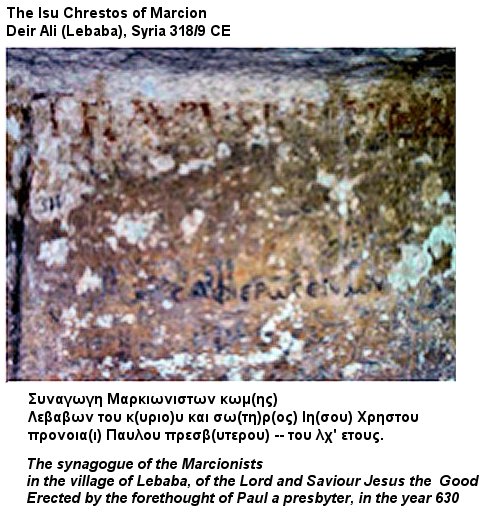
It is well known that the Marcionites did not identify their Lord by the name "Jesus" or "Joshua" but the three letter appellation Isu (yod-samekh-vav).
This name has never been properly explained but bears a striking structural similarity to the name of Jesus in rabbinic literature - viz "Yeshu" (yod-shin-vav).
As such the Marcionite and Jewish name for Jesus seem to come from a common source.
Yet notice that Irenaeus in Book Two Chapter Twenty Four seems to indicate that the 'those of Mark' - i.e. the 'Marcosians' - share the same name for Jesus with the Marcionites:
Moreover, (the name) Jesus, which is a word belonging to the proper tongue of the Hebrews, contains, as the learned among them declare, two letters and a half, and signifies that Lord who contains heaven and earth; for Jesus in the ancient Hebrew language means "heaven," while again "earth" is expressed by the words sura usser. The word, therefore, which contains heaven and earth is just Jesus. Their explanation, then, of the Episemon is false, and their numerical calculation is also manifestly overthrown. For, in their own language, Soter is a Greek word of five letters; but, on the other hand, in the Hebrew tongue, Jesus contains only two letters and a half.
The idea that the name 'Jesus' only contains 'two and a half letters' is easily explained by the original translators of Irenaeus as they note the name 'Jesus':
being written thus, ישו, and the small י being apparently regarded as only half a letter.
I asked Rory to develop an explanation for the rest of Irenaeus' argument about Jesus meaning 'heaven' and 'earth' being expressed by the words sura usser a long time ago and his work appears here.
The difference between those of Mark and Irenaeus is that the former see Jesus' name signifying only 'heaven' while Irenaeus argues that Jesus' proper name is 'Yeshu' and this signifies Yahweh Sura Ushera.
The original Marcosian argument is not reported but one can make a strong case that the difference comes down to the Marcionite rendering of the name 'Jesus' with a samekh rather than a shin. Why so? Because the numerical value of this name is seventy six (yod = 10, samekh = 60, vav = six) which in turn has the same value as the Aramaic word for being 'full' (mem-lamed-aleph-heh - see Jastrow p. 785) or 'fullness' viz. mem-lamed-vav-aleph).
It is interesting that the Aramaic word for 'word' - you know that hypostasis that appears at the beginning of the Greek gospels as the 'logos' would be spelled the same way - i.e. mem-lamed-heh or even mem-lamed-aleph-heh.
If the latter form is acceptable then we would theoretically have a term which meant both 'word' and the equivalent of the Greek term pleroma which is assigned in the NASB the meanings (1), fulfillment (2), full (2), fullness (10), patch (2) which also happened to have the same numerological value of the Marcionite spelling of the name Jesus - viz 'Isu' or 76.
In other words, what Irenaeus fails to say is that the 'followers of Mark' used the same Marcionite name for Jesus - Isu - and took it to be a gematria for 'fullness' or heaven, a term used throughout the apostolic letters.
Does this mean that the Marcionites employed a similar gematria? It is difficult to say right now but at the very least it seems clear that the Marcionites (Marqione = Aram. 'those of Mark') and the Marcosians (Gk = 'those of Mark') shared the same spelling of the name Jesus.
Clement of Alexandria can be argued to have used the same term when he argues that the root of the name Jesus is in the Greek name 'Jason' (from the root yod-samekh-vav ?) rather than Joshua.
Again the underlying argument is that ALL the Markan traditions shared the same spelling of Jesus name viz. Isu (yod-samekh-vav) and likely took it to mean that Jesus was 'the fullness' from heaven i.e. an angelic hypostasis.
If Christianity can be said to be the religion which developed from Mark's gospel it is impossible to ignore the fact that this text was interpreted by its earliest interpretators to signal a return to the ten original utterances which alone of Moses' commandments came from heaven.
I also demonstrated that this idea appears not only in Mark's gospel but on his episcopal throne - i.e. the ten torches - split five to each side - of the object represents this same principle associated with Mark - i.e. 'the heavenly Torah.'
I also proved or at least provided strong evidence to suggest that that "those of Mark" - ie the Marcosians in Irenaeus' Against the Heresies Book 1 Chapter 13f - are one and the same as the Markan believers in Alexandria.
Now let me take this one step further.
It is well known that the Marcionites did not identify their Lord by the name "Jesus" or "Joshua" but the three letter appellation Isu (yod-samekh-vav).
This name has never been properly explained but bears a striking structural similarity to the name of Jesus in rabbinic literature - viz "Yeshu" (yod-shin-vav).
As such the Marcionite and Jewish name for Jesus seem to come from a common source.
Yet notice that Irenaeus in Book Two Chapter Twenty Four seems to indicate that the 'those of Mark' - i.e. the 'Marcosians' - share the same name for Jesus with the Marcionites:
Moreover, (the name) Jesus, which is a word belonging to the proper tongue of the Hebrews, contains, as the learned among them declare, two letters and a half, and signifies that Lord who contains heaven and earth; for Jesus in the ancient Hebrew language means "heaven," while again "earth" is expressed by the words sura usser. The word, therefore, which contains heaven and earth is just Jesus. Their explanation, then, of the Episemon is false, and their numerical calculation is also manifestly overthrown. For, in their own language, Soter is a Greek word of five letters; but, on the other hand, in the Hebrew tongue, Jesus contains only two letters and a half.
The idea that the name 'Jesus' only contains 'two and a half letters' is easily explained by the original translators of Irenaeus as they note the name 'Jesus':
being written thus, ישו, and the small י being apparently regarded as only half a letter.
I asked Rory to develop an explanation for the rest of Irenaeus' argument about Jesus meaning 'heaven' and 'earth' being expressed by the words sura usser a long time ago and his work appears here.
The difference between those of Mark and Irenaeus is that the former see Jesus' name signifying only 'heaven' while Irenaeus argues that Jesus' proper name is 'Yeshu' and this signifies Yahweh Sura Ushera.
The original Marcosian argument is not reported but one can make a strong case that the difference comes down to the Marcionite rendering of the name 'Jesus' with a samekh rather than a shin. Why so? Because the numerical value of this name is seventy six (yod = 10, samekh = 60, vav = six) which in turn has the same value as the Aramaic word for being 'full' (mem-lamed-aleph-heh - see Jastrow p. 785) or 'fullness' viz. mem-lamed-vav-aleph).
It is interesting that the Aramaic word for 'word' - you know that hypostasis that appears at the beginning of the Greek gospels as the 'logos' would be spelled the same way - i.e. mem-lamed-heh or even mem-lamed-aleph-heh.
If the latter form is acceptable then we would theoretically have a term which meant both 'word' and the equivalent of the Greek term pleroma which is assigned in the NASB the meanings (1), fulfillment (2), full (2), fullness (10), patch (2) which also happened to have the same numerological value of the Marcionite spelling of the name Jesus - viz 'Isu' or 76.
In other words, what Irenaeus fails to say is that the 'followers of Mark' used the same Marcionite name for Jesus - Isu - and took it to be a gematria for 'fullness' or heaven, a term used throughout the apostolic letters.
Does this mean that the Marcionites employed a similar gematria? It is difficult to say right now but at the very least it seems clear that the Marcionites (Marqione = Aram. 'those of Mark') and the Marcosians (Gk = 'those of Mark') shared the same spelling of the name Jesus.
Clement of Alexandria can be argued to have used the same term when he argues that the root of the name Jesus is in the Greek name 'Jason' (from the root yod-samekh-vav ?) rather than Joshua.
Again the underlying argument is that ALL the Markan traditions shared the same spelling of Jesus name viz. Isu (yod-samekh-vav) and likely took it to mean that Jesus was 'the fullness' from heaven i.e. an angelic hypostasis.
The Marcionite Hope in the King Who Was To Come After Jesus
If therefore it is so — as indeed it is — John, the humbled and lowly, announced the coming of Isu, who differs, by reason of his lowliness, from that high exalted King who is coming ; and he is alien, by reason of his abasement, to that mighty messenger who is sent before the face of that Mighty One. But does the Messiah come to save Israel or to torment it ? If he comes to |li save it, his messenger therefore convicts of sins or preaches salvation. But if he is one who convicts, when they repent then they are saved. And if they do not wish to repent, does he preach to them ease or salvation ? But if he preaches destruction to them, all those things which Israel expects are annulled. [Ephraim Against Marcion II]
A Brief Note About Marcion
I am walking in the woods again with my BlackBerry and thought I would share another observation (hence the name of this site).
If Marcion was who the Church Fathers say he was - ie a strange guy who had a fight with the Roman Church about keeping "Judaism" out of the gospel and New Testament - his position is utterly illogical as Ulrich Schmid notes because his New Testament retained Old Testament citations.
There is a word for what the Church Fathers do with "Marcion" - he is little more than a caricature.
Notice the number of rewrites and layers to Tertullian's Against Marcion and the confession at the beginning of Book One that what follows is a copy of a reworking of a copy of a lost original work likely by someone else (or many "someone elses").
Anyone who takes this information at face value will necessarily only be studying a gruesome caricature of the original historical figure behind "Marcion.". This information is inherently unreliability (thanks Beowolf for reminding me of this).
Adamantius is worse so we are left having to overturn the traditional scholarly "difficulty" with later reports about the Marcionites.
Ephraim and Eznik likely get it right. (Epiphanius is consistently retarded about everything he reports; he's the Don Knotts of the Church Fathers).
So when it comes time to understand the Marcionite attitude towards Judaism the reports of a tripartite division in the heavenly household in Eznik and other sources are likely the most reliable.
Marcionitism was not a dualistic tradition. It wasn't Manichaeanism.
The Creator wasn't the Devil in this system. He was the lower power "Adonai" in Jewish mystical traditions.
The Marcionite distinction between this Creator and Chrestos (otherwise called 'the Good' god) undoubtedly distinguishes the six hundred and three commandments written on the authority of Moses with the ten from heaven.
I have never run across this exact system in Jewish mystical writings but it seems to be only an earlier variation on a common theme (ie God as a series of emanations).
To this end, if this explanation of Marcionitism is accepted it is difficult to argue that Marcionites weren't gnostics. They were just better at hiding their kabbalah.
If Marcion was who the Church Fathers say he was - ie a strange guy who had a fight with the Roman Church about keeping "Judaism" out of the gospel and New Testament - his position is utterly illogical as Ulrich Schmid notes because his New Testament retained Old Testament citations.
There is a word for what the Church Fathers do with "Marcion" - he is little more than a caricature.
Notice the number of rewrites and layers to Tertullian's Against Marcion and the confession at the beginning of Book One that what follows is a copy of a reworking of a copy of a lost original work likely by someone else (or many "someone elses").
Anyone who takes this information at face value will necessarily only be studying a gruesome caricature of the original historical figure behind "Marcion.". This information is inherently unreliability (thanks Beowolf for reminding me of this).
Adamantius is worse so we are left having to overturn the traditional scholarly "difficulty" with later reports about the Marcionites.
Ephraim and Eznik likely get it right. (Epiphanius is consistently retarded about everything he reports; he's the Don Knotts of the Church Fathers).
So when it comes time to understand the Marcionite attitude towards Judaism the reports of a tripartite division in the heavenly household in Eznik and other sources are likely the most reliable.
Marcionitism was not a dualistic tradition. It wasn't Manichaeanism.
The Creator wasn't the Devil in this system. He was the lower power "Adonai" in Jewish mystical traditions.
The Marcionite distinction between this Creator and Chrestos (otherwise called 'the Good' god) undoubtedly distinguishes the six hundred and three commandments written on the authority of Moses with the ten from heaven.
I have never run across this exact system in Jewish mystical writings but it seems to be only an earlier variation on a common theme (ie God as a series of emanations).
To this end, if this explanation of Marcionitism is accepted it is difficult to argue that Marcionites weren't gnostics. They were just better at hiding their kabbalah.
Saturday, August 29, 2009
Tertullian On the Marcionite 'Heavenly Gospel' (Against Marcion Book 4:Chapters 4 and 6)
I have I think confirmed throughout detailed examination of Tertullian's original material what we uncovered in the Dialogues of Adamantius - namely that the Marcionite gospel likely began with Mark 1:1 - viz. 'the gospel of Christ' or some such variation - which was taken to prove that the text was written by Christ or came as a heavenly revelation.
Now let us move on to connect the gospel - i.e. the 'heavenly revelation' given to Mark - with the 'heavenly Torah' (i.e. the ten utterances) given to Moses.
We already suggested that the Marcionite position 'against the Law and prophets' might well have been in keeping with the interpretation of the 'heavenly Torah' that rabbinic authorities said was the original one in Israel - namely that only these ten were divinely inspired, the other six hundred and three came from the human authority of Moses.
We pick up where we left off in Tertullian's Against Marcion Book 4. In the last post we noted that Tertullian tries to twist the Marcionite emphasis of a 'heavenly gospel' into proof that they were 'hiding something' about the origins of their text. Now in chapter four Tertullian puts forward stark dichotomy:
I say that my (gospel) is true Marcion makes that claim for his. I say that Marcion's is falsified: Marcion says the same of mine. Who shall decide between us? Only such a reckoning of dates, as will assume that authority belongs to that which is found to be older, and will prejudge as corrupt that which is convicted of having come later.
Of course Tertullian makes the claim that his gospel of Luke came before the Marcionite 'heavenly gospel' which was without human author. He claims to have a letter in which Marcion claims to have once believed in the Catholic faith. I don't know what to make of such a claim as this 'original letter' isn't even cited.
Yet pay careful attention to the words with are used to describe Marcion's objection to the 'Law and the prophets.' We hear Tertullian write:
If that gospel which among us is ascribed to Luke — we shall see whether it is Marcion — if that is the same that Marcion by his Antitheses accuses of having been falsified by the upholders of Judaism with a view to its being so combined in one body with the law and the prophets that they might also pretend that Christ had that origin.
The Latin reads:
Si enim id evangelium quod Lucae refertur penes nos (viderimus an et penes Marcionem) ipsum est quod Marcion per Antitheses suas arguit ut interpolatum a protectoribus Iudaismi ad concorporationem legis et prophetarum, qua etiam Christum inde confingerent
Tertullian goes on to say:
No one passes censure on things afterwards to be, when he does not know they are afterwards to be. Correction does not come before fault. As corrector apparently of a gospel which from the times of Tiberius to those of Antoninus had suffered subversion, Marcion comes to light, first and alone, after [Jesus] had waited for him all that time, repenting of having been in a hurry to send forth apostles without Marcion to protect them.
And yet heresy, which is always in this manner correcting the gospels, and so corrupting them, is the effect of human temerity, not of divine authority: for even if Marcion were a disciple, he is not above his master: and if Marcion were an apostle, Whether it were I, says Paul, or they, so we preach: and if Marcion were a prophet, even the spirits of the prophets have to be subject to the prophets, for they are not (prophets) of subversion but of peace: even if Marcion were an
angel, he is more likely to be called anathema than gospel-maker, seeing he has preached a different gospel. And so, by making these corrections, he assures us of two things—that ours came first, for he is correcting what he has found there already, and that that other came later which he has put together out of his corrections of ours, and so made into a new thing of his own.
I see this as an echo of an original understanding of Mark (Marcion) as the one whom Jesus hailed as the messiah but that's another story.
Let's just focus on the parallels between those described in the rabbinic tradition as holding that only the ten utterances (Ten Commandments) came from heaven, the other 603 coming only from the authority of Moses and the Marcionites.
The Marcionites clearly hold that their gospel alone was 'heavenly.' Notice the words Tertullian uses in the quote just cited:
(Marcion's) heresy ... is the effect of human temerity, not of divine authority
Tertullian here is attacking the Marcionite claim that there text alone is a 'heavenly Torah.' Notice how the Marcionites are identified as attacking the gospels based on mere human authorities. They says that the 'heavenly gospel' was:
falsified by the upholders of Judaism with a view to its being so combined in one body with the Law and the Prophets
I don't want to go into the details of how Jewish mystical writers interpreted the Sinaitic revelation to Moses but it is one of two revelations to the community of Israel. The idea that this revelation was from a lower power is well established within the literature and would explain the Marcionite position.
Notice what Tertullian acknowledges about the Marcionite positon in other statements in his writings:
They (the Marcionites) allege that in separating the Law and the Gospel Marcion did not so much invent a new rule as refurbish a rule previously debased. [AM 1:20]
Tertullian objects to the Marcionite position saying that "he (Paul) himself
shows clearly that that adulteration of the gospel was not concerned with diversion of the faith towards another god and another Christ (i.e. other than Jesus), but with adherence to the regulations of the law." [AM 1:21]
In Against Marcion 3 Tertullian states clearly that the goal of Marcionites was not to convert Gentiles to Christianity but - strangely - to turn Jewish proselytes away from the "commandments of Moses":
Refuted however on the vocation of the gentiles, you now turn back to proselytes. You ask who they are from among the gentiles, that are passing over to the Creator, when those specifically mentioned by the prophet are proselytes, of a different condition, separate, by themselves: Behold, Isaiah says, proselytes by me shall come near unto thee,a showing that even proselytes were to come to God through Christ ... Proselytes however, whom you interpolate into the prophecy concerning the gentiles, do not as a rule hope in Christ's name, but in Moses' law, from which their instruction comes ... [and] so that here too you may learn that the Christ who was promised was not one powerful in war, but a bringer of peace ... Take notice even now of the inception and progress of (his) vocation to the gentiles, who since the last days are coming to God the Creator, that it was not (addressed) to proselytes, whose promotion (dates) rather from the earliest days. [AM 3:21 - 22]
We have all been stuck in a pattern of ONLY thinking of Christianity as being based on a mission to the Gentiles. What on earth could the Marcionite mission to the proselytes to Judaism have involved? Why emphasize a 'heavenly gospel' to them? How did this justify the 'abolition of the Law and prophets'?
I think my readers are getting the idea.
The idea that the Marcionites were only upholding an original position (see above) which argued that only the ten utterances were from heaven was the appeal to proselytes. Look at Tertullian's discussion of Jesus' statement regarding divorce:
When he [Jesus] forbids divorce ... must he not rather have defended than abolished Moses' regulation? But now, let us suppose that this Christ is yours, giving opposite teaching to Moses ... his teaching is not in opposition to Moses, for he in some form retains his regulation — I do not yet say he confirms it. If however you deny that divorce is in any way permitted by Christ, how comes it that you yourself make separation between married people? For you neither allow the conjunction of male and female, nor do you admit to the sacrament of baptism and the eucharist persons married elsewhere, unless they have made conspiracy between themselves against the fruit of matrimony ... You to your shame refuse to join together those whom your own Christ has joined. To your shame you put them asunder without that just cause for which your Christ also would have them put asunder. It is my next duty to show you also from what source the Lord derived this judgement, and for what purpose he intended it. So it will become more fully evident that he had no intention of suppressing Moses' ruling by this sudden introduction of the subject of divorce.
Notice that Tertullian does not say that 'Marcion' is against 'God's commandments' or the 'commandments issued by the Creator' as some might have expected. Instead there is a consistent identification of these laws as deriving their origins solely from the authority of the man Moses. Indeed at one point he even goes so far as to say that Moses actually had greater authority than the angelic power - the Creator - whom he spoke on behalf of. Nevertheless 'the Law' would clearly be understood by the Marcionites as deriving from the authority of the man Moses.
Tertullian says of the anger of the Lord against Israel for making the Golden Calf:
On that other occasion also God made himself little even in the midst of his fierce anger, when in his wrath against the people because of the consecration of the (golden) calf he demanded of his servant Moses, Let me alone, and I will wax hot in wrath and destroy them, and I will make thee into a great nation. On this you are in the habit of insisting that Moses was a better person than his own God — deprecating, yes and even forbidding, his wrath [AM 2:26]
Can my readership begin to see the justification that Marcionitism was developed out of a position that the ten utterances came from the God Most High and the rest of the 603 commandments were developed solely on the authority of Moses?
Now let us move on to connect the gospel - i.e. the 'heavenly revelation' given to Mark - with the 'heavenly Torah' (i.e. the ten utterances) given to Moses.
We already suggested that the Marcionite position 'against the Law and prophets' might well have been in keeping with the interpretation of the 'heavenly Torah' that rabbinic authorities said was the original one in Israel - namely that only these ten were divinely inspired, the other six hundred and three came from the human authority of Moses.
We pick up where we left off in Tertullian's Against Marcion Book 4. In the last post we noted that Tertullian tries to twist the Marcionite emphasis of a 'heavenly gospel' into proof that they were 'hiding something' about the origins of their text. Now in chapter four Tertullian puts forward stark dichotomy:
I say that my (gospel) is true Marcion makes that claim for his. I say that Marcion's is falsified: Marcion says the same of mine. Who shall decide between us? Only such a reckoning of dates, as will assume that authority belongs to that which is found to be older, and will prejudge as corrupt that which is convicted of having come later.
Of course Tertullian makes the claim that his gospel of Luke came before the Marcionite 'heavenly gospel' which was without human author. He claims to have a letter in which Marcion claims to have once believed in the Catholic faith. I don't know what to make of such a claim as this 'original letter' isn't even cited.
Yet pay careful attention to the words with are used to describe Marcion's objection to the 'Law and the prophets.' We hear Tertullian write:
If that gospel which among us is ascribed to Luke — we shall see whether it is Marcion — if that is the same that Marcion by his Antitheses accuses of having been falsified by the upholders of Judaism with a view to its being so combined in one body with the law and the prophets that they might also pretend that Christ had that origin.
The Latin reads:
Si enim id evangelium quod Lucae refertur penes nos (viderimus an et penes Marcionem) ipsum est quod Marcion per Antitheses suas arguit ut interpolatum a protectoribus Iudaismi ad concorporationem legis et prophetarum, qua etiam Christum inde confingerent
Tertullian goes on to say:
No one passes censure on things afterwards to be, when he does not know they are afterwards to be. Correction does not come before fault. As corrector apparently of a gospel which from the times of Tiberius to those of Antoninus had suffered subversion, Marcion comes to light, first and alone, after [Jesus] had waited for him all that time, repenting of having been in a hurry to send forth apostles without Marcion to protect them.
And yet heresy, which is always in this manner correcting the gospels, and so corrupting them, is the effect of human temerity, not of divine authority: for even if Marcion were a disciple, he is not above his master: and if Marcion were an apostle, Whether it were I, says Paul, or they, so we preach: and if Marcion were a prophet, even the spirits of the prophets have to be subject to the prophets, for they are not (prophets) of subversion but of peace: even if Marcion were an
angel, he is more likely to be called anathema than gospel-maker, seeing he has preached a different gospel. And so, by making these corrections, he assures us of two things—that ours came first, for he is correcting what he has found there already, and that that other came later which he has put together out of his corrections of ours, and so made into a new thing of his own.
I see this as an echo of an original understanding of Mark (Marcion) as the one whom Jesus hailed as the messiah but that's another story.
Let's just focus on the parallels between those described in the rabbinic tradition as holding that only the ten utterances (Ten Commandments) came from heaven, the other 603 coming only from the authority of Moses and the Marcionites.
The Marcionites clearly hold that their gospel alone was 'heavenly.' Notice the words Tertullian uses in the quote just cited:
(Marcion's) heresy ... is the effect of human temerity, not of divine authority
Tertullian here is attacking the Marcionite claim that there text alone is a 'heavenly Torah.' Notice how the Marcionites are identified as attacking the gospels based on mere human authorities. They says that the 'heavenly gospel' was:
falsified by the upholders of Judaism with a view to its being so combined in one body with the Law and the Prophets
I don't want to go into the details of how Jewish mystical writers interpreted the Sinaitic revelation to Moses but it is one of two revelations to the community of Israel. The idea that this revelation was from a lower power is well established within the literature and would explain the Marcionite position.
Notice what Tertullian acknowledges about the Marcionite positon in other statements in his writings:
They (the Marcionites) allege that in separating the Law and the Gospel Marcion did not so much invent a new rule as refurbish a rule previously debased. [AM 1:20]
Tertullian objects to the Marcionite position saying that "he (Paul) himself
shows clearly that that adulteration of the gospel was not concerned with diversion of the faith towards another god and another Christ (i.e. other than Jesus), but with adherence to the regulations of the law." [AM 1:21]
In Against Marcion 3 Tertullian states clearly that the goal of Marcionites was not to convert Gentiles to Christianity but - strangely - to turn Jewish proselytes away from the "commandments of Moses":
Refuted however on the vocation of the gentiles, you now turn back to proselytes. You ask who they are from among the gentiles, that are passing over to the Creator, when those specifically mentioned by the prophet are proselytes, of a different condition, separate, by themselves: Behold, Isaiah says, proselytes by me shall come near unto thee,a showing that even proselytes were to come to God through Christ ... Proselytes however, whom you interpolate into the prophecy concerning the gentiles, do not as a rule hope in Christ's name, but in Moses' law, from which their instruction comes ... [and] so that here too you may learn that the Christ who was promised was not one powerful in war, but a bringer of peace ... Take notice even now of the inception and progress of (his) vocation to the gentiles, who since the last days are coming to God the Creator, that it was not (addressed) to proselytes, whose promotion (dates) rather from the earliest days. [AM 3:21 - 22]
We have all been stuck in a pattern of ONLY thinking of Christianity as being based on a mission to the Gentiles. What on earth could the Marcionite mission to the proselytes to Judaism have involved? Why emphasize a 'heavenly gospel' to them? How did this justify the 'abolition of the Law and prophets'?
I think my readers are getting the idea.
The idea that the Marcionites were only upholding an original position (see above) which argued that only the ten utterances were from heaven was the appeal to proselytes. Look at Tertullian's discussion of Jesus' statement regarding divorce:
When he [Jesus] forbids divorce ... must he not rather have defended than abolished Moses' regulation? But now, let us suppose that this Christ is yours, giving opposite teaching to Moses ... his teaching is not in opposition to Moses, for he in some form retains his regulation — I do not yet say he confirms it. If however you deny that divorce is in any way permitted by Christ, how comes it that you yourself make separation between married people? For you neither allow the conjunction of male and female, nor do you admit to the sacrament of baptism and the eucharist persons married elsewhere, unless they have made conspiracy between themselves against the fruit of matrimony ... You to your shame refuse to join together those whom your own Christ has joined. To your shame you put them asunder without that just cause for which your Christ also would have them put asunder. It is my next duty to show you also from what source the Lord derived this judgement, and for what purpose he intended it. So it will become more fully evident that he had no intention of suppressing Moses' ruling by this sudden introduction of the subject of divorce.
Notice that Tertullian does not say that 'Marcion' is against 'God's commandments' or the 'commandments issued by the Creator' as some might have expected. Instead there is a consistent identification of these laws as deriving their origins solely from the authority of the man Moses. Indeed at one point he even goes so far as to say that Moses actually had greater authority than the angelic power - the Creator - whom he spoke on behalf of. Nevertheless 'the Law' would clearly be understood by the Marcionites as deriving from the authority of the man Moses.
Tertullian says of the anger of the Lord against Israel for making the Golden Calf:
On that other occasion also God made himself little even in the midst of his fierce anger, when in his wrath against the people because of the consecration of the (golden) calf he demanded of his servant Moses, Let me alone, and I will wax hot in wrath and destroy them, and I will make thee into a great nation. On this you are in the habit of insisting that Moses was a better person than his own God — deprecating, yes and even forbidding, his wrath [AM 2:26]
Can my readership begin to see the justification that Marcionitism was developed out of a position that the ten utterances came from the God Most High and the rest of the 603 commandments were developed solely on the authority of Moses?
Tertullian On the Marcionite 'Heavenly Gospel' (Against Marcion Book 4:Chapters 2 and 3)
We have been drawing from the Marcionite testimony in the Dialogues of Adamantius to see prove that their refusal to identify a human author for the gospel has everything to do with the Markan interest in the 'heavenly Torah.'
Here is Tertullian's testimony from the beginning Chapter Two of Book Four Against Marcion:
I pass on next to show how his [i.e. Marcion's] gospel — certainly not Judaic but Pontic — is in places adulterated: and this shall form the basis of my order of approach.
The rejection of the Marcionite claim to possess a 'Judaic gospel' is consistent with other statements in Against Marcion where the Marcionites are portrayed as attaching themselves to Jewish interests and causes. The Marcionites 'wrongly' think the messiah will be a man of war etc.
In other words, I think that Tertullian is rebutting a Marcionite claim to possess a 'Jewish gospel.' Instead he argues it is from Pontus.
Again we are so used to thinking that the mission to the Gentiles was 'only natural' while the Marcionites (Tertullian Against Marcion 3) appealed their message to proselytes to Judaism.
So Tertullian says just before this statement - again against the Marcionite position - that:
Long ago did Isaiah proclaim that the law will go forth from Sion, and the word of the Lord from Jerusalem — another law, he means, and another word. In fact, he says, he shall judge among the gentiles, and shall convict many people, a meaning not of the one nation of the Jews, but of the gentiles who by the new law of the gospel and the new word of the apostles are being judged and convicted in their own sight in respect of their ancient error [Tert AM 4:1]
Again Tertullian (or his original source) seems to be consistently rebutting a Marcionite argument that the apostle's mission was only to the Jews and - as I see it - was more of a 'restorer' of the heavenly Torah than the missionary to the Gentiles.
In any event Tertullian continues with his original argument by saying:
I lay it down to begin with that the documents of the gospel have the apostles for their authors, and that this task of promulgating the gospel was imposed upon them by
our Lord himself. If they also have for their authors apostolic men, yet these stand not alone, but as companions of apostles or followers of apostles
This is the standard Catholic opinion and Tertullian goes on to cite the typical Marcionite objection (that we also saw in Adamantius' Dialogues):
It matters not that the arrangement of their narratives varies, so long as there is agreement on the essentials of the faith — and on these they show no agreement with Marcion. Marcion, on the other hand, attaches to his gospel no author's name, — as though he to whom it was no crime to overturn the whole body, might not assume permission to invent a title for it as well.
I have never read a single scholar who knows what to do with this statement. I have shown in a previous post that the reference is to Mark 1:1 appearing at the beginning of the Marcionite 'super gospel' and taken as a title of the world as a whole.
The underlying emphasis again is that the gospel is a heavenly Torah - undoubtedly borne out of the 'revelation' mentioned by the apostle in 2 Cor 13:1f.
In other words the apostle (whoever he was or whatever name he was recognized by) received a revelation of the Gospel. It came from heaven. It was not written by the apostle in the same way Mohammed is not understood by Muslims to have 'written' the Quran.
Of course Tertullian wants to turn around this emphasis on a heavenly Torah or a heavenly revelation by arguing that the Marcionite 'are hiding something':
At this point I might have made a stand, arguing that no recognition is due to
a work which cannot lift up its head, which makes no show of courage, which gives no promise of credibility by having a fully descriptive title and the requisite indication of the author's name.
Tertullian says that
Marcion is seen to have chosen Luke as the one to mutilate.
which is quite a weakly worded statement. The original Latin is:
Nam ex iis commentatoribus quos habemus Lucam videtur Marcion elegisse quem caederet.
Holmes translates the same passage as:
Now, of the authors whom we possess, Marcion seems to have singled out Luke for his mutilating process
The million dollar question of course is why does Tertullian hesitate? Why doesn't he make his statement echo the certainty that almost every other scholar who borrows from his original testimony - i.e. 'Marcion singles out Luke'? Why add the qualifying idea that Marcion only 'seems to single out' or 'can be argued to falsify Luke'?
The obvious answer is that Tertullian knows this is bu----it.
The reason Marcionites thought that their gospel came from Christ or heaven was because it began with Mark 1:1 'the gospel of Christ' which they took as the title of the work.
The Diatessaron similiarly begins with these words.
Of course it was Irenaeus who developed Luke and Acts in order to refute the claims of the Marcionites. The fact that 'Luke' is only some jackass follower of an apostle rather than an apostle himself echoes the low rank that 'Mark' holds in the tradition (i.e. he is now developed into only a 'hearer' of Peter, it is Peter's gospel - a position refuted by the Marcionite interestingly in Adamantius' Dialogue also).
As Tertullian writes:
Now Luke was not an apostle but an apostolic man, not a master but a disciple, in any case less than his master, and assuredly even more of lesser account as being the follower of a later apostle, Paul, to be sure: so that even if Marcion had introduced his gospel under the name of Paul in person, that one single document would not be adequate for our faith, if destitute of the support of his predecessors.
As such we have to be clear here - in no way, shape or form is the Marcionite gospel identified as 'according to Paul' or any human author. It simply begins with Mark 1:1 as I have already noted.
Now notice that Tertullian actually proceeds with a very dangerous argument arguing that Paul himself not only did not write a gospel or Luke's gospel but that (a) he knew of an earlier gospel and (b) Luke came after the widespread promulgation of this text (notice the words of Luke 1:1 - 4 which seem to support this idea of a 'correction' of previous efforts following thereafter). So Tertullian writes:
For we should demand the production of that gospel also which Paul found, that to which he gave his assent, that with which shortly afterwards he was anxious that his own should agree ... If he therefore who gave the light to Luke chose to have his predecessors' authority for his faith as well as his preaching, much more must I require for Luke's gospel the authority which was necessary for the gospel of his master.
So according to the Catholic claims, Luke's gospel was produced only after another text was in wide circulation. But this certainly wasn't the Marcionite interpretation.
The Marcionites held that the apostle received a heavenly revelation (like Moses) and then was shocked to learn that another version of that text was in circulation which no longer retained the 'heavenly fire' of that original text.
Tertullian goes on to say that the Marcionites rejected the existence of a figure called Luke in their tradition and similarly
Marcion has got hold of Paul's epistle to the Galatians, in which he rebukes even the apostles themselves for not walking uprightly according to the truth of the gospel, and accuses also certain false apostles of perverting the gospel of Christ: and on this ground Marcion strives hard to overthrow the credit of those gospels which are the apostles' own and are published under their names, or even the names of apostolic men, with the intention no doubt of conferring on his own gospel the repute which he takes away from those others.
If you really look at the argument here it is difficult to see where the argument of 'the apostle' begins and that of 'Marcion' ends. There is a blur in distinction as the apostle similarly accuses 'false apostles' of corrupting his gospel just as Marcion accuses those same 'false apostles' of affixing their names to a text which was once simply identified as a 'heavenly gospel' with no human author.
Indeed Marcion is indeed - as Tertullian notes accusing 'the apostles of
dissimulation or pretence, even to the debasing of the gospel ... [that] false apostles have falsified the truth of their gospel, and from them our copies are derived' but asks:
what can have become of that genuine apostles' document which has suffered from adulterators—that document which gave light to Paul, and from him to Luke? Or if it has been completely destroyed, so wiped out by a flood of falsifiers as though by some deluge, then not even Marcion has a true one. Or if that is to be the true one, if that is the apostles', which Marcion alone possesses, then how is it that that which is not of the apostles, but is ascribed to Luke, is in agreement with ours?
Again Tertullian is using the Marcionite emphasis of a heavenly Torah without human author against them. The Marcionite position was clearly that the apostle was only receiving a divine revelation (2 Cor 13) of which he was human receptacle.
Notice again what follows:
Or if that which Marcion has in use is not at once to be attributed to Luke because it does agree with ours — though they allege ours is falsified in respect of its title — then it does belong to the apostles. And in that case ours too, which is in agreement with that other, no less belongs to the apostles, even if it too is falsified in its title.
That is a complete misstating of the Marcionite position. The easiest way to explain their position is to imagine it to be a text like that which was in the hands of Justin Martyr (i.e. a 'gospel harmony' principally of Mark and Luke but which began with Mark 1:1).
Here is Tertullian's testimony from the beginning Chapter Two of Book Four Against Marcion:
I pass on next to show how his [i.e. Marcion's] gospel — certainly not Judaic but Pontic — is in places adulterated: and this shall form the basis of my order of approach.
The rejection of the Marcionite claim to possess a 'Judaic gospel' is consistent with other statements in Against Marcion where the Marcionites are portrayed as attaching themselves to Jewish interests and causes. The Marcionites 'wrongly' think the messiah will be a man of war etc.
In other words, I think that Tertullian is rebutting a Marcionite claim to possess a 'Jewish gospel.' Instead he argues it is from Pontus.
Again we are so used to thinking that the mission to the Gentiles was 'only natural' while the Marcionites (Tertullian Against Marcion 3) appealed their message to proselytes to Judaism.
So Tertullian says just before this statement - again against the Marcionite position - that:
Long ago did Isaiah proclaim that the law will go forth from Sion, and the word of the Lord from Jerusalem — another law, he means, and another word. In fact, he says, he shall judge among the gentiles, and shall convict many people, a meaning not of the one nation of the Jews, but of the gentiles who by the new law of the gospel and the new word of the apostles are being judged and convicted in their own sight in respect of their ancient error [Tert AM 4:1]
Again Tertullian (or his original source) seems to be consistently rebutting a Marcionite argument that the apostle's mission was only to the Jews and - as I see it - was more of a 'restorer' of the heavenly Torah than the missionary to the Gentiles.
In any event Tertullian continues with his original argument by saying:
I lay it down to begin with that the documents of the gospel have the apostles for their authors, and that this task of promulgating the gospel was imposed upon them by
our Lord himself. If they also have for their authors apostolic men, yet these stand not alone, but as companions of apostles or followers of apostles
This is the standard Catholic opinion and Tertullian goes on to cite the typical Marcionite objection (that we also saw in Adamantius' Dialogues):
It matters not that the arrangement of their narratives varies, so long as there is agreement on the essentials of the faith — and on these they show no agreement with Marcion. Marcion, on the other hand, attaches to his gospel no author's name, — as though he to whom it was no crime to overturn the whole body, might not assume permission to invent a title for it as well.
I have never read a single scholar who knows what to do with this statement. I have shown in a previous post that the reference is to Mark 1:1 appearing at the beginning of the Marcionite 'super gospel' and taken as a title of the world as a whole.
The underlying emphasis again is that the gospel is a heavenly Torah - undoubtedly borne out of the 'revelation' mentioned by the apostle in 2 Cor 13:1f.
In other words the apostle (whoever he was or whatever name he was recognized by) received a revelation of the Gospel. It came from heaven. It was not written by the apostle in the same way Mohammed is not understood by Muslims to have 'written' the Quran.
Of course Tertullian wants to turn around this emphasis on a heavenly Torah or a heavenly revelation by arguing that the Marcionite 'are hiding something':
At this point I might have made a stand, arguing that no recognition is due to
a work which cannot lift up its head, which makes no show of courage, which gives no promise of credibility by having a fully descriptive title and the requisite indication of the author's name.
Tertullian says that
Marcion is seen to have chosen Luke as the one to mutilate.
which is quite a weakly worded statement. The original Latin is:
Nam ex iis commentatoribus quos habemus Lucam videtur Marcion elegisse quem caederet.
Holmes translates the same passage as:
Now, of the authors whom we possess, Marcion seems to have singled out Luke for his mutilating process
The million dollar question of course is why does Tertullian hesitate? Why doesn't he make his statement echo the certainty that almost every other scholar who borrows from his original testimony - i.e. 'Marcion singles out Luke'? Why add the qualifying idea that Marcion only 'seems to single out' or 'can be argued to falsify Luke'?
The obvious answer is that Tertullian knows this is bu----it.
The reason Marcionites thought that their gospel came from Christ or heaven was because it began with Mark 1:1 'the gospel of Christ' which they took as the title of the work.
The Diatessaron similiarly begins with these words.
Of course it was Irenaeus who developed Luke and Acts in order to refute the claims of the Marcionites. The fact that 'Luke' is only some jackass follower of an apostle rather than an apostle himself echoes the low rank that 'Mark' holds in the tradition (i.e. he is now developed into only a 'hearer' of Peter, it is Peter's gospel - a position refuted by the Marcionite interestingly in Adamantius' Dialogue also).
As Tertullian writes:
Now Luke was not an apostle but an apostolic man, not a master but a disciple, in any case less than his master, and assuredly even more of lesser account as being the follower of a later apostle, Paul, to be sure: so that even if Marcion had introduced his gospel under the name of Paul in person, that one single document would not be adequate for our faith, if destitute of the support of his predecessors.
As such we have to be clear here - in no way, shape or form is the Marcionite gospel identified as 'according to Paul' or any human author. It simply begins with Mark 1:1 as I have already noted.
Now notice that Tertullian actually proceeds with a very dangerous argument arguing that Paul himself not only did not write a gospel or Luke's gospel but that (a) he knew of an earlier gospel and (b) Luke came after the widespread promulgation of this text (notice the words of Luke 1:1 - 4 which seem to support this idea of a 'correction' of previous efforts following thereafter). So Tertullian writes:
For we should demand the production of that gospel also which Paul found
So according to the Catholic claims, Luke's gospel was produced only after another text was in wide circulation. But this certainly wasn't the Marcionite interpretation.
The Marcionites held that the apostle received a heavenly revelation (like Moses) and then was shocked to learn that another version of that text was in circulation which no longer retained the 'heavenly fire' of that original text.
Tertullian goes on to say that the Marcionites rejected the existence of a figure called Luke in their tradition and similarly
Marcion has got hold of Paul's epistle to the Galatians, in which he rebukes even the apostles themselves for not walking uprightly according to the truth of the gospel, and accuses also certain false apostles of perverting the gospel of Christ: and on this ground Marcion strives hard to overthrow the credit of those gospels which are the apostles' own and are published under their names, or even the names of apostolic men, with the intention no doubt of conferring on his own gospel the repute which he takes away from those others.
If you really look at the argument here it is difficult to see where the argument of 'the apostle' begins and that of 'Marcion' ends. There is a blur in distinction as the apostle similarly accuses 'false apostles' of corrupting his gospel just as Marcion accuses those same 'false apostles' of affixing their names to a text which was once simply identified as a 'heavenly gospel' with no human author.
Indeed Marcion is indeed - as Tertullian notes accusing 'the apostles of
dissimulation or pretence, even to the debasing of the gospel ... [that] false apostles have falsified the truth of their gospel, and from them our copies are derived' but asks:
what can have become of that genuine apostles' document which has suffered from adulterators—that document which gave light to Paul, and from him to Luke? Or if it has been completely destroyed, so wiped out by a flood of falsifiers as though by some deluge, then not even Marcion has a true one. Or if that is to be the true one, if that is the apostles', which Marcion alone possesses, then how is it that that which is not of the apostles, but is ascribed to Luke, is in agreement with ours?
Again Tertullian is using the Marcionite emphasis of a heavenly Torah without human author against them. The Marcionite position was clearly that the apostle was only receiving a divine revelation (2 Cor 13) of which he was human receptacle.
Notice again what follows:
Or if that which Marcion has in use is not at once to be attributed to Luke because it does agree with ours — though they allege ours is falsified in respect of its title — then it does belong to the apostles. And in that case ours too, which is in agreement with that other, no less belongs to the apostles, even if it too is falsified in its title.
That is a complete misstating of the Marcionite position. The easiest way to explain their position is to imagine it to be a text like that which was in the hands of Justin Martyr (i.e. a 'gospel harmony' principally of Mark and Luke but which began with Mark 1:1).
Marcus the Heretic and St. Mark of Alexandria
The scholars who study the New Testament and the writings of the Church Fathers have no imagination. Many of them wear this as a badge of distinction. Apparently, there are these things called 'facts' which appear in the writings of the Church Fathers and all we have to do as scholars is recite them without 'doing too much' in the way of interpreting them.
So when Irenaeus says over and over again that the reason there are all these 'other Christians' with a single, gospel who pass on a 'secret tradition' or 'secret traditions' from Jesus and his beloved apostles is because the Devil has established these men as 'tests' for the true community the 'good scholar' is supposed to ...
What?
Ignore the testimony? No, apparently the right answer is to smile and say 'Irenaeus had the right idea - his tradition is indeed the 'good' tradition or the 'correct belief' but ... he shouldn't have said those things about the Devil. It's not politically correct to do so.
Of course from the way I look at it only the desperate have to introduce bogeymen and devils. If history or human reason could prove these heretics wrong Irenaeus would have only employed those arguments instead of resorting to the 'break glass in case of emergency' argument - the Devil did it!
So what do scholars say to that? Well, they generally throw their hands up in the air and ask 'what are we supposed to do? We have to accept the testimony of Irenaeus and his minions, it's all we have.
Well, that's not exactly true. The truth is only that - that's all you have if you are intellectually lazy. There are other traditions. There are other lines of transmission. You just have to look for them.
For instance there is Tatian's implicit claim to have received a 'super gospel' - a single, long text from Justin. No one disputes that Justin used a so-called 'gospel harmony' (God I hate that term). No one disputes that Tatian used one too. Indeed no one disputes that Tatian THOUGHT or claimed that he was passing on the tradition of Justin but because third century Church Fathers - not even Irenaeus but later authorities who never met any of these figures - 'throw up doubt' about Tatian's claims, the scholars hesitate.
Again where is my aluminum bat ...
So we can't accept the obvious that Justin and Tatian and Tatian's disciples represented a line of transmission because the Church Fathers (figures who had a vested interest in attacking that 'other tradition' won't accept the idea.
Then there is the alternative line of transmission from John through Polycarp to the Valentinian community. I have spoken about this elsewhere. Florinus lived at the time of Irenaeus, was a 'Valentinian' (or was so identified; Tertullian notes that Valentinians never so identified themselves) and argued against Irenaeus' interpretation of Polycarp's teachings (and thus put forward necessarily that his 'heretical beliefs' were associated with his master Polycarp).
There were countless Johannine heretics who seemed to be associated with a single, long gospel (the Diatessaron) and 'heresy.' Lucius Charinus is one name but there were others. This is another tradition which reinforces my belief that Polycarp used a single, long gospel that was developed from the Marcionite 'heavenly gospel.'
There is even a claim developed by Eisler that Marcion was accused of corrupting the gospel of John - i.e. Polycarp's original gospel. Given that a number of studies have noted 'Marcionitisms' in Polycarp's letter I would turn this around and say that Polycarp likely corrupted the original Marcionite text, but that's just me ...
The third discernible tradition is that associated with Mark. I think this was the original Christian tradition. I think it was based in Alexandria. I think it spread from Alexandria across the world. I think Mark was identified as 'Marcion' by the Church Fathers and his identification as being 'of Pontus' or 'of Sinope' have everything to do with the Emperor Hadrian's likening of Alexandrian and Egyptian Christians to the followers of Sarapis (Sarapis according to the most prevalent report was shipped from this province by the Black Sea to Ptolemy at the start of his reign.
Yet for the moment let me identify why I KNOW - notice I didn't say 'suspect' - that the community of 'followers of Mark' (Aram 'Marqione) in the Rhone valley necessarily represented an early branch of the Alexandrian church spread (already at that time) in every corner of the Empire.
I can demonstrate that these 'followers of Mark' in the south of France held the same beliefs and cited the same 'secret texts' as Clement of the Markan see of Alexandria.
I don't need to explain Clement's silence or possible 'denial' of his affiliation with the evangelist. I already discussed this in my second to last post.
It is enough to say that by all appearances, Clement demonstrates himself to be as orthodox as any other member of the Catholic Church. Nevertheless, one statement in his controversial letter To Theodore tips us off to his “secret beliefs” in regards to Mark. It is here that Clement openly acknowledges that members of his tradition frequently “deny” their association to a secret Markan tradition for reasons he never quite explains to us.
Whoever the followers of “Carpocrates” or “Harpocrates” really may have been, Clement tells Theodore that good Christians
must never give way [to them]; nor, when they put forward their falsifications, should one concede that the secret Gospel is by Mark, but should even deny it on oath.
The specific details of their attachment to Mark are to be kept hidden because, according to Clement, “not all true things are to be said to all men.” The text is remarkable for several reasons, not least because it acknowledges the manner in which the “secret Mark faith” continued to survive despite “Roman Catholic pressure” in Alexandria and other cities. The tradition was driven underground with members being forced to join the officially tolerated Christian community during the reign of Commodus - the assembly of Irenaeus - and were forced to publicly deny their affiliation with Mark and could only acknowledge his authority in private.
It would be easy to get bogged down with the many controversies which have come to dominate the Clementine letter to Theodore and its notorious gospel quote. Luckily, we find a near-contemporary report from Irenaeus’ student Hippolytus which alerts us to something missed by seven generations of scholars and which serves to clarify who the Alexandrian Mark really is. Hippolytus reproduces his master Irenaeus’s report about the “heretical Mark” faith which flourished near Lyons.
Most of us skip over this “copy” and prefer to work with Irenaeus’ original work. Yet when we do this we overlook the important fact that, in the process of recycling the Against the False Gnostics material, he adds a marginal note which, if read properly, completely transforms our understanding of the whole “secret Markan faith.”
The third century Roman presbyter confirms what any careful reader of Irenaeus report would have seen anyway - namely that the heretical “Markan community” Irenaeus originally wrote about a generation or too earlier was not some group of heretics which gathered independently of the Church but was a group of hypocrites within the Catholic Church.
Now scholars who ignore Irenaeus' statements about his close 'working relationship' with the wicked Emperor Commodus ask at this point - why would the followers of Mark need or want to embrace a canon they didn't believe in or join a church whose principles they denied.
The answer is to look at the statements of Irenaeus which confirm that a violent Imperial campaign was being directed against all Christians who didn't embrace the officially tolerated faith he designed.
In short, the reason Clement and Origen were so desperate to accept Catholic ordination was that it was the difference between life and death in Alexandria.
So it is that we should not be surprised to hear Hippolytus say that these 'followers of Mark' who Irenaeus reports have 'heretical beliefs' they hide from their (Imperially appointed) overseers take issue with much of Irenaeus' report.
He tells us that, after Against the Heresies circulated among the presbytery, “it appears that some of them on meeting with it deny that they have so received [the tradition he claims for them] but they have learned that always they should deny.” What Hippolytus reports about the “secret Mark faith” is identical with the advice which Clement gives to Theodore to “never give way… one should never concede that the secret Gospel is by Mark, but should even deny it on oath.”
While some might contend that Clement is talking about a “secret gospel” and Irenaeus a “secret tradition” relating to Mark, there is negligible difference, as it is easy to show. All one need do is put the writings of Clement and Irenaeus side by side and demonstrate that Against the False Gnostics is actually quoting a text utilized by Clement. To this end I shall cite original sections from chapter six of the sixth book of Clement’s Stromata and then identify the parts of Irenaeus’ report which draw from that account. The underlying Alexandrian kabbalistic theology is quite complex. I will not even attempt to explain what each of the passages actually means. My purpose is only to demonstrate that the wording of Irenaeus is identical to that of Clement’s original:
TABLE ONE:
DISCUSSION OF THE TRANSFIGURATION NARRATIVE
CLEMENT STROMATA 6:6 -Thus [with] the Lord, who ascended the mountain, the fourth becomes the sixth, and is illuminated all round with spiritual light, by laying bare the power proceeding from Him, as far as those selected to see were able to behold it]
HIPPOLYTUS AGAINST THE HERESIES 6:42 - as the result of this computation and that proportion, that in the similitude of an image He appeared who after the six days Himself ascended the mountain a fourth person, and became the sixth. And (he asserts) that He (likewise) descended and was detained by the Hebdomad, and thus became an illustrious Ogdoad.[AH 6:42]
TABLE TWO:
AN ALLUSION TO GENESIS 1:4
CLEMENT STROMATA 6:6 - man is said to have been made on the sixth day, who became faithful to Him who is the sign (episemo), so as straightway to receive the rest of the Lord's inheritance. Some such thing also is indicated by the sixth hour in the scheme of salvation, in which man was perfected. Further, of the eight, the intermediates are seven; and of the seven, the intervals are shown to be six. [Stromata 6:16]
HIPPOLYTUS AGAINST THE HERESIES 6:42 - (Marcus maintains) that Moses says that man was created on the sixth day. And (he asserts) that the dispensation of suffering (took place) on the sixth day, which is the preparation; (and so it was) that on this (day) appeared the last man for the regeneration of the first man. And that the beginning and end of this dispensation is the sixth hour, at which He was nailed to the (accursed) tree.
TABLE THREE:
SUPPORTING KABBALISTIC INTERPRETATIONS
CLEMENT STROMATA 6:6 For six is reckoned in the order of numbers, but the succession of the letters acknowledges the character which is not written. In this case, in the numbers themselves, each unit is preserved in its order up to seven and eight. But in the number of the characters, Zeta becomes six and Eta seven. And the character having somehow slipped into writing, should we follow it out thus, the seven became six, and the eight seven.
HIPPOLYTUS AGAINST THE HERESIES 6:42 - And in regard of another number they express themselves in this manner: that the letter Eta along with the remarkable one constitutes all ogdoad, as it is situated in the eighth place from Alpha. Then, again, computing the number of these elements without the remarkable (letter), and adding them together up to Eta, they exhibit the number thirty. For any one beginning from the Alpha to the Eta will, after subtracting the remarkable (letter i.e., episimon) ... they subtract twelve, and reckon it at eleven. And in like manner, (they subtract) ten and make it nine.
TABLE FOUR:
SUPPORTING SCRIPTURAL CITATIONS
CLEMENT STROMATA 6:6 (A) - For that is another ground, in which seven glorifies eight, and "the heavens declare to the heavens the glory of God."
HIPPOLYTUS AGAINST THE HERESIES 6:42 (A) - he (Mark) says, the seven powers glorify the Logos, so also does the sorrowing soul in babes (magnify Him). And on account of this, he says, David likewise has declared, "Out of the mouths of babes and sucklings Thou hast perfected praise." And again, "The heavens declare the glory of God."
CLEMENT STROMATA 6:6 (B) - The sensible types of these, then, are the sounds we pronounce. Thus the Lord Himself is called "Alpha and Omega, the beginning and the end," "by whom all things were made, and without whom not even one thing was made."
HIPPOLYTUS AGAINST THE HERESIES 6:42 (B) -Thus the ineffable name in Christ consists, they allege, of thirty letters. And they assert that for this reason He utters the words, "I am Alpha and Omega,"
This is only a small sampling of the parallels which exist between Irenaeus' report of heretical gnostics in the south of France who acknowledge the authority of 'Mark' and Clement of Alexandrian see of St. Mark who openly calls himself a gnostic.
It is interesting that I have come across a handful of scholars in the nineteenth and early twentieth centuries who noticed the same parallels but these imbeciles somehow failed to make the connection that both parties were somehow connected to a common Markan tradition!!!! (apparently Clement of the Alexandrian See of St. Mark just happened to share a gnostic tradition with a group of gnostics inspired by another guy named Mark).
The point is of course that - as Robert McQueen notes - 'Mark' of the Marcosians is not identified as actually having been present among the congregation devoted to his authority in the Rhone Valley. There are also reports of his community also being present in Asia Minor and in Rome - the exact places that Coptic tradition identifies a world-wide network of 'churches of St. Mark' which took as their episcopal seat of authority, the Alexandrian throne of the same apostle.
I can demonstrate that Clement makes mention of the throne of St. Mark in the letter to Theodore. I will do so in a subsequent post. For the moment I would just like to note one thing.
The only reasonable explanation for the parallels between Clement's writings and those of the Markan community in the south of France is that they were part of a worldwide network of church - something which is paralleled in statements regarding the Marcionite Church. I have already demonstrated that the word 'Marcione' is Aramaic for 'those of Mark.' The exact phrase comes up in Syriac documents which deal with the 'Marcionite community.'
As such I strongly suspect that each of these three communities - the Alexandrian church of St. Mark, the worldwide Marcionite orthodoxy and the particular community of Mark in the south of France which Irenaeus reports embraced Catholic doctrine (as Clement did also) but secret kept their gnostic Markan roots.
Some may argue that Marcionites were not gnostics but this is an unproven argument. While it is true that Church Fathers seem obsessed with attacking the community for its 'corruption' of the gospel and its supposed 'antinomian' beliefs one wonders if any of these Church Fathers ever actually came across a real 'Marcionite' or was just recycling documents written about the Marcionites from a previous period (especially Tertullian).
One can be certain that Clement and Origen knew Marcionites. Origen's patron Ambrose was interestingly again a 'reformed' Marcionite but what does that really mean? Isn't it possible that both he and Origen were really only hypocrites - like those in the south of France who hadn't ever had their continued adherence to hersy exposed.
Oh wait a minute ... Origen's heresy was indeed exposed. Why isn't he considered a Marcionite. He never castrated himself as the Marcionite priesthood did, right? Oh, but he did this on his own.
And he didn't hold the crazy Marcionite belief in metempsychosis, right? Oh he did ...
But he can't be accused of secretly holding on to a single, long gospel while only hypocritically employing the four canonical texts introduced by Irenaeus.
What, he can? The citation of gospel passages in his Commentary on Matthew actually follows the Diatessaron almost line by line?
Well, even though Origen was condemned by the Catholic Church as a heretic, and can be seen as associating with Marcionites and holding many of their beliefs we can't for a minute allow ourselves to believe that this in any way reflects the existence of a Markan tradition driven into hypocrisy to adopt a position they never believed in.
All of Christian history might actually start making sense! My God ...what use then would we have for the faith that was beat into skulls of our ancestors on the threat of torture and death? And what's worse, we could just open the Church Fathers as we would a package of Kraft dinner in order to understand the history of that tradition.
What will all those lazy, intellectually dishonest academics do next? Actually think about the reports they read?
Oh, but all the certainty will be gone, the certainty that comes from just believing what Irenaeus and the Church Fathers tell us is the truth about the Christian Church.
Oh the horror, the horror of it all ...
So when Irenaeus says over and over again that the reason there are all these 'other Christians' with a single, gospel who pass on a 'secret tradition' or 'secret traditions' from Jesus and his beloved apostles is because the Devil has established these men as 'tests' for the true community the 'good scholar' is supposed to ...
What?
Ignore the testimony? No, apparently the right answer is to smile and say 'Irenaeus had the right idea - his tradition is indeed the 'good' tradition or the 'correct belief' but ... he shouldn't have said those things about the Devil. It's not politically correct to do so.
Of course from the way I look at it only the desperate have to introduce bogeymen and devils. If history or human reason could prove these heretics wrong Irenaeus would have only employed those arguments instead of resorting to the 'break glass in case of emergency' argument - the Devil did it!
So what do scholars say to that? Well, they generally throw their hands up in the air and ask 'what are we supposed to do? We have to accept the testimony of Irenaeus and his minions, it's all we have.
Well, that's not exactly true. The truth is only that - that's all you have if you are intellectually lazy. There are other traditions. There are other lines of transmission. You just have to look for them.
For instance there is Tatian's implicit claim to have received a 'super gospel' - a single, long text from Justin. No one disputes that Justin used a so-called 'gospel harmony' (God I hate that term). No one disputes that Tatian used one too. Indeed no one disputes that Tatian THOUGHT or claimed that he was passing on the tradition of Justin but because third century Church Fathers - not even Irenaeus but later authorities who never met any of these figures - 'throw up doubt' about Tatian's claims, the scholars hesitate.
Again where is my aluminum bat ...
So we can't accept the obvious that Justin and Tatian and Tatian's disciples represented a line of transmission because the Church Fathers (figures who had a vested interest in attacking that 'other tradition' won't accept the idea.
Then there is the alternative line of transmission from John through Polycarp to the Valentinian community. I have spoken about this elsewhere. Florinus lived at the time of Irenaeus, was a 'Valentinian' (or was so identified; Tertullian notes that Valentinians never so identified themselves) and argued against Irenaeus' interpretation of Polycarp's teachings (and thus put forward necessarily that his 'heretical beliefs' were associated with his master Polycarp).
There were countless Johannine heretics who seemed to be associated with a single, long gospel (the Diatessaron) and 'heresy.' Lucius Charinus is one name but there were others. This is another tradition which reinforces my belief that Polycarp used a single, long gospel that was developed from the Marcionite 'heavenly gospel.'
There is even a claim developed by Eisler that Marcion was accused of corrupting the gospel of John - i.e. Polycarp's original gospel. Given that a number of studies have noted 'Marcionitisms' in Polycarp's letter I would turn this around and say that Polycarp likely corrupted the original Marcionite text, but that's just me ...
The third discernible tradition is that associated with Mark. I think this was the original Christian tradition. I think it was based in Alexandria. I think it spread from Alexandria across the world. I think Mark was identified as 'Marcion' by the Church Fathers and his identification as being 'of Pontus' or 'of Sinope' have everything to do with the Emperor Hadrian's likening of Alexandrian and Egyptian Christians to the followers of Sarapis (Sarapis according to the most prevalent report was shipped from this province by the Black Sea to Ptolemy at the start of his reign.
Yet for the moment let me identify why I KNOW - notice I didn't say 'suspect' - that the community of 'followers of Mark' (Aram 'Marqione) in the Rhone valley necessarily represented an early branch of the Alexandrian church spread (already at that time) in every corner of the Empire.
I can demonstrate that these 'followers of Mark' in the south of France held the same beliefs and cited the same 'secret texts' as Clement of the Markan see of Alexandria.
I don't need to explain Clement's silence or possible 'denial' of his affiliation with the evangelist. I already discussed this in my second to last post.
It is enough to say that by all appearances, Clement demonstrates himself to be as orthodox as any other member of the Catholic Church. Nevertheless, one statement in his controversial letter To Theodore tips us off to his “secret beliefs” in regards to Mark. It is here that Clement openly acknowledges that members of his tradition frequently “deny” their association to a secret Markan tradition for reasons he never quite explains to us.
Whoever the followers of “Carpocrates” or “Harpocrates” really may have been, Clement tells Theodore that good Christians
must never give way [to them]; nor, when they put forward their falsifications, should one concede that the secret Gospel is by Mark, but should even deny it on oath.
The specific details of their attachment to Mark are to be kept hidden because, according to Clement, “not all true things are to be said to all men.” The text is remarkable for several reasons, not least because it acknowledges the manner in which the “secret Mark faith” continued to survive despite “Roman Catholic pressure” in Alexandria and other cities. The tradition was driven underground with members being forced to join the officially tolerated Christian community during the reign of Commodus - the assembly of Irenaeus - and were forced to publicly deny their affiliation with Mark and could only acknowledge his authority in private.
It would be easy to get bogged down with the many controversies which have come to dominate the Clementine letter to Theodore and its notorious gospel quote. Luckily, we find a near-contemporary report from Irenaeus’ student Hippolytus which alerts us to something missed by seven generations of scholars and which serves to clarify who the Alexandrian Mark really is. Hippolytus reproduces his master Irenaeus’s report about the “heretical Mark” faith which flourished near Lyons.
Most of us skip over this “copy” and prefer to work with Irenaeus’ original work. Yet when we do this we overlook the important fact that, in the process of recycling the Against the False Gnostics material, he adds a marginal note which, if read properly, completely transforms our understanding of the whole “secret Markan faith.”
The third century Roman presbyter confirms what any careful reader of Irenaeus report would have seen anyway - namely that the heretical “Markan community” Irenaeus originally wrote about a generation or too earlier was not some group of heretics which gathered independently of the Church but was a group of hypocrites within the Catholic Church.
Now scholars who ignore Irenaeus' statements about his close 'working relationship' with the wicked Emperor Commodus ask at this point - why would the followers of Mark need or want to embrace a canon they didn't believe in or join a church whose principles they denied.
The answer is to look at the statements of Irenaeus which confirm that a violent Imperial campaign was being directed against all Christians who didn't embrace the officially tolerated faith he designed.
In short, the reason Clement and Origen were so desperate to accept Catholic ordination was that it was the difference between life and death in Alexandria.
So it is that we should not be surprised to hear Hippolytus say that these 'followers of Mark' who Irenaeus reports have 'heretical beliefs' they hide from their (Imperially appointed) overseers take issue with much of Irenaeus' report.
He tells us that, after Against the Heresies circulated among the presbytery, “it appears that some of them on meeting with it deny that they have so received [the tradition he claims for them] but they have learned that always they should deny.” What Hippolytus reports about the “secret Mark faith” is identical with the advice which Clement gives to Theodore to “never give way… one should never concede that the secret Gospel is by Mark, but should even deny it on oath.”
While some might contend that Clement is talking about a “secret gospel” and Irenaeus a “secret tradition” relating to Mark, there is negligible difference, as it is easy to show. All one need do is put the writings of Clement and Irenaeus side by side and demonstrate that Against the False Gnostics is actually quoting a text utilized by Clement. To this end I shall cite original sections from chapter six of the sixth book of Clement’s Stromata and then identify the parts of Irenaeus’ report which draw from that account. The underlying Alexandrian kabbalistic theology is quite complex. I will not even attempt to explain what each of the passages actually means. My purpose is only to demonstrate that the wording of Irenaeus is identical to that of Clement’s original:
TABLE ONE:
DISCUSSION OF THE TRANSFIGURATION NARRATIVE
CLEMENT STROMATA 6:6 -Thus [with] the Lord, who ascended the mountain, the fourth becomes the sixth, and is illuminated all round with spiritual light, by laying bare the power proceeding from Him, as far as those selected to see were able to behold it]
HIPPOLYTUS AGAINST THE HERESIES 6:42 - as the result of this computation and that proportion, that in the similitude of an image He appeared who after the six days Himself ascended the mountain a fourth person, and became the sixth. And (he asserts) that He (likewise) descended and was detained by the Hebdomad, and thus became an illustrious Ogdoad.[AH 6:42]
TABLE TWO:
AN ALLUSION TO GENESIS 1:4
CLEMENT STROMATA 6:6 - man is said to have been made on the sixth day, who became faithful to Him who is the sign (episemo), so as straightway to receive the rest of the Lord's inheritance. Some such thing also is indicated by the sixth hour in the scheme of salvation, in which man was perfected. Further, of the eight, the intermediates are seven; and of the seven, the intervals are shown to be six. [Stromata 6:16]
HIPPOLYTUS AGAINST THE HERESIES 6:42 - (Marcus maintains) that Moses says that man was created on the sixth day. And (he asserts) that the dispensation of suffering (took place) on the sixth day, which is the preparation; (and so it was) that on this (day) appeared the last man for the regeneration of the first man. And that the beginning and end of this dispensation is the sixth hour, at which He was nailed to the (accursed) tree.
TABLE THREE:
SUPPORTING KABBALISTIC INTERPRETATIONS
CLEMENT STROMATA 6:6 For six is reckoned in the order of numbers, but the succession of the letters acknowledges the character which is not written. In this case, in the numbers themselves, each unit is preserved in its order up to seven and eight. But in the number of the characters, Zeta becomes six and Eta seven. And the character having somehow slipped into writing, should we follow it out thus, the seven became six, and the eight seven.
HIPPOLYTUS AGAINST THE HERESIES 6:42 - And in regard of another number they express themselves in this manner: that the letter Eta along with the remarkable one constitutes all ogdoad, as it is situated in the eighth place from Alpha. Then, again, computing the number of these elements without the remarkable (letter), and adding them together up to Eta, they exhibit the number thirty. For any one beginning from the Alpha to the Eta will, after subtracting the remarkable (letter i.e., episimon) ... they subtract twelve, and reckon it at eleven. And in like manner, (they subtract) ten and make it nine.
TABLE FOUR:
SUPPORTING SCRIPTURAL CITATIONS
CLEMENT STROMATA 6:6 (A) - For that is another ground, in which seven glorifies eight, and "the heavens declare to the heavens the glory of God."
HIPPOLYTUS AGAINST THE HERESIES 6:42 (A) - he (Mark) says, the seven powers glorify the Logos, so also does the sorrowing soul in babes (magnify Him). And on account of this, he says, David likewise has declared, "Out of the mouths of babes and sucklings Thou hast perfected praise." And again, "The heavens declare the glory of God."
CLEMENT STROMATA 6:6 (B) - The sensible types of these, then, are the sounds we pronounce. Thus the Lord Himself is called "Alpha and Omega, the beginning and the end," "by whom all things were made, and without whom not even one thing was made."
HIPPOLYTUS AGAINST THE HERESIES 6:42 (B) -Thus the ineffable name in Christ consists, they allege, of thirty letters. And they assert that for this reason He utters the words, "I am Alpha and Omega,"
This is only a small sampling of the parallels which exist between Irenaeus' report of heretical gnostics in the south of France who acknowledge the authority of 'Mark' and Clement of Alexandrian see of St. Mark who openly calls himself a gnostic.
It is interesting that I have come across a handful of scholars in the nineteenth and early twentieth centuries who noticed the same parallels but these imbeciles somehow failed to make the connection that both parties were somehow connected to a common Markan tradition!!!! (apparently Clement of the Alexandrian See of St. Mark just happened to share a gnostic tradition with a group of gnostics inspired by another guy named Mark).
The point is of course that - as Robert McQueen notes - 'Mark' of the Marcosians is not identified as actually having been present among the congregation devoted to his authority in the Rhone Valley. There are also reports of his community also being present in Asia Minor and in Rome - the exact places that Coptic tradition identifies a world-wide network of 'churches of St. Mark' which took as their episcopal seat of authority, the Alexandrian throne of the same apostle.
I can demonstrate that Clement makes mention of the throne of St. Mark in the letter to Theodore. I will do so in a subsequent post. For the moment I would just like to note one thing.
The only reasonable explanation for the parallels between Clement's writings and those of the Markan community in the south of France is that they were part of a worldwide network of church - something which is paralleled in statements regarding the Marcionite Church. I have already demonstrated that the word 'Marcione' is Aramaic for 'those of Mark.' The exact phrase comes up in Syriac documents which deal with the 'Marcionite community.'
As such I strongly suspect that each of these three communities - the Alexandrian church of St. Mark, the worldwide Marcionite orthodoxy and the particular community of Mark in the south of France which Irenaeus reports embraced Catholic doctrine (as Clement did also) but secret kept their gnostic Markan roots.
Some may argue that Marcionites were not gnostics but this is an unproven argument. While it is true that Church Fathers seem obsessed with attacking the community for its 'corruption' of the gospel and its supposed 'antinomian' beliefs one wonders if any of these Church Fathers ever actually came across a real 'Marcionite' or was just recycling documents written about the Marcionites from a previous period (especially Tertullian).
One can be certain that Clement and Origen knew Marcionites. Origen's patron Ambrose was interestingly again a 'reformed' Marcionite but what does that really mean? Isn't it possible that both he and Origen were really only hypocrites - like those in the south of France who hadn't ever had their continued adherence to hersy exposed.
Oh wait a minute ... Origen's heresy was indeed exposed. Why isn't he considered a Marcionite. He never castrated himself as the Marcionite priesthood did, right? Oh, but he did this on his own.
And he didn't hold the crazy Marcionite belief in metempsychosis, right? Oh he did ...
But he can't be accused of secretly holding on to a single, long gospel while only hypocritically employing the four canonical texts introduced by Irenaeus.
What, he can? The citation of gospel passages in his Commentary on Matthew actually follows the Diatessaron almost line by line?
Well, even though Origen was condemned by the Catholic Church as a heretic, and can be seen as associating with Marcionites and holding many of their beliefs we can't for a minute allow ourselves to believe that this in any way reflects the existence of a Markan tradition driven into hypocrisy to adopt a position they never believed in.
All of Christian history might actually start making sense! My God ...what use then would we have for the faith that was beat into skulls of our ancestors on the threat of torture and death? And what's worse, we could just open the Church Fathers as we would a package of Kraft dinner in order to understand the history of that tradition.
What will all those lazy, intellectually dishonest academics do next? Actually think about the reports they read?
Oh, but all the certainty will be gone, the certainty that comes from just believing what Irenaeus and the Church Fathers tell us is the truth about the Christian Church.
Oh the horror, the horror of it all ...
The Testimony of the Throne of St. Mark
So I hope my readership 'gets it.' The throne of St. Mark is testifying to Mark being the messiah. That is why Deuteronomy 33 is invoked. Yet there is also a broader statement about what Christianity was from the beginning. The ten torches - five on the left and five on the right - signify that Mark and earliest Christianity were essentially engaged in an effort to 'restore' the original, heavenly Torah which became diluted - owing to the hardness of heart among the original Israelites - with the man-made ordinances of Moses.
I can't help but think that the destruction of the Jewish temple was decisive here. It was only in such an environment that this kind of a statement could be developed in a throne with 'secret Aramaic writings' - viz. the message of its iconography and indeed the message of nascent Christianity as a whole was directed towards Jews or - at least - proselytes to Judaism (as the Marcionites insisted).
Yet for those of my readers who happen to be Christians, you may ignore all I say about the throne that you don't necessarily like - viz. the identification of Mark as Marcus Agrippa and that this Mark was indeed the real messiah of Christianity. Just look at those ten torches and realize what the true essence of your religion really is, learn why it is that you don't adhere to the 603 commandments established by Moses on his own authority.
Your tradition is grounded in an attempt to restore the 'heavenly Torah.' You have just been kept in the dark about this because your Imperial masters didn't want you to understand your true and original Jewish and Samaritan heritage. It was enough to keep you as ignorant Gentiles mired in an illogical faith ...
I can't help but think that the destruction of the Jewish temple was decisive here. It was only in such an environment that this kind of a statement could be developed in a throne with 'secret Aramaic writings' - viz. the message of its iconography and indeed the message of nascent Christianity as a whole was directed towards Jews or - at least - proselytes to Judaism (as the Marcionites insisted).
Yet for those of my readers who happen to be Christians, you may ignore all I say about the throne that you don't necessarily like - viz. the identification of Mark as Marcus Agrippa and that this Mark was indeed the real messiah of Christianity. Just look at those ten torches and realize what the true essence of your religion really is, learn why it is that you don't adhere to the 603 commandments established by Moses on his own authority.
Your tradition is grounded in an attempt to restore the 'heavenly Torah.' You have just been kept in the dark about this because your Imperial masters didn't want you to understand your true and original Jewish and Samaritan heritage. It was enough to keep you as ignorant Gentiles mired in an illogical faith ...
Another Thought ...
I have already presented one of the central arguments in my book, the Real Messiah, which demonstrates that Marcus Julius Agrippa might have been St. Mark the original gospel writer - i.e. by the manner in which all reports of a 'Jewish' Mark in the first century period seem to have a fixation on the 'heavenly Torah' viz. the ten utterances which Moses received from Sinai as divine fire.
Let's leave that argument aside and focus instead on the three Marks of earliest Christianity viz.:
(a) Marcion
(b) St. Mark
(c) Marcus the heretic (from Irenaeus' report in Against the Heresies Book 1 Chapter 13f)
Are these figures entirely separate individuals (as scholars like to believe) or are they (as I suggest) three separate traditions associated with the same historical individual?
I have written a lot about (b) and (c) being one and the same person. I will bring over the argument that appears at my other site (therealmessiahbook.blogspot.com). Yet let me observe something else in passing.
I find it particularly intriguing that Clement in to Theodore encourages the denial that Mark was the original author of the Alexandrian secret gospel. I don't know what other scholars make of this emphasis. I don't want to hear from the homophobes who say that the letter is a fake. The exact same idea appears at the end of Hippolytus' recycling of Irenaeus' report on the heretic Marcus (who I think again is one and the same St. Mark).
The question we should have been asking is why the Markan tradition felt it necessary to deny that Mark wrote the longer gospel (if you look at Irenaeus' report about Marcus you will see that he too employed a 'gospel harmony' i.e. a longer version of the gospel than our canonical text)?
It is utterly baffling.
You'd think having Mark as the author of the gospel would necessarily add authority to the text. Look at how Tertullian attacks the Marcionites for not identifying a human author. So why were these heretics so stupid as not to see this?
The answer is obvious to me.
Something about Mark was problematic. Something about having a single, long gospel associated with Mark led individuals and communities to 'get into trouble' with authorities and possibly the Roman government.
The idea that Mark wrote a longer gospel isn't just witnessed in that letter discovered by Morton Smith. It is implicit in the acrostic at the beginning of the Diatessaron. It is implicit in the Coptic remembrance of where to identify 'St. Mark's presence' in his own gospel narrative - the scenes cited by the Copts aren't even found in the existing canonical gospel of Mark!
Let's look at this another way.
(1) the Marcionites don't say who the author of their gospel was and the Catholic exploit this and say that their text necessarily came subsequent to the accepted canonical gospel(s).
(2) the followers of Mark in Alexandria deny that Mark was the author of their gospel for some unidentified or unexplained reason too.
(3) then Hippolytus says that when confronted with Irenaeus' original charges about what their secret beliefs were and the contents of their gospel and 'Mark' as the head of their tradition these 'Marcosian' deny everything in Irenaeus' report.
(4) and then there is the 'kicker' as we say in English. 'St. Mark' is a shadowy figure who is only known through his absurdly short gospel. Trobisch noted this long before me. The Gospel of Mark is too short to be used on its own. This has to be seen as deliberate on the part of the final editor of the New Testament canon. With this 'editorial choice' anyone in the post-Irenaean environment would have to look to the other three canonical texts to make sense of the religion.
There is no mention of Jesus as 'the son of David' in Mark. There is no account of the resurrection. In short the gospel is absurdly short because the editor of the final edition was Irenaeus and Irenaeus - as he himself acknowledges - wants to destroy the arguments of 'those who prefer the gospel of Mark' - viz. the original single, long gospel which didn't require the addition of the other three counterfeit texts he procured for the world.
Now let's go back to the original problem.
(a) the followers of Mark in Alexandria and Lyons and undoubtedly Asia Minor too are forced to deny the 'secret tradition' associated with apostle which included a longer - indeed a single, long - gospel of Mark.
(b) the Marcionites used a single, long gospel which began with Mark 1:1 and consistently reflected western readings from Mark.
(c) when we look carefully at the Dialogues of Adamantius we see the Marcionites engaged in argument which denies that Mark was the author of their gospel. They deny that Marcion wrote their text and ascribe it to 'heaven,' 'Christ' or 'Chrestos.'
The Catholic representative tries to corner them into admitting that they are of 'Mark' or 'Marcion' and they consistently argue for them belonging 'to the house of Paul.' When the Marcionite writings of the Scillitan martyrs are introduced they are said to be 'books of Paul.' The same idea is present in the Acts of Archelaus, in the Marcionite stronghold of Harran, Osrohone.
Now it is possible that the Marcionite avoidance to invoke Marcion as the original evangelist and apostle is because it was simply untrue. You can argue that the Catholic assumptions about the 'Paul' were shared by the Marcionites yet this seems highly unlikely. The Church Fathers rarely allow us to hear what the Marcionites actually believed or why they believed what they believed.
Yet we know that they rejected the one historical text in our canon - the Acts of the Apostles - and had a completely different understanding of how Christianity spread across the globe. Indeed I think there is good circumstantial evidence to accept that Marcionitism was based in Alexandria.
Indeed if we look at the greater tradition of Mark in Alexandria and elsewhere we see a similar pattern unfold without reference to Marcion or Paul.
Look again at Hippolytus' statement against the Marcionites for a moment "“[w]hen, therefore, Marcion or some one of his hounds barks against the Demiurge, and adduces reasons from a comparison of what is good and bad, we ought to say to them, that neither Paul the apostle nor Mark, he of the maimed finger, announced such (tenets).” [Hippolytus Book VII, XVIII]
Clearly this isn't only in my imagination. Hippolytus says that Marcion isn't Mark nor is he Paul or if you prefer - he isn't behind the texts of the gospel of Mark and the letters of Paul as some of his followers secretly claim ("secretly" because as we have seen the public position of the sect was that the gospel didn't have an author).
It is difficult to PROVE that the Marcionite secret denied that Mark was the real author of the gospel and the real apostle of their tradition. Yet the idea seems to float around in the late second/early third century Christian environment. It just can't be definitively proved.
It is worth noting that Irenaeus reports on those who deny that Paul was really the name of the apostle too.
All I am saying is that this 'denial' associated with Mark in three different communities can't be ignored even if we can't definitively explain what it actually signified. We can't just stay on the 'safe' subjects that everyone already knows the answers to.
I happen to believe, for a variety of reasons spread out in a variety of previous posts that there was a war against Mark and the presence of Marcus Julius Agrippa within Christianity in the late second through early fourth century period. This is why the persecutions were focused on Alexandria as this was the center of Markan worship.
I believe that this was the reason why the various adherents of Mark are so adept at 'always denying' his presence in their tradition. To acknowledge this was at once - in my opinion - tantamount to accepting a death sentence - viz. acknowledging someone else as the true Lord and judge of the world.
Let me know what you think after you have actually considered this position. It may take awhile. It took me twenty years to come to this conclusion. You might not agree but at least consider it, okay? ...
Let's leave that argument aside and focus instead on the three Marks of earliest Christianity viz.:
(a) Marcion
(b) St. Mark
(c) Marcus the heretic (from Irenaeus' report in Against the Heresies Book 1 Chapter 13f)
Are these figures entirely separate individuals (as scholars like to believe) or are they (as I suggest) three separate traditions associated with the same historical individual?
I have written a lot about (b) and (c) being one and the same person. I will bring over the argument that appears at my other site (therealmessiahbook.blogspot.com). Yet let me observe something else in passing.
I find it particularly intriguing that Clement in to Theodore encourages the denial that Mark was the original author of the Alexandrian secret gospel. I don't know what other scholars make of this emphasis. I don't want to hear from the homophobes who say that the letter is a fake. The exact same idea appears at the end of Hippolytus' recycling of Irenaeus' report on the heretic Marcus (who I think again is one and the same St. Mark).
The question we should have been asking is why the Markan tradition felt it necessary to deny that Mark wrote the longer gospel (if you look at Irenaeus' report about Marcus you will see that he too employed a 'gospel harmony' i.e. a longer version of the gospel than our canonical text)?
It is utterly baffling.
You'd think having Mark as the author of the gospel would necessarily add authority to the text. Look at how Tertullian attacks the Marcionites for not identifying a human author. So why were these heretics so stupid as not to see this?
The answer is obvious to me.
Something about Mark was problematic. Something about having a single, long gospel associated with Mark led individuals and communities to 'get into trouble' with authorities and possibly the Roman government.
The idea that Mark wrote a longer gospel isn't just witnessed in that letter discovered by Morton Smith. It is implicit in the acrostic at the beginning of the Diatessaron. It is implicit in the Coptic remembrance of where to identify 'St. Mark's presence' in his own gospel narrative - the scenes cited by the Copts aren't even found in the existing canonical gospel of Mark!
Let's look at this another way.
(1) the Marcionites don't say who the author of their gospel was and the Catholic exploit this and say that their text necessarily came subsequent to the accepted canonical gospel(s).
(2) the followers of Mark in Alexandria deny that Mark was the author of their gospel for some unidentified or unexplained reason too.
(3) then Hippolytus says that when confronted with Irenaeus' original charges about what their secret beliefs were and the contents of their gospel and 'Mark' as the head of their tradition these 'Marcosian' deny everything in Irenaeus' report.
(4) and then there is the 'kicker' as we say in English. 'St. Mark' is a shadowy figure who is only known through his absurdly short gospel. Trobisch noted this long before me. The Gospel of Mark is too short to be used on its own. This has to be seen as deliberate on the part of the final editor of the New Testament canon. With this 'editorial choice' anyone in the post-Irenaean environment would have to look to the other three canonical texts to make sense of the religion.
There is no mention of Jesus as 'the son of David' in Mark. There is no account of the resurrection. In short the gospel is absurdly short because the editor of the final edition was Irenaeus and Irenaeus - as he himself acknowledges - wants to destroy the arguments of 'those who prefer the gospel of Mark' - viz. the original single, long gospel which didn't require the addition of the other three counterfeit texts he procured for the world.
Now let's go back to the original problem.
(a) the followers of Mark in Alexandria and Lyons and undoubtedly Asia Minor too are forced to deny the 'secret tradition' associated with apostle which included a longer - indeed a single, long - gospel of Mark.
(b) the Marcionites used a single, long gospel which began with Mark 1:1 and consistently reflected western readings from Mark.
(c) when we look carefully at the Dialogues of Adamantius we see the Marcionites engaged in argument which denies that Mark was the author of their gospel. They deny that Marcion wrote their text and ascribe it to 'heaven,' 'Christ' or 'Chrestos.'
The Catholic representative tries to corner them into admitting that they are of 'Mark' or 'Marcion' and they consistently argue for them belonging 'to the house of Paul.' When the Marcionite writings of the Scillitan martyrs are introduced they are said to be 'books of Paul.' The same idea is present in the Acts of Archelaus, in the Marcionite stronghold of Harran, Osrohone.
Now it is possible that the Marcionite avoidance to invoke Marcion as the original evangelist and apostle is because it was simply untrue. You can argue that the Catholic assumptions about the 'Paul' were shared by the Marcionites yet this seems highly unlikely. The Church Fathers rarely allow us to hear what the Marcionites actually believed or why they believed what they believed.
Yet we know that they rejected the one historical text in our canon - the Acts of the Apostles - and had a completely different understanding of how Christianity spread across the globe. Indeed I think there is good circumstantial evidence to accept that Marcionitism was based in Alexandria.
Indeed if we look at the greater tradition of Mark in Alexandria and elsewhere we see a similar pattern unfold without reference to Marcion or Paul.
Look again at Hippolytus' statement against the Marcionites for a moment "“[w]hen, therefore, Marcion or some one of his hounds barks against the Demiurge, and adduces reasons from a comparison of what is good and bad, we ought to say to them, that neither Paul the apostle nor Mark, he of the maimed finger, announced such (tenets).” [Hippolytus Book VII, XVIII]
Clearly this isn't only in my imagination. Hippolytus says that Marcion isn't Mark nor is he Paul or if you prefer - he isn't behind the texts of the gospel of Mark and the letters of Paul as some of his followers secretly claim ("secretly" because as we have seen the public position of the sect was that the gospel didn't have an author).
It is difficult to PROVE that the Marcionite secret denied that Mark was the real author of the gospel and the real apostle of their tradition. Yet the idea seems to float around in the late second/early third century Christian environment. It just can't be definitively proved.
It is worth noting that Irenaeus reports on those who deny that Paul was really the name of the apostle too.
All I am saying is that this 'denial' associated with Mark in three different communities can't be ignored even if we can't definitively explain what it actually signified. We can't just stay on the 'safe' subjects that everyone already knows the answers to.
I happen to believe, for a variety of reasons spread out in a variety of previous posts that there was a war against Mark and the presence of Marcus Julius Agrippa within Christianity in the late second through early fourth century period. This is why the persecutions were focused on Alexandria as this was the center of Markan worship.
I believe that this was the reason why the various adherents of Mark are so adept at 'always denying' his presence in their tradition. To acknowledge this was at once - in my opinion - tantamount to accepting a death sentence - viz. acknowledging someone else as the true Lord and judge of the world.
Let me know what you think after you have actually considered this position. It may take awhile. It took me twenty years to come to this conclusion. You might not agree but at least consider it, okay? ...
On the Meaning of Christianity
I know change is a hard thing to get used to. The basic question at the back of people's minds is - why do we need your stupid suggestions, Mr. Huller? We were getting along just fine before you came along with your interesting little throne from Alexandria.
Those people likely might say - the idea that there were four gospels is 'how it always was.' The idea that a spirit 'breathed' into four evangelists from the four corners of the world isn't necessary to accept the proposition. We are supposed to believe there always was four gospels because there are four gospels now in our New Testament canon.
Indeed, we aren't supposed to think about Christianity too deeply or 'try to make sense of its meaning.' It is this way because it always was this way. Your questioning just shows you have a lack of faith.
Yes but why does it have to be this way? We is everyone just waiting on a lost textual fragments or discoveries? Why not an object like the throne of St. Mark?
If someone discovered the original ark of the covenant everyone would celebrate that as an important day because ... well ... we acknowledge that such a thing existed at one time. But now that I have brought forward the original episcopal throne of Christianity (or at least Alexandria) the world doesn't know what to do.
Part of the reason is of course that they have that image of the 'fisherman church' of 'primitive Christianity' seared into their brain.
I think this is stupid but I happen to think that the Acts of the Apostles is fake.
If the Marcionites thought it was a fraud, I necessarily have my reservations about that 'thing' whether it be a counterfeit history of the Church or a counterfeit canon.
As I just showed in my last post, the Marcionite position necessarily SEEMS to be the original one. Why emphasize that the gospel didn't have a human author? Doesn't anyone see the way Tertullian exploits this at the beginning of Book 5 of his Against Marcion. We acknowledge human authors in our canon. The reason the Marcionites don't is because their church has no tradition dating back to the time of Jesus.
However it is impossible not to see that the Marcionites did have an episcopal tradition. The Dialogues of Adamantius make this absolutely certain. 'Marcion' - viz. Mark - was their original episcopus and from him all other bishops of the Church are named.
Ah but the dolts who make the study of the New Testament and Patristic tradition their profession interject that 'the Church Fathers' - i.e. those who swore to do all they could to destroy the Marcionite faith - claimed that Marcion only separated from the Church in 144 CE at Rome.
What the hell is the matter with these people?
Clement of Alexandria makes absolutely clear that Marcion was converted to Christianity at the earliest period of the Church. He says explicitly that it was at the same time as 'Simon' was converted.
So just as logic would dictate, the Marcionite episcopal tradition (at Alexandria?) could well have started in the apostolic age. Scholars just don't want to listen to what ALL our sources tell us. They want to keep everything neat and straightforward so they can avoid THINKING about the complexity of the earliest period of Christianity.
The point isn't that those of us who delighting in contemplating these complexities aren't trying to 'destroy the religion.' We're trying to make sense of it. The religion as it is right now cannot be made to make sense because there was an artificial 'interruption' during the reign of Commodus.
I have argued elsewhere that Irenaeus' final edition of the New Testament (to use Trobisch's terminology) was a deliberate and ultimately artificial procurement of the gospel in a fourfold form.
All the earlier traditions were 'one gospel' communities competing and attacking one another owing to slight - but ultimately inconsequential - differences between their single, long gospel texts.
In any event, the departure from the single gospel form is critical for us to understand 'what Christianity is.' In other words, when you have four gospel writers you immediately leave behind the core Marcionite emphasis of the gospel as 'heavenly Torah.' When there is Matthew, Mark, Luke and John the text cannot be rationally understood to be heavenly. It is just as good - or bad - as Moses' original composition of the Law which mixed 10 heavenly utterances with 603 commandments written on the authority of a human being.
Does any of this make sense to people? If not go back and read the other posts for the only way we will ever understand Christianity is when we see it as an attempt at restoration the heavenly Torah. Indeed its messiah is clearly after the Samaritan milieu - i.e. a Ta'eb or 'restorer.' He necessarily also appears more like Mohammed than modern American evangelists would like.
In any event, the throne of St. Mark is important owing to the fact that its iconography broadcasts this original understanding. The throne is older than the oldest surviving gospel text. I have effectively proven that in my article in the Journal of Coptic Studies. As such, while we may no longer have the Marcionite gospel we have a relic which testifies to that original - and indeed sensible - emphasis on a heavenly Torah which enlightens and makes understanding the true meaning of Christianity.
Those people likely might say - the idea that there were four gospels is 'how it always was.' The idea that a spirit 'breathed' into four evangelists from the four corners of the world isn't necessary to accept the proposition. We are supposed to believe there always was four gospels because there are four gospels now in our New Testament canon.
Indeed, we aren't supposed to think about Christianity too deeply or 'try to make sense of its meaning.' It is this way because it always was this way. Your questioning just shows you have a lack of faith.
Yes but why does it have to be this way? We is everyone just waiting on a lost textual fragments or discoveries? Why not an object like the throne of St. Mark?
If someone discovered the original ark of the covenant everyone would celebrate that as an important day because ... well ... we acknowledge that such a thing existed at one time. But now that I have brought forward the original episcopal throne of Christianity (or at least Alexandria) the world doesn't know what to do.
Part of the reason is of course that they have that image of the 'fisherman church' of 'primitive Christianity' seared into their brain.
I think this is stupid but I happen to think that the Acts of the Apostles is fake.
If the Marcionites thought it was a fraud, I necessarily have my reservations about that 'thing' whether it be a counterfeit history of the Church or a counterfeit canon.
As I just showed in my last post, the Marcionite position necessarily SEEMS to be the original one. Why emphasize that the gospel didn't have a human author? Doesn't anyone see the way Tertullian exploits this at the beginning of Book 5 of his Against Marcion. We acknowledge human authors in our canon. The reason the Marcionites don't is because their church has no tradition dating back to the time of Jesus.
However it is impossible not to see that the Marcionites did have an episcopal tradition. The Dialogues of Adamantius make this absolutely certain. 'Marcion' - viz. Mark - was their original episcopus and from him all other bishops of the Church are named.
Ah but the dolts who make the study of the New Testament and Patristic tradition their profession interject that 'the Church Fathers' - i.e. those who swore to do all they could to destroy the Marcionite faith - claimed that Marcion only separated from the Church in 144 CE at Rome.
What the hell is the matter with these people?
Clement of Alexandria makes absolutely clear that Marcion was converted to Christianity at the earliest period of the Church. He says explicitly that it was at the same time as 'Simon' was converted.
So just as logic would dictate, the Marcionite episcopal tradition (at Alexandria?) could well have started in the apostolic age. Scholars just don't want to listen to what ALL our sources tell us. They want to keep everything neat and straightforward so they can avoid THINKING about the complexity of the earliest period of Christianity.
The point isn't that those of us who delighting in contemplating these complexities aren't trying to 'destroy the religion.' We're trying to make sense of it. The religion as it is right now cannot be made to make sense because there was an artificial 'interruption' during the reign of Commodus.
I have argued elsewhere that Irenaeus' final edition of the New Testament (to use Trobisch's terminology) was a deliberate and ultimately artificial procurement of the gospel in a fourfold form.
All the earlier traditions were 'one gospel' communities competing and attacking one another owing to slight - but ultimately inconsequential - differences between their single, long gospel texts.
In any event, the departure from the single gospel form is critical for us to understand 'what Christianity is.' In other words, when you have four gospel writers you immediately leave behind the core Marcionite emphasis of the gospel as 'heavenly Torah.' When there is Matthew, Mark, Luke and John the text cannot be rationally understood to be heavenly. It is just as good - or bad - as Moses' original composition of the Law which mixed 10 heavenly utterances with 603 commandments written on the authority of a human being.
Does any of this make sense to people? If not go back and read the other posts for the only way we will ever understand Christianity is when we see it as an attempt at restoration the heavenly Torah. Indeed its messiah is clearly after the Samaritan milieu - i.e. a Ta'eb or 'restorer.' He necessarily also appears more like Mohammed than modern American evangelists would like.
In any event, the throne of St. Mark is important owing to the fact that its iconography broadcasts this original understanding. The throne is older than the oldest surviving gospel text. I have effectively proven that in my article in the Journal of Coptic Studies. As such, while we may no longer have the Marcionite gospel we have a relic which testifies to that original - and indeed sensible - emphasis on a heavenly Torah which enlightens and makes understanding the true meaning of Christianity.
Friday, August 28, 2009
The Gospel and The Throne
I will assume that the readers of this post have read the posts that preceded it namely - that the context of Mark's original enthronement was the scene describing Moses' recognition as king of Israel in Deut 33 and that Mark was remembered in three different cultures to have consistently emphasized that only the ten utterances were from heaven.
If the reader is now 'on the same page as me' with regards to what the episcopal throne of Alexandrian 'declares' about Mark it is impossible to avoid seeing any longer that the tradition was originally Marcionite.
Now I know what 'Marcionite' has come to mean for the intellectually lazy - i.e. a tradition that 'hates' the Law and prophets. However I have already demonstrated in a previous post how the reports of the Church Fathers had to have misconstrued the original 'Marcionite' (i.e. Aram. marqione = 'those of Mark') position.
In other words, the followers of Mark said that only the ten utterances came from heaven; their detractors said they maligned the Law and the prophets.
So this is what is represented on the throne - i.e. we see ten torches, five on the left, five on the right - which symbolize this concept of 'heavenly Torah.'
Now let's move on to what I see as the implications of this symbolism - i.e. the Marcionites have a similar emphasis when it comes to the gospel.
The Church Fathers say that all they had was a bastard copy of Luke. The source of this information comes from Irenaeus who indeed was the first person ever to mention a text of this name.
I have always felt that the opening lines of Luke fit much better as the introduction to a Diatessaron, a 'super gospel' in the name of John. I think this came from Polycarp and was developed alongside Acts as the single gospel text of his community in Asia Minor and was likely 'introduced' by 1 John ... but more on that another time.
I don't believe for a moment that a strong argument has ever been made that the Marcionites used a 'bastard text of Luke.' The only reason the argument is accepted is because scholarship didn't start in a void. It took over from the presuppositions of the Church and 'rebaptized' them as scientific-sounding hypotheses.
The thing that I have always found so striking about the Marcionites is their consistent emphasis that their gospel text came from heaven, that their gospel text didn't have a human author (it was NOT a 'gospel of Paul' but a 'gospel of Christ' or 'Chrestos').
This emphasis is repeated (and ridiculed) by Tertullian and other writers and scholars have ignored what is really striking about it.
It can easily be connected with that Markan emphasis we learn about in Samaritan and Jewish sources regarding the 'different character' of the ten utterances.
It is difficult to dance around this issue but one can see in the rabbinic reports at least that the emphasis that the 'ten utterances' were from heaven - even fire brought down from heaven - was leading to heresy. It naturally lowered the status of the other 603 even if it wasn't intended.
I can't help but think that the Marcionite emphasis regarding the 'heavenly source' for the gospel comes from the same source. On some level the community said, there were two Torahs in Israel - where our Torah was revealed from heaven (2 Cor 13:1f) and was from the same source as the ten but your Torah, the laws of sacrifice, the laws which sanctioned divorce etc. were made on the authority of Moses.
The 'gospel of Christ' is better than the law of Moses (or at least the 603 established subsequent to the ten) because our Christ is better than your Moses.
This is the idea behind 2 Cor chapter 3 and notice the 'radiance' that comes from the gospel - one would swear that the light was made of 'heavenly fire.'
Now I could go on and develop a rather dull examination of all the sources in the anti-Marcionite writings of the Church Fathers which show that the Marcionites didn't believe the gospel had a human author. Instead I would like to show the specifically Alexandrian context to bring us back to the imagery on the throne.
Origen already knew a tradition where Jesus and 'Marcion' (i.e. Mark) sat enthroned, Jesus on the 'right hand' of the episcopos of the Church.
Now let's look at a passage from the Dialogues of Adamantius which Roger Pearse has graciously translated for us. As he notes:
Comparing the GCS edition with the Pretty page online, I find that 830a is the pagination of some early edition, which appears on p.86-87 of the GCS edition.
Interestingly I can see a deviation between the Greek and the translation of Rufinus at just this point; Rufinus doesn’t use the word “Jesus.”
On the previous page, the statement by Peter, “you are the Christ” has been raised. Eutropius the pagan arbitrator asks whether Peter wrote the gospel.T he Marcionite Marcus replies “Christ, not Peter, wrote the gospel.”
Pretty: “What right has Marcus to say that Christ wrote the gospel. The Gospel writer did not refer to himself; he refers to him who he is proclaiming - Jesus Christ.”
Rufinus: “Deinde quomodo dicit Christum scripsisse euangelium? Non enim tanquam de se scribens loquitur scriptor euangelii, sed tanquam alium et qui extra se sit praedicans Christum.”
Greek: “πῶς δὲ λέγει τὸν Χριστὸν γεγραφηκέναι τὸ εὐαγγέλιον? οὐ γὰρ ὡς περὶ αὑτοῦ ὁ γράψας τὸ εὐαγγέλιον ἐσήμανε, σημαίνει ὃν κηρύσσει Χριστὸν Ἰησοῦν,…”
My attempt from Greek: “But how does he say that the Christ has written the gospel? For he who wrote the gospel did not indicate himself, he indicates the one he is proclaiming - Christ Jesus.”
I noted at his site that it is impossible to see that this wasn't a fight over the 'gospel of Peter' but the age old Alexandrian contention that the gospel of Mark was not a 'gospel of Peter' as the Roman Church wants to believe.
The continuation of this Alexandrian understanding is represented in Pope Shenouda III's the Evangelist Mark Chapter 3.
As I already noted at Roger's site, the Marcionite are already identified as using a 'gospel of Mark' in Hippolytus' report (Hippolytus denies the report but clearly testifies to the pre-existence of this claim). There are a zillion reasons for believing that not only did the Marcionite gospel begin with Mark 1:1 but was properly identified by some as a 'gospel of Mark.'
I don't want to get off track my original interest though in connecting the Markan emphasis of only the ten utterances representing 'the heavenly Torah' and the Marcionite (= 'those of Mark') interest in portraying the gospel as the restoration of 'the heavenly Torah' which in turn was inferred (by later wholly hostile sources) to mean a devaluation of 'the Law and the prophets' on their part.
There are countless references I could bring forward but I am struck by the pseudo-Clementine Homily III to a lost gospel account:
Accordingly [Jesus] knowing the true things of the law, said to the Sadducees, asking on what account Moses permitted to marry seven, 'Moses gave you commandments according to your hard-heartedness; for from the beginning it was not so: for He who created man at first, made him male and female.'
The Marcionite gospel had Jesus similarly deny any form of divorce owing again to Moses effectively developing commandments on his own authority (the Coptic Church does not allow for divorce).
The point of this post is to put forward that Marcionite concept of 'gospel without human author' seems to fit the first century Markan milieu we have already demonstrated elsewhere. Indeed when you really think about it - how can the gospel have a human author?
I know Christians have learned to take for granted that a man named Matthew wrote this text and another man named Mark wrote that text and so on. Yet the Marcionite position seems to present a logical extension of Jesus' statement about divorce and his healing on the Sabbath etc.
The Marcionites were emphasizing that the 603 weren't heavenly whereas the gospel was. This is witnessed by the statement attributed to Marcion by Harnack:
"O wonder beyond wonders, rapture, power, and amazement is it, that one can say nothing at all [i.e. the Gospel ] nor even conceive of it, nor even compare it to anything"
This comes shining through the Dialogues of Adamantius too when we see the Marcionite Megethius debate with the Catholic representative Adamantius (undoubtedly at Alexandria):
Meg. I will show that the gospels, that you (Catholics) read, are false.
Ad. From whence can this be proven?
Meg. I shall prove from out of these very gospels that they are false.
Ad. Then will you also permit me to prove from these same gospels that they are not false?
Meg. I shall permit it, if it can be exhibited by you. Still earlier it was proclaimed, of who composed the gospels.
Ad. The disciples of Christ are those who had written them, which are John, Matthew, Mark and Luke.
Meg. Christ never had Mark and Luke for disciples, and out of this itself they are proven to be false. For who were the disciples, which names are written in the Gospel,- were the gospels composed of these, but by others, who were unknown, who were not made disciples? Who is Luke, or who is Mark? Thus even upon these very names are your gospels clearly convicted of the verdict of falsehood ...
Indeed Megethius goes on to say that the Catholic 'codices are deceitful' and the argument continues:
Meg. I show there to be a false gospel. For the apostle says there is one Gospel, but you say there are four.
Ad. There are four gospels, but it is one gospel...
Meg. The Apostle doesn't say, "according to my gospels", but "according to my gospel". You see how he speaks of one. And a second time he says "if anyone should proclaim to you a different gospel, let him be accursed" (Gal.1:9?). How is it that you speak of four?
Ad. The Gospel which we speak is one, but there are four evangelists.
Meg. Neither are there four evangelists, for the Apostle says (Gal.1:7) : "which is not another but there are some that trouble you and would divert (you) unto a different gospel of Christ."
Ad. Paul speaks of there being a plurality of evangelists, how is it that you say there is only one?
Meg. He does not speak of many evangelists.
So there is only one evangelist who is - as we have seen in the beginning of this discussion - also Christ (i.e. 'Christ wrote the gospel'). Notice what follows:
Meg. I shall show that there is one gospel.
Ad. From whom can you appeal from scripture itself that confirms there is only one Gospel?
Meg. Christ.
Notice that the discussion ends with Marcion being the 'bishop' (episcopus) who established 'a great many bishops' -
Meg. Marcion was my bishop (episcopus ).
Ad. Since the death of Marcion there have been so many successor bishops among you, or rather pseudo-bishops, why then have you not been named after his successors instead of after the schismatic Marcion?
It is interesting to note that the existing text does not answer that question.
I guess the point of this rambling post is that when you really get down to 'brass tax' Ulrich Schmid has already demonstrated that most or many of the variants in the Marcionite gospel look like western readings of Mark. The opening words of the Marcionite gospel - the place where the title is found - seems to be Mark 1:1. The very name 'Marcion' and 'Marcionite' invariably go back to a historical individual named 'Mark.'
Tertullian says 'the gospel of Marcion' so many times in his treatise you get the feeling that Marcion wrote (or edited) the text.
I can't shake the feeling that Marcion stood behind our 'St. Paul' as well. Inventing the person of 'Paul' would be a neat trick for the Catholics to pull the rug right from under the Marqione (so now 'Marcion' can't be the authority on his own revelation; he's only 'interpreting' the writings of someone else).
My suspicion is that the Mark stood at the heart of the 'Marcionite' church. I think all these smoke and mirrors hide St. Mark sitting on that little throne in Alexandria. I also think the Marcionites were headquartered in Alexandria.
Origen preserve a reference to an enthroned 'Marcion.'
Then there's that whole business of the Marcionite preservation of a letter to the Alexandrians and the disappearance of that letter or its renaming in the Catholic canon (maybe it wouldn't be a big deal if it were a 'letter to Pittsburgh' but Alexandria??? The real question has to be why isn't there a letter to this massively important Christian center in the Catholic New Testament. It has to be explained.
My answer is that all of Catholic Christianity was developed in opposition to the authority of Mark aka 'Marcion' and the Alexandrian see.
The idea that Marcion was like Mark the 'first bishop' (so Rufinus) after whom all other bishops in his church sounds again suspiciously Alexandrian. Look at the influence of the see of Mark over all of Alexandria and - in the third and fourth centuries - its influence over Palestine, Gaza, north Africa and beyond.
When all of this is said we come back to the throne of St. Mark - a little throne for a 'little Mark' (Marcion) - and we notice the shared shared interest in the revelation/restoration of the original 'heavenly Torah.'
Is there a relationship between the Marcionite emphasis on a 'heavenly gospel' is somehow related to the recorded position associated with various first century Mark figures and the 'heavenly Torah'?
I think so.
But I think I can only answer it more fully when I bring in some ignored evidence from To Theodore which has to do with our throne.
Yet before I go, just one more thing. Isn't it interesting that the Marcionites while fighting the Catholics deny that the Gospel has a human author, deny Mark was an evangelist, say that 'Christ wrote it' (owing to Mark 1:1 viz. 'the Gospel of Christ' etc)... and then there is this now disputed letter to Theodore where Clement of Alexandria says virtualy the same thing about this longer, secret gospel of Mark.
To those within the fold it is acknowledged that 'Mark':
left his composition to the church in Alexandria, where it even yet is most carefully guarded ...
But to outsiders the tactic was different:
one must never give way; nor, when they put forward their falsifications, should one concede that the secret Gospel is by Mark.
Things that make you go, hmmmmm. I think am dating myself ...
If the reader is now 'on the same page as me' with regards to what the episcopal throne of Alexandrian 'declares' about Mark it is impossible to avoid seeing any longer that the tradition was originally Marcionite.
Now I know what 'Marcionite' has come to mean for the intellectually lazy - i.e. a tradition that 'hates' the Law and prophets. However I have already demonstrated in a previous post how the reports of the Church Fathers had to have misconstrued the original 'Marcionite' (i.e. Aram. marqione = 'those of Mark') position.
In other words, the followers of Mark said that only the ten utterances came from heaven; their detractors said they maligned the Law and the prophets.
So this is what is represented on the throne - i.e. we see ten torches, five on the left, five on the right - which symbolize this concept of 'heavenly Torah.'
Now let's move on to what I see as the implications of this symbolism - i.e. the Marcionites have a similar emphasis when it comes to the gospel.
The Church Fathers say that all they had was a bastard copy of Luke. The source of this information comes from Irenaeus who indeed was the first person ever to mention a text of this name.
I have always felt that the opening lines of Luke fit much better as the introduction to a Diatessaron, a 'super gospel' in the name of John. I think this came from Polycarp and was developed alongside Acts as the single gospel text of his community in Asia Minor and was likely 'introduced' by 1 John ... but more on that another time.
I don't believe for a moment that a strong argument has ever been made that the Marcionites used a 'bastard text of Luke.' The only reason the argument is accepted is because scholarship didn't start in a void. It took over from the presuppositions of the Church and 'rebaptized' them as scientific-sounding hypotheses.
The thing that I have always found so striking about the Marcionites is their consistent emphasis that their gospel text came from heaven, that their gospel text didn't have a human author (it was NOT a 'gospel of Paul' but a 'gospel of Christ' or 'Chrestos').
This emphasis is repeated (and ridiculed) by Tertullian and other writers and scholars have ignored what is really striking about it.
It can easily be connected with that Markan emphasis we learn about in Samaritan and Jewish sources regarding the 'different character' of the ten utterances.
It is difficult to dance around this issue but one can see in the rabbinic reports at least that the emphasis that the 'ten utterances' were from heaven - even fire brought down from heaven - was leading to heresy. It naturally lowered the status of the other 603 even if it wasn't intended.
I can't help but think that the Marcionite emphasis regarding the 'heavenly source' for the gospel comes from the same source. On some level the community said, there were two Torahs in Israel - where our Torah was revealed from heaven (2 Cor 13:1f) and was from the same source as the ten but your Torah, the laws of sacrifice, the laws which sanctioned divorce etc. were made on the authority of Moses.
The 'gospel of Christ' is better than the law of Moses (or at least the 603 established subsequent to the ten) because our Christ is better than your Moses.
This is the idea behind 2 Cor chapter 3 and notice the 'radiance' that comes from the gospel - one would swear that the light was made of 'heavenly fire.'
Now I could go on and develop a rather dull examination of all the sources in the anti-Marcionite writings of the Church Fathers which show that the Marcionites didn't believe the gospel had a human author. Instead I would like to show the specifically Alexandrian context to bring us back to the imagery on the throne.
Origen already knew a tradition where Jesus and 'Marcion' (i.e. Mark) sat enthroned, Jesus on the 'right hand' of the episcopos of the Church.
Now let's look at a passage from the Dialogues of Adamantius which Roger Pearse has graciously translated for us. As he notes:
Comparing the GCS edition with the Pretty page online, I find that 830a is the pagination of some early edition, which appears on p.86-87 of the GCS edition.
Interestingly I can see a deviation between the Greek and the translation of Rufinus at just this point; Rufinus doesn’t use the word “Jesus.”
On the previous page, the statement by Peter, “you are the Christ” has been raised. Eutropius the pagan arbitrator asks whether Peter wrote the gospel.T he Marcionite Marcus replies “Christ, not Peter, wrote the gospel.”
Pretty: “What right has Marcus to say that Christ wrote the gospel. The Gospel writer did not refer to himself; he refers to him who he is proclaiming - Jesus Christ.”
Rufinus: “Deinde quomodo dicit Christum scripsisse euangelium? Non enim tanquam de se scribens loquitur scriptor euangelii, sed tanquam alium et qui extra se sit praedicans Christum.”
Greek: “πῶς δὲ λέγει τὸν Χριστὸν γεγραφηκέναι τὸ εὐαγγέλιον? οὐ γὰρ ὡς περὶ αὑτοῦ ὁ γράψας τὸ εὐαγγέλιον ἐσήμανε, σημαίνει ὃν κηρύσσει Χριστὸν Ἰησοῦν,…”
My attempt from Greek: “But how does he say that the Christ has written the gospel? For he who wrote the gospel did not indicate himself, he indicates the one he is proclaiming - Christ Jesus.”
I noted at his site that it is impossible to see that this wasn't a fight over the 'gospel of Peter' but the age old Alexandrian contention that the gospel of Mark was not a 'gospel of Peter' as the Roman Church wants to believe.
The continuation of this Alexandrian understanding is represented in Pope Shenouda III's the Evangelist Mark Chapter 3.
As I already noted at Roger's site, the Marcionite are already identified as using a 'gospel of Mark' in Hippolytus' report (Hippolytus denies the report but clearly testifies to the pre-existence of this claim). There are a zillion reasons for believing that not only did the Marcionite gospel begin with Mark 1:1 but was properly identified by some as a 'gospel of Mark.'
I don't want to get off track my original interest though in connecting the Markan emphasis of only the ten utterances representing 'the heavenly Torah' and the Marcionite (= 'those of Mark') interest in portraying the gospel as the restoration of 'the heavenly Torah' which in turn was inferred (by later wholly hostile sources) to mean a devaluation of 'the Law and the prophets' on their part.
There are countless references I could bring forward but I am struck by the pseudo-Clementine Homily III to a lost gospel account:
Accordingly [Jesus] knowing the true things of the law, said to the Sadducees, asking on what account Moses permitted to marry seven, 'Moses gave you commandments according to your hard-heartedness; for from the beginning it was not so: for He who created man at first, made him male and female.'
The Marcionite gospel had Jesus similarly deny any form of divorce owing again to Moses effectively developing commandments on his own authority (the Coptic Church does not allow for divorce).
The point of this post is to put forward that Marcionite concept of 'gospel without human author' seems to fit the first century Markan milieu we have already demonstrated elsewhere. Indeed when you really think about it - how can the gospel have a human author?
I know Christians have learned to take for granted that a man named Matthew wrote this text and another man named Mark wrote that text and so on. Yet the Marcionite position seems to present a logical extension of Jesus' statement about divorce and his healing on the Sabbath etc.
The Marcionites were emphasizing that the 603 weren't heavenly whereas the gospel was. This is witnessed by the statement attributed to Marcion by Harnack:
"O wonder beyond wonders, rapture, power, and amazement is it, that one can say nothing at all [i.e. the Gospel ] nor even conceive of it, nor even compare it to anything"
This comes shining through the Dialogues of Adamantius too when we see the Marcionite Megethius debate with the Catholic representative Adamantius (undoubtedly at Alexandria):
Meg. I will show that the gospels, that you (Catholics) read, are false.
Ad. From whence can this be proven?
Meg. I shall prove from out of these very gospels that they are false.
Ad. Then will you also permit me to prove from these same gospels that they are not false?
Meg. I shall permit it, if it can be exhibited by you. Still earlier it was proclaimed, of who composed the gospels.
Ad. The disciples of Christ are those who had written them, which are John, Matthew, Mark and Luke.
Meg. Christ never had Mark and Luke for disciples, and out of this itself they are proven to be false. For who were the disciples, which names are written in the Gospel,- were the gospels composed of these, but by others, who were unknown, who were not made disciples? Who is Luke, or who is Mark? Thus even upon these very names are your gospels clearly convicted of the verdict of falsehood ...
Indeed Megethius goes on to say that the Catholic 'codices are deceitful' and the argument continues:
Meg. I show there to be a false gospel. For the apostle says there is one Gospel, but you say there are four.
Ad. There are four gospels, but it is one gospel...
Meg. The Apostle doesn't say, "according to my gospels", but "according to my gospel". You see how he speaks of one. And a second time he says "if anyone should proclaim to you a different gospel, let him be accursed" (Gal.1:9?). How is it that you speak of four?
Ad. The Gospel which we speak is one, but there are four evangelists.
Meg. Neither are there four evangelists, for the Apostle says (Gal.1:7) : "which is not another but there are some that trouble you and would divert (you) unto a different gospel of Christ."
Ad. Paul speaks of there being a plurality of evangelists, how is it that you say there is only one?
Meg. He does not speak of many evangelists.
So there is only one evangelist who is - as we have seen in the beginning of this discussion - also Christ (i.e. 'Christ wrote the gospel'). Notice what follows:
Meg. I shall show that there is one gospel.
Ad. From whom can you appeal from scripture itself that confirms there is only one Gospel?
Meg. Christ.
Notice that the discussion ends with Marcion being the 'bishop' (episcopus) who established 'a great many bishops' -
Meg. Marcion was my bishop (episcopus ).
Ad. Since the death of Marcion there have been so many successor bishops among you, or rather pseudo-bishops, why then have you not been named after his successors instead of after the schismatic Marcion?
It is interesting to note that the existing text does not answer that question.
I guess the point of this rambling post is that when you really get down to 'brass tax' Ulrich Schmid has already demonstrated that most or many of the variants in the Marcionite gospel look like western readings of Mark. The opening words of the Marcionite gospel - the place where the title is found - seems to be Mark 1:1. The very name 'Marcion' and 'Marcionite' invariably go back to a historical individual named 'Mark.'
Tertullian says 'the gospel of Marcion' so many times in his treatise you get the feeling that Marcion wrote (or edited) the text.
I can't shake the feeling that Marcion stood behind our 'St. Paul' as well. Inventing the person of 'Paul' would be a neat trick for the Catholics to pull the rug right from under the Marqione (so now 'Marcion' can't be the authority on his own revelation; he's only 'interpreting' the writings of someone else).
My suspicion is that the Mark stood at the heart of the 'Marcionite' church. I think all these smoke and mirrors hide St. Mark sitting on that little throne in Alexandria. I also think the Marcionites were headquartered in Alexandria.
Origen preserve a reference to an enthroned 'Marcion.'
Then there's that whole business of the Marcionite preservation of a letter to the Alexandrians and the disappearance of that letter or its renaming in the Catholic canon (maybe it wouldn't be a big deal if it were a 'letter to Pittsburgh' but Alexandria??? The real question has to be why isn't there a letter to this massively important Christian center in the Catholic New Testament. It has to be explained.
My answer is that all of Catholic Christianity was developed in opposition to the authority of Mark aka 'Marcion' and the Alexandrian see.
The idea that Marcion was like Mark the 'first bishop' (so Rufinus) after whom all other bishops in his church sounds again suspiciously Alexandrian. Look at the influence of the see of Mark over all of Alexandria and - in the third and fourth centuries - its influence over Palestine, Gaza, north Africa and beyond.
When all of this is said we come back to the throne of St. Mark - a little throne for a 'little Mark' (Marcion) - and we notice the shared shared interest in the revelation/restoration of the original 'heavenly Torah.'
Is there a relationship between the Marcionite emphasis on a 'heavenly gospel' is somehow related to the recorded position associated with various first century Mark figures and the 'heavenly Torah'?
I think so.
But I think I can only answer it more fully when I bring in some ignored evidence from To Theodore which has to do with our throne.
Yet before I go, just one more thing. Isn't it interesting that the Marcionites while fighting the Catholics deny that the Gospel has a human author, deny Mark was an evangelist, say that 'Christ wrote it' (owing to Mark 1:1 viz. 'the Gospel of Christ' etc)... and then there is this now disputed letter to Theodore where Clement of Alexandria says virtualy the same thing about this longer, secret gospel of Mark.
To those within the fold it is acknowledged that 'Mark':
left his composition to the church in Alexandria, where it even yet is most carefully guarded ...
But to outsiders the tactic was different:
one must never give way; nor, when they put forward their falsifications, should one concede that the secret Gospel is by Mark.
Things that make you go, hmmmmm. I think am dating myself ...
The New Amazon Rankings At Week's End
 Bart Ehrman, Jesus Interupted (Harper One) 3,375
Borg, Crossan, the First Paul (Harper One) 8,826
Stephan Huller, the Real Messiah (Watkins), 22,095
Again, the other two books released at the same time as my book are written by more authoritative authors. The other two authors do a good job explaining things that are well established within the study of early Christianity. They also happen to have a better publisher behind them (Harper Collins).
Thanks to Beowolf from Minneapolis, MN my book is getting closer to its competitors. Everyone, buy it here.