Friday, December 30, 2011

Another Early Patristic Writer Who Did Not Use the Term Christianoi

I have been telling you that we who are interested in Marcion have been playing defense for too long.  Why do we continue to accept the name 'Christianoi' as the original name of the Jesus sect?  An interesting fact I did not know before a few minutes ago. In discussing the use of Chrestos among early Christians Judith Lieu:
Hermas, who does not use the word 'Christian', can still see 'conversion' in terms of becoming 'useful' to God: Vis. III.6.7 (Lieu, Christian identity in the Jewish and Graeco-Roman world p. 258)
The dating of Hermas is given by the Muratorian Canon as written during the reign of Pius I (= 142 - 154 CE). I think this reinforces the idea that the term Christianoi is later - i.e. mid-second century. The Latinized Greek is very unusual and likely presupposes an origin in Latin-speaking circles. If Christians originally identifies themselves as Christaioi or Christenoi why haven't these forms survived? I don't think that the use of Chrestos and Chrestoi are as marginalized and as ideosyncratic as you think they are. It is Christianoi which is the anomaly, albeit one which we have grown to take as second nature.

Why Celsus Over Emphasized the Marcionite Hatred of Judaism

I have already demonstrated that Celsus was in fact the first person to make reference to the Marcionite sect.  That a pagan should have anticipated the insipid works of Irenaeus and those who copied him (or whose original works were reshaped by him i.e. Justin Martyr) should strike us as very odd. Why is it that all the Church Fathers borrow from Celsus - a sworn enemy of Christianity as it were - to develop arguments against fellow Christians?  The answer clearly must be that Celsus was well connected, well read and thus widely influential.

The question then is not to just simply believe what the Church Fathers tell us about 'Marcion' and 'those of Marcion' (Clement of Alexandria) but (a) why did Celsus advance such the arguments he did and (b) why did the Patristic writers follow him?  The second part is quite easy to figure out - Celsus's 'study' was ultimately accepted as authoritative by Roman society at large.  Much of the terminology, the Latinized Greek names of the various sects, must have been established or confirmed in that text.  The Church Fathers thought it better to embrace the findings and go out of their way to demonstrate they did not share the beliefs of the sectarian groups mentioned in the work than attack the study as flawed.

Of course all of this changed with Origen's publication of Against Celsus but by then the damage had been done.  The idea that 'Christians' infected with a viral 'irrational logos' became so mentally deranged that they attacked their native Jewish traditions and would soon encourage rebellion against the Roman state had been established.  There is obviously something to the claim that Christians and Jews were disputing in the streets of the Roman Empire.  Yet Celsus necessarily exaggerated the extent to which the 'Marcionites' (or whatever term he used to describe the sect) turned its back on the Jewish god, religion and culture.  He did this to make the sect seem like a natural threat to the peace and stability of the Roman Empire.

The Church Fathers who followed him naturally picked up on this and went to great lengths to show the Catholic tradition as 'faithful' to the Creator of the universe.  They did this to somehow make themselves seem to be 'conservative.'  Yet how it is that they explained why they abandoned Jewish practice remains unanswered.  Perhaps the Imperial authorities just decided to pick the best of a bad lot when they spared the Roman Church of any serious persecution in the coming age (most of the violence in the third century seems especially concentrated in Egypt and North Africa).

The bottom line is that Celsus began the ball rolling with the claim that the Marcionites hated the god of the Jews and he did it to make their beliefs seem both rebellious and irrational.

The Lost Jewish Roots of Marcion


There is so little imagination in religious scholarship.  Imagination even becomes a dirty word.  Yet we should see ourselves as attempting to decode religion rather than accept what it wants us to believe is its origin.  So it is that we who study the Marcionite phenomenon have to learn to think out of the box, to resist allowing the enemies of the tradition to dictate to us what it is.  

You know when I was growing up I was a complete loser.  This isn't to say that I am still not a loser. Perhaps now my failure is less complete.  I think I have looked death in the eye - the futility of existence - and managed to 'do something' with my life with the gaping existential void present in my mind.

In any event, I was such a loser because I allowed everyone else around me define who I was to myself.  I know that sounds like something you'd see on Oprah but it's the honest truth.  I think to some degree anyone with an impulse for scholarship has to care what other people think.  It is utterly essential.  Yet at the same time the slavish devotion to words on a written page leads to a lot of mediocrity in the humanities.  As the saying goes, you can't always believe what you read.  

In terms of the Marcionite tradition we have to stop thinking in terms of a man named 'Marcion' appearing in the second century after having a revelation about Paul.  This is so obviously propagandist we shouldn't pay it much mind.  The question we should be asking is how do we connect Marcion to something Jewish?  How do we disarm the apologists for orthodoxy of the one thing they can't do with their reactionary tradition?

For, as I have said many times here before, there is absolutely nothing Jewish about the Catholic tradition.  They rape the concept of the messiah for self-serving aims (i.e. to make Jesus the Christ of the Jews).  They make 'faith in God' the center of religion when the real purpose has always been trust and obedience to his commands.

Everything with this silly religion operates in an ephemeral nowhere land.  It's all so womanly - 'feelings,' 'intentions,' 'faith' - all subjective nonsense which has no place in any discussion of truth.  

You know, when I was having my ten minute phone discussion with Father Aristarchos about the Mar Saba document and he starts telling me that I should adhere to the truth of the Gospel of Mark in the canon and the two thousand year old tradition of the Church, I just told him straight up - 'God knows the truth.'  My point was to say that all this garbage about a letter destroying the faith of ages should have no place in a discussion between men who trust truth.  

Whether or not God somehow managed to allow a manuscript from Clement of Alexandria to survive in the blank pages of some seventeenth century book is not for us to decide.  We shouldn't be standing in the way of divine will because we think we know better than him.  Father Aristarchos knows exactly what happened to that manuscript.  All he will tell me is that Kallistos Dourvas ripped the text from the book.  He made a point of saying 'this much I can tell you.'  Yet the whereabouts of where the text is known to him.  He just thinks he can reinterpret God's will.  

We know can at least know this much of the truth - that is, that these people are so scared by what was preserved from Clement of Alexandria's letter that they were willing to rip the pages out of that book that would let us know something more than was revealed to us by the Church Fathers.  The same thing holds true about Marcion.  The Church Fathers tell us that Marcion came to the world to corrupt the orthodox New Testament scriptures and they will only let us see this deeply into the truth because it keeps us from knowing something essential about the Christian faith.  

Indeed you'd figure if the Marcionite writings were stupid and utterly worthless works the Fathers would have kept them for us to see to know what a bunch of morons the heretics really were.  

The answer to everything then is to stop swimming around in the artificial fish bowl created by Irenaeus, Tertullian and the rest in order that we don't get to the essential truths about Marcion.  And what truths am I talking about?  Well, I've already given you the first clue - the Marcionite tradition was closer to Judaism than anything represented in the writings of the Church Fathers.  'Faith' in the Creator is meaningless.  Indeed one could argue that it only developed as an attempt to escape from the essential truth of Marcionitism.  

The answer my friends is to connect Marcion to the only form of Judaism that resembles Christianity in any way - i.e. the yesharim who produced the Qumran literature and whom the Church Fathers already tell us over and over again were proto-Christians.  

Wednesday, December 28, 2011

Nukraya - The 'Other' of the Marcionite Tradition

The most annoying thing about contemporary Christians of course is that their 'faith in Jesus.'  What exactly is this supposed to do?  I believe that Jesus is the Son of God.  Yet when you go back in time and read Athanasius's condemnation of the Arians (i.e. the followers of Arius the 'schismatic' presbyter of the Martyrium of St Mark) you see how the forefathers of these people simply refused to acknowledge what 'being a Son' meant.

Arius got into trouble for preserving the original understanding that there was a time when Jesus the Son did not exist, and that Jesus, the Logos had a beginning.  To acknowledge the only possible position possible when you have a narrative involving a 'father' and a 'son' - i.e. that there was a time when the father existed alone without the son - meant that you were a heretic.  Yet how could anyone have any intellectual integrity and claim otherwise?

Yet people in churches everywhere utter the inane nonsense that the Son was 'co-substantial' with the Father in order to sidestep the obvious truth that the Son was inferior to the Father, even in the early Alexandrian system.  You see, I inevitably end up in a collision course with 'Marcionophiles' (i.e. the hundred or so people on the internet that claim to love and defend Marcion) when I suggest that they must have had a doctrine where Jesus was a repentant Creator who crucified himself in order to atone for his failings.

That orthodox Christians might have a problem with this formula goes without saying.  Yet because I couch the discussion in terms of 'Marcion' or 'the Marcionites held this or that' they ignore me.  Nevertheless the logic of my argument is such that it is absolutely impossible that the original Christians held any other position than that the Creator was improved through this act of atonement.  I can't see how it could be otherwise.

You have all these pieces to the puzzle - the strangeness of holding that Jesus was crucified.  What could this possibly mean?  I think F C Burkitt
In GR ii 53 and GR i 29 we read that Anush-Utra 1 comes into the world in the days of Piliatus (or Paltus, ie Pilate) the king of the world ; he heals the sick, makes the blind to see, cleanses the lepers, raises the cripples so that so that they can walk, and makes the deaf and dumb to speak. With the power of the high King of Light he raises the dead. Those who believe in him among the Jews he teaches that there is Life and Death, Light and Darkness and burning Fire, Truth and Error. Three hundred and sixty Prophets go out of Jerusalem and preach in the name of the Lord of Glory 1 : then Anush-Utra ascends to the Mandaean Paradise and will not be seen again by mankind till the End comes. Before he ascended, we read in another place that Anush-uthra will unmask the Deceiver, the Byzantine Christ, who will confess that he is only one of the deceiving Seven Planets : he will be seized by the Jews and crucified (GR II.58).

That this tale of the preaching and of the miracles of Anush-uthra in Jerusalem is no isolated patch in the Mandaean construction appears from GR xiv 288 f., where true religion is represented as being the doctrine taught by Anush-Uthra and still more from GR xv, where Anush-uthra himself sings of his coming into the world. He calls himself the Stranger (nukraya, GR 328, last line) and says: 'I took a bodily form and appeared in Jerusalem. I spoke with my voice and preached, and became a Healer for Miriai: a Healer for Miriai I became, and healed her from head to foot. I was called Healer of the Truth (kushtd), who heals and takes no fee' (GR 331 f.). This is followed among other things by the mission of 365 disciples. Clearly we have here a parallel to what we read in GR 1 and 11; it is the same doctrine that is set forth.

The Mandaeans, then, rejected the Christ of the Catholic Church, born of a woman and crucified, but they accepted the Stranger who appeared in Jerusalem in the days of Pilate, who healed the sick and taught the true and life-giving doctrine, and who ascended in due course when his work was done to his own place in the world of Light. This Personage is called the Stranger, but he is no stranger to the modern student of Christian antiquity: it is clearly the Manichaean Jesus, a personage adopted by Mani from Jesus of Marcion. In other words it is no new controversial figment of the Mandaeans.

The Marcionites in the fifth and sixth centuries were an unlicensed and vanishing society. But they had once been a great factor in the Christianity of the Euphrates Valley, as is clear from the polemics of Ephraim and still more from the polemics of Ephraim and still more from the influence which they had on the new theology of Mani. I am not suggesting that the Mandaeans are Marcionites : what I am suggesting is that Theodore bar Konai was right when he tells us their doctrines are partly derived from the Marcionites, and I think we can say with confidence that that part is their 'Christology', that Anush-uthra is the Marcionite Jesus.


I know some people will disagree with Burkitt's . Yet let me bring this back down to earth for a minute. Nukraya might only have had the original meaning of 'the Other' - i.e. the other god, the other Christ beside as we see in this Mandaean understanding, the crucified Jesus. I am not saying that the Mandaean proves anything about the original Marcionite conception. I think however it opens up the possibility that nukraya was used in the sense of 'other.'

My Problem With Christian Faith (Part One)

People ask me all the time to define what 'my beliefs' are.  I never know how to answer this request and for this reason I have to admit I have a problem with the Christian concept of 'faith.'

Whenever I have attended a Christian church service I have found the Nicene Creed portion the most problematic.  It's the part where everyone literally seems to turn off their brain and display what they believe is the essence of 'the faith.'   Indeed in Greek and Latin it is called 'the symbol' of the faith for this very reason.  Yet I can't help but think this is the part of the service which is the furthest from Jesus, the furthest from the early Church and the furthest from Judaism.

When you stand in a room hearing the droning voices of basically ignorant people repeating words they don't fully understand it makes you very certain that this assembly simply 'isn't for you.'  For me at least the whole procession seems like a military oath taking ceremony.  It has nothing to do with the original experience of the yesharim (= χρηστοί) who followed the angel who gave the name Israel to Jacob and his descendants.

Yet when you start to think about why the Nicene Creed was established you can start to make sense of things by merely focusing on the shift from Χρηστοί to Χριστιανοί.

The original Χρηστοί of Alexandria clearly must have understand their 'communion' with Jesus to be the establishment of a separate nation within the Roman Empire.  This was the new Israel rising from the ashes of failed messianic revolts.  The definition of Χριστιανοί starts with the notion of a human teacher who gathered disciples who now has no ambitions on establishing a nation within a nation.

So we can start to understand why it was the early creeds were established in the third century.  There was this pre-existent 'nation within a nation' (i.e. the Χρηστοί based in Alexandria) who needed to prove their loyalty to the Roman state.  For this reason the sacramentum were established.  The Latin Church would well have translated the Greek μυστήριον with the pre-existent Latin terminology mysterium so the choice of sacramentum cannot be accidental.  The sacramentum was a military oath taken by all Roman legionaries on entering the Roman army, part of the state ritual created by Augustus during his military reforms in the early firstst century CE. By the third century it was administered annually, on 3 January, as attested by the calendar of state ritual discovered at Dura-Europos, the so-called Feriale Duranum, which dates to the reign of Severus Alexander (222-235 CE).

I don't think that readers can possibly overestimate the importance of loyalty in this rite.  A recent article by Alexandra Holbrook makes this quite manifest as early as the Late Republic.  The point is that when we read Kelly in his Early Christian Creeds discuss the use of the term sacramentum in early Latin authors it becomes clear the military context is never lost.  Speaking about Tertullian for instance Kelly notes that:

whenever he has occasion to refer to the Christian's affirmation of his faith at baptism ... several times he employs the metaphor of a soldier of the imperial army taking a military oath. There must have been a close parallelism between the procedures involved, and since the soldier's oath was generally rehearsed in his hearing while he simply indicated his assent, the obvious deduction is that much the same must have happened at baptism. There is a well-known sentence in his treatise De Spectaculis which points to the same conclusion: 'when we entered the water and affirmed the Christian faith in answer to the words proscribed by its law, we testified with our lips that we had renounced the devil, his pomp and his angels.' The passage from the De Corona which has already been referred to is similar in its bearing: 'then we are three times immersed making a somewhat fuller reply than the Lord laid down in the gospel.' [pp. 46, 47]

What prompted this idea of forcing military oaths upon Christians should be obvious.  The loyalty of Christians to the Empire was questioned as early as the second century where Origen tells us that Celsus in his anti-Christian polemic a True Word brings forward a hostile claim

that the Christians entered into secret associations with each other contrary to law, saying, that “of associations some are public, and that these are in accordance with the laws; others, again, secret, and maintained in violation of the laws.” And his wish is to bring into disrepute what are termed the agape of the Christians, as if they had their origin in the common danger, and were more binding than any oaths. Since, then, he babbles about the public law, alleging that the associations of the Christians are in violation of it, we have to reply [Against Celsus 1.1]

What should be obvious is that the closer we get to Rome the more obvious the imposition of a military creed to demonstrate the loyalty of the 'state within a state' to the Emperor.  It is for this reason that I disgusted by the Nicene Creed.  It has nothing to do with the original faith of the yesharim.  

Tuesday, December 27, 2011

Modernizing Marcionitism - Is the Bible Relevant?

I don't know about you but every once and awhile when I am thinking about religion I just wonder - how are the scriptures relevant anymore?  Yes they are poetic.  Maybe they are even great poetry (I've never seen it).  But is the whole body of scripture relevant any longer?  Or perhaps more importantly - is it really divine?

I happen to work in the entertainment industry where the standard answer to 'how can I improve my act?' is 'cut five minutes from your show.'  It just seems to me that God if he wanted to express himself 'divinely' would find a way to be more concise.

For example, there is a lot to prune in the writings of Isaiah.  You could probably pare down the present 66 chapters to a 'greatest hits' package of about twenty chapters or so.  The same goes for most of the prophetic writings.  The Book of Numbers?  Are we really supposed to believe that this is a truly holy book?  I'd argue you could probably shave it down to about five chapters.

And what about the gospels?  Why the need for four texts?  It all seems a bit sloppy on God's part.  Couldn't you boil this down into a single narrative and prune the apostolic letters?  I almost forgot - this is so very Marcionite.  Yet is style an argument for authenticity?  For me it is certainly.  Yet have you ever seen the way the university crowd go about in public?

Marcion was certainly an aesthete.  No wonder the rest of the uncultured Christians ran him out of town.

Monday, December 26, 2011

The Yesharim and the Man With the Withered Hand

I have already told you that the Alexandrian tradition and the Marcionites (assuming they were different) identified themselves as Chrestoi not Christianoi. The Latinized form of Greek we have grown accustomed to could only have developed as a corruption of the Alexandrian terminology deliberate or otherwise. Yet equally clear as well is that this terminology goes back to the Hebrew name yesharim which a number of scholars have noted was likely a name used by the Qumran sectarians to distinguish themselves.

The basic idea is that Israel is derived from the root yashar by means of the name yeshurun (Deut 32:15). Jewish mystics have always interpreted Israel as meaning 'straight (= yashar) to God.' Like all Hebrew words yashar can be translated by many different Greek words depending on the context. While chrestos (= χρηστὸς) is used in Proverbs 2:21 LXX the more frequent terminology is εὐθύς, a term which appears especially frequently in the Gospel of Mark undoubtedly because yashar was so important to the early Christian identity associated with the text.

I am one of the few who believe that a Hebrew gospel - perhaps one in Aramaic- was behind our present Greek editions. It is possible in my mind that the Marcionite text may well have been written originally in a Semitic language (the Marcionites certainly survived in great numbers as a Syriac speaking community). Let's notice the important of the word peshat in the story of the man with the withered hand:
And he beheld them with indignation, while it grieved him on account of the hardness of their hearts. And he said to the man, Stretch out thy hand. And he stretched (it); and his hand straightened (upeshat wetubh leh yedha).
This narrative has always puzzled me. Why would the gospel author spend so much time telling the story of Jesus 'straightening out someone's hand'? Surely resurrecting the dead or healing the sick are more impressive miracles. The answer must be that the idea of 'straightening' someone has symbolic significance. My guess is that it goes back to understanding that the individual is preparing to become a yasharim. Already Ibn Ezra takes peshat to be a synonym for yashar (Comm on Numbers 22:28). I think Mark had the same idea with regards to this story.

Sunday, December 25, 2011

Is Professor Markus Vinzent Inching His Way to Seeing 'Secret Mark' as the Marcionite Gospel?

Probably not.   Nevertheless there are so few people who take Marcion seriously out there.  Now Vinzent is noticing something I have talked about for months here - the fact that there were two gospels in the Marcionite tradition.  I know it is still a leap to get to the understanding that the Mar Saba document discovered by Morton Smith in 1958 has anything to do with this phenomenon.  Nevertheless it is difficult to find any support for what Tertullian, Irenaeus (and by implication pseudo-Hippolytus) all say about a shortened gospel (of Luke) and a longer gospel (of Mark) outside of this 'letter to Theodore.'  Do the Patristic reports about the Marcionite tradition prove that the Letter to Theodore is authentic?   No perhaps not but there is an underlying 'agreement' here which has to be explained by those who claim the document was forged in the modern era by the discoverer Morton Smith.  Indeed I think that this 'agreement' - i.e. that both the Marcionite and Alexandrian traditions used a 'short' and 'long' gospel - will ultimately help convince the scholars of tomorrow to accept the document as genuine.

Indeed when I had my recent discussion with Father Aristarchos of the Jerusalem Patriarchate his argument consisted of reinforcing that the document must be a forgery because it contradicts the inherited orthodoxy of his ancestors.  I was polite of course.  I am still holding out hope that he releases the manuscript that I am convinced that he still has in his possession.  Nevertheless, I found it reassuring to see that this is what is really behind all the opposition to this discovery.  Of course we are above these concerns.  We already engaged in heresy by searching after heretics like Marcion ...

Can We Imagine a Christianity Without Christmas?

I am not sure that anyone should want to get rid of Christmas.  After all it is a very beautiful holiday - perhaps the most beautiful holiday in the history of humanity. Who knows for certain.  Whenever I spend time at Christian ceremonies I see so much Plato at its core.  It is difficult to hate anything that starts with the greatest of Greek philosophers.  There are of course constant references to scripture and the obvious indebtedness to ancient mystery religions.  Yet as beautiful as Christmas is, it is difficult to avoid questioning how it is that Jesus could have been born exactly nine months before the day he rose from the dead (March 25th).

I am not going to make reference to the influence of the cult of Sol Invictus and Aurelian.   I am not sure whether December 25th was a pagan or Christian holiday originally.  All I am sure about is that the birth of Jesus only became celebrated later in Christian antiquity.  The Marcionites clearly understood Jesus to have descended as God from the heavens to Jerusalem.  There is something inherently Jewish about this concept (especially when compared with the contemporary interest in a visit from God among the Qumran texts).  I happen to think it was the original understanding in Christianity.

Merry Xmas.

Saturday, December 24, 2011

Father Aristarchos of the Jerusalem Patriarchate of the Greek Orthodox Church Just Confirmed That It Was Kallistos Dourvas Who Ripped the Pages of the Letter to Theodore from the Back of the Voss Book

It's almost Christmas and I know its old news but Father Aristarchos confirmed that it was the library Kallistos Douvas ripped the pages of the manuscript from the Voss book (Dourvas happens to still be alive interestingly enough).  It may not be much but at least it is a confirmation of what we already know.

Merry Christmas!

Friday, December 23, 2011

Why Isn't the Kingdom of Agrippa Counted as a Jewish Kingdom

I noticed this reference in the History of Physicians written by Ibn Abi Usaibia sometime in the thirteenth century quoting some Byzantine chronicle by a certain 'Andronicus':

The period of the Greek kingdom, from Alexander to the first of the Roman rulers who bore the title of Emperor, lasted 272 years. The first Roman ruler who bore the title of Emperor was Julius Gaius Caesar. He ruled the kingdom for four years and two months. He was succeeded by the Emperor Augustus, who reigned for fifty-six years and six months. In the forty-third year of his reign the Messiah was born in Bethlehem. The sum total of years from Adam to the birth of Christ was 5,504. After Augustus the Emperor Tiberius reigned for twenty-three years, and in the fifteenth year of his reign, Christ was baptised in the River Jordan by John the Baptist. In the nineteenth year of Tiberius' reign, Christ was crucified. This was on Friday, March 24th. On Sunday, March 26th, he rose from the dead, and forty days later he ascended to heaven in the sight of the disciples. After Tiberius Julius Gaus II reigned for four years. He was murdered in his palace. After him, the Emperor Claudius Germanicus reigned for fourteen years. Thereafter, the Emperor Nero, Claudius' son, reigned for thirteen years or, according to Andronicus, fourteen years. It was he who murdered Peter and Paul in prison because he relapsed into idolatry after having been a believer. He was murdered during a time of sickness Andronicus states in his "History" that after Nero, Galba reigned for seven months, Vitellius for eight months and Otho for three months. Thereafter, the Emperor Vespasian reigned for ten years. In the latter part of his rule, he undertook a campaign against Jerusalem, sacked the city and transferred all the vessels of the Temple to Constantinople [!]. This was the end of the Jewish kingdom and prophecy, [p.145] which, as God had decreed, was to take place upon the coming of the Messiah. Thereafter, the Jews were never to revert to their former status — that kingdom was the last of those which God had promised them. After Vespasian, his son Titus ruled for two years. In a shorter ancient book of Roman history, I have read that Vespasian was succeeded by Titus, in whose days Pliny, the sage, lived, and that Titus was succeeded by his brother Domitian. According to the same source, Vespasian ruled for fifteen years, and in his time Mani appeared and the town of Ra's al-`Ain was sacked.

How do we know that this is a Christian chronicle?  The appearance of Christ 5500 years from Adam is a dead giveaway.  Yet notice also the (mis)use of Daniel - the destruction of Jerusalem "was to take place upon the coming of the Messiah" "this was the end of the Jewish kingdom and prophesy."

Yet whoever was re-interpreting the Seventy Weeks prophesy of Daniel was developing the most implausible arguments to fit 'Jesus' into the original formula.  The original understanding was that king Agrippa was the anointed one who was 'cut off.'  The earliest Jewish and Christian source agree.  The later Christian chroniclers kept repeating the most implausible interpretations of Daniel until they seemed quite normal - i.e. Jesus crucifixion 35 years before the destruction of the temple becomes the 'half week.'  My question has always been - why doesn't anyone notice that the Jewish kingdom of Agrippa didn't end in 66 CE (or whatever point he was understood to have been 'cut off').  Agrippa and his sister Berenice had nothing short of a 'golden age' in the years following the destruction of the Jewish temple.  Why isn't anyone else interested in investigating or even speculating what happened to the Jewish religion during their cultural renaissance?

Thursday, December 22, 2011

Sightings of 'Secret Mark' in the Church Fathers: Cyprian's De Lapsis

The truth, brethren, must not be disguised; nor must the matter and cause of our wound be concealed. A blind love of one’s own property has deceived many; nor could they be prepared for, or at ease in, departing when their wealth fettered them like a chain. Those were the chains to them that remained—those were the bonds by which both virtue was retarded, and faith burdened, and the spirit bound, and the soul hindered; so that they who were involved in earthly desires might become a booty and food for the serpent, which, according to God’s sentence, feeds upon earth. And therefore the Lord the teacher of good things, forewarning for the future time, says, “If thou wilt be perfect, go, sell all that thou hast, and give to the poor, and thou shalt have treasure in heaven: and come and follow me.” If rich men did this, they would not perish by their riches; if they laid up treasure in heaven, they would not now have a domestic enemy and assailant. Heart and mind and feeling would be in heaven, if the treasure were in heaven; nor could he be overcome by the world who had nothing in the world whereby he could be bound. He would follow the Lord loosed and free, as did the apostles, and many in the times of the apostles, and as some have often done since, leaving their parents and possessions to bind themselves inseparably to Christ. [de Lapsis 11]

The pattern of scriptural citations in this text resemble exactly what Cosaert noticed about Clement of Alexandria - i.e. the only Markan passages being Mark 8:38 and Mark chapter 10.  Odd.

On the Name Yeshu

Thanks to an enlightening discussion with a colleague I think I finally figured out where the rabbinic name for Jesus originated. The rabbis came into contact with 'Yeshu' in the Semitic Christian cultures of the East. Because Syriac does not use the 'furtive' pathach (see link below) Yeshua the shortened form of the name Yehoshua would be naturally rendered Yeshu (i.e. so the 'a' vowel is not used). This follows a pattern noticed with respect to other Hebrew words rendered in Syriac. The third and fourth century rabbis must have come across the name Yeshu and found it puzzling or decided to preserve the unusual form in their Aramaic reports about their Christian neighbors. It does not provide any window into the original name of Jesus as it represents only a transformation of the short form of 'Joshua' into Syriac.

Cosaert Acknowledges - Clement of Alexandria Just About Always Cites from Mark Chapter 10 in His Writings

I don't know why but I decided to take a break from our discussion about the yesharim (= chrestoi) as the original name of Christianity to cite something that James Snapp posted at a Yahoo discussion group I belong to.  James Snapp has been going through Cosaert's study of the gospel citations of Clement of Alexandria.  Only the first line has any real interest to anyone studying Secret Mark.  Nevertheless I thought I would cite the whole post because James put so much effort into things here:

Let's make a head-to-head comparison of Clement's agreements with the flagship witnesses of the Byzantine and Alexandrian text-types in the Gospel of Mark. This comparison has some special limitations, since Cosaert reckons that Clement makes only one verifiable quotation (at 8:38) from outside chapter 10, and since Clement's extensive quotation from chapter 10 is notoriously loose.

In terms of its inherent ability to reveal the character of Clement's text of Mark, the available evidence does not appear very promising at all at the outset. In Cosaert's analysis of Matthew, he more or less excluded Codex A from consideration because it is so lacunose; yet Codex A covers more of Matthew than Clement's citations, adaptations, and allusions cover in Mark. With such limited data, whatever conclusions are drawn about Clement's text of Mark as a whole should be considered tentative. Nevertheless, here are the comparisons.

LIST ONE - Places in Mark Where Clement Agrees With Byz and Disagrees With B

(1) 10:19 - Clem and TR have MH MOIXEUSHS MH FONEUSHS; B transposes

(2) 10:20 - Clem and TR have APOKRIQEIS; B does not

(3) 10:21 - Clem and TR have EN SOI; B has EN SE

(4) 10:24 - Clem and RP-2005 (but not TR) have TOUS PEPOIQOTAS EPI CRHMASIN (the TR and D have TOIS between EPI and CRHMASIN); B does not have any of this.

(5) 10:27 - Clem and TR have DE; B does not [This could be considered a three-way disagreement in which Clement has O DE, TR has DE, and B omits, but I have separated the inclusion of O as a reading supported by neither TR nor B.]

(6) 10:28 - Clem and TR have O PETROS LEGEIN AUTW; B transposes

(7) 10:28 - Clem and TR have HKOKOUQHSAMEN; B has HKOLOUQHKAMEN

(8) 10:29 - Clem and TR have APOKRIQEIS [Cosaert erroneously does not include TR in the list of witnesses agreeing with Clement in this reading.]

(9) 10:29 - Clem and RP-2005 (text) has ENEKEN after ENEKEN EMOU KAI; B (and the TR as represented by Steph. 1550) does not.

That's a total of nine agreements in Mark between Clement and Byz against B (or eight, if one does not include #5, where Clem reads O DE and TR reads DE and B has neither). If Cosaert had just taken RP-2005 in hand, he would have noticed agreements #4 and 9; unfortunately he did not.

LIST TWO: Places in Mark Where Clement Agrees With B and Disagrees With Byz

(1) 10:19 - Clem and B do not have (after PSEUDOMARTURHSHS) MH APOSTERHSHS; TR has MH APOSTERHSHS

(2) 10:21 - At the end of the verse, after MOI, Clem and B do not have ARAS TON STAURON; TR has ARAS TON STAURON

(3) 10:29 - Clem and B do not have EIPEN; TR has EIPEN

(4) 10:31 - Clem and B have OI before ESCATOI; RP-2005 (text) does not [RP-2005 and TR have OI before ESCATOI in the margin] [A and Pi also do not have OI before ESCATOI]

That's a total of four agreements in Mark between Clem and B against Byz -- one of which is a reading for which Byz is divided.

LIST THREE: Places in Mark Where Clement Agrees With Byz and Disagrees With Aleph

(1) 10:19 - Clem and TR have MH MOICEUSHS MH FONEUSHS; Aleph has MH FONEUSHS (without MH MOICEUSHS)

(2) 10:19 - Clem and TR have MHTERA without SOU; Aleph adds SOU

(3) 10:20 - Clem and TR have APOKRIQEIS; Aleph does not have APOKRIQEIS

(4) 10:21 - Clem and TR have EN SOI; Aleph has ETI EN SE

(5) 10:23 - Clem and TR have LEGEI; Aleph has ELEGEN

(6) 10:25 - Clem and TR have THS TRUMALIAS; Aleph has TRHMATOS

(7) 10:27 - Clem and TR have DE; Aleph does not have DE [but this may be considered a three-way disagreement, since Clem's full reading is O DE]

(8) 10:28 - Clem and TR have O PETROS LEGEIN AUTW; Aleph transposes

(9) 10:28 - Clem and TR have SOI; Aleph adds TI ARA ESTAI HMIN

(10) 10:29 - Clem and RP-2005 have APOKROQEIS (TR: APOKROQEIS DE); Aleph has EFH AUTW

(11) 10:29 - Clem and RP-2005 (text) have EMOU KAI ENEKEN; Aleph omits

[For 10:31, Cosaert lists TR in support of OI before ESCATOI, and this is true of Steph. 1550; however, RP-2005 (text) does not include OI. Byz is divided at this point.]

That's a total of 11 agreements in Mark between Clem and TR against Aleph.

LIST FOUR: Places in Mark Where Clement Agrees with Aleph and Disagrees with Byz

(1) 10:21 - At the end of the verse, after MOI, Clem and Aleph do not have ARAS TON STAURON; TR has ARAS TON STAURON

(2) 10:27 - Clem and Aleph have EIPEN; TR has LEGEI

(3) 10:29 - Clem and Aleph do not have EIPEN; TR has EIPEN

That's a total of three agreements in Mark between Clem and Aleph against Byz.

If we combine List and List 4, we see the following points at which Clem agrees with a reading of B and/or Aleph against Byz:

(1) 10:19 - Clem does not support the Byz reading MH APOSTERHSHS (after PSEUDOMARTURHSHS)

(2) 10:21 - Clem does not support the Byz reading (after MOI) ARAS TON STAURON

(3) 10:27 - Clem does not support the Byz reading LEGEI

(4) 10:29 - Clem does not support the Byz reading EIPEN

(5) 10:19 - Clem does not support the Byz reading MH APOSTERHSHS (after PSEUDOMARTURHSHS)

(6) 10:27 - Clem does not support the Byz reading LEGEI

(7) 10:29 - Clem does not support the Byz reading EIPEN

(8) 10:31 - Clem does not support the omission of OI before ESCATOI [Byz is divided at this point]

So, if all non-Byzantine readings in either Aleph or B or both are regarded as Alexandrian readings, Clement supports a total of eight Alexandrian readings in Mark.

If B is taken as the definitive representative of the Alexandrian Text, then Clement and Byz agree against the Alexandrian Text nine times. If Aleph is taken as the definitive representative of the Alexandrian Text, then Clement and Byz agree against the Alexandrian Text 11 times. Either way, Clement's text of Mark agrees with Byz about twice as often as it agrees with the Alexandrian Text. Also, regarding the eight readings where Clement agrees with either Aleph or B or with Aleph and B, the compilers of NA27 made the following assessments:

(1) 10:19 - NA27 agrees with TR and Aleph, disagreeing with B

(2) 10:21 - NA27 agrees with Aleph and B, disagreeing with Byz

(3) 10:27 - NA27 agrees with TR and B, disagreeing with Aleph

(4) 10:29 - NA27 agrees with Aleph and B, disagreeing with TR

(5) 10:19 (after PSEUDOMARTURHSHS) - NA agrees with TR and Aleph, disagreeing with B

(6) 10:27 - NA27 agrees with TR and B, disagreeing with Aleph

(7) 10:29 - NA27 agrees with Aleph and B, disagreeing with TR

(8) 10:31 - NA27 agrees with B, disagreeing with RP-2005 (text) and Aleph

So, in four of these eight instances where Clement agrees with one of the two definitive Alexandrian MSS, Clement and the Alexandrian witness are in error. Only four times, if the judgment of the compilers of NA27 is correct, do Clement and Alex agree together about a correct reading that is not supported by Byz.


I am actually developing a similar line of argument with James Kelhoffer (or perhaps better - trying to get him to agree with my line of thought).  My point here is that Morton Smith discovered the Mar Saba document almost fifty years before Cosaert developed his thesis about Clement's gospel citations.  If Morton Smith was the forger of this document (as some claim) why pick the Gospel of Mark which Clement cites so rarely and how did he know to pick chapter 10 of the Gospel of Mark?  Had Smith picked another chapter it would clearly have seemed to be out of character.

Sure Smith could have carefully gone through all of Clement's references to the Gospel of Mark in all of his works and then determined that chapter 10 was the right place to 'invent' an addition.  Yet you also have to figure that he could have only known that additions to Mark like the long ending take the form of a pastiche of material from other gospels from another 'do it yourself' study of Mark chapter 16.  Similarly Mark's technique of 'sandwiching' stories within stories had not been generally recognized at this point in scholarship.  So you have Smith literally working from scratch to concoct a truly Markan pastiche addition because of the intercalation technique and then developing another layer of research to determine that this addition could only have been cited by Clement as being a part of chapter 10 because Clement only cites from Mark chapter 10.

Of course these people will reassure us that all of this complexity is plausible and even likely because Morton Smith was superman.   Yet can someone please tell me why he would have went through all this effort and then - even more implausibly - have had to then sit down with obviously inferior scholars like Helmut Koester and have to pretend that they were smarter than him and he was clueless when they discussed for months and years on end about 'Markan characteristics' of his find (and of course act clueless the whole time).  Not only this but Smith also commissioned students like Stanley Isser to carry out research tables and spread sheets regarding the Gospel of Mark and Clement of Alexandria all of which Smith himself had supposedly carried out secretly before developing his forgery.

Can you imagine the monotony and the fatigue of going through all of this a second time?  This is supposed to be plausible and even possible?

Wednesday, December 21, 2011

Clement's Use of the Term Chrestoi Clearly Belies Its Contemporary Attachment to a Heretical Group

If the reader looks carefully at Clement's testimony it becomes near certain that Celsus is the original source of these arguments against the heresies. We shall take a closer look at this later. But first the testimony from Clement:
For it is not suitable to the nature of the thing itself, that they should apprehend in the truly gnostic manner the truth, that all things which were created for our use are good (καλὰ); as, for example, marriage and procreation, when used in moderation (σωφροσύνη); and that it is better than good (καλοῦ δὲ εἶναι ἄμεινον) to become free of passion, and virtuous by assimilation to the divine.

But in the case of external things, agreeable or disagreeable (εὐχρήστοις ἢ δυσχρήστοις), from some they abstain, from others not. But in those things from which they abstain from disgust, they plainly find fault with the creature and the Creator; and though in appearance they walk faithfully, the opinion they maintain is impious. That command, "Thou shall not lust," needs neither the necessity arising from fear, which compels to keep from things that are pleasant; nor the reward, which by promise persuades to restrain the impulses of passion.

And those who obey God through the promise, caught by the bait of pleasure, choose obedience not for the sake of the commandment, but for the sake of the promise. Nor will turning away from objects of sense, as a matter of necessary consequence, produce attachment to intellectual objects. On the contrary, the attachment to intellectual objects naturally becomes to the Gnostic an influence which draws away from the objects of sense; inasmuch as he, in virtue of the selection of what is good, has chosen what is good according to knowledge (gnwstikwu), admiring generation, and by sanctifying the Creator sanctifying assimilation to the divine.

But I shall free myself from lust, let him say, O Lord, for the sake of alliance with Thee. For the economy of creation is good, and all things are well administered: nothing happens without a cause. I must be in what is Thine, O Omnipotent One. And if I am there, I am near Thee. And I would be free of fear that I may be able to draw near to Thee, and to be satisfied with little, practising Thy just choice between things good and things like. [Strom 4.23]

Let me note that the reference to 'Do not lust' is a passage from an extra-canonical gospel Clement's Alexandrian community shared with the heresies (cf. Stromata Book Three).  Assuming of course Clement's community is not in reality the heretical association being attacked by outsiders.

Tuesday, December 20, 2011

More Alexandrian Interest in Yesharim Passages in the Old Testament

But it is clear to every one that piety, which teaches to worship and honour, is the highest and oldest cause; and the law itself exhibits justice, and teaches wisdom, by abstinence from sensible images, and by inviting to the Maker and Father of the universe. And from this sentiment, as from a fountain, all intelligence increases. “For the sacrifices of the wicked are abomination to the Lord; but the prayers of the upright (κατευθυνόντων) are acceptable before Him,” (Prov. 15. 8) since “righteousness is more acceptable before God than sacrifice.” [Clement of Alexandria, Stromata 2.18]

The Passage in Which Clement References the Members of the Alexandrian Jesus-Cult as 'Chrestoi'


In The Statesman he (Plato) says expressly, "So that the knowledge of the true king is kingly; and he who possesses it, whether a prince or private person, shall by all means, in consequence of this act, be rightly styled royal." Now those who have believed in Christ both are and are called Chrestoi, as those who are cared for by the true king are kingly. For as the wise are wise by their wisdom, and those observant of law are so by the law; so also those who belong to Christ the King are kings, and those that are Christ's Christianoi. 

ὥστε ἡ τοῦ ἀληθινοῦ βασιλέως ἐπιστήμη βασιλική, καὶ ὁ ταύτην κεκτημένος, ἐάν τε ἄρχων ἐάν τε ἰδιώτης ὢν τυγχάνῃ, πάντως κατά γε τὴν τέχνην αὐτὴν βασιλικὸς ὀρθῶς προσαγορευθήσεται. αὐτίκα οἱ εἰς τὸν Χριστὸν πεπιστευκότες χρηστοί τε εἰσὶ καὶ λέγονται, ὡς τῷ ὄντι βασιλικοὶ οἱ βασιλεῖ μεμελημένοι. ὡς γὰρ οἱ σοφοὶ σοφίᾳ εἰσὶ σοφοὶ καὶ οἱ νόμιμοι νόμῳ νόμιμοι, οὕτως οἱ Χριστῷ βασιλεῖ βασιλεῖς καὶ οἱ Χριστοῦ Χριστιανοί [2.4.18]

That the monks who transmitted Clement's material to us systematically replaced 'chrestos' references with 'Christos' is clear from what they did to Clement's references to 1 Peter 2:3.  Yet Clement also takes an interest in the LXX version of Proverbs 2:21 where 'yesharim' is translated by 'chrestoi' too:

For the image of God is really the man who does good, in which also he gets good: as the pilot at once saves, and is saved. Wherefore, when one obtains his request, he does not say to the giver, Thou hast given well, but, Thou hast received well. So he receives who gives, and he gives who receives. "But the righteous pity and show mercy." But the chrestoi shall be inhabitants of the earth, and the innocent shall be left in it. But the transgressors shall be extirpated from it.

τῷ γὰρ ὄντι εἰκὼν τοῦ θεοῦ ἄνθρωπος εὐεργετῶν, ἐν ᾧ καὶ αὐτὸς εὐεργετεῖται· ὥσπερ γὰρ ὁ κυβερνήτης ἅμα σῴζει καὶ σῴζεται. διὰ τοῦτο ὅταν τις αἰτῶν τύχῃ, οὔ φησι τῷ διδόντι· καλῶς ἔδωκας, ἀλλά· καλῶς εἴληφας. οὕτω λαμβάνει μὲν ὁ διδούς, δίδωσι δὲ ὁ λαμβάνων. δίκαιοι δὲ οἰκτείρουσι καὶ ἐλεοῦσι, χρηστοὶ δὲ ἔσονται οἰκήτορες γῆς, ἄκακοι δὲ ὑπολειφθήσονται ἐπ' αὐτῆς, οἱ δὲ παρανομοῦντες ἐξολοθρευθήσονται ἀπ' αὐτῆς [2.19.102]

The original Hebrew not only says 'yesharim' here but also 'the land' as opposed to 'the earth.'  In other words, the Christian interpretation of this passage is the 'other side' of the Jewish Birkat Haminim:

For the apostates let there be no hope. And let the arrogant government be speedily uprooted in our days. Let the noẓerim and the minim be destroyed in a moment. And let them be blotted out of the Book of Life and not be inscribed together with the righteous. Blessed art thou, O Lord, who humblest the arrogant"

Just re-read Shabbat 116 for the context here. As I have argued many times here - there clearly was a historical period where the 'Jesus-cult' was the official religion in Palestine (likely before the Hadrianic period). The fact that these things are not mentioned in the history books does not prove they didn't happen. Indeed our history books have a 'black hole' for the official religion of Palestine between Jewish revolts ...

Monday, December 19, 2011

Why Christians Didn't Originally Identify Themselves As 'Χριστιανοί'

I haven't posted anything for the last few days because I have had a breakthrough realization (and besides which it's Xmas and my wife is making me run around in a shallow attempt to imitate a Norman Rockwell painting).  The realization has been that the term 'Christian' wasn't how members of the Jesus sect originally identified themselves.  After all it's a very unusual formulation in the Greek language (the -ianoi ending is Latin not Greek).  It is not a stretch of the imagination to claim that the term originally developed among speakers of Latin and then entered the Greek language after being established in the foreign tongue.  The difficulty has always been imagining who on earth would be speaking Latin and determining the name 'Christian' should be used to described the Jesus sect other than the Imperial authorities.  And then you start sounding like some sort of conspiracy nut.  But what other choices are there?  How else can this Latinized Greek be explained?

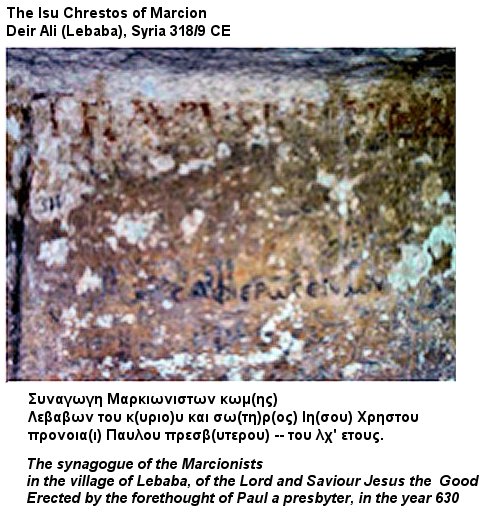
The name 'Christianoi' developed in Latin and then began to be adopted in Greek in the mid-second century.  The earliest example of 'Christianoi' being used in the New Testament is two examples from the Acts of the Apostles.  Yet this is clearly a Catholic document.  The Marcionites and other sects didn't use it.  They are recorded as identifying Jesus as χρηστός on that discovery from Deir Ali.  Yet I think I can do one better and prove that Clement of Alexandria also understood the real name of the Jesus association to be that of the  Χρηστοί rather than the Χριστιανοί.

There is so much bad information that goes around on the internet about this that we have to take our time here.  The key part is the -ianoi suffix.  Associations so identified in Latin are almost always groups that form around human beings and never gods.  The Latin terminology is clearly un-Marcionite which is a sect which understood Jesus to have come as a divine being down to earth from heaven.  Which brings us back to the Χρηστοί terminology.  There is no Latin suffix here.  It is the original terminology by which Marcionites and Alexandrians identified themselves (assuming they were different groups).  Yet this isn't the end of the story.

The term Χρηστοί goes back to a very significant Hebrew term which a number of experts on the Qumran literature argue was likely the way the Jewish sectarian group identified itself - i.e. the Yesharim ( יְשָׁרִ֣ים).

This is the crazy part of my developing formulation that both gets me excited and then at the same time makes me start to feel uncomfortable.  We can now drive right past the Roman involvement in the second century formation of Catholic Christianity.  We can begin to connect the Marcionite sect - at least one of the earliest Christian groups - more firmly with the Qumran sectarian tradition which is wonderful because the idea that God would come down and walk among men is clearly witnessed there.

Yet it is also impossible to escape the growing dread that this sounds like one of these idiotic theories about the 'Dead Sea Scrolls' that used to come out every other month in the last century.  I don't like the way my theory sounds and yet I have amassed a ton of evidence over the last few days clearly witnessing that not only did Clement of Alexandria identify his Jesus-tradition as the Χρηστοί but more significantly the χρηστοί is the term often used by the LXX to translate יְשָׁרִ֣ים in Jewish scriptural material.

Did I mention that  יְשָׁרִ֣ים is inevitably believed to be the root of the term 'Israel' by most of our earliest witnesses?  It doesn't matter that the argument is linguistically unsound.  This is what the ancients believed was true.

I have written about some of this before.  Nevertheless what is new is the interest of Clement of Alexandria.  I will bring forward dozens of examples over the next couple of days.  Yet it is just so very weird stripping the idea that 'Christians' were so-called because they followed 'Christ.'  The Marcionite and Alexandrian traditions were something very different.  The Yesharim was a term which was used to describe the angels who stood around the divine presence in Jewish Aramaic.  The root of the term is that of 'straightness' or 'uprightness' and the underlying concept here was that those who became Yesharim were ultimately purified from the sinful animal life of Adam after the fall.

I found countless striking examples of the use of this terminology in the Hebrew scriptures and the exegesis of the community at Qumran.  Yet let me note perhaps the most incredible example which caught Clement of Alexandria's eye - Psalm 49.  Let me first give you Clement's original reference where he says:

The frequent asking of forgiveness, then, for those things in which we often transgress, is the semblance of repentance, not repentance itself. “But the righteousness of the blameless cuts straight paths,” [Prov. 11.5] says the Scripture. And again, “The righteousness of the innocent will make his way right.” [Prov. 13.6] Nay, “as a father pitieth his children, so the Lord pitieth them that fear Him.” [Ps. 103. 13] David writes, “They who sow,” then, “in tears, shall reap in joy;” [Ps. 126. 5] those, namely, who confess in penitence. “For blessed are all those that fear the Lord.” [Ps. 128. 1] You see the corresponding blessing in the Gospel. “Fear not,” it is said, “when a man is enriched, and when the glory of his house is increased: because when he dieth he shall leave all, and his glory shall not descend after him.” [Ps. 49.16,17]

Clement tells us elsewhere that there are two classes of people in God's nation - the χρηστοί who will inherit the land and judge the world and who possess divine knowledge of the truth and those who are only taught fear of the Lord because of their mental limitations. The references to 'straight' and 'right' here clearly go back to the term yashar (= תְּיַשֵּׁ֣ר).

Yet before the discovery of the Mar Saba letter we never had any inkling how all these ideas came together.  I want to end this quick post by citing the whole of this last scripture (Psalm 49) and lay it side by side with the reference to Secret Mark and ask my readers if they see the context that I see in it.  First the LXX of Psalm 49 (with the words I think relate to Secret Mark emboldened in black and the words cited by Clement in red):

Listen to this, all you nations; give ear, you who dwell in the land; you earth-born ones and sons of men, both the rich and the poor. For, my mouth will now speak of wisdom, and the thoughts of my heart about comprehension. I will turn my ear to a proverb, and explain my riddle in song.

Why do I fear that wicked day, when the lawless are at my heels and surround me those who enforce their own power, and brag of their wealth before all?  May his brother serve as a man's ransom?  Why, he can't pay God for even himself!  For, if he tries to ransom himself, through the age he'll grow weary of trying. Thus, may he live 'till the end, so his body will not see corruption.

Whenever a wise man has died, with the foolish and mindless he passes away, and the wealth that he leaves is passed on to strangers.  Thereafter, his home is his tomb; it's his tent from generation to generation. They may call their land by his name,  but none [in the grave] see the honor in that. [This man] is then like the cattle, for like them he thinks not at all.

This is the snare in their path, for they take pleasure in the things that they say, but they go down to their graves just like sheep, and there they are tended by death. In that morning [when they awaken], they will be ruled by the upright (Heb. יְשָׁרִ֣ים) , who're no help to them now in their graves, where they and their glory are banished. For, only God can ransom our lives, from the hand of the grave, whenever He chooses to take us [from there].

So, be not in fear of those who grow rich, or those whose houses get glory. For, when they die they take nothing along, and all of their glory goes with them.  Yet, while they live they think their lives blest, and men have given them praise. But from one generation to another, they'll go down to their fathers, and through the ages they'll never see light.  For a man of honor doesn't know, that he resembles the unthinking cattle, and [his end] is also like theirs. [Strom 2.13]

I strongly suspect that Mark chapter 10 with the addition from Secret Mark was developed from this Psalm.   The rich youth asking about money, being told to abandon his wealth and then dying and going to the underworld only to be re-stood by Jesus as a yesharim.

And going near Jesus rolled away the stone from the door of the tomb. And straightway, going in where the youth was, he stretched forth his hand and raised him, seizing his hand. But the youth, looking upon him, loved him and began to beseech him that he might be with him. And going out of the tomb they came into the house of the youth, for he was rich. And after six days Jesus told him what to do and in the evening the youth comes to him, wearing a linen cloth over his naked body. And he remained with him that night, for Jesus taught him the mystery of the kingdom of God. And thence, arising, he returned to the other side of the Jordan

I have always believed that one thing which was working against the Mar Saba discovery is that New Testament and early Patristic scholars have no clue what Judaism is.

Tuesday, December 13, 2011

Did Celsus Actually Mention the Marcionites By Name?


Let's take a close look at the passage in Against Celsus. Origen begins by noting that:

Εἶτα σωρὸν καταχέων ἡμῶν ὀνομάτων φησὶν εἰδέναι τινὰς καὶ Σιμωνιανούς, οἳ τὴν Ἑλένην ἤτοι διδάσκαλον Ἕλενον σέβοντες Ἑλενιανοὶ λέγονται

He next pours down upon us a heap of names, saying that he knows (εἰδέναι) of the existence of certain Simonians who worship Helene, or Helenus, as their teacher, and are called Helenians

Clearly Celsus makes explicit mention of the Simonians and that they are related to a certain woman.  These stories show up in Irenaeus and Hippolytus.  Then we learn from Origen again that:

Κέλσος μὲν οὖν οἶδε καὶ Μαρκελλιανοὺς ἀπὸ Μαρκελλίνας καὶ Ἁρποκρατιανοὺς ἀπὸ Σαλώμης καὶ ἄλλους ἀπὸ Μαριάμμης καὶ ἄλλους ἀπὸ Μάρθας

Celsus knows (οἶδε), moreover, certain Marcellians, so called from Marcellina, and Harpocratians from Salome, and others who derive their name from Mariamme, and others again from Martha.

In each case the verb Origen uses is οἶδα (= to know) so the same kind of knowledge or familiarity is understood throughout. These are sects that Celsus specifically mentions in his work the True Word.

Yet Origen's remark about Celsus making an allusion to the Marcionites is very different and comes at the end of this section of sects familiar to the anti-Christian writer.  Origen here offhandedly makes the comment after the reference to the female sects that:

Ἐμνήσθη δ´ ὁ Κέλσος καὶ Μαρκιωνιστῶν, προϊσταμένων Μαρκίωνα

He is aware (ἐμνήσθη) also of the Marcionites, whose leader was Marcion.

It should be noted that ἐμνήσθη here is usually translated as 'he makes mention of' or 'il nomme' in French but  mimnḗskō literally means recall, bring to mind, remind oneself actively (purposefully); to remember, have in mind, "be mindful of."

Are we reading too much into the change of wording in the chapter?  I don't know.  Certainly Origen could have meant 'he also made mention of the Marcionites' (not Marcion though).  Yet I get the sense at least as if Origen has been literally dealing with a section of text in the True Word which makes explicit reference to the manner in which Christian groups are formed around women and the Origen adds in his own voice that Celsus also 'has in mind' the Marcionites.  The reason I say this is because all that follows in Origen's Against Celsus is a lengthy account of Celsus making reference to a Pauline sect where Celsus make reference to passage of Pauline scripture cited by this group.

It is worth noting that Origen never again references Celsus this way in the True Word.  In Book Six however he alludes to his previous use of the epistle of Plato in the following manner:

Ἀλλ´ οὐδ´ ἐβουλήθη τὸ παρὰ Πλάτωνι ἐν ταῖς ἐπιστολαῖς λελεγμένον, οὗ ἐν τοῖς ἀνωτέρω ἐμνήσθημεν, περὶ τοῦ διακοσμήσαντος τόδε τὸ πᾶν ὡς ὄντος υἱοῦ θεοῦ παραθέσθαι

Nay, he would not even quote the passage in the letters of Plato, to which we referred in the preceding pages, concerning Him who so beautifully arranged this world, as being the Son of God

The question here isn't whether or not Origen names the individual letter of Plato.  His use of mimnḗskō here only makes clear that he 'had in mind' the contents of the letters.  The question of whether he names the letters isn't the point in discussion.  I think Origen's allusion to Celsus's reference to the Marcionites is much the same.  Origen is merely saying that Celsus 'has in mind' the Marcionites in what follows and throughout the discussion.  Yet there is no proof that they are mentioned by name.  Origen only knows that the opinions cited by Celsus 'fit' the description of the sect which Origen knows to be the Marcionites.

The point is that there is no reason to believe from Origen's description of the contents of the True Word that the specific name 'Marcionite' was to be found.  The beliefs of the Marcionites are take to represent a large portion of Christians - perhaps even the majority.  One might even wonder if the reference to the 'Marcellians' which is certainly explicit in the True Word is the historical source of the Patristic reference to the Marcionites.  As mentioned, Jerome identifies Marcellina as a Marcionite which at first strikes us as odd because the Hypomnemata of Hegesippus identifies Marcellina as a 'Carpocratian.'  Yet notice that the two names stand side by side on the page in Origen and 'Harpocratian' (= 'those of the Horus the child') have already also been corrupted into 'Carpocratians.'

All the later Church Fathers who cite the existence of a sect called 'the Carpocratians' are also familiar with Hegesippus's text.  One may be tempted to say that Hegesippus is the source of the error here (Origen plainly says that he has never met a Carpocratian). Why can't the same thing be true with the 'Marcellians' (again not specifically identified in Celsus as 'of Marcellina' Origen does that for us)?  This is the only way in fact that we can begin to explain why Jerome thinks that Marcellina was the first Marcionite missionary to Rome.  In other words, that Marcellina wasn't explicitly identified here as a 'Harpocratian.'

The name Μαρκελλιανοί could also have been used to identify a group centered around a male named 'Marcellus.' The Μαρκελλιανοί are indeed identified a heretical sect 'of Marcellus' in the fourth century.

After Twenty Five Years of Thinking About Marcion I Think I Have Finally Come to Some Sort of Conclusion About Him

I don't know how it is going to be when I die.  My son keeps asking me about death and I don't know what to tell him.  In any event, I sometimes wonder what kind of memories are going to go flashing passed my eyes.  I doubt very many of these images will involved getting laid - not because it happened so rarely (even though that's true enough) - but because you don't think about things like that when you're dying.  I wonder whether any of the moments of illumination while developing my this present thesis about Marcion will be present then.

As much as I hate to admit it publicly I do think there is some 'greater purpose' to learning about the revelation of divine truths.  I don't know what that 'greater purpose' is.  I have always been struck by that line in the Social Network where the Mark Zuckerberg character says 'we don't even know what it is yet.'  My life has had a lot of that in it.  I have never figured out why knowing about Marcion matters, I just know that it somehow does.  Does that make sense?

There is something like 'truth' - an imaginary light coming out of a coffin (to use a movie metaphor) - whenever I think about Marcion.  I have never been a particularly religious person.  My parents developed into very serious atheists as I was growing up.  I don't know why I am so interested in revealing the stone crypt where Marcion is buried has always been important to me.  The important thing is that I have put off finishing that article on Marcion because I am starting to see what twenty five years of research have led me to realize about this mystery figure.

I think it all comes down to Celsus.  I am finally becoming quite certain that Celsus is the original source for the 'invention' of Marcion.  It took me this long to wrestle with the material but I think it has all come down to whether Hegesippus was borrowing from Celsus or Celsus from Hegesippus. Once I resolved this question the whole question of Marcion came together for me.

Let's start with some context for my regular readers.  There once was this early Christian historical work called the Hypomnemata of Hegesippus.  A hypomnema is a kind of unfinished work which is sometimes translated as 'memoir' but the ancient meaning goes deeper than that.  It often meant a kind of memory aid that served as the first draft of a finished treatise.

In any event, this early Christian work is associated with a figure named Hegesippus which is clearly a corruption of the name Josephus (= Joseph).  The historical work at least covers the period of time between Jesus's ministry all the way down to 147 CE which happened to be the seventy seventh year since the destruction of the Jewish temple.  Yet there was somehow also a later addition - a reference to Marcellina the follower of Carpocrates coming to Rome written during the reign of the Roman Pope Eleutherius, (whose reign is usually dated to the period 174 - 189 CE).

The difficulty for me is that somewhere along the line I abandoned my early dating of Celsus's Ἀληθὴς Λόγος (= True Word) to the same period.  I was heavily influenced by Chadwick and because of my abandonment of my original dating of the anti-Christian text to a much later period I couldn't resolve the last obstacle for my thesis regarding Marcion.

You see Jerome seems to 'mistake' Marcellina the Carpocratian for the first Marcionite missionary in Rome.  Many others have noted that that the names 'Marcion' and 'Marcellina' are strikingly similar - both are diminutives of the name Mark.  There are similarities in the idea of them visiting Rome in this period and corrupting the Church during the episcopate of Anicetus.  Lawlor correctly noted that Epiphanius seems to have been using the original text of Hegesippus's Hypomnemata to give us better information than Irenaeus on the event.  Yet Celsus also seems to be aware of the same details and according to Origen he cites makes mention of both 'Marcionites' and 'Marcellians' as well as various other heretical groups who have become famous from the works of Irenaeus and those who were influenced by him.

My dilemma again was figuring out whether the addition to Hegesippus's Hypomnemata was taken from Celsus or Celsus knew and was using the Hypomnemata.  As I said Chadwick's dating of Celsus to 178 CE made them rough contemporaries.  Yet I happened to be reading John Granger Cook's The interpretation of the New Testament in Greco Roman Paganism (2000 Mohr Siebeck) and I finally found enough bits and pieces to rescue my original belief that Celsus's True Word was certainly the original source of the report used by Hegesippus.

Cook begins by acknowledging that Celsus 'is virtually an anonymous figure.' Yet the question quickly becomes whether or not this Celsus is the Epicurean philosopher of the same name who flourished during the reign of Hadrian and Antoninus Pius.  Origen certainly thinks so and extends the productivity of this Celsus down to the early years of Marcus Aurelius and Lucius Verus's joint rule of the Empire.  It was to this Celsus that Lucian of Samosata's Alexander the False Prophet.  The scholiast on Lucian also identifies this Celsus with the author of the True Word.  It is worth noting that this Celsus also wrote extensively against magic and corresponded with Galen who in turn seems to have been familiar with Christians.

Without getting into all the reasons why I think Origen and the scholiast are correct we have to acknowledge that the major reason why others have doubted their identification is that the author of the True Word appears as a Platonist.  Origen gives a number of possibilities to explain why Celsus seems to have abandoned Epicureanism in writing this treatise and first on the list is that being an Epicurean would weaken the effectiveness of his argument.

In any event, it is important to merely acknowledge that Cook mentions 160 CE as a possible date for the publication of the True Word.  However Origen's testimony and internal evidence from Origen's refutation of that original text broadens the possible dating to any time during the reign of Anicetus (= 150 - 167 CE).  Indeed given that fact that Celsus is the source of the addition of the Marcellina the Carpocratian's visit to Rome in this period, it would seem the original editor of the Christian history wanted to include an important bit of information that was left out of that work.  After all Hegesippus was alleged to have come to Rome and delivered the Hypomnenata to the Church in the very same period.  How could he have omitted to have referenced Marcellina?

By restoring the early dating of Celsus the most important thing happened to my understanding of Marcion.  I finally see why it is that so many works 'Against Marcion' emerge in the late second century and into the third century.  Most scholars have simply assumed that Marcion must have been a widely influential figure that so many texts were written against him.  Yet I would argue that they were only reacting to the influence of Celsus's anti-Christian tome.  They were all trying to distinguish the true Christian tradition from the 'heresy' of Marcion.

In other words, Celsus is the starting point for the idea that the Marcionites were hostile to the Creator (= Logos).  His treatise was written to defend the 'True Logos' against the Marcionites who he argued were hostile to Him/It.  Justin and Irenaeus and the like were all reacting to and developing ways of distinguishing Christianity from the arguments of his text.  These texts were developed in Greek and Syriac.  Even Justin seems to have developed a few.  But the point we must never lose site of is that we can no longer simply say that because all our sources say similar things about the beliefs and practices of the Marcionites necessarily means there actually was a sect of this nature.  The ultimate ground of the 'Against Marcion' genre was Celsus's True Word.  All surviving traditions were very much influenced by his mode of argument.

tus

Monday, December 12, 2011

How Accurate Were the Early Reports About Christian Heresies?

I have been trying to resolve this in my mind with particular attention paid to the Marcionites.  Were the Marcionites a real sect or were they just a misunderstanding which arose from the heresiological literary genre? This question is more difficult to answer than appears at first glance because - as the philosopher Bill Clinton aptly pointed out with respect to another conundrum, it all comes down to what you mean by 'is.'

Let's take a parallel example in modern times - the existence of anti-Jewish literature such as the Protocols of Zion or Mein Kampf.  There certainly are people who identify themselves as Jews.  But much of what is said about the Jews in anti-Jewish polemics is ridiculous.  By the same token there is some familiarity with the general patterns of Jewish practice and belief (look at www.come-and-hear.com - a site which presents most of the contents of the Talmud with an anti-Jewish bent).  Nevertheless no one can seriously claim that Jews ever ate Christian children or encouraged pedophilia or any of the other crazy exaggerations promoted by these people.

To the same end, something at the bottom of the reports about the Marcionites must have been true.  There must have been someone or something which prompted the sect to be identified with the name 'Marcionite' or some such derivation.  Yet the story about a rich shipowner, the son of the bishop of Sinope who seduced a virgin, bribed the church of Rome and hated the god of the Jews so much he created his own religion is certainly bullshit.

The difficulty of course is that a number of Church Fathers develop some sort of report to explain the existence of members of this sect as late as the fifth century.  What about these 'Marcionites' was similar enough to the original description put forward by the second century Fathers which allowed them to be easily identified as such?  The answer - surprisingly - must have been quite a bit more generic than most scholars realize.  The obvious 'tipping off' that this Christian sect was Marcionite could well have come down to:

  1. the fact that they were a Christian community not part of the Catholic network of churches. 
  2. that they only accepted the one apostle (= 'Paul') and only his writings
  3. that they had only one gospel (in Syria and the East this wouldn't have been distinguishing up to the fifth century)
  4. that they were 'overly' involved in praying, fasting and sexual abstention
  5. that they resisted citing the Jewish scriptural writings
There may have been more than this which helped label a community 'Marcionite' but we shouldn't fall into the trap of assuming that because a fourth or fifth century writer came across 'Marcionites' that everything about the sect fit the description established by Irenaeus at the turn of the third century.  In other words, the fact that Marcionites were being identified after the council of Nicaea does not prove the accuracy of the ante-Nicean information.  Much of that is confusing and contradictory in nature beyond what is cited above.  

Saturday, December 10, 2011

Does the Fact that Mar Saba 65's Secret Mark Fragment Might Be a Pastiche Help or Hurt Its Authenticity?

I had to bring my son to a classmate's birthday party tonight (since when do children have celebrations at night?) and I was ruminating about a new strategy in the Secret Mark debate.  What if we go along with the contention that the addition to chapter 10 does indeed resemble a pastiche of other gospel material?  Doesn't the existence of the long ending suddenly become an argument for authenticity of the Secret Mark passage in the Letter to Theodore?

the Long Ending is best read as a cento or pastiche of material gathered from the other Gospels and from other sources, slanted towards a particular interpretation ... the verses are a summary of a number of events recorded at greater length in the other Gospels. [David Parker the Living Text of the Gospel p. 140]

Grant also points to the fact that Irenaeus is (a) very aware of contemporary centonized gospels and (b) demonstrates his abilities as a composer of centos meaning that quite clearly both LGM 1 (= the first citation of the longer gospel of Mark in to Theodore) and the long ending of Mark are representative of contemporary Christian literary habits.

My question is whether we can take the argument one step further and ask - was Morton Smith even aware that the long ending of Mark was a pastiche.  James Snapp, who is very familiar with everything ever written about the long ending notes that:

Kelhoffer was the first person to systematically work through all 12 verses and see what sort of scenario was necessary to maintain the premise that these verses are a pastiche. The scenario that he came up with -- and proposed! -- is that these 12 verses were written by someone who was deliberately making an ending for the Gospel of Mark, and that this ending consisted of verbiage drawn from all four Gospels (and may have concluded a four-Gospel collection in which Mark was situated fourth), (not just from the parallel resurrection-accounts, but from throughout the books) as well as Acts and possibly Revelation, and that the ending-creator consulted his source-texts some 63 times (about once every three words, on average) to gather material to imitate -- only to create a text which (according to so many commentators claim) has "non-Marcan" style and vocabulary, and which contains details that are not paralleled in the other accounts.

Kelhoffer published this thesis about forty years after Morton Smith discovered Mar Saba 65.  While there were others who noticed the similarities between the long ending of Mark and material in the canonical gospels no one ever systematically laid out how it might have been done.

What I am starting to wonder is whether the pastiche argument helps or hurts the authenticity of the Letter to Theodore.  Was Morton Smith even aware of the loose observations of Griesbach, Swete, Alford and Warfield that similarities exist between the long ending of Mark and the synoptic gospels?  Where else would he have got the idea that expansion efforts related to Mark took the form of a pastiche?

Francis Waston on the Longer Ending of Mark as an 'Authentic Pastiche' Which is 'Appropriate to the Gospel of Mark Itself.'

In a previous post I mentioned Larry Hurtado's apparently inconsistency - arguing that the reference to Secret Mark in the Mar Saba letter is a forgery in part because it appears as a 'pastiche' while accepting the long ending of Mark as an ancient addition to Mark made up of the three other synoptic gospels.  Now it is time to look at the apparent contradiction in Francis Watson's estimation of the same material.  Francis Watson, perhaps the critic most associated with the "Markan pastiche = modern forgery" argument goes even further than Hurtado and not only accepts the longer ending of Mark as an ancient edition to Mark but moreover as an ending to Mark which is 'entirely appropriate' to the gospel (even Hurtado and Evans don't go that far).  Let's start with a typical reference to the longer ending in one of Watson's books:

It is for this reason that the two disciples on the way to Emmaus are represented as not recognizing the traveller who joined them on the road - not because he appeared to them 'in another form' (en hetera morphe), as the longer ending of Mark claims in an attempt to summarize the Lucan narrative (Mark 16.12), but because the conditions were not yet in place within which faith becomes a possibility [Text Church and World p. 290] 

Yet when we look to his statement in his Text and Truth we see Watson argue that even though the longer ending of Mark was made up of other synoptic material it is still should not be rejected by modern textual critics:

My own argument shows that, at least at certain points, the Longer Ending is appropriate to the Gospel of Mark itself [p. 90] 

But that's very curious given the lengths to which Watson argues that the pastiche nature of the addition to chapter 10 of Mark in to Theodore is by its very nature proof of forgery.

As I have to attend a children's birthday part I will simply cite from Roger Viklund's summary of the development of this argument in scholarship.  Viklund notes:

I shall focus upon another old argument which Raymond E. Brown dealt with already in the 1970s and since then has been recycled by many, for instance by Per Beskow. As Watson explains it: “It has often been suggested that Clement’s excerpts from the Secret Gospel are a mere mosaic or collage, drawing from mainly Markan phraseology to create a new narrative loosely related to the Lazarus story.” While R. E. Brown seems to have taken this to indicate an ancient pastiche forgery, Watson must believe that Morton Smith cut and pasted from mainly the Gospel of Mark in order to create the first Secret Mark passage within the Clement letter. Watson continues: “The Secret Gospel passages comprise 14 sense-units (phrases or sentences) distributed evenly throughout the pericope. The Markan and other synoptic parallels have contributed 66 of its 157 words, in sequences of between three and ten words. A minimum of 32 of the remaining words are employed to complete the sense-units in question. That leaves just five sentences out of account, which tell of Jesus’ departure to the tomb; the voice heard from the tomb; Jesus’ entry into the tomb and his stretching out his hand; the departure to the young man’s home; and the night spent together. These sentences are full of synoptic language, but they are not dependent on synoptic word-sequences. … The pericope would seem to be the work of an author determined to pattern his own work on mainly Markan phraseology.” 

Some might argue that it is entirely possible that the letter to Theodore is an ancient or even modern forgery. Yet the fact the fact that the addition referenced therein is a pastiche cannot possibly be argued to be a proof in any sense that the material is forged. Indeed I am curious when the pastiche nature of the long ending was first recognized in scholarship. Was it before or after 1958?

Another Demonstration that the Claim the Marcionites Called Their Collection of Pauline Letters 'the Apostolikon' Has Very Little Going For It

In our previous post we demonstrated how the claim that the Marcionites called their collection of Pauline letters 'the Apostolikon' is really quite weak given the corrupt state of the one source that mentions this - the so-called Dialogues of Adamantius.  The Dialogues were clearly written after Methodius had already written his anti-Origenist treatises - so they fourth century compositions.  It was only in the fourth century that the term τὸ ἀποστολικόν became used to denote 'the collection of Pauline writings.'  Yet scholars have come to use the term as if it were originally used by the Marcionites.  Yet is this all a misunderstanding developed from the late composition of the original material?

Some scholars point typically point to the second use of the terminology in Adamantius's debate with a radical Marcionite dualist named Marcus:

AD. If I should prove that the Good God does judge, would you be convinced that God is a Unity, and that there is not another?

MK. You cannot prove it.

AD. Would you be convinced by the Apostle?

MK. I would be convinced by my Apostolicon.

AD. I have your Apostolicon here, and I read: "God will judge the secrets of men through Jesus Christ, according to my Gospel"


Yet we see in the earlier dialogue with another 'moderate Marcionite' named Megethius we clearly see that the term 'apostolikon' seems to have been used by both Catholics and Marcionites alike:

MEG. It is impossible that these men ever saw Paul.

AD. I can show the apostle himself testifying to Mark and Luke.

 MEG. I do not accept your spurious Apostolicon

AD. Produce your Apostolicon — even though it is much mutilated and I will prove that Mark and Luke worked with Paul.

MEG. Prove it.

AD. I read at the end of Paul's letter to the Colossians ...


Almost the same logic used to identify the Marcionite collection as 'the Apostolikon' could be used here to determine that the Catholic collection was also so called.  As such it is easier to attribute the identification of the Pauline collection as an 'apostolikon' as being reflective of the general terminology of the period (= fourth century) rather than any special name given to the collection by the Marcionites in the third century and earlier.

Friday, December 9, 2011

Is There Any Convincing Evidence that the Marcionites Called their Collection of Pauline Letters 'the Apostolikon' (= τὸ ἀποστολικόν)?

I know that all Marcionophiles (the hundred or so of us) bandy about the piece of knowledge that 'Marcionites referenced to their collection of Pauline letters as 'τὸ ἀποστολικόν' - but do you know where the evidence for this comes from?  The Dialogues of Adamantius.  There are several passages in the Dialogue in the edition of W. H. van de Sande Bakhuyzen, Der Dialog des Adamantius (GCS 4), e.g. p. 10 l. 19; p. 66 ll. 9–10; p. 188 l. 14)  Yet the Dialogues are hopelessly corrupt.  We have to be careful to take pride in terminology merely because it makes us feel important or intelligent.

Why should we accept the claim of a mutilated and many times rewritten source that the Marcionite text was so called?  This information is not passed on through any of our other sources.  The earliest use of the term τὸ ἀποστολικόν I can find is in the Eclogae Propheticae and it is used to describe the words of John the Baptist.  The fact that Clement of Alexandria never once uses the term in any of his writings should open us up to the question of whether either this text or the Excerpts of Theodotus were really written by Clement or added to the collection because there were some blank pages needing to be filled.

Indeed τὸ ἀποστολικόν the neuter of αποστολικός often combined with the noun τεύχος or βιβλίον (‘book’, ‘volume’) and clearly came to mean a collection of New Testament Letters assembled in one volume by the fourth century. There is no doubt about this.  So we see, in his edition of the Letters of Paul (CPG 3642) the deacon Euthalius, who lived in the fourth century ad, speaks of an ἀποστολικόν τεύχος.  Yet are we really to believe that the orthodox start using the original Marcionite name of the Pauline collection?

I think a much more plausible explanation can be found.  The Dialogues are also usually dated to the fourth century.  Couldn't the use of the term τὸ ἀποστολικόν merely be a reflection of the language of fourth century ecclesiastical circles that the Dialogues of Adamantius were written?  Or perhaps the authors overall anti-Origenistic worldview?

I will stop calling the Marcionite collection of Pauline letters 'the apostolikon' from now on.

The Thirteenth Apostle

I frequently engage in online discussion groups because I readily admit I do not know everything there is to know about early Christianity.  I know that should sound self evident to anyone about everyone in a field or discipline but there is something about studying the Bible which encourages ordinary people to posit that they have 'absolute knowledge' about any given topic.  Perhaps it is the idea of 'God' - the very embodiment of the idea of omniscience - which is the root of the problem.  I bet no one studying the causes of physical, mental or spiritual ailments ever thinks they have all the answers.  Yet turn that around and study the perfect and absolutely True One - aka God - and there all sorts of perfectly infallible 'experts' on every question related to his revelation to humanity.

In any event, the point of this very quick post is that I have always known that the representative of St Mark, the Patriarch of Alexandria has as one of his oldest titles the epithet 'thirteenth among the Holy Apostles.'  It is commonly attributed to St Mark but there is no direct proof that Mark was ever identified as such.  Instead we find - very interestingly for my Marcionite theory - that the figure usually associated with this title is Paul.  Paul is repeatedly identified as 'the thirteenth apostle' in early literature, the idea being that he is the one after or apart from the Twelve.

The interesting part of all of this is of course that both Paul and Mark can be seen as 'fitting' this role.  Yet it is the Alexandrian Patriarchate which is most explicitly connected with the title.  Not only do we have the early testimony of Athanasius demonstrating that Alexandrian Patriarchs called themselves 'the thirteenth apostle' later representatives of St. Mark used the fuller title 'the thirteenth apostle and fifth evangelist' implying certainly that there was a fifth gospel written by their patron saint Mark ....

Thursday, December 8, 2011

Secret Mark and the Long Ending of Mark

What do the rest of you think about Larry Hurtado?  Here's what I have to say - he certainly seems to develop the same argument for 'Secret Mark' being a modern forgery that he does later in the same book for the long ending of Mark being an ancient addition.  Can someone help me out what I'm not understanding about his point?  First Hurtado uses the pastiche argument to demonstrate why Morton Smith had to be the forger of the Letter to Theodore:

Secret Mark employs phrasing with uncanny resemblances to the canonical Gospels to narrate an incident that looks suspiciously like a novelistic expansion of the Markan narrative [Hurtado Lord Jesus Christ p. 436]

Then later on he uses another scholar's study of the long ending of Mark to demonstrate that these kinds of 'pastiche' compositions were en vogue.  Indeed it is how Hurtado says the ending of Mark was composed at the time of Irenaeus or earlier:

Most recently, James Kelhoffer's detailed analysis of the "long ending" of Mark shows that this block of material (16:9-20), which represents an attempt to fit Mark with a more "suitable" ending, used elements from the other three canonical Gospels, and these writings only. [p. 585]

So why does the pastiche argument (or cento gospel to use Grant's terminology) 'prove' that the story about the resurrected youth in to Theodore is a modern fake?  Please help me out ...
 
Stephan Huller's Observations by Stephan Huller
is licensed under a
Creative Commons Attribution 3.0 United States License.