Monday, April 15, 2013

The Jewishness of Marcion [Part Three]

Any objective overview of the original evidence 'against Marcion' will notice that his 'heresy' seems to dwell on the creation of man.[1]  Marcionites seemed to be 'obsessively' determined in their demonstration of the Lord's short-comings because of this single act.  It is surprising to note that we see no substantive refutation of the creation of the world in the manner of Celsus.[2]  Tertullian acknowledges an apparent inconsistency in the Marcionites using things from the material Creation for their sacraments.[3]  The Carmen Adversus Marcionitas even goes so far as to declare ipsum factorem reprobatis facta probantes?[4]  The possibility at least exists that the creation of man was distinguished by Marcion because the text of Genesis identifies 'the Lord' for the first time taking part in Creation.[4]

We have already seen that when the Marcionites are allowed to speak they saw two gods take part in the creation of man.  Even the famous Marcionite interest in the the parable of the two trees and their two 'fruits' (Luke 6:43 - 49) necessarily goes back to the presence of the two powers of God and the Lord in Eden.[5] Harnack acknowledges on behalf of Marcion that the two trees are the gods of the Old Testament and the gospel. [6]  Yet the obvious place to locate these two trees are in Paradise.  So the 21st memra of the Liber Graduttm, a fourth-century Syriac treatise of uncertain provenance related to Marcionitism: "In that world in which there is no death, . . . they will eat the life-giving words of our Lord. They shall eat our Lord and live. . . . The good tree, in that world of light invisible to the eyes of flesh, is our Lord Jesus. He is the tree of life who gives everything life by its fruit wherever the perfect will of God is."[7]

If we allow the likelihood that Marcionitism imagined two powers - one visible, one invisible - being present in Paradise we should return to the second century and our earliest surviving anti-Marcionite treatise.  As we have already noted Irenaeus's Sabellian anti-Marcionite strategy stands in sharp contrast to the argument developed by his predecessor Theophilus of Antioch a generation earlier.  That Book Two of Tertullian's Against Marcion was recycled from a lost original anti-Marcionite text written by Theophilus has already been established by Harnack, Grant and Quispel.[8]  It is in this work that we see what amounts to a less successful strategy against Marcionites given that Theophilus is willing to concede that there are indeed two powers in heaven with distinct characteristics.

In the middle of one his most ferocious attacks against the Marcionite he is forced to admit that:

To such a degree as this is justice even the plenitude of divinity itself, that it reveals God in his perfection both as Father and as Lord: as Father in clemency, as Lord in discipline: as Father in kindly authority, as Lord in that which is stern: as Father to be loved from affection, as Lord to be necessarily feared: to be loved because he would rather have mercy than sacrifice, to be feared because he forbids to sin: to be loved because he would rather have a sinner's repentance than his death, to be feared because he refuses such as do not now repent. For that reason the law lays down both these commandments, Thou shalt love God, and, Thou shall fear God: the one it sets before the obedient, the other before the transgressor.(Adv. Marc. 2.13)

By admitting that there are indeed two separate powers in heaven associated with two different names the debate that would follow would necessarily leave both sides vulnerable to the charge of improperly dividing the oneness of the godhead.[9]  As we have seen, while this attack was first leveled against Christianity by pagan critics of the religion, it was soon picked up by Irenaeus and employed to devastating effectiveness.

It would seem no Church Father could live up to Irenaeus's high standards save Polycarp of Smyrna.[10]  While Irenaeus welcomed the testimony of Justin and Theophilus as witnesses against Marcion, he certainly could not have accepted the underpinnings of their scriptural exegesis. For instance where as Irenaeus sees the heavenly Father himself present in the burning bush (Ex 3:14) Justin understands only the manifestation of his lower power.[11]  It is difficult to see how the original writings of these earlier Patristic witnesses could not have caused problems for Irenaeus.  As such it stands to reason that they likely have come down to us in a substantially altered form.[12] Tertullian was likely copying a text already manipulated at least once before by Irenaeus. The lengthy transmission of Against Marcion is explicitly witnessed by the opening words of Book One.[13]

In spite of the unfortunate state of manuscript, we still get a sense of Marcion's hostility to activities of 'the Lord' in Paradise.  Theophilus responds however that if he abolished freewill "Marcion would have call out, 'Look at that Lord and Master, so unstable, so inconsistent and untrustworthy, cancelling appointments he himself has made. Why did he grant free choice, if he had to interfere? Why interfere, if he has made the grant? Let him choose on which side he will admit himself mistaken, whether in the appointment or in the cancelling of it?" (Adv Marc 2.7)  Moreover Theophilus notes that Marcion also criticizes the Lord for being too vengeful,(ibid 2.18) encouraging idolatry,(ibid 2.22)  ignorant of the affairs of man,(ibid 2.25) too severe, (ibid 2.26) and too inconsistent (ibid) to be worthy of respect.

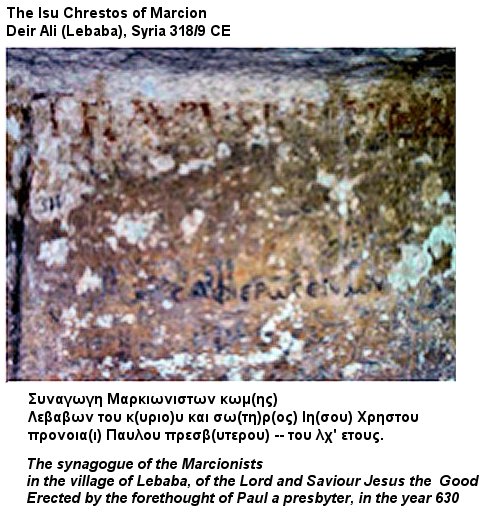
It is well established by Irenaeus at the very start of Against Heresies that the heretics resisted calling Jesus Lord preferring instead to call him Savior.[14]  While this is specifically applied to the Valentinians, it is generally thought to apply to other groups too.[15]  Epiphanius's statement that Marcion altered κύριον to χριστον in 1 Corinthians 10:9 has been argued by Blackman to the point to the fact that "κύριον in this context refers to the Creator, and if Marcion was going to make any use of the passage at all he could have no object in exhorting his followers not to tempt the Demiurge."[16]  There are a number of other statements implying directly that the Marcionites resisted the word Lord; on the other hand we see the Marcionite inscription at Deir Ali makes reference to "του κ(υριο)υ και σω(τη)ρ(ος) Ιη(σου) Χρηστου."[17]

Putting aside this difficulty for the moment it should be noted that Theophilus himself had strange notions about the name κύριος which might have compromised his ability to combat the heresy of Marcion.   We see this clearly during the course of his treatise against a certain Hermogenes - a work again preserved again by Tertullian.[18]  Theophilus sees κύριος as a name which was only created with the appearance of matter in the world, that "the substance [of divinity] existed always with its own name, which is God; the title Lord was afterwards added, as the indication indeed of something accruing."[19]  Yet Theophilus's understanding could certainly have been used to argue that there was a time when Yahweh was not - a heretical understanding reflected in the rabbinic literature.[20]

According to Theophilus's reasoning 'the Lord' co-existed with matter - "from the moment when those things began to exist, over which the power of a Lord was to act, God, by the accession of that power, both became Lord and received the name thereof."[21]  Indeed in a like manner "God is a Father, and He is also a Judge; but He has not always been Father and Judge, merely on the ground of His having always been God. For He could not have been the Father previous to the Son, nor a Judge previous to sin."[22]  These arguments could certainly have been twisted by heretics to justify the belief that there was a time when the Son was not - and for that matter - that there was a time when the Lord was not.

Indeed Theophilus goes so far as to read Genesis as describing two separate powers involved with two separate creations - i.e. that of the world and that of man.  To this end the Marcionites may well have forced Theophilus to concede that the two were not that far off in many basic assumptions; the difference between them may have only come down terminology.  As we read in what immediately follows:


Do I seem to you to be weaving arguments, Hermogenes? how neatly does Scripture lend us its aid, when it applies the two titles to Him with a distinction, and reveals them each at its proper time! For God, indeed, which always belonged to Him, it names at the very first: "In the beginning God created the heaven and the earth; " and as long as He continued making, one after the other, those things of which He was to be the Lord, it merely mentions God. "And God said," "and God made," "and God saw; " but nowhere do we yet find the Lord. But when He completed the whole creation, and especially man himself, who was destined to understand His sovereignty in a way of special propriety, He then is designated Lord. Then also the Scripture added the name Lord: "And the Lord God, took the man, whom He had formed; " "And the Lord God commanded Adam." Thenceforth He, who was previously God only, is the Lord, from the time of His having something of which He might be the Lord. For to Himself He was always God, but to all things was He only then God, when He became also Lord. Therefore, in as far as (Hermogenes) shall suppose that Matter was eternal, on the ground that the Lord was eternal, in so far will it be evident that nothing existed, because it is plain that the Lord as such did not always exist.  

It would be a mistake to gloss over the original distinction between the two different names being associated with the two different creations.  The argument at the heart of Against Hermogenes is an adaptation of the traditional two powers formulation - perhaps one that has been further refined by exposure to Irenaeus's Sabellianism.[23]

It is also very interesting to note that Philo becomes suddenly muted when speaking of two powers when discussing the creation of man.  The very ascription of two divine participants in Eden - one visible, the other invisible and perhaps acting without the knowledge of the former - was likely an established, heretical view at the time he was writing.[24]  The Nag Hammadi texts Yahweh's declaration to be 'the only god' as an ironical statement of his ignorance while creating Adam.  Our Patristic witnesses expand that list by including the Marcionites of heresies that held the secret presence of the other God in Paradise.  It was also certainly witnessed in the various references to the 'two powers' controversy in the rabbinic literature.

In Eznik's long summary of the Marcionite account of creation the just god is repeatedly identified as 'the Lord of creatures.'[25]  The best explanation of this title is that 'the Lord' alone formed man but that 'God' gave him his spirit.[26]  As such the Marcionite focus on the redemption of man rather than creation may well reflect the Marcionite hostility to 'the Lord' but not 'God' in the Pentateuch narrative.  Eznik stands as the last in a long line of witnesses that took special interest in the 'arrogance' of Yahweh, to suggest that he was the only God when there was another God explicitly demonstrated in the Pentateuch narrative.  It is the clearest example of the Marcionite use of Jewish scriptures independent of Paul.[27]

Long before Eznik, Tertullian writes "this time with an eye to Marcion, He says, I am God, and other apart from me there is not. And when he repeats this in other terms, Before me there was no god, he is having a knock at those I know not what genealogies of aeons, of the Valentinians" (Tertullian Flesh of Christ 24).  So too Irenaeus when he writes "He is the Former, He the Builder, He the Discoverer, He the Creator, He the Lord of all; and there is no one besides Him, or above Him, neither has He any mother, as they falsely ascribe to Him; nor is there a second God, as Marcion has imagined (Irenaeus 2.22.9)  But it is Eznik who makes clear that it was the Marcionites themselves - not merely the Church Fathers attacking the group - who culled Scriptural sayings in order to create their own drama of the events in Eden.

Eznik explicitly preserves for us that the Marcionites identified the Lord of Creatures (= Yahweh) as saying:

"Adam I am God, and there is no one else, and you shall have no other god before me. When you will have other gods before me, know that you will die"

In the narrative we are told that Matter, the power of Evil declares after a falling out with the Lord that:

he has hated me, and he has not kept his compact with me, I will create many gods, and I will fill up the world with them completely so that he will seek who might be God, but he will not find." And she created, they say, many idols, and she named them gods, and she filled the world with them. And the name of God who is the Lord of creatures was sunk in the midst of the names of many gods, and nowhere was He being found.

The Israelites may well have rediscovered the name Yahweh - but they and their Master were still ignorant of the ultimate Being behind all things.  It was not until "Jesus descended a second time in the form of his divinity to the Lord of creatures, .... [that] the Lord of the world saw that divinity he discovered that another god apart from himself existed."[28]

As we have already noted the Christian groups were not the only ones who obsessed over the "I am God and there is no God before me" declaration or those like in the Old Testament.  Segal acknowledges that "[n]ot only is Marcion's exegesis of scripture similar to the rabbinic exegesis in some respects" but that his opponents too exhibit "many of the characteristics of 'two powers' heresy which offended the rabbis."  Speaking specifically of Tertullian's re-purposing of earlier treatises, Segal notes that this similarity to the rabbinic reaction to the two powers doctrine "is to be expected, in part, since Tertullian is usually seen to have developed his defense against Marcion out of writings which came down to him from Justin, Irenaeus, and Theophilus, all of whom have assumed candidacy for the charge of 'two powers' heresy."[29]

Segal goes on to suppose that the existing material implies that some modalists may have accused Christian orthodoxy of believing in a second God in order to group it together with Marcionism.  According to him:

The exegeses typical of this heresy in Judaism thus came to be completely revalued in Christianity.As his use of "alterius deus" seems to imply, Tertullian can also use anti-dualism arguments against Marcionism which are familiar to us from rabbinic writings themselves:

"To such a degree is this justice, even plentitude of divinity itself . . .God Father and Lord, Father in clemency, Lord in discipline ... Thou shall love God and Thou shall fear Him . . . The same God who smites also heals: He kills and also makes alive, He brings down, He rises up: He creates evil, but also makes peace. So that on this suggestion too I have to answer the heretics. "See," they say, "He himself claims to be the creator of evil things when He says: 'It is I who create evil' ..." 
'
As Segal notes "it is surprising to see Tertullian marshal what look like Philonic or rabbinic arguments against "two powers" to defeat Marcion." The backbone of the passage is Dt. 32:39 which, as Segal acknowledges, was central to the rabbinic exegesis against "two powers."  Indeed he points to many other times where Tertullian relies on this passage and tentatively concludes "Tertullian might be relying on a rabbinic tradition directly or indirectly through other church fathers, who had used it in their battles with heretics."[30]

Yet as we have already noted many times so far, Tertullian was only part of an active literary tradition which re-purposed early anti-heretical treatises according to ever changing standards of orthodoxy.  Irenaeus represents a complete break from the past owing to his wholesale adoption of Sabellianism.  Whereas Theophilus to some degree engaged Marcionites from a mutual acceptance of two powers in heaven, Irenaeus sifted through these original arguments and recast their from an entirely new point of view.  Irenaeus essentially took over the point of view of the fiercest critics of Christianity - the well educated men that he met in the highest circles of the Imperial court - and tried to transform Christianity away from its 'all too Jewish' obsession with the magical power of divine names.  Under this new reinterpretation of the Church's traditional relationship with its mother religion, both Judaism and Christianity were always strictly monotheistic.  It was if the 'two powers' controversy was all a big misunderstanding.

Marcion was one of many individual 'heretics' who seized upon an idea of two powers on their own.  It was if Judaism itself never recognized or condoned the understanding.  Irenaeus purpose was to rehabilitate the over-active imagination which spawned heresies.  He takes it to be his mission to enlighten the Marcionites so "that they may know the Framer and Maker of this universe, the only true God and Lord of all."(Adv Haer 3.25.7). The Marcionites like other heretics have erred in identifying the names of god for distinct powers and this view must be corrected.  Irenaeus repeats this mantra ad nauseum in Against Heresies.  It is repeated literally hundreds of times and can be fairly described as the overarching theme to the entire work.

His obsessiveness on this point even extends to the very gospels.  Irenaeus takes pains to present each text as originally holding the correct belief before being 'corrupted' by individual heretics.  With respect to Matthew that Jesus and his disciples "did acknowledge any other Lord or God, but the God and Lord supreme: the prophets and the apostles confessing the Father and the Son; but naming no other as God, and confessing no other as Lord: and the Lord Himself handing down to His disciples, that He, the Father, is the only God and Lord, who alone is God and ruler of all." (ibid 3.9.1)  With respect to Mark "plainly does the commencement of the Gospel quote the words of the holy prophets, and point out Him at once, whom they confessed as God and Lord." (3.10.5)  With respect to Luke that Jesus "simply, absolutely, and decidedly confessed in his own person as God and Lord, Him who had chosen Jerusalem, and had instituted the sacerdotal office. For he knew of none other above Him; since, if he had been in possession of the knowledge of any other more perfect God and Lord besides Him, he surely would never--as I have already shown--have confessed Him, whom he knew to be the fruit of a defect, as absolutely and altogether God and Lord." (ibid 3.10.5)

Each individual evangelist testifies to the same overarching truth about the Sabellian foundation of Christianity.  Only John now references the concept of the Logos.  Yet at the time Irenaeus was writing it is unlikely that many people were familiar with his four gospel set.  Whether it be, Marcion's gospel, Tatian's Diatessaron or some other text, there were many single gospel communities which preached the existence of more than one power in heaven.  The irony of Irenaeus's system of course was that there was now a quaternion which argued through the witness of multiplicity to the unity of the godhead.  Was this a deliberate formulation on Irenaeus's part?  It is difficult to say with any degree of certainty.  Yet it is important to recognize that the choice of four gospels on Irenaeus was quite deliberate.  The argument which unfolds in Book Three of Against Heresies was clearly well thought out and designed for the purpose of forever redefining Christianity away from the two powers doctrine.[31]


[1]
[2]
[3]
[4]
[5]
[6] Harnack, Marcion: The Gospel, 22 “When he [Jesus] spoke of the two trees, the corrupt and the good, which are able to produce only such fruits as are given by their very nature, he can mean thereby only the two great divine authors, the Old Testament God, who creates nothing but bad and worthless things, and the Father of Jesus Christ, who produces exclusively what is good."
[7] Pedersen, Demonstrative proof in defence of God: a study of Titus of Bostra's Contra Manichaos p. 223 "the fragment in De paradiso 5,28 could be interpreted to mean that Apelles believed that the Tree of Life, which had more power for giving life than the Creator's breath (Gen. 2.7), represented the highest God." Acts of Archelaus 10 identifies Jesus as the good tree in Paradise "And that tree in paradise, by which men know the good, is Jesus Himself, or the knowledge of Him in the world." (M. Kmosko, ed., "Liber Graduum," in R. Graffin, ed., Patrologia Syriaca [Paris, 1894-1926]. The idea seems to be consistently referenced in known Manichaean writings perhaps under influence from Marcionitism.
[8]
[9] שובלה , שבלה , pl. שובלין , שבלין n.f. ear (of corn), cluster of fruit.  The idea goes back to the frequent epithet of Demeter = Δάματερ πολύκαρπε where the ear of grain is the goddess's chief symbol. Δάματερ πολύκαρπε πολύσταχυ Theocritus, Idylls 10.42. (cf. Aelian, De Natura Animalium 11.4, Diodorus Siculus, Bibliotheca Historica book 3, chapter 42 etc) . "The rice, according to Aristobulus, stands in water in an enclosure. It is sowed in beds. The plant is four cubits in height, with many ears, and yields a large produce." (ὕψος δὲ τοῦ φυτοῦ τετράπηχυ πολύσταχύ τε καὶ πολύκαρπον Strabo Geography 15.1)
[10]
[11] For instance let us consider that Theophilus is remembered to have preferred or used a Diatessaron. Ep. Ad Algasiam 121.6 Theophilus, Antiochenae ecclesiae septimus post Petrum apostolum episcopus, qui qiuituor evangelistarum in unum opus dicta compingens, ingenii sui nobis mouimenta reliquit, haec super hac parabola in suis com- mentariis locutus est.[12]  The arguments against Marcion's gospel in Book Four of Tertullian's Against Marcion don't seem to have been accused Marcion of tampering with Luke but a gospel which contained sayings of Matthew and Luke. To this end, the Luke only arguments of the present text were distilled from a much longer treatise which presumed the sanctity of a Diatessaronic text.  Book Five of Tertullian's has a Galatians-first Pauline canon which was common in Syria.  While many scholars have presumed that the argument here reflects the order of Marcion's Apostolikon, it is better to assume that the author - accusing the heretic of falsifying 'the true canon' - again preserved the order of his Apostolikon rather than that of Marcion.  Given that Books Four and Five were originally written by the same hand, a Diatessaronic text plus a Galatians first Apostolikon would suggest a Syrian origin for the material possibly reinforcing again Theophilus as the author of the material.
[12]
[13]
[14] We affirm, then, that the name of God always existed with Himself and in Himself-but not eternally so the Lord. Because the condition of the one is not the same as that of the other. God is the designation of the substance itself, that is, of the Divinity; but Lord is (the name) not of substance, but of power. I maintain that
[15]
[16]
[17]  There was, however, a time when neither sin existed with Him, nor the Son; the former of which was to constitute the Lord a Judge, and the latter a Father. In this way He was not Lord previous to those things of which He was to be the Lord. But He was only to become Lord at some future time: just as He became the Father by the Son, and a Judge by sin, so also did He become Lord by means of those things which He had made, in order that they might serve Him.
[18]Epiphanius also brings forward the same idea during his retelling of a debate he had with a Marcionite about the temptation of Jesus in the wilderness - a narrative which did not appear in the heretical gospel. He writes "remarking how it says in the Gospel that the Spirit took Jesus into the wilderness to be tempted by the devil. And he asked me, 'How could Satan tempt the true God (τὸν ὄντα θεὸν), who is both greater than he and, as you say, [emphasis mine] his Lord (καὶ κύριον αὐτοῦ ὡς ὑμεῖς λέγετε πειράσαι), Jesus his Master (τὸν Ἰησοῦν τὸν αὐτοῦ δεσπότην)?'[13] Similarly Tertullian speaks of the difficulties for the Marcionite interpretation For all that time then even the Jews knew no other god except him besides whom they as yet knew no other, nor called upon any other god than him whom alone they knew. If that is so, whom shall we take to have asked, Why callest thou me Lord, Lord? Shall it be one who had never been so called, because never until now revealed? or shall it be he who was always acknowledged as Lord, as having been known from the beginning—in fact, the God of the Jews? [4.17] First then I claim that none can be acknowledged as Father Lord except the Creator and upholder of man and of the universe: also that to the Father the name of Lord is 5. 1 See Appendix 2. V. 5 ADVERSUS MARCIONEM 537 added by reason of his authority: and this name the Son also obtains from the Father. [5.5] he Gospel of Luke and various other sources may in fact preserve for us the preferred Marcionite epithet for Jesus - ἐπιστάτα.[14]
[19]
[20]
[21]
[21a]cf Tertullian Adv Marc 4.24 "For Moses was an apostle, just as much as the apostles were prophets: the authority of these two offices must be regarded as equal, as proceeding from one and the same Lord of both apostles and prophets. Who is it now will give the power of treading upon serpents and scor- pions? Is it to be the Lord of all living creatures, or he who is not even the god of a single lizard? "

Sunday, April 14, 2013

The Jewishness of Marcion [Part Two]

The place to restart our discussion is with the earliest known testimony about the Marcionite borrowing from first century Jewish conceptions of two powers in heaven.  It appears at the end of Book Three of Irenaeus's Against Heresies, immediately following a lengthy discussion of Tatian's interpretation of the salvation of Adam.  The material is generally regarded to have been written around 190 CE.[1]  Irenaeus begins by apparently citing the creation narrative seeming incorrectly to the effect that "the Scripture says that the Lord spake, 'Let Us make man after Our own image and likeness' and we are all from him: and as we are from him, therefore have we all inherited his title (Lord)." (AH 3.23.2)

Irenaeus's Sabellian worldview sees 'the Lord' as a title shared by the Father and Son.[2]  After arguing that it is absurd to maintain, as Tatian apparently did, that Adam was not saved by Christ Irenaeus writes:

But inasmuch as man is saved, it is fitting that he (= Adam) who was created the original man should be saved. For it is too absurd to maintain, that he who was so deeply injured by the enemy, and was the first to suffer captivity, was not rescued by Him (= Jesus) who conquered the enemy, but that his children were,--those whom he had begotten in the same captivity.(ibid)

Irenaeus consistently associates Tatian with the Marcionites and the idea of Adam was denied salvation not surprisingly seems to be related to Marcionite ideas recorded in other Church Fathers.[3]  Indeed Irenaeus's rejection of Tatian's position on the redemption of Adam is clearly echoed in the Dialogues of Adamantius.

In this text the Marcionite Megethius says that when the 'Creator God' cursed the earth also condemned Adam because his soul was made of earth.[4]   The additional layer of complexity is that Irenaeus seems to cite Philo of Alexandria to disprove this heretical understanding in what immediately follows:

For God is neither devoid of power nor of justice, who has afforded help to man, and restored him to His own liberty.  It was for this reason, too, that immediately after Adam had transgressed, as the Scripture relates, He pronounced no curse against Adam personally, but against the ground, in reference to his works, as a certain person among the ancients has observed: "God did indeed transfer the curse to the earth, that it might not remain in man." (ibid)

Indeed in his third book of Allegorical Interpretation Philo writes the following with respect to the initial cursing episode:

Adam is the intermediate sort of mind which at one time if investigated is found to be good, and at another time bad; for inasmuch as it is mind, it is not by nature either good or bad, but from contact with virtue or with vice, it frequently changes for the better or for the worse; therefore it very naturally is not accursed of its own nature, as neither being itself wickedness nor acting according to wickedness, but the earth is accursed in its works: for the actions which proceed from the entire soul, which he calls the earth, are open to blame and devoid of innocence, inasmuch as he does everything in accordance with vice.[246,247]

On the one hand Philo's argument brings some surprising parallels with Marcion.  As Runia notes here "there can be no question of an active opposition between God and hyle resulting in a true dualism. The chief characteristic of matter is not active maleficence but negativity and recalcitrance." [5]  Marcion is repeatedly identified as sharing similar views.  Matter, rather than the Lord, is the power of evil in the world.  The Creator is understood to occupy the middle place between good and evil as with Philo's description of Adam.[6]

Without getting too deeply into the complex situation here, our only point of interest is that repeatedly intimates that Tatian and the Marcionites understood that the Lord and God had different functions within the godhead and with respect to Genesis's narrative of the creation of man.  Philo may well have had a similar understanding based on his Septuagint text.  Nevertheless the Marcionites consistently refuse to cite 'their text' of Genesis so it is difficult to put all the pieces together.[7]  The Patristic sources about Marcion are also for the most part corrupt.  They represent layer after layer of rewriting and correcting older anti-Marcionite treatise founded upon outdated notions of orthodoxy.[8]

To this end, the indirect testimony of Irenaeus is about as good as it gets.  He makes clear that Tatian and the Marcionities had highly unusual interpretation of Genesis.  Not only were the Lord and God separate powers, but powers who operated independent of one another even in the act of the creation of man.  Irenaeus writes immediately after 'demonstrating' the errors of Tatian that:

Since this, then, has been clearly shown, let all his disciples be put to shame, and let them wrangle about Adam, as if some great gain were to accrue to them if he be not saved; when they profit nothing more, even as the serpent also did not profit when persuading man, except to this effect, that he proved him a transgressor, obtaining man as the first-fruits of his own apostasy.  But (they say) he did not see God. Thus also do those who disallow Adam's salvation gain nothing, except this, that they render themselves heretics and apostates from the truth, and show themselves patrons of the serpent and of death.  Thus, then, have all these men been exposed, who bring in impious doctrines regarding our Maker and Framer, who also formed this world. and above whom there is no other God and those have been overthrown by their own arguments who teach falsehoods regarding the substance of our Lord, and the dispensation which He fulfilled for the sake of His own creature man

Clearly then the 'other God' argument is core to both the Tatianites no less than the Marcionites.  Yet this is not 'another god' who is completely alien to the creation of man.  'He did not see God' is certainly directed at both Adam and the Lord - for the stranger God was present at the creation of man but went unrecognized.[9]

Harvey hints at Irenaeus's rooting in the Syriac language and here 'not recognizing God' and understanding him as a Stranger God come from the same root - נכר.  Not surprisingly Irenaeus continues to develop this 'stranger theme' in what follows, identifying the heretics themselves in the place of Adam from the previous section:

Alienated (alienati = ἀπηλλοτριωμένους) thus from the truth, they do deservedly wallow in all error, tossed to and fro by it, thinking differently in regard to the same things at different times, and never attaining to a well- grounded knowledge, being more anxious to be sophists of words than disciples of the truth. For they have not been founded upon the one rock, but upon the sand, which has in itself a multitude of stones. Wherefore they also imagine many gods, and they always have the excuse of searching (for they are blind), but never succeed in finding it. For they blaspheme the Creator, Him who is truly God, who also furnishes power to find; imagining that they have discovered another god beyond God (alterum invenisse Deum), or another Pleroma, or another dispensation. Wherefore also the light which is from God does not illumine them, because they have dishonoured and despised God, holding Him of small account, because, through His love and infinite benignity, He has come within reach of human knowledge ... but they dream of a non-existent being above Him, that they may be regarded as having found out the great God, whom nobody, can recognise holding communication with the human race, or as directing mundane matters: that is to say, they find out the god of Epicurus, who does nothing either for himself or others; that is, he exercises no providence at all.

The reference to Epicurus only serves to remind us that we are dealing with a literary tradition that stands very close to the two powers material in the rabbinic writings.  Irenaeus seems acutely aware that the Marcionites called their god 'the Stranger' because he was unrecognized in Eden.[10]  More importantly the understanding was certainly at the heart of a much older controversy where Marcionites opponents accepted some form of the two powers in heaven doctrine but rejected his claim about the 'blind ignorance' of Adam and the Creator.[11]

It has to be recognized that Irenaeus's Sabellianism was a particularly effective strategy against the heretics.  If we assume for a moment that these groups held to the doctrine that 'the Lord' and 'God' weren't just two powers in heaven but two being 'known' and 'unknown' and where 'gnostics' were those who had been 'brought into acquaintance with the second God, Irenaeus's views seem aimed at blowing up the whole tradition which facilitated a negative view of the Jewish Lord.  It should also be noted that there may have been certain inherited linguistic factors in the Greek language which assisted the subordination of Yahweh.  As the near contemporary Minucius Felix notes in his Octvian, the title kurios was almost always used in conjunction with mortals rather than divinities.

Combating the very same heretical two powers doctrine among the Christians as Irenaeus he surprisingly comes to the very same conclusions as the Church Father noting:

Neither must you ask a name for God. God is His name. We have need of names when a multitude is to be separated into individuals by the special characteristics of names; to God, who is alone, the name God is the whole. If I were to call Him Father, you would judge Him to be earthly; if a King, you would suspect Him to be carnal; if a Lord, you will certainly understand Him to he mortal. Take away the additions of names, and you will behold His glory. 

It is interesting to see the parallels which exist between contemporary pagan writers and Irenaeus on the question of 'the heresies' and their obsession with the names of various powers in heaven.  Irenaeus plainly manifests that he hung out in the highest circles of the Commodian administration.  Many of his other arguments against the Christian sectarians develop from other contemporary pagan critics.  One wonders if there was some sort of relationship, an unofficial effort to encourage reform among the Palestinian sects.[12]

In the very same manner as the Octavius Irenaeus goes on to criticize the understanding of a blind, ignorant Lord and an unknown God.  He even points to the correctness of "certain of the Gentiles" and were "convinced that they should call the Maker of this universe the Father, who exercises a providence over all things, and arranges the affairs of our world" and their rebuke of the Marcionites who:

remove the rebuking and judicial power from the Father, reckoning that as unworthy of God, and thinking that they had found out a God both without anger and good, they have alleged that one judges, but that another saves, unconsciously taking away the intelligence and justice of both deities. For if the judicial one is not also good, to bestow favours upon the deserving, and to direct reproofs against those requiring them, he will appear neither a just nor a wise judge. On the other hand, the good God, if he is merely good, and not one who tests those upon whom he shall send his goodness, will be out of the range of justice and goodness; and his goodness will seem imperfect, as not saving all; [for it should do so,] if it be not accompanied with judgment.

Marcion, therefore, himself, by dividing God into two, maintaining one to be good and the other judicial, does in fact, on both sides, put an end to deity. For he that is the judicial one, if he be not good, is not God, because he from whom goodness is absent is no God at all; and again, he who is good, if he has no judicial power, suffers the same [loss] as the former, by being deprived of his character of deity. And how can they call the Father of all wise, if they do not assign to Him a judicial faculty? For if He is wise, He is also one who tests [others]; but the judicial power belongs to him who tests, and justice follows the judicial faculty, that it may reach a just conclusion; justice calls forth judgment, and judgment, when it is executed with justice, will pass on to wisdom. Therefore the Father will excel in wisdom all human and angelic wisdom, because He is Lord, and Judge, and the Just One, and Ruler over all. For He is good, and merciful, and patient, and saves whom He ought: nor does goodness desert Him in the exercise of justice, nor is His wisdom lessened; for He saves those whom He should save, and judges those worthy of judgment. Neither does He show Himself unmercifully just; for His goodness, no doubt, goes on before, and takes precedency.

It is impossible to read this description and not understand the Marcionites as a Jewish 'two powers' sectarian group.  Moreover the context of this statement - i.e. that the 'merciful' and 'judicial' powers were involved separately in the creation of man - necessarily connects these beings back to the controversy over the two names of God in Pentateuch.

While Megetheus refuses to bring forward the accepted Marcionite text of the Old Testament writings, such an edition must certainly have existed.  In the same manner that the LXX became the preferred text of the Catholic tradition, there must have been a parallel 'official' text which at the very least demonstrated that the Marcionites were the tradition of Paul.  As the Marcionites 'retained' at least some scriptural references in the Apostolikon it is unthinkable that they wouldn't have wanted to have access to the context of these statements especially in their ongoing dialogue with the Catholics.[13]

The closest we get to this understanding is Epiphanius's statement that Theodotion the Greek translator of the Old Testament was a Marcionite.[14]  The Marcionites seemed to have developed a detailed interpretation of the Book of Daniel and Theodotion's text was the preferred Christian text of Daniel.[15]  Theodotion also translated all the Jewish books and what little we know of his text demonstrates that it was in places radically different from the received books - for instance God sending fire in the sky to demonstrate his choice of Abel's sacrifice.[16]  Yet perhaps the closest affinity between the Marcionite reading of Paul and their possible preference for Theodotion especially in the last chapters 1 Corinthians.

In 1 Cor. 15:54 Paul cites a version of Isaiah 25:8a: κατεπόθη ὁ θάνατος εἰς νῖκος, it is clearly not the LXX reading. The LXX reads: κατέπιεν ὁ θάνατος ἰσχύσας, which is not a very close translation of the Hebrew. Paul’s citation, therefore, is not from the LXX.  Paul’s text aligns with what we now know to be Theodotion’s version. Theodotion read the Hebrew verb (vocalized as a Piel in the MT) as a Pual (was swallowed) and he translated לָנֶצַח (“forever” in biblical Hebrew) with εἰς νῖκος (“in victory”; cp. Job 36:7 et al). For the latter translation, Theodotion has read the Hebrew with the Aramaic meaning “victory” as he does in many places.[17]

Similarly, and perhaps more significantly, 1 Cor 15:45 also follows Theodotion's reading as no LXX manuscripts contain the word “Adam” in Gen 2:7.  Theodotion's text adds ὁ Ἀδὰµ ἄνθρωπος to the Genesis text.  Theodotion's addition is typical of his interest in the original Hebrew terminology and probably added to to reinforce the notion that the individual Adam was from the ‘‘ground,’’ hence the addition of adama in 2:7a.  Yet we have already seen that this idea was also extremely significant to the heretical understanding of Adam not being saved because he was 'earthy.'  To this end it would be impossible not to assume that Tatian and the Marcionites would not have appealed to 1 Corinthians to make their case, but also so Theodotion's translation of Genesis.[18]

Tertullian claimed Marcion "altered 'last Adam' into 'last Lord' because he feared, of course, that if he allowed the Lord to be the second Adam, we should contend that Christ, being the second Adam, must needs belong to that God who owned also the first Adam."[19]  Yet the distinction went much deeper than that.  Adam was the work of the first Lord just as the apostle was the perfect work (tamym po'olos) of the second Lord - hence the title 'Paulos' i.e. he was the work of the second Lord.[20] The emphasis of Adam being earthly is absolutely necessary to understand why the heretics rejected his salvation.  If we are of Adam we die; our salvation depends on being 'remade' after the image - 'image' being the very spiritual substance - of Christ.

There is great discussion about the dating of Theodotion. We should persuaded that he worked in the first century, despite contradictory Patristic testimony which places him at the end of the second century.  The specific identification of Theodotion as a Marcionite must have developed from the Marcionite use of his translation of the Old Testament to develop their interpretation of the Pauline material.[21]  The actual translation must have been much older than Marcionitism and indeed it is noteworthy that the translation was also employed by Hermas and Justin Martyr in the middle of the second century.  How could three figures, utterly independent of one another have cited the same translation of the Old Testament?  'Theodotion' must have been a first century translation which was particularly useful to Christians in their battle with the newly emerging orthodoxy of the second century.

It is also particularly interesting that the Marcionites seem to have allowed for the participation of their 'God' during the act of the creation of man.  As Paul notes Adam was given a 'living soul' which many Christian sectarian groups interpreted left him when Eve was separated from him.[22]  The Marcionites seem to have suggested that this came from their 'God' as we read Marcus declare against Adamantius:

AD:The spirit of Man: does it come from the Creator God or from the Good God?
MK. From the Good God.
AD. In that case, the Creator God and the Good God created man together.
 MK. How is that?
AD. You said that the soul and the body come from the Creator God, but the spirit from the Good God, did you not?
MK. When the Creator God formed man and breathed into him, he could not bring him to perfection; but the Good God above saw the figure turning about and palpitating: He therefore sent some of His own spirit and gave man life. This, then, is the spirit that we claim is saved. [De Recta 826a]

While Megethius shows reluctance to reference his text of Genesis, Marcus gives us some hints that the text here again develops from Theodotion who has επνευσεν for God's act of breathing rather the LXX and Aquila's ενεφυσησεν.  The difference is extremely significant if - as we see here - the Marcionites associated the giving of the spirit to Adam (at least temporarily) with their Good god.

Indeed the idea also seems to be echoed in Ephrem's hypothetical argument developed by his opponent with respect to Genesis that "if Marcion says that the sole reason that the Stranger did not come previously was that at the last his grace might be seen, that God had already shown a small measure of grace in connection with His justice, so that His great grace was not deemed strange when it was manifested in its time."[23]  Ephrem goes on show that if the Marcionites conceded that the God gave a small token of his grace at the time of the creation of Adam the Marcionites should also concede that this extended to his warning about eating the tree - and hence the portrait of 'God' as having characteristics of justice:

And therefore He who showed a small measure of grace towards Adam at that time—when no strange God had shown his grace towards him—is known to be the same who showed great grace at this time, (a grace) of which they say that it is the grace of the Different (or 'the other' = nukraya). For God had decreed this in His justice concerning Adam, (saying) that 'In the day that thou eatest thereof thou shalt surely die.' For our God decreed justly and in order that He might in His love warn Adam who was existing in a good state, lest he should exist in an evil state. But when Adam did not take warning and fell from grace, Justice overtook him, according as it (had) decreed that 'In the day that thou eatest thereof thou shalt surely die.' But God turned in [the way] of grace and tempered the harshness of justice, that Adam might not die that very day but that he might live nine hundred and thirty years [and] then die. 

The Marcionite understanding of the 'Good God' as also 'the Different' or simply 'the other' needs to be understood as being in relation to the other divine name, the Lord.  The fanciful supposition of scholars that it means 'otherworldly' results from a complete lack of familiarity with the Syriac terminology.[24]


[1]
[2] cf. Adv Haer 2.35.2 after an (silly) etymological explanation of divine titles like 'the Lord,' 'God' etc. "All the other expressions likewise bring out the title of one and the same Being; as, for example, The Lord of Powers, The Father of all, God Almighty, The Most High, The Creator, The Maker, and such like. " Adv Haer 3.6.1 "Since, therefore, the Father is truly Lord, and the Son truly Lord, the Holy Spirit has fitly designated them by the title of Lord. " Adv Haer 3.10.5 commenting on "Prepare ye the way of me Lord, make straight paths before our God." For the prophets did not announce one and another God, but one and the same; under rations aspects, however, and many titles. For varied and rich in attribute is the Father, as I have already shown in the book preceding this; and I shall show from the prophets themselves in the further course of this work. Also, towards the conclusion of his Gospel, Mark says: "So then, after the Lord Jesus had spoken to them, He was received up into heaven, and sitteth on the right hand of God."
[3] Tatian might well be the Marcionite group that uses the heretical gospel of Mark mentioned throughout Book Three of Against Heresies.
[4] De Recta in Deum Fide 827d
[5] Philo of Alexandria and the Timaeus of Plato p. 454
[6]
[7]AD. Please read, Megethius, how the Creator God condemned the soul. MEG. Read for yourself what is written in Genesis.
[8]
[9] For a different view H Jonas Gnostic Religion p. 138 "Marcion accepts the Genesis account of the creation of man, with the consequence to him that the Good God had no hand in it at all."
[10]
[11]
[12]
[13]
[14]
[15]
[16]
[17] Döpke Hermeneutik der neutestamentlichen Schriftsteller p. 271
[18]
[19]
[20] Hence also the patronymic 'Marcion' son of
[21]
[22]
[23]
[24]

Friday, April 12, 2013

The First Half of the First Draft of My New Article on the Jewish Marcion

Marcion is perhaps the most important and the least understood of the great heretics of the earliest period of Christianity.  He should be acknowledged as 'the most important' of the apocryphal list of names which have come down to us from the Church Fathers because he is most likely to be the first Christian believer to organize a canon of holy writings which excluded a great number of other texts deemed spurious or adulterated.[1]  Marcion should be designated as 'misunderstood' owing to the conflicting testimonies of our ancient sources and the disagreement that continues to this day among scholars who attempt to explain away these inconsistencies in order to put together a portrait of this heretical boogeyman.[2]

The place to begin any study of Marcion is to honestly admit that our sources are so much at odds with one another that they demand us to make fundamental choices - 'this source' or 'that source' - every step along the way of our reconstruction.  If Marcion was an airport runway and the Church Fathers were our only map to help us land, not a single pilot would survive the descent from high altitude.  With that said, to continue the analogy, it is enough for us to determine in what state, what city or even - if we are so lucky - what neighborhood this legendary airport is located.  This is the reality of the situation of Marcion.  All claims to greater certainty profoundly misrepresent the state of the existing evidence.

It is perhaps as a consequence of the nebulous state of our knowledge about Marcion that a recent effort by Sebastian Moll has sought to present Marcion as a radical dualist, distinguishing between two divine powers one good and one evil.[3]  Moll presented his work as a fundamental revision of the established opinion of Harnack who rightly saw the evidence as pointing to a Marcionite interest in two powers one good, the other just.  Moll develops his hypothesis mostly from the hostile testimonies of the Church Fathers and their repeated citation of scriptural material to disprove Marcion.  In other words, he has profoundly mistaken cause for consequence, in this case the methods the early Fathers chose to combat Marcionitism for the tradition itself.[4]  In this way, it is much like mistaking the nausea associated with chemotherapy as a symptom of cancer.

Nevertheless we should recognize that there great merit in Moll's thesis.  The question surely has arisen in the minds of anyone who has ever bothered to wade through Tertullian's Against Marcion or any of the other writings directed against there heresiarch - why did the Church Fathers feel the need to array an arsenal of scriptural passages to combat a supposed antinomian heretic?  Moll's answer is to argue that Marcion developed his ideas not from the gospel or the New Testament writings but the Jewish scriptures themselves.  To this end, the Church Fathers recognizing the foundation of Marcion's thought sought to make war with him 'on his ground.'[5]

As misguided and oversimplistic as Moll's overall approach is, he draws attention to an aspect of Marcionitism that has been traditionally ignored in previous studies - that is Marcion's relation to the Old Testament.  The implicit understanding that Marcion simply 'ignored' the Jewish writings because he felt they had been already eclipsed by the new revelation is all too convenient for New Testament scholarship.  The reality is that Moll is quite certainly correct that Marcion must have been centrally focused on Judaism and the Jewish writings in particular.  The difficulty with his approach is that completely misrepresents the reality of religious diversity within contemporary Judaism and so entirely fumbles the question of Marcion's relationship with Judaism.

Even if we accept a late date for Marcion it cannot be ignored that our earliest Christian sources identify Philo of Alexandria as the true representative of the Jewish religion.[6]  Philo's model for the 'god of the Jews' is to argue for a plurality of powers - indeed two powers in particular, kurios and theos, whose names appeared through the Greek translation of the Pentateuch that was used in his community.  Moll does not ever reference Philo a single time in his work.[7]  The reason for this should be self-evident - the idea of Marcion as a 'radical dualist' who posited his own 'invented god' in opposition to 'the Jewish god' simply won't work with Philo or for that matter what we know about Palestinian Judaism throughout much of the second century.

Moll's Jew hating - or Jewish god-hating - Marcion is an absolutely artificial creation which speaks more to recent historical events in his native country than with the actual reality of the historical period in which Marcion was active.  It is also often overlooked that the single most important witness against Marcion - the second century Church Father Irenaeus - had extremely radical notions of the indivisibility of the godhead.  While those Sabellian [8] views have to some extent clouded our own religious sensibilities owing to subsequent religious controversies, it is often forgotten that our portrait of the heresy of Marcion has to a great extent been shaped by the exaggerated by a radical - or a series of radical - lenses in the witness of our various Patristic sources.

In other words, to a Sabellian the idea of god manifesting himself in the world through two distinct or separate powers of mercy and justice would have seemed outrageous.  Nevertheless most of us can work our way through a particular work of Philo of Alexandria without feeling the need to throw it in the fire.  To this extent, if indeed as we will suggest most of the information about Marcion has been filtered in one way or another through the exaggerated lens of Irenaeus or his associates our inherited opinion about Marcion should likely be regarded as hopelessly skewed.  It would be akin to getting information about the merits of a particular steakhouse from an extreme vegetarian, or deciding which bordello to frequent on the advice of a monk.

Indeed in spite of this historical situation, the closest thing to what Moll is suggesting which emerges from the reports of Irenaeus about Marcion's view of the Creator is that he was responsible for 'making evil' (malorem fabricatorem).[9]  This charge does get passed on to the third century writer Tertullian,[10] nevertheless even Moll is forced to concede that his famous work Against Marcion still consistently represents the Creator god of the Marcionites as 'just' rather than 'evil.'[11]  To this end, it would be entirely hazardous to any attempt at fairness to follow Moll in skewing the evidence even further away from any semblance of historical reality by applying yet another subjective 'fun house mirror' to the problem of Marcion.

To the degree that the Church Fathers consistently used scripture to combat Marcion, it is probable that Marcionitism was a heresy rooted in contemporary Judaism.  Nevertheless in order to understand what contemporary Judaism might entail, it behooved Moll to actually engage contemporary scholarship on that subject rather than merely assuming outdated notions of perpetual Jewish monotheism.  The reality is that very age in which Marcion was active was one of profound religious diversity.  Whenever rabbinic texts reference the rule of Hadrian and the period leading up to the bar Kochba revolt they emphasize that even their most learned sages were engaged in combating heretical ideas which greatly resembled Marcionitism.[12]

Alan Segal's now classic work Two Powers in Heaven, Early Rabbinic Reports About Christianity and Gnosticism does an exception job bringing together a diverse collection of materials which underscores the fatal flaw in Moll's work - there simply was no monolithic 'Judaism' for Marcion to hate to such an extent to create a new religion.  In fact, as Segal himself concedes, Marcionitism even as defined by the most superficial reading of the early Church Fathers themselves would have felt itself right at home with the big tent of contemporary Jewish faiths of the period.[13]

For it is in Two Powers in Heaven that Segal demonstrates that early rabbinic reports reinforce the mystical understanding of the twin powers of 'mercy and justice' found in the first century Jewish exegete Philo of Alexandria.  If Clement of Alexandria and those after him could take inspiration from the Philonic notion of two distinct powers interacting with the Jewish patriarchs throughout the pages of the Pentateuch, why is reasonable to assume that the same couldn't be true for Marcion?  To be certain Clement does criticize particular inferences about 'the Lord' and his creation developed within Marcionitism. But at the same time Clement consistently identifies Jesus as the 'God' of the same Biblical narratives.[14]  Again, why couldn't Marcionitism be reducible to much the same interpretation?

Before we get too deeply involved in the Jewishness of the division of the Marcionite godhead, it might be useful for us to fill in the some of the gaps in Moll's research.  Let us ask - what was 'Judaism' like in the period that Marcion was acitve?  Could Marcionitism or Marcion have been wholly Jewish phenomena?  As Segal rightly points out in his Two Powers Marcion's exegesis of scripture is very similar to the rabbinic exegesis in some respects.[15] Yet perhaps even more interestingly - especially from the perspective of Moll's recent work - is that for Segal the literary reaction against Marcionitism  "exhibits many of the characteristics of 'two powers' heresy which offended the rabbis."[16]

In other words, in light of Segal's work we can argue that those traditions later defined as 'rabbinic Judaism' and 'Christian orthodoxy' not only both emerge out of a conflict with a pre-existent 'two powers' doctrine like Marcionitism in the second century - their tactics for combating the heresy appear remarkably similar. Both these normative forms of Judaism and Christian reacted against a heretical interpretation of a set of scriptures passages with a very similar appeal to other sets of scripture.  This historical reaction was very slow to develop and changed over time for both religions.  Yet it is interesting to note that when the rabbis preserve memorials to their combat with heresies they are often portrayed as Christian heretics, and at the same time when Marcionites are specifically referenced in the writings of the Church Fathers they are identified as Jewish heretics or heretics who have borrowed ideas from the Jews.[17]

Do the surviving writings related to the two powers doctrine amount to two monkeys touching two different parts of the same elephant?  Segal doesn't answer that question directly emphasizing the specific 'Jewishness' of the heretical throughout his investigation.  Nevertheless as Segal is quick to point out, this should not in itself discount the idea that the Marcionites should be included among the greater umbrella of 'two power' heretical groups.  Indeed Segal goes to great lengths to demonstrate how closely the Marcionites fit the description of the sectarian groups mentioned in the early rabbinic texts.[18]

To this end, as a tonic against taking too seriously Moll's conclusions about Marcion we present an encapsulation of Segal's chronological scheme for the development of later Judaism away from the two power doctrine.  It has clear parallels in the known writings of the Church Father insofar as we see a 'normative' form of the new religion only emerge with any confidence at the beginnings of the third century.[19]  According to Segal we see within Jewish sources the following:

  1. a second manifestation of God can be shown in Hellenistic mystical and apocalyptic Judaism as early as the beginning of the Common Era (e.g., Philo of Alexandria). 
  2. extreme varieties of this kind of speculation came to be opposed by the rabbis. 
  3. by the mid-second century, R. Akiba or his admiring successors in his name were using the doctrine of God's aspects of mercy and justice to counter the heresy.  Since the argument about God's justice and mercy is not consonant with the normative rabbinic doctrine, it seems probable that the rabbis were responding to opponents with a tradition associating justice and mercy with the names of God in a different fashion. 
  4. the Bar Kokhba Revolt (ca. 135 C.E.) is likely the setting for the growth of this consolation theme.
  5.  these initial arguments were strengthened in the early amoraic period (220 - 260 CE) by specific interpretative rules regarding the reading of scriptures (i.e.that the singular of any verse counteracts the dangerous implications of a divine plural). 

Since many early Christian writers saw Philo as the Jewish soil from which Christianity developed, it should not be surprising that very similar patterns emerge with respect to the rejection of the 'two powers' doctrine in Christianity in the same period.  Indeed one may argue that many of the original difficulties with respect to the proper interpretation of scripture continued until the fourth century struggles with 'Arianism'.[20]

While these discussions mostly lie outside of our present effort to properly define Marcionitism, it is important to remind ourselves of the process of 'purification' which led to monolithic interpretation of the presence of multiple divine names for the divinity in scripture. The natural way to interpret different names appearing on the written page is to assume multiple beings.  Irenaeus's attempted explanation of the many names in scripture is among the most awkward moments in Against Heresies.[21]  Nevertheless we 'forgive' Irenaeus's desperate attempt at interpreting Hebrew because we have inherited his theological suppositions; we are all Sabellians by instinct, Yahwehists by habit.

A careful reading of Irenaeus's work makes clear that the heresy of dividing the godhead was widespread at his time.  It is the one constant theme that runs through all of his writings.  One would need to write waste thousands of lines of text to combat an idea that had only limited acceptance.  To this end, we should view the struggles against the two powers doctrine to have been continued within two increasingly separate religious communities.  While it may have been very difficult to distinguish between what was 'Jewish' and 'Christian' before 135 CE - these very terms do not even seem to have had widespread use before this period - the struggle with the two powers doctrines helped to negatively define 'Judaism' and 'Christianity' individually and as distinct groups from one another in many ways divided along ultimately ethnic lines.[22]

If normative Christianity developed into the belief in one Almighty God among Gentile believers in the second half of the second century, it is fair to say that 'Judaism' came to be defined as very much the same assumption among Jews.  Our earliest reports about 'Marcionitism' and the 'two powers' heresy emerge in this very same period, being very consistently associated with a large body of Jewish proselytes - Gentiles who had already come over to some nominally 'Jewish' form of belief that had existed in previous ages but now fell outside the limits of religious orthodoxy.

Segal makes an extremely important statement on this very subject matter noting that from the perspective of later rabbinic sources noting that "the argument may have originated in the Hellenistic milieu with people who were who were interested in Judaism but had not yet become Jews according to rabbinic definition."[23]  While the heretics are often identified as 'Gentiles,' Segal repeatedly argues for the proper definition of this terminology to be 'proselytes.'  To this end, it is worth noting that the very same thing is said about the Marcionites in a source which can ultimately be traced back to Justin Martyr.[24]  For all practical purposes then, we are not dealing with two separate groups of heretics but one and the same tradition.

In Book Three of Tertullian's Against Marcion we hear an extremely important but overlooked statement about the contemporary composition of the Marcionite community.  The author, assuming that Paul's missionary call was directed to the nations declares:

Refuted however on the vocation of the gentiles, you (Marcion) now turn back to proselytes. You ask who they are from among the gentiles, that are passing over to the Creator, when those specifically mentioned by the prophet are proselytes, of a different condition, separate, by themselves: Behold, Isaiah says, proselytes by me shall come near unto thee,a showing that even proselytes were to come to God through Christ. Also the gentiles, which we are, likewise had their own mention, as people that were hoping in Christ: And in his name, he says, shall the gentiles hope. Proselytes however, whom you interpolate into the prophecy concerning the gentiles, do not as a rule hope in Christ's name, but in Moses' law, from which their instruction comes: whereas the promotion of the gentiles has come about in these last days. [Adv. Marc 3.21]

In other words, there is a clear, early and - as we shall see - consistent testimony with respect to Marcionite missionary activity, that it was directed at Gentile proselytes to Judaism rather than ignorant Gentiles.[25]

What stands in the way of the acceptance of this understanding in a large part is that Moll and others - on purpose seemingly - place Marcion at far too late a period to properly understand the context of the movement associated with him.  It is of course true, that Tertullian and other sources date Marcion to an appearance in Rome during the reign of Antoninus Pius (c. 140 CE).[26]  Nevertheless, as we shall see shortly, more reliable sources make clear that he was an established heresiarch from at least the time of Hadrian (117 - 138 CE).[27]  In other words, the period immediately preceding the Bar Kochba revolt and the beginning of the rabbinic reaction against the 'two powers' tradition.

One of the biggest flaws in Segal's work is his acceptance of the late date for Marcion.  As a result, he is forced to conclude that Marcionitism is not to be identified as the two power doctrine itself but something ultimately related to it - perhaps even its offshoot.[28]  It should be noted that Harnack and others assume a birth of 85 CE for Marcion, making it very possible to date the heretical movement to the earliest years of the second century based in part on the testimony of Clement of Alexandria.  Moll for his part, strangely, makes it seem as if the highly educated Clement is a less reliable source of information about Marcion than Tertullian - this, even though, it is absolutely certain that Tertullian is only copying and adulteration to information established by earlier sources many of whom he cites inaccurately.[29]

Indeed it would seem that Moll helps his argument for a late date of Marcion through his selective citation of the source material.   He cuts off Clement's testimony at a critical point.[30]  To this end, whereas Moll concludes Clement's testimony from Stromata Book Seven with the words "... for Marcion, who arose in the same age with them, lived as an old man with the younger" the actual citation continues for another sentence which is very inconvenient for Moll's claims.  Clement actually writes "... or Marcion, who arose in the same age with them, lived as an old man with the younger. And after him Simon heard for a little the preaching of Peter."  Who this Simon is plainly evident from the original passage making it clearly that Harnack's 85 CE estimation for the date of Marcion unnecessarily cautious.

For a careful examination of the context of the original statement makes plain that 'Simon' here can only be 'Simon Magus.'  In other words, Clement is saying Marcion preceded Simon Magus as the oldest and most original of the heresies.  Indeed his testimony is quite specific in the greater context of the passage as a whole.  Whereas that whereas the true Church was established from the time of Tiberius (= 'high antiquity'), Marcion and after him Simon Magus started a chain of innovation which diverted attention from the true word of Christ.[31]

Of course it must be acknowledged that this stands at odds with our other sources.  But it also be acknowledged that it would be improper to characterize Justin, Irenaeus and Tertullian as three independent witnesses to the same set of facts.  Instead Irenaeus recycles Justin in the same way as Tertullian recycles his two predecessors.  In the end we are dealing with two separate traditions - one which identifies Marcion as living only into the reign of Hadrian and another which claimed he lived on to the middle of the reign of Antoninus.

According to Clement then, Marcion was an influential Christian before Simon heard the preaching of Peter - an 'event' which is typically understood to have occurred in the late years of Nero's reign (c. 66 CE) - and lived on to the early years of Hadrian.  This is hardly an incredible claim.  Marcion would be understood by Clement to have had a lifespan comparable to the great twin poles of Jewish exegesis in the age - Akiba and Elisha ben Abuya.

Of course it is extremely difficult to reconcile these dates with someone who lived on to the period claimed by the Roman tradition.  Justin, writing during the reign of Antoninus Pius, claims that Marcion was "alive even at this day."[32]  He also contradicts Clement insofar as he establishes Simon as both Marcion's predecessor and his teacher.[33]  In spite of the fact that Irenaeus and Tertullian seem to go along with Justin's claims there are nevertheless difficulties with his testimony which cannot be ignored.

First and foremost is the plain fact that his information about Simon Magus is simply not very reliable.  Immediately before he claims Marcion 'has lived to this very day' he claims that a statue of the Etruscan god Sancus found in the Sabine's shrine on the Quirinal Hill was really devoted to Simon Magus.[34]  Not only is this factually incorrect, it is a mistake which one would presume a resident of Rome should and would have known unless he was the worst sort of historical witness.  When we couple this 'mistake' with Justin's appeal to the supernatural with respect to Marcion 'existence' - i.e. he is currently also 'aided' and 'inspired by devils' - it is simply hard to take him seriously.[35]  Clement makes so such egregious errors and so his testimony should not be summarily dismissed merely because it contradicts the testimony of three overtly superstitious witness.

The only additional piece of evidence which helps the claims of Marcion's existence in the middle of the second century is the story perpetuated by Irenaeus about Polycarp's meeting with Marcion at Rome around this very same time.  There are clear parallels with Justin's testimony.  Irenaeus claims Polycarp also saw the Devil in Marcion when he identifies him as 'the firstborn of Satan.'[36]  It is also the only place Irenaeus identifies Polycarp by name in Against Heresies; he is always referenced as 'the elder' in other parts of the text or left unnamed.[37]

Indeed it has been long been noted that Irenaeus fuses two distinct sources through his Against Marcion.  On   the one hand it is generally acknowledged that he used Justin's Syntagma especially in Book One, on the other he incorporated the Roman episcopal list of Hegesippus's Hypomnemata.  It is most interesting for our purposes to see that when we try to account for the origin of Marcion - especially in Book One - that it is one of the most unstable elements in the narrative.  When, for instance the Philosophumena augmented the original account of Irenaeus, it strangely chose an entirely different account of Marcion.  It would seem as if Marcion was not a part of Justin's original Syntagma despite Irenaeus's repeated insistence that Justin championed the fight against Marcionitism.[38]

The famous testimony in Book Three is even more unusual in many respects.  We have already mentioned that Irenaeus here uncharacteristically cites the tradition about Marcion in his master Polycarp's name. Nevertheless it has been established by Lawlor and many others that the context of the statement about Marcion appears as part of a direct citation of Hegesippus' Roman episcopal list from the lost pages of the Hypomnemata.  The unusual thing here is that we can be absolutely certain that Hegesippus's narrative specified that a female named Marcellina - not Marcion - came to Rome during the episcopacy of Anicetus.[39]

Is it possible that Irenaeus is misrepresenting who Polycarp confronted in Rome in the middle of the second century?  In fact Jerome confirms this understanding when he identifies Marcellina as the first Marcionite missionary to visit Rome.[40]  Moreover the very same mistake is made by the author of the Carmen adversus Marcionitas.[41]  What is causing all of these sources to confound Marcion for Marcellina?  The solution might well be that it was not entirely an innocent mistake.

As Lawlor has ably demonstrated, Epiphanius clearly preserves the original text of the Hypomnema verbatim when he references "a certain Marcellina who had been led into error by them [the disciples of Carpocrates] paid us a visit some time ago. She was the ruin of a great number of persons in the time of Anicetus, bishop of Rome, who succeeded Pius and his predecessors."[42]  The pagan writer Celsus of Rome either had access to this testimony or is the original source of the information only underscores the process of 'broken telephone' when relaying such information.  Whereas the 'Harpocratians' appear in Celsus and this group is apparently identified as a sect separate from the Marcellians (Μαρκελλιανοὺς) by the time of Hegesippus the two groups are conflated and Marcellina becomes the leader of a group with a corrupted name - the 'Carpocratians.'[43]

We must imagine that some information has gotten lost or corrupted between the mention of the Μαρκιανοί (Dial 35) in the best manuscripts of Justin and the Μαρκιανισταί (Eusebius Hist Ecc 5.15.21) elsewhere in Hegesippus to lead the Marcellians (Μαρκελλιανοὺς) to become Marcionites.  Indeed the very form used in one of the earliest surviving Greek testimonies of the Polycarp meeting with 'Marcion' seems to suspiciously resemble the Μαρκιανισταί of Hegesippus:

He [Polycarp] mentions this fact also, that when Marcion (Μαρκίωνος), after whom the Marcionites (Μαρκιωνισταί) are called, met the holy Polycarp on one occasion, and said 'Recognize us, Polycarp,' he said in reply to Marcion, 'Yes indeed, I recognize the firstborn of Satan. [Martyrdom of Polycarp Moscow Manuscript 23.4]

To this end, it is seems quite plausible to suggest that an original reference to the female figure named Marcia or Marcellina was corrupted into the Marcionites and Marcion.  The question now that remains unanswered is how and why this was accomplished.

A further suggestion pointed out by Hilgenfeld is that Marcion itself is likely to have developed from a Greek diminutive of the Latin name Marcus.[44]  The female form of this name is Marcia and it may well be that the insertion of the name Marcion in to the information gleaned from Hegesippus is a correction to obscure a hostile reference to a prominent Christian of this name and at the time Irenaeus was active - Marcia Aurelia Ceionia Demetrias, the concubine of Commodus.  The surviving account of her activity in the third century Philosophumena is highly complimentary and shows her in a very similar role as that of Hegesippus's 'Marcellina' - something very unusual for a woman in that period.  As de Ceuleneer notes her epithet "is not even synonymous with Christian" and which he notes is actually "used several times by pagan authors, and Aristotle and a Pollux, only in the sense of Dei amans."[45]

Indeed traditional interpretations of this epithet gloss over its significance.  Alexandrian sources make clear that it was used in conjunction with Moses and Abraham who are described as philotheoi after being prepared by God for the mystic vision of the divinity. Philo moreover says that Moses "with a few other men, was loved by God and was a lover of God, being inspired by heavenly love, and honouring the Father of the universe beyond all things, and being honoured by him in a particular manner."[46]  Clement of Alexandria develops these very same ideas within the context of the Christian mysteries and its goal of being totally assimilated with God writing that that "the godly man is the only lover of God, and such will he be who knows what is becoming, both in respect of knowledge and of the life which must be lived by him, who is destined to be divine, and is already being assimilated to God. So then he is in the first place a lover of God (philotheos). For as he who honours his father is a lover of his father, so he who honours God is a lover of God."[47]

To this end the idea that Hegesippus originally wrote disparagingly of the influence that Marcia had over the church as early as the time of Anicetus (157 - 168 CE) and then this understanding was obscured during the Commodian period when Irenaeus wrote Against Heresies is not at all implausible.  Clement of Alexandria's information about the dates for Marcion are again in no way inherently inferior to the sources marshaled by Irenaeus to support his claims about a visit by Marcion rather than Marcia or Marcellina.[48]  Given the uncertainty regarding the original appearance of a heretic in Rome under Anicetus - i.e. whether it was a man or a woman associated with a group named the Μαρκιανισταί or Μαρκιωνισταί - the wholly distinct testimony of Clement can be accepted more readily.

The idea that Marcion was an influential figure in the period immediately following the apostolic age suits the existing evidence quite well.  It certainly compliments Robert Eisler's re-punctuating the shorter anti-Marcionite prologue - which he ascribes to Fortunatian - to discover Marcion as the first century secretary for John's gospel.[49]  An earlier dating for Marcion also helps put J Rendel Harris's discovery of the beginning of the Marcionite Antitheses buried in the writings associated with Methodius.[50]  Yet most significant of all it helps us go beyond the limitations of Segal's interpretation of Marcion in Two Powers in Heaven.  The understanding of Marcionitism as a mere 'extension' of the the original Jewish heretical tradition suddenly disappears.  We are faced with the possibility that the rabbinic tradition and the Church Fathers were combating the very same or a closely related sect.[50]

Indeed we begin to approach the possibility that 'Paul' himself was a Catholic invention to disguise the original author of the Apostolikon was this very same Jewish heretic.  The words of Eznik of Kolb still ring in our ears - "And the Apostle says 'Inexpressible are the words which I heard' and Marcion says "I have heard them."[51]  Intimations of the very same idea - that the Catholic person of Paul was squeezed between Marcion and his corpus in order to raise questions about the heretical interpretation of the original material - can be found in another ancient sources as well.[52]  Yet before we get too carried away with our revaluation of Marcionitism it is useful for us to get back to our original problem.  How is it that we can use Philo to help us understand the original 'Jewishness' of Marcion?

[1]
[2]
[3]
[4]
[5]
[6]
[7]
[8]
[9]
[10]
[11] 
[12]
[13]
[14]
[15]
[16]
[17]
[18]
[19]
[20] Indeed it is very important to note that there is little reason to believe that in the earliest period of Marcionitism, the concepts of 'Judaism' or 'Christianity' were that well defined before the second century.   The specific term Ιουδαϊσμός does not seem to have widespread use before the second century.  Justin Martyr writing at the middle of the second century notes that Marcionites were commonly identified as 'Christians' (albeit there is some ambiguity in the surviving manuscripts - the original root of the terminology may have been 'the kind one' rather than 'the anointed one').  Both Ιουδαϊσμός and χριστιανισμός derive from transcriptions of official Latin terminologies, thus unlikely to represent 'grass roots' self-identifications of the groups themselves.
[21]
[22]
[23]
[24]
[25]
[26]
[27]
[28]
[29]
[30]
[31]  We cite in full:  For the teaching of our Lord at His advent, beginning with Augustus and Tiberius, was completed in the middle of the times of Tiberius.  And that of the apostles, embracing the ministry of Paul, ends with Nero. It was later, in the times of Adrian the king, that those who invented the heresies arose; and they extended to the age of Antoninus the eider, as, for instance, Basilides, though he claims (as they boast) for his master, Glaucias, the interpreter of Peter.  Likewise they allege that Valentinus was a hearer of Theudas. And he was the pupil of Paul. For Marcion, who arose in the same age with them, lived as an old man with the younger And after him Simon heard for a little the preaching of Peter.

Such being the case, it is evident, from the high antiquity and perfect truth of the Church, that these later heresies, and those yet subsequent to them in time, were new inventions falsified [from the truth].  From what has been said, then, it is my opinion that the true Church, that which is really ancient, is one, and that in it those who according to God's purpose are just, are enrolled. For from the very reason that God is one, and the Lord one, that which is in the highest degree honourable is lauded in consequence of its singleness, being an imitation of the one first principle. In the nature of the One, then, is associated in a joint heritage the one Church, which they strive to cut asunder into many sects.

Therefore in substance and idea, in origin, in pre-eminence, we say that the ancient and Catholic Church is alone, collecting as it does into the unity of the one faith -- which results from the peculiar Testaments, or rather the one Testament in different times by the will of the one God, through one Lord -- those already ordained, whom God predestinated, knowing before the foundation of the world that they would be righteous.

But the pre-eminence of the Church, as the principle of union, is, in its oneness, in this surpassing all things else, and having nothing like or equal to itself. But of this afterwards. Of the heresies, some receive their appellation from a [person's] name, as that which is called after Valentinus, and that after Marcion, and that after Basilides, although they boast of adducing the opinion of Matthew [without truth]; for as the teaching, so also the tradition of the apostles was one. Some take their designation from a place, as the Peratici; some from a nation, as the [heresy] of the Phrygians; some from an action, as that of the Encratites; and some from peculiar dogmas, as that of the Docetae, and that of the Harmatites; and some from suppositions, and from individuals they have honoured, as those called Cainists, and the Ophians; and some from nefarious practices and enormities, as those of the Simonians called Entychites.[Stromata 7.16]  There is no other way to read the material.  Clement's point There are two lists of individuals and groups which fell from the truth and in each case 'Simon' and then 'the Simonians' appears last in a list of heretics and heretical groups.
[32]
[33]
[34]
[35]
[36]
[37]
[38]
[39]
[40]
[41]
[42]
[43]
[44]
[45]  to the Churches by John whilst he was still alive in the body,
as Papias, called the Hieropolitan, the beloved disciple of John, has reported in his five books of 'Exegetics'.
But (he who) wrote down the Gospel, John dictating correctly the true (evangel) (was) Marcion the heretic.
Having been disapproved by him for holding contrary views, he was expelled by John.
He had, however, brought him writings, or letters, from the brethren who were in the Pontus.
[46]
[47]
[48] Moreover there is great uncertainty with the existing manuscripts of Justin - which survive in a single corrupt exemplar. The original address to the Roman Emperor may have been from a previous period and then corrected as we see with the Second Apology.  Moreover, the tradition about Marcion does not seem to be part of the original Syntagma adapted by Irenaeus to develop Against Heresies and later the Philosophumena.


Wednesday, April 10, 2013

Everything You Know About Christianity is Wrong

I don't know how to introduce this idea.  It isn't like I post here as much as I used to.  That doesn't mean I haven't been engaged in research.  I have also been making a living.  But the reality is that I had a profound revelation, an understanding that didn't come to me on one particular day or as some sort frenzied experience.  I think I was driving with my son in the car today.  I just turned to him and told him I loved him and mentioned how happy I was.  I had finally figured out what Christianity was, what the gospel is, how it all came together.  

As I reach a certain age I have come to many conclusions about life.  In many ways my research into the origins of Christianity has acted as a kind of parallel to the experience of aging and ultimately dying.  Indeed everything in my life has revealed itself in relation to something else.  I don't think I would have cared less about Christianity if it wasn't for the fact that I married a Catholic.  The fact that I am a completely disinterested observer, in my opinion, means I more likely to come to some right answers about the religion as compared with all the believers out there.  

One of the 'conclusions' I was talking about just a second ago is the fact that there is nothing better than quiet and peace.  When I had my revelation, it was all in my head.  It wasn't histrionic or anything.  I go about my life.  I try to be the best father, the best husband, to perform the best at my job.  But in the end I always come back to this problem, the problem of early Christianity.  Why?  It's a habit, I guess, something like nail biting or the circumstances which lead to insomnia.  

To make a long story short, a few different tracks of research have recently converged.  I haven't been posting so much at this blog, I think, because I new that something big was coming.  There are a lot of reasons why other people haven't come to the same conclusions as I have.  We are all different people with different needs and different purposes in life.  I don't mean to sound presumptuous but how many hookers have found true love on the job?  Maybe a meal ticket, maybe a way out of a dead end.  Professional scholarship works much the same way.  In order to keep out all the lunatics, they have to also bar the door to the most fertile, creative minds.  

In my case, it came down to something much simpler.  When I met my wife, I knew I couldn't do any better. Like I said, when I look back at my life I am amazed at my unexpected lucidity.  To be so coldly rational about love.  I mean this quite sincerely.  My wife came upon me like this revelation.  I won't say heaven sent, but at the very least with a strange detachment.  I simply knew she was the right answer in the way that Albert Einstein knew he had come up with the theory to relativity.  It was utterly rational.  

I think in a strange way this is another reason I have such a detached empathy for the Christian religion.  I have always found it utterly rational.  Of course I don't mean the peasant superstition that survived necessarily but the central message that I kept coming up against in the writings of Clement of Alexandria.  Lust is the enemy; 'impassibility' the path to salvation.  Everything done in weakness fails and the only things that last in this world originate from detachment.  

I know I must sound like the most boring person in the world to many of you, but I am the furthest thing from this.  I will tell you a little about me.  I make people laugh.  I feel it is nothing short of an obligation on my part to cause a reaction in other people.  I think that comes from have a depressed, overbearing Jewish mother hover over every aspect of my life for twelve plus years.  I have great taste.  I am somewhat socially withdrawn (but I blame that on my wife).  

The point of course here is that in the next few days I am going to tell you the story of how Christianity developed.  I will reveal to you it's long ignored essential core.  That story starts with Philo moves to Marcion and it ends with the Secret Gospel of Mark.  For me at least the claim that 'Christianity is a Jewish sect' seems utterly empty when mouthed by white scholars.  What Judaism are you talking about?  The answer it would seem is that most of them haven't the faintest clue what they are talking about.  'Judaism' is some abstract monotheistic belief system that they see at the core of their ancestral religion but know little beyond that.  

Our story is going to begin with Philo because Clement and the rest of the Alexandrian tradition makes the point implicit - this is Judaism, this is the Jewish religion from which Christianity developed.  Yet for some reason professional scholars are unwilling to take the argument much beyond this.  They don't want Christianity to develop from Philo because Philo's Judaism is quite heretical.  Surely the Jews didn't believe that Yahweh and Elohim were names of separate powers of justice and mercy.  Yes they did.  Yes they did. And the transition to Christianity took place through Marcionitism, a tradition which I can successfully demonstrate was a development from the pre-existent Jewish doctrine of 'two powers in heaven.'  

Tuesday, April 9, 2013

Mar Saba was a (Secret) Marcosian

No not that story.  I'm talking about this one - Mar Saba himself seems to have been a Marcosian or was familiar at least with the Egyptian heretical teacher 'Marcus.'  The story develops from something posted at the blog of Alin Suciu, an authority on Coptic writings who happens to run one of the best Biblical blogs on the internet.  From time to time Alin allows fellow Coptologists to post translations and articles at his site.  In the last few days he seems to have rented his space out to Anthony Alcock who this week published a translation of a text I certainly didn't know about - 'the Mysteries of the Greek Alphabet' ascribed to Mar Saba himself.

From the foreword at Alin's blog:

This is the first part of Dr. Anthony Alcock’s translation of an intriguing text, the Mysteries of the Greek Alphabet. This text is preserved in a single Copto-Arabic paper manuscript in the Bodleian Library, Oxford. Here is a photograph of the manuscript (sorry for the low quality). The text has survived also in Greek (see the edition in C. Bandt, Der Traktat “Vom Mysterium der Buchstaben”: Kritischer Text mit Einführung, Übersetzung und Anmerkungen (Texte und Untersuchungen, 162; Berlin: Walter de Gruyter, 2007).

And then a little about the text itself:

Among the many scholars to have studied Huntington 393 was E. Amélineau, who pointed out that the name of the writer was not atase but apa seba. The question then presented itself: was this Sabas, who founded several monasteries in Palestine in the 5th cent. Hebbelynck believes that the Coptic is a translation from someone whose first language might have been Hebrew or Syriac, but he does not say why. On p. 12 of the text the writer refers to himself as xecnos ‘gentile’. Part Four of the text mentions the Arabic alphabet, which would make a 5th-6th cent. composition date more or less impossible. However, this part may be a later addition to an earlier composition.

What makes this text so intriguing for the rest of us is the discovery at Mar Saba of a fragment of a lost letter of Clement of Alexandria handwritten in the blank pages of an old book in the library.  All conspiracy theories attempting to pin the writing as a forgery initiated by the discoverer Morton Smith have fallen flat on their face.  So what are we left with?  We should at the very least allow for the possibility that the document is very much at home in the monastery which had deep ties with the Origenists who escaped from the Nitra desert around the time Mar Saba himself was founding the monastery.

The unfortunate facts of life are that the winners write history. So it is that the Life of Sabas (which I happen to have sitting on my lap as I write this) was written by a prominent anti-Origenist, Cyril of Scythopolis.  When the Emperor Justinian tried to clear the heretics out of the monastery which bears Sabas's name, Cyril attempted to make it seem as Sabas had nothing to do with these neo-Alexandrians.  The actual name 'Origenist' is in fact something of a misnomer.  As Panayiotis Tzamalikos recently showed in his Cassian the Sabaite, the Mar Saba monastery represented "a prolonged fruitful autumn of Late Antique Christian scholarship, who saw Hellenism as a treasured patrimony to draw on, rather than as a demon to be exorcised."  To this end 'Origenism' is something of a misnomer.  These monks represented an educated elite who were more 'Alexandrian' than simple 'Origenists.'

The difficulty has always been that because of Cyril's portrait of Sabas himself, it always seemed to scholars that this 'Origenism' developed as something of a later heresy.  It was like someone held a part and the wrong crowd came over.  This new text clearly associates the heresy of the Marcosians with Sabas.  Mark (= Marcus) if we remember, was a heretic described in some detail in the writings of Irenaeus of Rome.  Irenaeus says that Mark had a wide following.  Jerome and others identify him as specifically Egyptian.  At the core of Mark's doctrine however was a Pythagorean interest in the mystical significance of letters - something which rabbinic writers would later call 'gematria.'

The most important part of Mark's mystical interest in letters is the doctrine concerning the episemon - the sixth letter of the Greek alphabet in the earliest period of the language, but a letter which ultimately fell out of disuse.  There is a parallel mystical interest in the sixth letter in Jewish mysticism.  The number six symbolizes Creation in part because man - the crowning achievement of God's creation - and the world was established on the sixth day.  Mark himself passed forward a tradition to his disciples that there was mystical important in every place where the number six appeared in the gospel.  Jesus was crucified in the sixth hour, no less than Jesus took the disciples up to the mountain after six days, because Jesus himself was the mystical episemon (the name Iesous has six letters).

Sabas himself takes a mystical interest in the same episemon in the text translated by Alcock.  We read at the very beginning the author tell us that he received the revelation of the 'alpha and omega' one particular day:

I saw myself one evening as if I were standing on Mount Sinai, the place where the law of God came into being and the revelation of the nature of the world to Moses from God. In fear I saw the power of a ruler to which many people were singing, from whom emanates the light to become wise, as he alone knows. I heard the revelation of the letters and their nature and was taught by him and I also wrote them. The one who believes therefore what you say is wise. The one who is unbelieving will receive the portion of unbelievers and he will be judged with them on the true judgement day.
While Irenaeus's account of Mark does not specify a Sinai revelation, Moses is clearly very important to Mark who clearly had a very similar revelation.  We are told that "he has induced [his followers] to join themselves to him, as to one who is possessed of the greatest knowledge and perfection, and who has received the highest power from the invisible and ineffable regions above."

In the Irenaean account Mark - a 'teacher' of the highest order - watches as a being named 'Truth' descends from heaven and reveals to him the secrets of the letters.  In this present account Sabas speaks instead about:

The teacher, who does not need teaching teaches us about that mystery hidden since eternity, the letters of the alphabet, saying as follows. These letters are called 'elements', not because they are composed of elements as the vain pagan philosophers think (God forbid !), but, because of their form, the elements of the creation of the world are in them when they are written.

It is important to note that Mark too stresses the letters of the alphabet contain 'elements' (= stoicheia).  As Birger Pearson notes in his work on Gnosticism that:

Marcus presents his teaching as a revelation from the Tetrad in the Pleroma. What is interesting about Marcus's system is that he interprets a Valentinian myth with the use of numerology and alphabet mysticism. The Valentinian aeons are represented as elements or letters of the alphabet. (The Greek word stoicheion can mean “element” or a “letter” of the alphabet.) The primal Father “willed to make utterable that of him which was ineffable and to give form to that which was invisible,” and “opened his mouth and sent forth a word which was similar to himself." "He uttered the first word of his name, which was 'beginning' (Arche),” a word made up of four letters (Greek αρχή).[p. 169]

As we continue through Sabas's work we hear also that:

And in this alphabet, the things which are thought to be of slight importance, resided the mystery hidden from the beginning of the world. The number (= episemon) of the form which is in it teaches us the descent to earth of God the Logos from heaven, and the time when he migrated to us, and the establishment of the Church by him. And that is not all. But there is also his suffering on the Cross to save us. And through him we have become justified and received santification. And not only those upon the earth have received his grace, but also those in hell have enjoyed the presence of Christ. He went and evangelized those in captivity in that place. He rose from the dead and went up to heaven. He sent the Paraclete to us. The Gospel he preached in the whole world, and this will endure until the end.

This treasure, that is each of the letters, teaches us that Christ is a duality, that is, man and god at the same time, which means 'he is he'. And that he is a sign appearing as the 'episêmon'.And that he is life and the life-giver. He is the Lord. He is also the Ecclesiast of truth who has assembled together the holy Church of the faithful and he is immortal. He is eternal. He is the support and help. He is the beacon and the truth. He is the sanctification and the custodian of all. He is also the beginning and the end. He is the true lawgiver and all that is beautiful and all that is good. he teaches us about the word of the Trinity by means of a strange argument using remarkable letters

The very same ideas about Jesus as the episemon appear throughout Irenaeus's published comments on the sect associated with Mark.

In Against Heresies Book One we see Irenaeus's reference the concept of Jesus as the episemon, his suffering on the cross is related to the same letter/number and much more.  We read that Mark

asserts that the fruit of this arrangement and analogy has been manifested in the likeness of an image, namely, Him who, after six days, ascended into the mountain along with three others, and then became one of six (the sixth), in which character He descended and was contained in the Hebdomad, since He was the illustrious Ogdoad, and contained in Himself the entire number of the elements, which the descent of the dove (who is Alpha and Omega) made clearly manifest, when He came to be baptized; for the number of the dove is eight hundred and one. And for this reason did Moses declare that man was formed on the sixth day; and then, again, according to arrangement, it was on the sixth day, which is the preparation, that the last man appeared, for the regeneration of the first, Of this arrangement, both the beginning and the end were formed at that sixth hour, at which He was nailed to the tree. For that perfect being Nous, knowing that the number six had the power both of formation and regeneration, declared to the children of light, that regeneration which has been wrought out by Him who appeared as the Episemon in regard to that number. [1.14.6]

There are so many parallel themes in this first section of the translation alone it cannot possibly be thought to be an idle coincidence that both Sabas and the followers of Mark had this same mystical interest.

Yet there is an additional layer of profundity to the discovery insofar as a fragment of a letter of Clement of Alexandria happened to be found in the monastery over fifteen hundred years after Sabas's original foundation.  The letter itself makes specific reference to the mystical significance of the number six when the Secret Gospel of Mark tells of:

And after six days Jesus told him what to do and in the evening the youth comes to him, wearing a linen cloth over his naked body. And he remained with him that night, for Jesus thaught him the mystery of the Kingdom of God. And thence, arising, he returned to the other side of the Jordan.

The consistency of interest between Sabas himself and this fragment discovered in his monastery only tell part of the story.  For it has long been established in scholarship that Clement of Alexandria, the teacher of Origen, was himself a Marcosian or at the very least made use of the very same Marcosian text that Irenaeus cites with such disdain throughout many chapters in Against Heresies:

"Irenaeus gives an account of [the heretic] Marcus and the Marcosians in 1.13 - 21 ... Hippolytus and Epiphanius (Haer 34) copy their accounts from Irenaeus, and probably had no direct knowledge of the works of Marcus or of his sect. Clement of Alexandria, however, knew and used his writings." [Philip Schaff note on Eusebius Church History iv.11.4]

" ... for on comparison of the sections just cited from Clement and from Irenaeus [regarding the Marcosians] the coincidences are found to be such as to put it beyond doubt that Clement in his account of the number six makes an unacknowledged use of the same [Marcosian] writing as were employed by Irenaeus." [William Smith A Dictionary of Christian Biography p. 161]

"Clement of Alexandria, himself infected with Gnosticism, actually uses Marcus number system though without acknowledgement (Strom, VI, xvi)." [Arendzen JP. Marcus. The Catholic Encyclopedia, Volume IX]

I have brought up the evidence here so many times that I hope I don't bore my readership.  What it amounts is several verbatim citations in Book Six of the Stromata of a Marcosian text cited by Irenaeus.  In addition there are citations of Marcosian saying in other works.

I noted in a previous post that one such parallel in language and mystical interest can be found in the Exhortation.  Clement here speaks about the need for grace to restore man to his original perfection:

This Jesus, who is eternal, the one great High Priest of the one God, and of His Father, prays for and exhorts men. "Hear, ye myriad tribes, rather whoever among men are endowed with reason, both barbarians and Greeks. I call on the whole race of men, whose Creator I am, by the will of the Father. Come to Me, that you may be put in your due rank under the one God and the one Word of God; and do not only have the advantage of the irrational creatures in the possession of reason; for to you of all mortals I grant the enjoyment of immortality. For I want, I want to impart to you this grace, bestowing on you the perfect boon of immortality; and I confer on you both the Word and the knowledge of God, My complete self. This am I, this God wills, this is symphony, this the harmony of the Father, this is the Son, this is Christ, this the Word of God, the arm of the Lord, the power of the universe, the will of the Father; of which things there were images of old, but not all adequate. I desire to restore you according to the original model, that ye may become also like Me. I anoint you with the ungent of faith, by which you throw off corruption, and show you the naked form of righteousness by which you ascend to God. Come to Me, all ye that labour and are heavy laden, and I will give you rest. Take My yoke upon you, and learn of Me; for I am meek and lowly in heart: and ye shall find rest to your souls. For My yoke is easy, and My burden light." Let us haste, let us run, my fellowmen--us, who are God-loving and God-like images of the Word. Let us haste, let us run, let us take His yoke, let us receive, to conduct us to immortality, the good charioteer of men. Let us love Christ. He led the colt with its parent; and having yoked the team of humanity to God, directs His chariot to immortality, hastening clearly to fulfil, by driving now into heaven, what He shadowed forth before by riding into Jerusalem. A spectacle most beautiful to the Father is the eternal Son crowned with victory. Let us aspire, then, after what is good; let us become God-loving men, and obtain the greatest of all things which are incapable of being harmed--God and life. [Exhort. 12]

The words of Jesus - and the sense of the passage itself - is preserved in Irenaeus under the guise of 'Marcus' who we learn from later sources was a resident of Egypt.  We read Marcus now as something of a caricature only interested in having sex with dupes of both sexes:

I am eager to make thee a partaker of my grace, since the Father of all doth continually behold thy angel before His face. Now the place of thy angel is among us: it behoves us to become one. Receive first from me and by me grace. Adorn thyself as a bride who is expecting her bridegroom, that thou mayest be what I am, and I what thou art. Establish the germ of light in thy nuptial chamber. Receive from me a spouse, and become receptive of him, while thou art received by him. Behold grace has descended upon thee; open thy mouth and prophesy." [Against Heresies 1.13.3]

Look carefully at the two opening lines again:

I want to impart to you this grace,
ἐθέλω καὶ ταύτης ὑμῖν μεταδοῦναι τῆς χάριτος

I am eager to make thee a partaker of my grace
μεταδοῦναί σοι θέλω τῆς ἐμῆς χάριτος,

The point of all of this of course is that having Sabas the founder of the monastery which bore his name associated with the very same Marcosian ideas found not only in the writings of Clement but the 'secret gospel' preserved at Mar Saba can hardly be coincidental.  Morton Smith did not know about this additional layer of connection.  It would be profoundly 'lucky' of him to know to forge a document at this particular monastery which was founded by someone associated with the very mystical doctrines found in his discovery.

Indeed as I have also long noted at this blog, the testimony of Irenaeus also makes clear that the followers of Mark (= Clement and presumably later Sabas) maintained a second baptism rite in the very place we now learn 'secret Mark' had this initiation associated with the number six.  Irenaeus notes that this rite called 'the redemption' :


It happens that their tradition respecting redemption is invisible (= secret) and incomprehensible ... [T]his class of men have been instigated by Satan to a denial of that baptism which is regeneration to God, and thus to a renunciation of the whole [Christian] faith.  They maintain that those who have attained to perfect knowledge must of necessity be regenerated into that power which is above all. For it is otherwise impossible to find admittance within the Fullness, since this [regeneration] it is which leads them down into the depths of Depth ... And the baptism of John was proclaimed with a view to repentance, but the redemption by Jesus was brought in for the sake of perfection. And to this He refers when He says, "And I have another baptism to be baptized with, and I hasten eagerly towards it." Moreover, they affirm that the Lord added this redemption to the sons of Zebedee, when their mother asked that they might sit, the one on His right hand, and the other on His left, in His kingdom, saying, "Can ye be baptized with the baptism which I shall be baptized with?" Paul, too, they declare, has often set forth, in express terms, the redemption which is in Christ Jesus; and this was the same which is handed down by them in so varied and discordant forms. [1.21.1,2]

The saying here emboldened - the mother of John and James coming up to Jesus - is the passage which immediately precedes the 'additional narrative' found in Clement's letter in the gospel of Mark.  This testimony is reconfirmed by an anonymous testimony On Baptism which dates from the same period.

The reality is that there are multiple testimonies associated with a certain 'Mark' who was a mystagogue, who was a gnostic, who established a secret baptism rooted in a variant gospel which associated that rite with Mark chapter 10.  Even though I was roundly criticized by Birger Pearson for claiming it in my book five years ago, I still stand by my assertion that the evidence clearly points now to 'Mark the heretical mystagogue' as the author of 'secret Mark.'  Irenaeus's identification of the sect associated with Mark living on in the second century says nothing about when Mark actually lived.  The author of the Philosophumena, referencing the same material just cited says that contemporary Marcosians living in his day continue to 'deny' that they engage in such rites - the very advice that Clement gives to Theodore with respect to the secret gospel.

The idea then that both Clement and Sabas were associated with a secret tradition ultimately linked with St Mark himself is not as crazy as it sounds.  Such crypto-faiths have always existed and continue to exist to this day.  As one noted observer writes on the original material in Against Heresies:

Here then we should note that Irenaeus is not describing the founding teacher of a philosophical school (διαδοξή) but a figure comparable with Alexander the hierophant and prophet described by Lucian ... Marcus is the ἕξαρχος of a mystery cult involving an initiation rite (μυσταγωγία) ...We have, furthermore, already seen how Irenaeus attributed to Marcus a variety of followers, when in fact he was describing a variety of cults, practicing different forms of initiation such as baptism or the sacrament of the Bridalchamber, but devoted to the same quest for ἕνωσις with the spiritual and eternal order in order to obtain ἀφθαρσια. [Allen Brent, Ignatius of Antioch and the Second Sophistic p. 108]

I simply don't understand the obtuseness of scholars.  How don't all the individual piece of evidence in favor of the Letter to Theodore's authenticity added up to a likelihood of authenticity?  The answer you get from most of them - Morton Smith was a strange guy.

My response to that reckless ad hominem is - aren't you guys too old for playground gossip?  Aren't you demonstrating yourselves to be just as weird spinning your cobwebs, writing books that no one outside of your immediate circle will ever read, resisting a tide of circumstantial evidence for authenticity which is far stronger than anything to the contrary.  The letter sounds Clementine.  The gospel fragment reads Markan.  The idea of finding a 'Marcosian' text in a monastery founded by someone associated with similar 'Marcosian' doctrines is now hardly surprising.  All that remains is your intransigence.  Could it be that it all comes down to simply the basest of human emotions - jealousy?  That all Morton Smith's hard work paid off.  That he discovered something that people actually might care about, which shatters all the idiotic and hopelessly misguided works that the rest of you worked so hard to establish but have since fallen on deaf ears.

As a collective resistance effort you can continue to ignore the text with good conscience.  I am sure that many of your colleagues pat you on the back for your stubbornness.  But I tell you, some time soon - sooner than may of you may suspect - this silly 'academic boycott' of yours with respect to the greatest discovery of the last century will make you look much like the fools you really are.

UPDATE - Roger Pearse has uncovered the original French translations of the text by Hebbelynck here.  Not surprisingly the translator makes mention of Clement's interest in the episemon but not the Marcosians.

The text exists in Greek and was translated into German by De Gruyter.  Here is a review of that book http://bmcr.brynmawr.edu/2008/2008-08-06.html  The author makes reference to the Marcosian connection http://books.google.com/books?id=nEAaSOIRnx8C&pg=PA83&dq=%22greifen+neben+rechtgl%C3%A4ubigen%22&hl=en&sa=X&ei=YPhkUZvPKaSgiAKRzoFg&ved=0CC4Q6AEwAA#v=onepage&q=%22greifen%20neben%20rechtgl%C3%A4ubigen%22&f=false as well as noting that the author is identified as a 'mystagogue.'
 
Stephan Huller's Observations by Stephan Huller
is licensed under a
Creative Commons Attribution 3.0 United States License.