Saturday, January 7, 2012
New Book On the Way
I have finally figured out how to write my next book. I am not sure that this will be a 'big seller' - in fact, it is this disturbing fact that holds me back from giving it a second try. Nevertheless I know what it's going to be about. If it was up to me I'd call the book Veni, Vidi, Victus Sum but that would be telling ...

Friday, January 6, 2012
Clement Identifies Jesus as Philo's ὁ χρηστὸς θεός
As is well known in scholarship, Philo identifies two powers in heaven - 'theos' the power of mercy and kindness and 'kurios' the power of fear and judgment. Philo gives as a title of the merciful power ὁ χρηστὸς θεός = the god Chrestos as we already saw from his discussion of Genesis chapter 17:
The Marcionite identified Jesus as ὁ χρηστὸς θεός and Clement identifies this same power of mercy referenced in the previous discussion of Philo by this title as 'Jesus':
My assumption is that Marcionitism is the most primitive Alexandrian Christianity, developed from the original Jewish community of Egypt shortly after the Passion.
Since the, the virtuous man has been bred up among and practised in these and similar divisions and discriminations of things, does he not rightly appear to pray that Ishmael may live, if he is not as yet able to become the father of Isaac? What then does the Good God say [τί οὖν ὁ χρηστὸς θεός]? To him who asks for one thing he gives two, and on him who prays for what is less he bestows what is greater; for, says the historian, he said unto Abraham, "Yea, behold, Sarrah thy wife shall bring forth a Son." Very felicitous and significant is this answer, "Yea;" for what can be more suitable to and more like the character of God, than to promise good things and to ratify that promise with all speed! But what God promises every foolish man repudiates; therefore the sacred scriptures represent Leah as hated, and on this account it is that she received that name; for Leah, being interpreted, means "repudiating and labouring," because we all turn away from virtue and think it a laborious thing, by reason of its very often imposing commands on us which are not pleasant. But nevertheless, she is thought worthy of such an honourable reception from the prince, that her womb is opened by him, so as to receive the seed of divine generation, in order to cause the production of honourable pursuits and actions. Learn therefore, O soul, that Sarrah, that is, virtue, will bring forth to thee a son; and that Hagar, or intermediate instruction, is not the only one who will do so; for her offspring is one which has its knowledge from teaching, but the offspring of the other is entirely self-taught. And do not wonder, if God, who brings forth all good things, has also brought forth this race, which, though rare upon the earth, is very numerous in heaven. [De Mutione Nomimum 1.253]
The Marcionite identified Jesus as ὁ χρηστὸς θεός and Clement identifies this same power of mercy referenced in the previous discussion of Philo by this title as 'Jesus':
Again, when He speaks in His own person, He confesses Himself to be the Instructor: "I am the Lord thy God, who brought thee out of the land of Egypt." Who, then, has the power of leading in and out? Is it not the Instructor? This was He who appeared to Abraham, and said to him, "I am thy God, be accepted before Me;" and in a way most befitting an instructor, forms him into a faithful child, saying, "And be blameless; and I will make My covenant between Me and thee, and try seed." There is the communication of the Instructor's friendship. [Paed. 1.56.2]
My assumption is that Marcionitism is the most primitive Alexandrian Christianity, developed from the original Jewish community of Egypt shortly after the Passion.
Thursday, January 5, 2012
On the 'Good God' of the Marcionite Sect or Why It Sucks That Much of Our Earliest Information About the Marcionites is Preserved in Latin

Whatever or whoever 'Marcion' was, it is terribly unfortunate that our earliest witnesses to him are now preserved almost exclusively in Latin - Irenaeus and Tertullian. For instance when Tertullian writes:
alioquin certi Marcionem dispares deos constituere, alterum iudicem, ferum, bellipotentem, alterum mitem, placidum et tantummodo bonum atque optimum [Against Marcion 1.6]
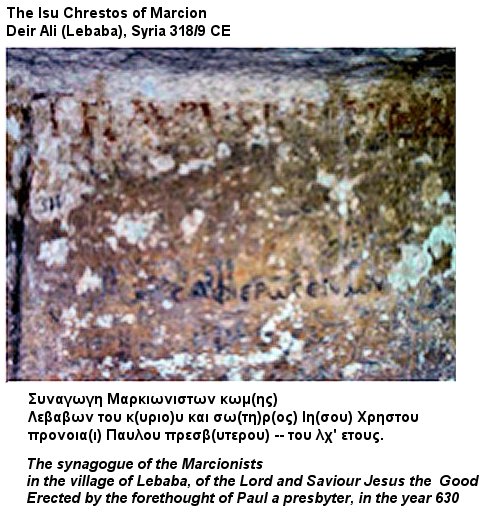
it is unclear what technical terminology was used by the sect to describe the godhead. We know for instance that the Marcionites identified Jesus as 'Chrestos' from the inscription at Deir Ali. Such physical evidence is very important. Yet the reports of the Church Fathers don't even so much as reference this terminology. The Dialogues of Adamantius for instance are preserved in Greek and the terms ὁ χρηστὸς θεός or even χρηστὸς are never used.
To this end, I think it something of a misrepresentation to argue that the Marcionite identification of Jesus as ὁ χρηστὸς θεός was in itself 'heretical.' As we have already seen from the writings of Philo that it was in fact quite typical of the Alexandrian Jewish worldview to understand that there were two divine powers - one of mercy (θεός) and the other of judgment - and where the former was often referenced as ὁ χρηστὸς θεός. Yes, to be certain Irenaeus criticizes Marcion for also divided the godhead after the Alexandrian fashion. Nevertheless, one must assume that the Jesus of the Alexandrian community as a whole was ὁ χρηστὸς θεός (= the kind God) up to the beginning of the third century. The Origen doesn't use this terminology isn't significant as Origen was something of a renegade.
What made the Marcionites heretical was the emphasis that the Father of the Good Son was τοῦ ἀγαθοῦ θεοῦ (= the Good God). This becomes perfectly clear from the writings of Clement of Alexandria. The other Church Fathers garble the actual formula - perhaps deliberately - or perhaps owing to their unfamiliarity with the true beliefs of the Marcionite community.
It wasn't then that the Marcionites believed that Jesus was 'kind' or even 'the kind power' of the godhead but rather the sectarian belief that the Israelites of previous generations had never known the Father, τοῦ ἀγαθοῦ θεοῦ. This is the crux of the controversy between Marcionites and the Catholics. Clement notes that the Marcionites put the distinction between the gospel and the Pentateuch in that Abraham saw Jesus (= theos, the merciful power) but did not know the Father whom Clement says the Marcionites calls τοῦ ἀγαθοῦ θεοῦ.
But were they to say that the visit of the Saviour was necessary, then the properties of nature are gone from them, the elect being saved by instruction, and purification, and the doing of good works. Abraham, accordingly, who through hearing believed the voice, which promised under the oak in Mamre, “I will give this land to thee, and to thy seed,” was either elect or not. But if he was not, how did he straightway believe, as it were naturally? And if he was elect, their hypothesis is done away with, inasmuch as even previous to the coming of the Lord an election was found, and that saved: “For it was reckoned to him for righteousness.” [Gen. xv. 6; Rom. iv. 3]. For if any one, following Marcion, should dare to say that the Creator saved the man that believed on him, even before the advent of the Lord, (the election being saved with their own proper salvation); the power of the good Being will be eclipsed; inasmuch as late only, and subsequent to the Creator spoken of by them in words of good omen, it made the attempt to save, and by instruction, and in imitation of him. But if, being such, the good Being save, according to them; neither is it his own that he saves, nor is it with the consent of him who formed the creation that he essays salvation, but by force or fraud. And how can he any more be good, acting thus, and being posterior? But if the locality is different, and the dwelling-place of the Omnipotent is remote from the dwelling-place of the good God; yet the will of him who saves, having been the first to begin, is not inferior to that of the good God.
δὲ ἀναγκαίαν τὴν ἐπιδημίαν τοῦ κυρίου φήσαιεν, οἴχεται αὐτοῖς τὰ τῆς φύσεως ἰδιώματα, μαθήσει καὶ καθάρσει καὶ τῇ τῶν ἔργων εὐποιίᾳ, ἀλλ' οὐ φύσει σῳζομένης τῆς ἐκλογῆς. ὁ γοῦν Ἀβραὰμ δι' ἀκοῆς πιστεύσας τῇ φωνῇ τῇ ὑπὸ τὴν δρῦν τὴν ἐν Μαμβρῇ ἐπαγγειλαμένῃ σοὶ δίδωμι τὴν γῆν ταύτην καὶ τῷ σπέρματί σου ἤτοι ἐκλεκτὸς ἦν ἢ οὔ; ἀλλ' εἰ μὲν οὐκ ἦν, πῶς εὐθέως ἐπίστευσεν οἷον φυσικῶς; εἰ δὲ ἦν ἐκλεκτός, λέλυται αὐτοῖς ἡ ὑπόθεσις, εὑρισκομένης καὶ πρὸ τῆς τοῦ κυρίου παρουσίας ἐκλογῆς καὶ δὴ καὶ σῳζομένης· ἐλογίσθη γὰρ αὐτῷ εἰς δικαιοσύνην. ἐὰν γάρ τις τολμήσας λέγῃ Μαρκίωνι ἑπόμενος τὸν δημιουργὸν σῴζειν τὸν εἰς αὐτὸν πιστεύσαντα καὶ πρὸ τῆς τοῦ κυρίου παρουσίας ἐκλογῆς καὶ δὴ καὶ σῳζομένης τὴν ἰδίαν αὐτοῦ σωτηρίαν, παρευδοκιμηθήσεται αὐτῷ ἡ τοῦ ἀγαθοῦ δύναμις, ὀψὲ καὶ μετὰ τὸν ὑπ' αὐτῶν εὐφημούμενον δημιουργὸν ἐπιβαλλομένη σῴζειν καὶ αὐτὴ ἤτοι μαθή σει ἢ καὶ μιμήσει τούτου. ἀλλὰ κἂν οὕτως ἔχων σῴζῃ κατ' αὐτοὺς ὁ ἀγαθός, οὔτε τοὺς ἰδίους οὔτε μετὰ τῆς γνώμης τοῦ πεποιηκότος τὴν κτίσιν ἐπιχειρεῖ τὴν σωτηρίαν, βίᾳ δὲ ἢ δόλῳ. καὶ πῶς ἔτι ἀγαθὸς ὁ οὕτως καὶ ὕστερος; εἰ δὲ ὁ τόπος διαφέρει καὶ ἡ μονὴ τοῦ παντοκράτορος λείπεται ἀπὸ τῆς τοῦ ἀγαθοῦ θεοῦ μονῆς, ἀλλ' ἡ τοῦ σῴζοντος βούλησις οὐκ ἀπολείπεται τοῦ ἀγαθοῦ ἥ γε προκατάρξασα [Strom 5.1]
Let me reiterate the significance of this discovery. We have already demonstrated that in Genesis 17 Clement identified Chrestos as visiting with Abraham and Clement says it was Jesus. Now Clement cites Genesis 12 and 15 (both θεός passages in his LXX, the original Greek translation of the Pentateuch). I think this is the great secret of the Marcionite community. The Alexandrian and Marcionite churches understood the Son (= Jesus Chrestos) to have visited humanity already once but only revealed the Father (= τοῦ ἀγαθοῦ θεοῦ) in the gospel narrative.
As noted I went through the whole of Adamantius's Dialogues and nowhere in the text does the term χρηστὸς let alone ὁ χρηστὸς θεός appear in the text. This couldn't have been what distinguished the Marcionites from 'orthodoxy' in this part of the world (whatever that was). The terminology τοῦ ἀγαθοῦ θεοῦ appears here a number of times as well as other anti-Marcionite texts. The Deir Ali inscription makes clear that Jesus was ὁ χρηστὸς θεός and τοῦ ἀγαθοῦ θεοῦ must have been a title of his Father. As such it is terribly significant that we see Megethius the Marcionite explains the concept of τοῦ ἀγαθοῦ θεοῦ in the Dialogues:
MEG: Although they were bad, the Good God rescued humankind from the Evil One, and then changed and made good those who had believed in Him.
AD. Since you claim that the Good God rescued and changed mankind into goodness, tell us, then, what it was the Good God came to save: soul and body, or only the soul? God?
MEG. Only the soul.
AD. Does the soul belong to the Good God, or to the Creator God?
MEG. The soul is a breath of the Creator God; so when He had created it, He saw that it was evil and disobedient, and cast it out. But the Evil One noticed the soul cast out, and brought it back to himself. However, the Good God had mercy and rescued the soul from the Evil One.
AD. After He had rescued the soul from the Evil One, did the Good God give it to the Creator God, or retain it himself?
Pretty, the English translator of the Dialogues notes in the footnotes to this reference that "in this passage, and in two others (p. 80, "The Good God saves those who believe in Him"; and p. 104, "The Good God is the Father of those who believe"), the ideas of Megethius and Marcus on saving raith are brought to view." I think there can be no doubt that 'the Good God' (= τοῦ ἀγαθοῦ θεοῦ) is the Father and Jesus ὁ χρηστὸς θεός. The term τοῦ ἀγαθοῦ θεοῦ also shows up as a Manichaean terminology too.
Wednesday, January 4, 2012
The Implications of Jesus as Chrestos
Wow, what a day. My dog is literally biting its own tail and I have been crazy busy with work. Nevertheless I always have time to dream. I know it sounds corny but in those brief moments that I think about early Christianity I float over an ancient landscape and am allowed a brief escape from the banality of existence. Today's realization is so obvious I can't believe that no one has thought about it before - if Clement of Alexandria developed his understanding of the godhead from Philo, why don't more people recognize the obvious implications of 'Chrestos' on the two advent theory of Christ?
I did a Google search to see if there was a quick Wikipedia article to reference the concept of the early 'two advent' theory of Christ but was amazed to see there was nothing. Perhaps this is why so few people think about the implications of Jesus as 'Chrestos' in this conceptual framework.
Let's make matters as explicit as possible. Jesus did not fulfill the expectations of the coming of the messiah. It is commonly recognized that the apologists answered that the messiah was to come twice, first in weakness and then, a second time, in power (see Tert., lud 14; Justin, Dial 49.2). These first two references come from Justin but Clement, Origen and other Alexandrian sources make reference to this same doctrine. The implication seems to be that the tradition developed in Alexandria (on Justin's relationship with Alexandria see my previous posts).
As obvious as this may seem, no one to my knowledge has ever connected the 'two advent' theory with the Philo's understanding of two powers in heaven. In other words, Jesus as Chrestos is the power of mercy or 'theos' (= God) and the second coming of the messiah will be 'in power' because it is the manifestation of judgment or 'kurios' (= Lord). As I already said this seems quite obvious. There are some inklings of at least part of this doctrine in the Samaritan doctrine of the Day of Vengeance and Recompense.
Yet the twist that I see Christians giving to this traditional Samaritan concept - and this may explain Marcionitism proper - is that while the first coming of 'mercy' is that of a divine visitation, there are signs that the Marcionites envisioned the manifestation of the messiah proper was through the agency of a wholly human figure. In other words, when we keep hearing that the Marcionites emphasized that Jesus is not the messiah of the Jewish expectation this was strictly speaking quite true. Indeed this concept is already witnessed in Samaritan sources too.
This point was made by the well-known fourteenth century Samaritan author, Abisha b. Pinhas, in his hymn Shira Yetima, for the Day of Atonement where it is said of the Taheb (the Samaritan 'messiah') "he shall execute a righteous judgement" (TA 68, p.128). While the concept dominates the Samaritan liturgy associated with the Day of Atonement it is important to note that the concept is not found in Marqe. My guess is that it was removed. Nevertheless the possibility that this might have been the original Marcionite understanding is most significant.
More on that later ...
I did a Google search to see if there was a quick Wikipedia article to reference the concept of the early 'two advent' theory of Christ but was amazed to see there was nothing. Perhaps this is why so few people think about the implications of Jesus as 'Chrestos' in this conceptual framework.
Let's make matters as explicit as possible. Jesus did not fulfill the expectations of the coming of the messiah. It is commonly recognized that the apologists answered that the messiah was to come twice, first in weakness and then, a second time, in power (see Tert., lud 14; Justin, Dial 49.2). These first two references come from Justin but Clement, Origen and other Alexandrian sources make reference to this same doctrine. The implication seems to be that the tradition developed in Alexandria (on Justin's relationship with Alexandria see my previous posts).
As obvious as this may seem, no one to my knowledge has ever connected the 'two advent' theory with the Philo's understanding of two powers in heaven. In other words, Jesus as Chrestos is the power of mercy or 'theos' (= God) and the second coming of the messiah will be 'in power' because it is the manifestation of judgment or 'kurios' (= Lord). As I already said this seems quite obvious. There are some inklings of at least part of this doctrine in the Samaritan doctrine of the Day of Vengeance and Recompense.
Yet the twist that I see Christians giving to this traditional Samaritan concept - and this may explain Marcionitism proper - is that while the first coming of 'mercy' is that of a divine visitation, there are signs that the Marcionites envisioned the manifestation of the messiah proper was through the agency of a wholly human figure. In other words, when we keep hearing that the Marcionites emphasized that Jesus is not the messiah of the Jewish expectation this was strictly speaking quite true. Indeed this concept is already witnessed in Samaritan sources too.
This point was made by the well-known fourteenth century Samaritan author, Abisha b. Pinhas, in his hymn Shira Yetima, for the Day of Atonement where it is said of the Taheb (the Samaritan 'messiah') "he shall execute a righteous judgement" (TA 68, p.128). While the concept dominates the Samaritan liturgy associated with the Day of Atonement it is important to note that the concept is not found in Marqe. My guess is that it was removed. Nevertheless the possibility that this might have been the original Marcionite understanding is most significant.
More on that later ...
Tuesday, January 3, 2012
Me and Marcion - Our Lifelong Journey Together

As many of my regular readers know, I have been thinking about the problem of the origins of Christianity for quite some time - I even published a stupid book on the subject. My interest in Christianity began with some chance encounter with the person of Marcion. I don't know how it happened. I was still attending university and had always had an interest in the pagan religions of antiquity. I think many people have a fancy for history but Jewish people quite especially because it makes them fell immortal and indomitable somehow. You know, we take a licking and keep on ticking or something like that.
In any event, I had to make sense of Christianity. I had lived alongside Christians for most of my life. Who was this 'Jesus Christ' that they venerated so? He was Jewish, right? Well, how did a Jew garner so much love and devotion from 'white people'? More importantly, I think my real interest began with the death of the pagan religions and Dionysus especially, the patron of the dramatic arts.
Why did 'white people' abandon what appeared at first glance to be a far more interesting religion or series of cults for this morbid Jewish sectarian association? I must confess, I had many theories for the origins of Christianity along the way. Yet I think my first 'theory' as it were was that Jesus was a development of the cult of Dionysus. It all seems to silly when I look back. I think I even gave a presentation on this Jesus as a Development of the Greek Natural Religion in a graduate course on Hegel that I happened to be taking. I remember the look of scorn on the part of the 'serious students' who were taking the class.
The point here is that somewhere along the line (I think I took a right turn at Origen's Against Celsus and never looked back) I became fixated with the subject of Marcion and Marcionitism. I was already corresponding with Daniel Mahar and Robert Price while I was still attending Glendon College of York University in Toronto. I kept writing these 'books' which I sent to anyone and everyone who might allow me to get my ideas published.
I did everything so completely 'assed-backwards.' I never thought about being a 'writer' and just writing on various topics. I had this obsession with 'knowing the truth' and figuring that if I 'figured it all out' then everyone would simply realize I was right and I would become famous.
I sometimes wonder if I suffered brain damage somewhere along the line in my youth.
The bottom line is that by the time I actually published the Real Messiah I started to put together what I still consider to be a workable model for the origins of Christianity. I don't know what will happen to this theory. I think I started spending time writing this blog with the understanding that I would not change the world or in the very least I would fail to become famous in my own right. Nevertheless I thought and still think that I am on to something, something that someone else or a succession of other people could flesh out sometime after I either pass away or give up trying to change the world.
My basic theory is that the Marcionites were right. Jesus was a God rather than a man and he was originally understood to have originally come down from heaven to the temple of Jerusalem (= beth saida) and was mistaken for the messiah rather than his divine herald and ultimately condemned by crucifixion. This is the core story as it were to the Christian experience. The difficulty was flushing out the other details and develop it into some kind of narrative that could be sold as a book.
I avoided the subject of Marcion completely in my Real Messiah. The reason was quite simple really. I hadn't figured out how to make all the pieces fit. Some might argue that I should have done my research in a university. Yet I can honestly tell you that I don't believe I would be standing here with my particular theory if I had to publish papers in a particular field of study. I have come to believe that Marcionitism can be likened to a minority population in Texas whose constituency or body is divided up by the deliberate redistricting efforts of election officials.
According to my way of thinking the categories we have been trained to use were deliberately imposed on the world by the Imperial authorities in the late second century. 'Christianity' is an artificial category. It implies something which is ultimately 'Gentile' rather than Jewish, an association which has a human founder named Christ (hence the Latin -ianus in the name) which believed in one God rather than many, and most importantly a tradition which interpreted the scriptures by means of a revealed 'faith' rather than the Greek philosophical exegesis of Justus of Tiberias and Philo of Alexandria.
I know it may sound like something which borders on a 'conspiracy theory' but the evidence in Judaism and Samaritanism already supports the idea of just such a re-engineering. The difficulty is that scholars of Christianity have very little idea how the Imperial authorities abused and coddled the various Palestinian sects in order to reshape them as strict monotheists. This did not simply happen 'naturally.' There was a pronounced interest in 'streamlining' the various religious faiths of the Empire in the third century. It all seems to culminate in Aurelian's solar cult but the roots of this trend go back to the time of Commodus.
In my mind, Marcionitism was a relic from the Alexandrian origins of Christianity. I don't exactly know how this Alexandrian cult became identified as being associated with a figure named 'Marcion' nevertheless it is patently obvious that it has something to do with Marcion being a form of the name Mark and St Mark being the patron saint of Alexandrian.
Almost every Patristic writer makes reference to Marcion as a Platonist. Yet because scholars can't get around the repeated statement in the Church Fathers that Marcion 'hated Judaism and the god of the Jews' these academics can't make the ultimate connection that Marcionitism was a development of Alexandrian Judaism. I don't know why this is but I am sure it has something to do with the fact that Christian scholars have very little working knowledge of what Judaism is and what forms Jewish worship can take.
Marcus Julius Agrippa was such an interesting historical figure to me because of course he is the historical Marcion. All scholars need to do is read the actual reports which survive in the rabbinic writings and they will see this as clear as day. He was a Jew who embraced the idea of another god besides what became known as 'the Jewish god.'
Yet even this paradigm is developed from something of a false premise. For the assumption here is that 'Judaism' is based on the notion of strict monotheism. Of course anyone who has ever read the writings of Philo knows full well that this Alexandrian Jew takes the two divine names of the Pentateuch to refer to two different divine powers. How then can the rabbinic tradition assert that Marcus Julius Agrippa introduced another God besides the true God of Israel? It is because the later rabbis of the third and fourth centuries had learned to define themselves against this interpretation. Yet it is unmistakable that Marcus Julius Agrippa's religious reforms of the first century had an effect on Judaism of the later period. Jews were still identifying the last king of Israel as the messiah into the twentieth century.
The important thing for us to see (and it is something that I realized early in my studies) is that we will never get a direct sighting of 'Marcion' in any source outside of the Patristic literature because he is ultimately a fictitious literary figure after the manner of 'Ebion,' 'Elxai' and the rest of the boogeymen of the heresiological genre. Christianity is now filled with these ghosts. 'St. Mark' is another such ghost. The real historical figure behind all these empty masks is Marcus Julius Agrippa, the Platonizing philosopher king of Israel.
The clearest way to see this phenomenon is to look at the name the Marcionites gave to Jesus - 'Chrestos' and then notice that the Alexandrian tradition starting with Philo and going down to Clement of Alexandria makes the very same connection. Philo for instance identifies 'El Shaddai' as the 'Good God' and Clement who was very aware of Philo's interpretation further identifies this figure as his Instructor (= Jesus). I think the Marcionite understanding of Jesus Chrestos was identical with this tradition.
Monday, January 2, 2012
Breakthrough! The Marcionite Interest in Chrestos as a Divine Title May Be Derived From Alexandrian Judaism
One of the best investments I ever made was buying Brill's the Philo Index - the complete word index for Philo of Alexandria - on sale at Half Price Books for $9.99. I think the choice must have been this book or a Big Mac combo and I certainly made the right choice. For today while I had a few minutes away from my family I decided to look up the entry for χρηστὸς on the suspicion that I might find some context for the Marcionite use of the term to describe Jesus. Boy, was I right!
But before I do this, let me explain to my readers what we have been doing here in the last few days. The term Christianoi (= 'Christian') is secondary. This isn't how a Greek speaker would identify 'the followers of Jesus.' It is derived from Latin and who in their right mind could possibly believe that the earliest Christians spoke Latin?
To this end we have to start looking at the possibility that Marcionite primacy might well be proved by their interest in identifying Jesus as the χρηστὸς (= the good one) and Clement of Alexandria's identification of his followers as . All that scholars have to do is get rid of that heavily biased notion that Jesus was a man. The Marcionites identified him as a divine being, even God with absolutely no real humanity. As such χρηστὸς was certainly a divine epithet. How interesting then that Clement, Origen and possibly Marcion borrowed this terminology from Philo and the Jewish community of Alexandria.
Let's go through some of the clearest signs that the Jews of Alexandria referred to one of the 'divine powers' of their godhead as ὁ χρηστὸς θεός (= the Good God). Speaking of wicked Esau's wish:
that that species in the nature of things which is void of passions, namely, Isaac (to whom the oracle had been given, that he should not descend into Egypt), may be the victim of an irrational affection, in order I suppose that he may be wounded by the stings of pleasure or pain, or of any other passion, showing that the man who is not wholly perfect and who makes laborious improvements, will receive not merely a wound, but utter destruction. However, the good God [ὁ ... χρηστὸς θεὸς] will neither allow that invulnerable species among created things to be subdued by passion, nor will he surrender the practice of virtue to bloody and raging destruction. On which account we read in a subsequent passage, "Cain rose up against Abel, his brother, and slew Him." For according to the first imagination, he suggests the idea that Abel has been killed. But if you look at it according to the most accurate investigation, you will see that the intimates that Cain himself was slain by himself, so that we ought to read it thus: "Cain rose up and killed himself," and not the other. And very reasonably may we attribute this to him. For the soul, which destroys out of itself the virtue-loving and God-loving principle, has died as to the life of virtue, so that Abel (which appears a most paradoxical assertion) both is dead and alive. He is dead, indeed, having been slain by the foolish mind, but he lives according to the happy life which is in God. And the holy oracle which has been given will bear witness, which expressly says, that he cried out loudly, and betrayed clearly by his cries what he had suffered from the concrete evil, that is from the body. For how could one who no longer existed have conversed? [Quod deterius potiori insidiari 1:46 - 49]
These ideas have clearly influenced Clement of Alexandria's exegesis of the gospel. But let's leave this topic to continue to demonstrate Philo's interest in the figure of the 'the Good God.'
The next explicit reference appears in On the Change of Names where Philo interprets the original LXX version of Genesis 17 (where 'El Shaddai' is said to have conversed with a ninety nine year old Abram, changed his name and promised him that his old wife will soon bear Isaac):
Since the, the virtuous man has been bred up among and practised in these and similar divisions and discriminations of things, does he not rightly appear to pray that Ishmael may live, if he is not as yet able to become the father of Isaac? What then does the Good God say [τί οὖν ὁ χρηστὸς θεός]? To him who asks for one thing he gives two, and on him who prays for what is less he bestows what is greater; for, says the historian, he said unto Abraham, "Yea, behold, Sarrah thy wife shall bring forth a Son." Very felicitous and significant is this answer, "Yea;" for what can be more suitable to and more like the character of God, than to promise good things and to ratify that promise with all speed! But what God promises every foolish man repudiates; therefore the sacred scriptures represent Leah as hated, and on this account it is that she received that name; for Leah, being interpreted, means "repudiating and labouring," because we all turn away from virtue and think it a laborious thing, by reason of its very often imposing commands on us which are not pleasant. But nevertheless, she is thought worthy of such an honourable reception from the prince, that her womb is opened by him, so as to receive the seed of divine generation, in order to cause the production of honourable pursuits and actions. Learn therefore, O soul, that Sarrah, that is, virtue, will bring forth to thee a son; and that Hagar, or intermediate instruction, is not the only one who will do so; for her offspring is one which has its knowledge from teaching, but the offspring of the other is entirely self-taught. And do not wonder, if God, who brings forth all good things, has also brought forth this race, which, though rare upon the earth, is very numerous in heaven. [De Mutione Nomimum 1.253]
Is El Shaddai the 'Good God' (ὁ χρηστὸς θεός) of the Marcionite system? This can't be said with any certainty yet. However it is interesting to note that while our Hebrew text reads:
When Abram was ninety-nine years old, the Lord appeared to him and said, “I am God Almighty; walk before me faithfully and be blameless. Then I will make my covenant between me and you and will greatly increase your numbers.” [ibid]
Philo's LXX abandoned the reference to El Shaddai and read instead:
Abraham was ninety and nine years old; and the Lord appeared unto Abraham, and said unto him, I am thy God.Now Philo goes on to explain than ninety nine was one removed from the perfect number one hundred and it is impossible not to see that the Jewish author is the source of the Clementine and Marcosian interest in a similar interest in the earliest gospels. Yet let's stay focused for a moment on how clearly Philo identifies the 'Good God' (ὁ χρηστὸς θεός) as El Shaddai and moreover this being as the angel which gives Jacob the name Israel. For we read a few sentences later Philo elaborate on this figure 'the living God':
Do not, however, think that the living God, he who is truly living, is ever seen so as to be comprehended by any human being; for we have no power in ourselves to see any thing, by which we may be able to conceive any adequate notion of him; we have no external sense suited to that purpose (for he is not an object which can be discerned by the outward sense), nor any strength adequate to it: therefore, Moses, the spectator of the invisible nature, the man who really saw God (for the sacred scriptures say that he entered "into the Darkness," by which expression they mean figuratively to intimate the invisible essence), having investigated every part of every thing, sought to see clearly the much-desired and only God [ibid]
Philo consistently gives the implausible explanation of the name Israel as 'a man seeing God' so clearly he has it in his head that the 'Good God' (ὁ χρηστὸς θεός) is somehow the merciful aspect of the godhead who granted divinity to the human race. I think we are on the doorstep of connecting El Shaddai to the being who wrestled with Jacob and gave him the name Israel it would be easy to connect that being back to Chrestos (as yashar = χρηστὸς in LXX Proverbs 2:21).
Now how do we get from here to the Marcionite Chrestos? Let's not forget that without getting into too much detail Irenaeus certainly witnesses that the Marcionites divided the godhead into mercy and justice and posited a second or 'other' (= Syriac nukraya) god beside the familiar god of justice:
He is the Former, He the Builder, He the Discoverer, He the Creator, He the Lord of all; and there is no one besides Him, or above Him, neither has He any mother, as they falsely ascribe to Him; nor is there a second God, as Marcion has imagined [Irenaeus AH 2.30.9]
And, indeed, the followers of Marcion do directly blaspheme the Creator, alleging him to be the creator of evils, [but] holding a more tolerable theory as to his origin, [and] maintaining that there are two beings, gods by nature, differing from each other,--the one being good, but the other evil. [ibid 3.12.12]
Again, that they might remove the rebuking and judicial power from the Father, reckoning that as unworthy of God, and thinking that they had found out a God both without anger and [merely] good, they have alleged that one [God] judges, but that another saves, unconsciously taking away the intelligence and justice of both deities. For if the judicial one is not also good, to bestow favours upon the deserving, and to direct reproofs against those requiring them, he will appear neither a just nor a wise judge. On the other hand, the good God, if he is merely good, and not one who tests those upon whom he shall send his goodness, will be out of the range of justice and goodness; and his goodness will seem imperfect, as not saving all; [for it should do so,] if it be not accompanied with judgment. Marcion, therefore, himself, by dividing God into two, maintaining one to be good and the other judicial, does in fact, on both sides, put an end to deity. For he that is the judicial one, if he be not good, is not God, because he from whom goodness is absent is no God at all; and again, he who is good, if he has no judicial power, suffers the same [loss] as the former, by being deprived of his character of deity. And how can they call the Father of all wise, if they do not assign to Him a judicial faculty? For if He is wise, He is also one who tests [others]; but the judicial power belongs to him who tests, and justice follows the judicial faculty, that it may reach a just conclusion; justice calls forth judgment, and judgment, when it is executed with justice, will pass on to wisdom. Therefore the Father will excel in wisdom all human and angelic wisdom, because He is Lord, and Judge, and the Just One, and Ruler over all. For He is good, and merciful, and patient, and saves whom He ought: nor does goodness desert Him in the exercise of justice, nor is His wisdom lessened; for He saves those whom He should save, and judges those worthy of judgment. Neither does He show Himself unmercifully just; for His goodness, no doubt, goes on before, and takes precedency.
The God, therefore, who does benevolently cause His sun to rise upon all, and sends rain upon the just and unjust, shall judge those who, enjoying His equally distributed kindness, have led lives not corresponding to the dignity of His bounty; but who have spent their days in wantonness and luxury, in opposition to His benevolence, and have, moreover, even blasphemed Him who has conferred so great benefits upon them.
Plato is proved to be more religious than these men, for he allowed that the same God was both just and good, having power over all things, and Himself executing judgment, expressing himself thus, "And God indeed, as He is also the ancient Word, possessing the beginning, the end, and the mean of all existing things, does everything rightly, moving round about them according to their nature; but retributive justice always follows Him against those who depart from the divine law." Then, again, he points out that the Maker and Framer of the universe is good. "And to the good," he says, "no envy ever springs up with regard to anything;"(6) thus establishing the goodness of God, as the beginning and the cause of the creation of the world, but not ignorance, nor an erring Aeon, nor the consequence of a defect, nor the Mother weeping and lamenting, nor another God or Father. [ibid 4.24.1 - 5]
I think we are standing on a very significant threshold. One can argue that Philo was influenced by Plato when he divided the godhead. Yet the same thing is said over and over about Marcion by the Church Fathers. Even the later Patristic writers who mention a tripartate Marcionite godhead are witnessing the same system because the third hypostasis is Satan.
I think the notion that Marcionitism was a dualistic system involving juxtaposing the 'good' Christian god against the evil Jewish god is a deliberate oversimplification on the part of some of the Fathers. The Jewish system itself made this division albeit not between a 'good' and 'evil' godhead but a 'mercy' and 'just' one. My guess is that Jesus 'the Good God' (ὁ χρηστὸς θεός) is the clearest proof yet that Marcionitism is a preservation of Alexandrian Judaism. In other words, that Marcion is once again merely a hidden reference to St Mark.
There are over seventy references to this 'Good God' in Philo. Here is are two more before I go to sleep:
God is merciful, and compassionate and kind (χρηστὸς ὢν καὶ φιλάνθρωπος ὁ θεός) [De Abrahamo 1:203]
inasmuch as the Father is kind and merciful, and most humane, still he is rather inclined to alleviate the evil than to add to men's misery (χρηστός ὢν καὶ φιλάνθρωπος ὁ θεὸς ἐπικουφίζει τὰ κακὰ μᾶλλον ἢ προστίθησι ταῖς συμφοραῖς) [Quaestiones in Genesim fragment. 2:54]
Sunday, January 1, 2012
Did the Gospel of Mark Really Put Forward that Jesus was the Christ?

Have you ever been in the situation where you are in a room and a group women are looking at you whispering? If you are a vain person you immediately think their secret is that one of them 'is into you.' If you are insecure you are sure they are making fun of you. The point is that you don't know until you confront them and even then the answer won't be immediately apparent to you. It is a secret after all and things kept hidden don't rush out into the light without some probing.
The same thing is true with the earliest gospel - the one that is now labeled 'according to Mark.' Almost everyone agrees there is a 'gospel secret' here. The text is so short very little of its literary purpose is revealed to us. We get a basic idea that Jesus appeared in a certain year at the beginning of the Common Era, began healing and preaching before being mistaken for a number of contemporary figures and ultimately crucified.
The assumption among Christians for centuries has been that Mark 'must' have believed that Jesus was the Christ. This is why the four canonical gospels were bundled together - i.e. the four evangelists, living in four different parts of the world, put forward four very similar testimonies about the resurrected Jesus as they were inspired by one and the same Holy Spirit.
Yet the Gospel of Mark is clearly in some form the ancestor of the other two synoptic gospels (i.e. Matthew and Luke). Matthew and Luke develop what was original laid out in Mark according to more explicit literary purposes. There is no question that Jesus is the Christ of these two evangelists and also John. But Mark? Well that's another story and I think story is key to making sense of the development of the Catholic New Testament.
I can't find a single reference in the narrative of the gospel of Mark which confirms that Χριστός was understood by the author to be the proper title of Jesus. Remember the Marcionites and Catholics were split on the question of whether Jesus was the Χριστός (= the Anointed One) or the Χρηστος (= the Good One). Irenaeus directs us to Luke as a guide to understand the Marcionite position saying that Marcion 'cut' things out of Luke's gospel. Yet other sources tell us that Marcion expanded or added things to the canonical gospel of Mark. I favor the latter position because of its agreement with what is said by Clement in the Letter to Theodore. Yet we have to consider the fact that the Gospel of Mark as it stands now in no way contradicts two core Marcionite principles - (a) that Jesus wasn't human and (b) that Jesus wasn't the Christ.
It is amazing to me that scholars haven't noticed what Vinzent has recently posted on his blog - namely that there were two editions of the Marcionite gospel. Tertullian's clear testimony that the Marcionites had an expanded text not only agrees again with Clement's reference to the longer 'secret' Mark in the Alexandrian community but moreover the basic idea that an original text of the gospel acted as a 'building block' for the various longer gospels used by a number of sectarian communities.
In other words, just as one community or person expanded a text resembling our canonical Mark to develop our canonical 'according to Matthew' Marcion is reported in pseudo-Hippolytus's Philosophumena to have expanded a gospel of Mark to develop his own mystical text infused allegedly with the philosophical doctrines of Empedocles.
I am not asking my readership to accept unquestioned what any Patristic source says on the matter of the relations between the gospels. The point is that there is a growing nexus of material which suggests that canonical Mark appeared to be a 'building block' or 'stepping stone' to a variety of expanded texts. Matthew and Luke developed Mark's silence on the question of Jesus's nature to declare that he was born from a virgin, a descendant of David and Christ the awaited messiah of the Jews. The Marcionite gospel according to pseudo-Hippolytus at least expanded canonical Mark to make manifest that Jesus was a divine being who descended from heaven to Jerusalem in order to manifest in some form that he was Chrestos the spokesman of a God unknown to the Jews.
This state of affairs is very useful for those arguing for the authenticity of the Letter to Theodore because this paradigm isn't even recognized today let alone at the time Morton Smith discovered the text in 1958 (i.e. that both orthodox and heretical texts were acknowledged in antiquity to be developments of the Gospel of Mark). Indeed I think we can go one step further. The Catholic tradition generally avoided the idea of Markan primacy because it undermined the authority of their tradition. This is also why undoubtedly there are no Commentaries on the Gospel of Mark from antiquity. The idea that a generic text which went out of its way to avoid acknowledging or supporting core claims of the Catholic tradition was the ancestor of the other canonical texts opens the door to the idea that heretical texts and the claims associated with them pre-dated orthodoxy.
In other words, Jesus was God on a 'visit' to humanity before the end times - a well established 'Jewish belief' of the Qumran community and not just some 'invention' of a bunch of sectarians from the 'true Church.' The Catholic tradition tries to attach itself to Judaism by means of Jesus 'the Christ.' But this argument was only added to Mark. It appears secondary in the same way - the Catholics argued - Marcion 'added' his mystical mumbo jumbo to the same short text of Mark. Clement however breaks the deadlock and says that it was Mark himself who added the mystical narratives.
Is Marcion a form of the name Mark? Most certainly. Could the claims about Marcion have developed out of a misunderstanding or an attempt to mask the existence of an expanded text of Mark which contradicted the core principles of the Christian tradition? Of course. Could Irenaeus have developed the claims about Luke (which is an expanded gospel narrative from Mark) in order to throw contemporaries off the trail of Marcion as Mark? Let's put it this way. What is the evidence for the existence of a Gospel of Luke before Irenaeus? Yes Acts certainly was known to Church Fathers before Irenaeus. But the claim that Luke was the author of Acts is put forward first by Irenaeus and interestingly he uses it as a key defense of his claim that Luke is the gospel of Paul (i.e. other than the expanded Marcionite text identified in the Philosophumena as effectively mystic Mark).