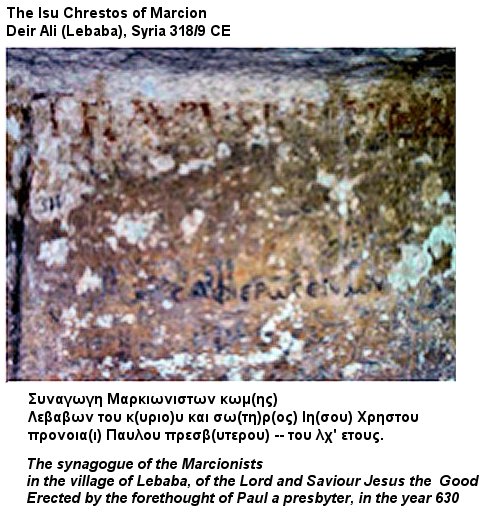
Here's a reference to Marcion I bet most of you didn't even know existed. It appears in the Kebra Negast, the most important work in the Ethiopian Orthodox Church after the Bible. The text appears almost at the end of the work. The reference comes from Budge's translation (1932):
the king of Rome … shall transgress and provoke God to wrath in the faith. The faith which we have ordered and laid down shall a king transgress who shall come in Rome, and there shall be associated with him a certain archbishop, and they shall change and pervert the word of the Twelve Apostles, and they shall cast it aside in the desire of their hearts and they shall teach what they wish … and when they have destroyed the faith the vanquisher and the enemy from the king who shall not guard the faith … shall make war upon him and defeat him, and it seems to me that his name is Marcion the Apostate. And the king … whose name is Irenaeus (Harênêwôs) shall conquer him, and the king shall carry him away, together with his horse, and by the will of God the horse on which the vanquisher of the enemy shall be stirred up and shall go into the sea and perish therein. But the nails shall shine there in the sea until Christ shall come again in great glory upon a cloud in heaven, together with power.
It is worth noting that both Amharic and Ethiopic have convoluted word order and subordination of phrases and clauses, quite unlike other Semitic languages but not the same as in Indo-European languages either.
I suspect that Wallis Budge was being careful when he did this translation. The compiler of the Kebra Nagast has copied a text which itself is a long quotation with annotations by a high church official or secular ruler. These annotations have been put in italics in my interpretation below. Wallis Budge did not see this. The text quoted by the ruler or prelate was in the form of a prediction. The prelate used it for his own purposes. But I think the prediction itself to be a prophecy made up by the ruler or official himself and attributed to some ancient sage. Here is my editing. Please put this on your blog.
The king of Rome …. will transgress, provoking God to wrath, in [matters of] the faith. [[ANNOTATION. The faith which we have ordered and laid down]]. (A big giveaway here of the secondariness and falseness of the doctrine being promoted!). A king will transgress, a future king in Rome, and there will be associated with him a certain archbishop (A very important reminiscence of the founder of Christianity being both a secular king and a religious leader), and they will change and pervert the word of the Twelve Apostles and cast it aside according to personal whim and teach whatever they like. (Meaning many will still reject the newly invented doctrine of Irenaeus and preserve the original). When they have destroyed the faith, [[ANNOTATION. The king that does not keep to the faith]], the vanquisher, the enemy [[ANNOTATION. Of the king that does not keep the faith]], will make war on him and defeat him [[ANNOTATION. It seems to me that the latter (the one defeated) is Markion the apostate. The king’s name (the name of the king that defeats him) is Irenaeus]]. The king will conquer him, and carry him away on his horse. By the will of God the horse [[ANNOTATION. On which is the vanquisher of the enemy]] will take fright and run into the sea and perish therein. (This explains why there is no record of any Roman emperor called Irenaeus). But the nails (the horse-shoe nails, all that is left of horse and rider, because inanimate) will shine there in the sea till Christ comes again in great glory on a cloud in the heavens, together with power. (Thus proving Irenaeus and his secular imperial patron right, even though the followers of the original doctrine, called Marcionites, have in fact not gone away).
There have been various attempts to explain away the reference as somehow having something to do with events during the reign of the Emperor Marcian (392 – 457) but this doesn't make sense. Those who put forward this thesis can never properly identify the figure of Harenewos as a contemporary of the Eastern Roman Emperor.
Showing posts sorted by relevance for query kebra. Sort by date Show all posts
Showing posts sorted by relevance for query kebra. Sort by date Show all posts
Sunday, October 24, 2010
Tuesday, June 5, 2012
Chapter Five of My New Book
How do we explain the sudden transformation of Christianity at the beginning of the third century? Most people ignore the question, as they simply assume that the doctrines of the Church have never changed. Yet outside of the large portion of believers in the world, there is a tendency among some skeptics to posit conspiracy theories to explain this enigma. In some form or another we are told 'the Imperial government took control of the Church and made changes.' There are numerous theories of this sort that have been floated over the years. The truth is that we know so very little about the period in question. Almost anything is possible. Yet there is stigma associated with being labeled a 'conspiracy theorist.' So we should ask, what are the alternatives?
There are some fundamental difficulties with the idea that the Roman government forced Christianity to change. Why for instance, should the government have cared whether Christians worshiped two gods or one? What would Caesar have a problem with a religion centered on the uniting of men? Yes to be certain pagans were making ridiculing Christians for being sexual deviants. We know that from the literature that has survived from antiquity. Nevertheless why would this in itself lead to a massive infiltration of the Church and force the adoption of 'family values'? It just doesn't seem to make very much sense.
It can't be denied of course, that there are reports of persecutions against Christians throughout the second and third centuries, the most noteworthy early examples being those which happened during the reign of Commodus.[1] Nevertheless it has to be acknowledged that the random of killing Christians is one thing; finding evidence for a systematically reorganizing of tradition is something else entirely. The pagan writer Celsus and the Church Father Irenaeus both reference 'unauthorized meetings' of Christians, where participation in such service is acknowledged to be dangerous to one's health.[2] There are reports which take matters one step further and suggest an organized conspiracy on the part of the persecutors. The eleventh century Establishment of Proofs for the Prophethood of Our Master Mohammed by ‘Abd al Jabbar is one such text. Shlomo Pines of Hebrew University has suggested the material goes back to a lost original Jewish-Christian document from the fourth or fifth century.[3]
According to the information which has come down to us an Emperor (we never know his name, nor exactly what age he is alleged to have lived) facilitated the taking over the Church with the assistance of traitors from within. As Al Jabbar preserves it:
The text goes on to describe how the Roman government helped transform the single gospel into a fourfold text through ruthless persecutions. The false Christians made a deal with the authorities, they agreed to give up the original observances of the religion and those who resisted were ultimately slaughtered or fled to the safety of inaccessible regions of the world.[5]
Indeed at the fringes of the Christian universe we find scattered reports of a similar nature which could be used to support the notion of a third century conspiracy. We find documents from the Ethiopian Orthodox Church such as their oldest and dearest native text, the Kebra Negast, where a garbled reference to familiar characters from the period involved in an Imperial plot. We are told that:
As such one could at least theoretically piece together a number of obscure texts to make the case that familiar Christian figures were involved in a conspiracy to transform the religion. Yet as fascinating as it is to raise questions about how the Church was 'renewed' (= Lat. novatus) in the third century, we must strive to find an alternative to this approach.
There is no way to prove that the Imperial government was ever involved in manipulating the Christian faith. Indeed since these reports have been preserved in cultures so far removed from Rome or the Roman Empire for that matter, how much value do they really have? There must have been any number of marginalized sectarian traditions who were eager to attribute their disenfranchisement to an uneven playing field in the distant past. Of course we shouldn't ignore the 'game was rigged' argument. Nevertheless it would be preferable to find some other explanation.
So what is the alternative to claiming the Roman government was directly involved in transforming Christianity? Is it worse or better to suggest that a single influential and well connected woman was responsible for many of the most important changes? We have demonstrated that the fourfold gospel, the military style oaths and monarchical doctrines were relatively recent demonstrations. At least some of these things can at least be indirectly connected with Julia Domna, wife of the Emperor Septimius Severus. Indeed she was likely prompted by an entirely personal motivation, something as far removed from the concerns of the state as perhaps - a disinterested gay husband?
Perhaps that is too great an oversimplification. Let us begin by revisiting the fact that there were a great number of women - even ladies from the highest ranks of society - who took an interest in Christianity. This is especially true of the Roman Christianity for some reason. One need only think of the great heretic Marcellina during the reign of bishop Anicetus no less than her namesake Marcia the concubine of Commodus almost two generations later. Of those Christians who happened to be affluent a disproportionate number of them seem to have been women. Yet men and women sat in different parts of the church during services. Women were barred from any significant role within the Church. Indeed the central symbol of the Roman Church was still a man lovingly embracing another man, a sign in some way that this always was a closed male society.
There can be no doubt that women of means could wield great influence over the Church. There are so many stories in the early writings of the Church Fathers of women as victims of ecclesiastical impropriety (at least among the heresies). One can imagine that the exact opposite must also have been true. Marcia certainly must have leveraged her influence. She is reputed to have had multiple sex partners and husbands and yet she is consistently identified as a Christian or in some more cautious reporting a 'God-fearer.' Nevertheless it is difficult to believe the ecclesiastic authorities didn't turn a blind eye to her indiscretions. In fact one be surprised to discover that the Roman Church of the time wasn't involved in the debauchery of the Commodian age.
It seems to coincidental that out of the shadows of that period and for which we have little in the way of reliable information that two of the three Christians who Marcia had dealings with were named 'Hyacinthus,' her tutor, and 'Zephyrinus,' the deacon or 'second in command' during Victor's reign. Zephyrinus is a wholly unknown name and must in fact be a corruption of the well attested Zephyrus. In Greek mythology Hyacinthus was a beautiful boy and lover of the god Apollo, though he was also admired by West Wind, Zephyrus. Hyacinthus's beauty caused a feud between Zephyrus and Apollo. Jealous that Hyacinthus preferred the radiant archery god Apollo, Zephyrus blew Apollo's discus off course, so as to injure and kill Hyacinthus. When he died, Apollo didn't allow Hades to claim the boy; rather, he made a flower, the hyacinth, from his spilled blood. According to a local Spartan version of the myth, Hyacinth and his sister Polyboea were taken to heaven by Aphrodite, Athena and Artemis.
Of course Marcia's Hyacinthus was a eunuch - a fact which only heightens the homosexual parallels given that the castrated were often used by men for sexual pleasure. This was after all the court of the infamous Commodus. Marcia is said to have personally witnessed the Emperor's seemingly insatiable desire for young boys. What remains of that period must be thought to be little more than distorted adaptations of myths - like that of Hyacinthus and Zephyrus. One would imagine that Irenaeus may well have been disgusted by stories of Christians being so close to such vice. It seems highly probable that he would have been motivated to clean things up and certainly blamed the 'heresies' for generations of abuse.
We can never lose sight of the fact that Irenaeus's principal work was principally directed against a sectarian group called 'the Valentinians.' This Christian group has been demonstrated by the Peter Lampe, Professor of New Testament Studies at the University of Heidelberg, to have been firmly entrenched in Roman Christian culture landscape from a very early period. In his mind certainly the Valentinians were a symptom of the over all moral decay of the Imperial capitol.
It is alleged by Irenaeus originally that "Valentinus came to Rome under Hyginus (c 136 CE), flourished under Pius, and remained until Anicetus (160 CE)." Lampe points to the fact that only Irenaeus seems to take issue with the sect. Valentinian teachings never get condemned until the efforts of this man finally caught on in the latter part of Victor's reign (c. 193 CE). Until that time speculating about the heavenly syzygies and partaking in the so-called 'bridal chamber' rite, where individuals entered into 'spiritual marriage' with each other and still be considered a full member of the Roman Church.
This Valentinian interest in spiritual marriage and divine syzygies are certainly related. Clement of Alexandria reports that the heretical rite was done in imitation of the angels. It was certainly also seen in Rome at least as being connected with symbolism of the concordia apostolorum between Peter and Paul. One inscription from the period seems to connect the practice also to the union of Father and Son:
The twofold division of the Roman Church then was clearly fully in keeping with these mystical doctrines. So too we must imagine that typical Valentinians interest in dividing the Church into separate 'psychic' and 'spiritual' communities.
Lampe draws attention to the fact that Justin's two 'apologetic epistles' to the Roman government (c. 155 CE) seem to reflect this situation . The first Apology was directed at the Emperor Antoninus Pius and names only Simon, Menander, and Marcion as heretics (1.26). Lampe argues that Valentinus is not considered an enemy of the Church at this point. Furthermore the second Apology directed to the Roman senate makes reference to the teacher Ptolemaeus (2.2). If he is to identified with the Valentinian Ptolemaeus it is eye opening to hear Justin praise him as a lover of truth (2.2.10) and that he faithfully represented the doctrines of Christianity (2.9, 14) in the awareness of goodness.[8]
It is remarkable that this long established culture of tolerance should have been so completely shattered in the late second century by the arrival of Irenaeus from Lyons (c. 189 CE). As noted, Irenaeus directs his main work, Against Heresies, against members of the sect and perhaps more importantly manages to 'rescue' Polycarp's reputation as a Valentinian in the process.[9] There was after all an influential Valentinian in the Imperial court at that time named Florinus. Florinus was acknowledged to have spent more time with Polycarp. All that Irenaeus can muster is the argument that he was present at some of these discussions while he was a young lad. Irenaeus writes "while I was yet a boy, I saw thee in Lower Asia with Polycarp, distinguishing thyself in the royal court."
The point here is that even Irenaeus's 'authority' as a hearer of Polycarp, one of the most important claims for his authority is entirely suspect. In reality he seems to have come out of nowhere - or perhaps better yet, Lyons - and arrived on the scene in Rome with incredible power and influence. The story about being a defender of Polycarp's beliefs and practices is simply implausible. The real Polycarp of history was likely a carbon copy of his hated Valentinian opponent Florinus. So what was the basis of Irenaeus's authority? Perhaps the basis to Irenaeus's appeal to Polycarp was in fact that he himself was more like Florinus than he cared to admit.
Buried in the midst of our citation of Irenaeus were the words 'royal court.' Where was it exactly that he claimed to have seen Florinus and Polycarp speaking? The obvious answer is that all three men were attached to the family of the future Emperor Antoninus Pius which he was governor of Asia.[10] At the very least it indicates that they were on the periphery of the Imperial court.
Indeed we must now ask ourselves why Victor continued to allowed Florinus to hold an important office in the church. Lampe points us to the fact that Florinus extols his community with the "psychic" Christians of Rome (se unum esse e vobis: Irenaeus, Fragm. syr. 28, Harvey, 2:457). He flatters himself in the fact that he labors as a presbyter in union with Bishop Victor and was able to freely circulated his Valentinian writings (Irenaeus, Fragm. syr. 28). As Lampe notes we should pay attention to the fact that it was "an outsider, Irenaeus from Gaul, incited Victor to intervene against Florinus and to suppress his writings, which had circulated as far as Gaul (Irenaeus, Fragm. syr. 28, Harvey, 2:457). Victor 'obeyed': Florinus had to lay down his priestly office; the separation was made (Eusebius, Ecc. Hist. 5.15)."
Lampe assumes that Irenaeus was working on Victor for quite sometime before having a change of heart. It would seem that Irenaeus insinuates that Victor had not read Florinus's Valentinian writings until then or at least silently tolerated by him because, there outside the city, it "harmed" hardly anything. Florinus seemed to be associated with an esoteric house community on the Via Latina outside the city. Whether ignorance or silent tolerance, Victor continued to consider Florinus as a brother until Irenaeus came between them.
What caused the change of heart? Lampe also points to another motive for Victor's 'tolerance' of Florinus - he likely held a high position in the imperial court. Apparently, Florinus held an imperial office in his younger years in the east (Eusebius, Ecc. Hist. 5.20.5). He probably also held this office in Rome.[9] When we start to critically examine all the evidence Lampe brings forward it is difficult not to see that Florinus's falling out of favor with Victor likely coincided with the ushering in of the new administration of Septimius Severus in 193 CE. In other words, Florinus and his 'Valentinian' beliefs seem to be associated or even embody the previous excesses of Christians within the Commodian administration.
We should pay careful note that while the reign of Commodus is described as something of a golden age for Christians by Eusebius, many contemporary believers must have been uncomfortable with the goings on in the palace. Marcia wasvery much the living embodiment of the whore Wisdom in the Valentinian creation myth. It is impossible to reconcile her with anything resembling virtue. One suspects that she must herself have been a Valentinian and moreover - if we can be allowed the indulgence of one additional speculation - the term 'Valentinian' itself may well have been a corruption of the Semitic pronunciation of 'Palatinian' i.e. of the Palatine, the Roman capitol.[11]
Florinus and other 'Valentinians' had access to the offices of the government on the Palatine Hill. 'Valentinus' might well have been a convenient way to obscure the the heretical leanings of the historical Polycarp. Now one of the two men who were active in Rome during the time of Anicetus was Polycarp and another 'Valentinus' the embodiment of official Christianity in the corrupt Commodian period. In fact it is difficult not to get the sense that despite Eusebius's lauding the great number of Christians who had infiltrated and influenced the government, in the contemporary world the believers were not so proud. In Lyons where Irenaeus likely formulated his writings with 'the brothers' speaking the barbaric tongue of Aramaic there must have been a deep mistrust that the Christianity of these 'Christians' was not the same as that of the folk in the heartland of the Empire.[12]
In fact, just as Polycarp's sojourn in Rome coincides with Valentinus's it is impossible not to get the sense that Irenaeus's rise to prominence coincided with the travels of the Emperor Septimius Severus. Severus was in Lyons working as Gallia Lugdenensis in 185 CE. Since Irenaeus already identifies himself as a hanger on at the 'royal court' while he was a boy, the idea that he had been bought or transferred to the family of Septimius Severus isn't as crazy as it sounds. As we saw from the story of Callixtus the third century bishop of Rome, many influential Christians in this period were slaves or recent freedmen.
It is well established that Severus had a number of Christians in his house at this time. Before arriving in Lyons he worked in Syria (c. 180 CE) as legate for the future emperor, Pertinax. It was in Syria that he first met his future wife Julia Domna. His son Caracalla during his time in Lyons. In 189 he was named governor of Sicily and in that same year Geta, their second and last son, was born. Severus entered Rome unopposed in 193 CE to claim the Empire. If Irenaeus was in the Imperial household at the time and moved with the Emperor it would help explain why he is both in Lyons before and after this period in Rome. For in 197 CE Severus was back in the city to fight his most decisive battle after declaring openly his son Caracalla as successor.
Clodius Albinus a nobleman from Africa who had initially formed an alliance with Severus was now hailed emperor by his troops and moved to Gallia. Severus, after a short stay in Rome, moved northwards to meet him. On 19 February 197, in the Battle of Lugdunum, with an army of about 75,000 men, Severus defeated and killed Clodius Albinus, securing his full control over the Roman world. Yet Albinus had the support of the Senate. Like Commodus before him, Severus would have to appeal his message to the common man in order to garner some support within the Roman Empire. It can even be argued that there is some evidence to suggest that Severus adapted the original Valentinian doctrine of the bridal chamber and spiritual marriage for that very purpose.
Let's start with the example of Commodus. As we noted in a previous chapter, the reputation of the son of Marcus Aurelius has suffered somewhat as most of the information that has come down to us about his reign was established by members of the upper classes. For whatever reason Commodus seems to have gone out of his way to appeal his message to the common man. Indeed the manner in which he identified himself with Hercules went beyond what even the most extravagant Roman rulers had done before him, or would do afterwards. All of this was likely part of that ancient public relations effort.
From 190 onwards, coins celebrated first Hercules Commodianus and then from December 191 onwards, even Hercules Romanus Augustus, several coins show the emperor on the obverse wearing the lion-skin.[13] Commodus had himself depicted as Hercules in the now famous bust which is prominently displayed in the Palazzo dei Convervatori in Rome. The Capitoline bust which shows the emperor wearing the lion-skin, and holding the club. This Herculean self-presentation, with Commodus standing in the middle of zodiac signs and other astrological symbols was linked to the renaming of senate, months, cities, and legions after himself.[14] There was an obvious appeal here to the average person so as to say Commodus was more than a wealthy ruler - he was a divine force, an integral part of the smooth running of the cosmos.[15]
As noted in 192, in what would turn out to be the twilight of this reign, even the capital was renamed the Colonia Antoniniana Commodiana.[16] As noted, the message must have been that only Commodus could continue to guarantee Rome's greatness, and would protect his realm in Herculean fashion. In similar hyperbole, Commodus re-enacted the divinity's mythological labors before massive audiences in the Roman Forum. Perhaps the best known incident was that at which the emperor allegedly assembled all those inhabitants of the urbs who had lost their feet, gave them serpentlike appendices, and then slaughtered them with either club or bow and arrows, pretending they were the mythological giants. Only marginally less striking is a previous story that Commodus advertised that he was going to 'put on' Hercules and the Stymphalian birds, only for the masses to avoid the arena so as not to get shot.[17]
Contemporary historians may have smiled at this, though it will have been ill-advised to do so openly. Yet these displays certainly were not aimed at members of the aristocracy. They were attempts on the part of the Emperor to gave himself heroic status, far above that of any senator, or indeed the senate as a whole. The masses seem to have flocked to these performances. We are repeatedly told about Commodus' popularity 'with the mob' in the context of the imperial performances, with spectators coming to Rome 'from all over Italy and the neighbouring provinces' packing the amphitheatre with people. It is for this apparent popularity of the emperor's behavior with the masses, and some indications of a favorable reception of his new image with the praetorians, various other legionaries, and inhabitants of the provinces, that modern authors have argued for a considered change in imperial self-fashioning, aimed at the plebs and the legions.[18]
Indeed the manner in which historians from a previous age simply repeated the propaganda of the contemporary aristocrats entirely misses the larger point. Commodus was killed by a conspiracy of his intimates - not from popular dissatisfaction with his rule. It is worth noting that Commodus's successor Publius Helvius Pertinax, likely one of the assassination conspirators, was killed by members of the military who remained steadfastly loyal to Commodus. This is demonstrated that when Pertinax was succeeded by Marcus Didius Julianus we see the new Emperor promising among other things to restore Commodus' reputation.
In the aftermath of the assassination, senators had lost no time in damning the latter's memory after his death. This is one of the clearest signs of the former emperor's posthumous popularity amongst these troops. Julianus did not last long either. Where Pertinax had lacked military support, Julianus' way of coming to power was abhorred by senate and populace alike. While Julianus's short rule is glossed over owing to Severus ultimate triumph and lengthy reign we shouldn't underestimate the challenges that faced the new Emperor. Severus felt concerned enough about the popularity of his rival Clodius Albinus while he took care of Pescennius Niger on the battlefield in the East.
One Niger had been defeated, Severus had to march on Rome to establish his power – only the second time in imperial history for this to happen. The residents of Rome must have been shocked at the seeing the capitol becoming an actual battlefield for the first time in well over a century. Severus may have later tried to overcome this memory by emphasizing military victories outside of Rome, and by embellishing the capital with monuments, many of which are visible in the well-known Severan Marble Plan – a map of Rome claiming to indicate 'every temple and warehouse, street and alleyway, shop, courtyard, bathing complex, and residences in the city.' Like many emperors had done before him, Severus used different means at his disposal to guarantee and display a new dynasty. In fact, he would prove to be the last emperor up to Constantine to create dynastic continuity for a substantial period of time.
It was, however, difficult for him to re-establish central authority, following Commodus' attempts to elevate the emperorship, and the military auction which had brought Julianus to power.[19] Commodus's solution was to strengthen his reputation was by adopting himself, retroactively, as Marcus' son, and Commodus' brother. In 195, at about the time when Clodius Albinus turned his alliance with Septimius Severus and was proclaimed Augustus, Severus 'found' himself a new father by being posthumously adopted into the Antonine family. From that moment onwards he presented himself as the son of Marcus Aurelius and brother of Commodus, whom he even deified, restoring Commodus' memory in the process. Caracalla was renamed Marcus Aurelius Antoninus, and it is probable that this new Severan dynastic claim spurred Albinus into action. Indeed as, Albinus must have reasoned, what good was it to be Caesar of a ruler who was openly establishing a dynasty?[20]
Yet modern historians have started to looked at things from another perspective - perhaps it was Severus who was prompted to take the extraordinary step of 'communing' with dead gods because he was afraid of Albinus' superior ancestry. Contemporary historians tell us that senators preferred Albinus 'because he traced his nobilitas to a long line of ancestors.' As such being able to trace his own invented ancestry back to so many esteemed rulers must have sounded like a good idea. Central coinage broadcast the message and exactly a century after Nerva's dies imperii the new 'Antonine' ruler set up an honorary inscription referring back to his self-defined atavus or great-great-great grandfather. Provincial elites took the emphatic hint, and set up similar inscriptions in turn, even before a perhaps somewhat hesitant senate accepted the new genealogical situation.[21]
The contemporary historian Dio Cassius laments that Severus "caused us especial dismay by constantly styling himself the son of Marcus and the brother of Commodus."[22] Yet it is likely that Severus's efforts were not aimed at senators but rather, the common man. It is striking that Severus explicitly emphasized, his new position as brother of divus Commodus (= 'Commodus the god'), instigating the first ever renovatio memoriae and going so far as to rename Jerusalem the Colonia Aelia Capitolina Commodiana Pia Felix during a visit of the Severan family in 201.[23] This may indicate that continuing popularity of Commodus in some quarters influenced Severus' actions, though the status advantage of being able to refer to many popular emperors as ancestors and the legal-financial advantage of being the unchallenged heir to private Antonine wealth probably outweighed anything else.[24]
Yet few scholars have taken the time to consider how unprecedented it must been to suggest that someone could use a dead man who was at once a divine Son (Commodus) to be adopted into the family of a divine Father (Marcus Aurelius). When you actually start to think about this formula it immediately becomes obvious that there is a Christian precedent in the Valentinian inscriptions from the period with its call to enter the "bridal chamber" and be adopted by the Father and the Son as preserved at the Via Latina. The objection that no mention of Jesus or specifically Christian themes in the reports of Severus's Antonine adoption can easily be overcome by evidence from Severus's inner circle.
The divus Commodus formula doesn't merely appear in contemporary Severan inscriptions and numismatic evidence - it also appears on an important inscription associated with a Christian within Severus's household. M. Aurelius Prosenes was an imperial freedman, Augustorum libertus, who was freed by Marcus Aurelius and the co-regent Commodus, that is between 176 - 180 CE. Under Commodus, Prosenes begins a respectable career administering a series of court offices (supervising the transport of wine from Italy to Rome, particularly for the table of the emperor [mensa Augusti]; director of the imperial gladiator games; .steward of the imperial assets; administrator of the treasure chamber) and advances to the most influential position of an imperial chief chamberlain under Caracella ("a cubiculo August!" ). Especially in the office of chief chamberlain, imperial freedmen could still exercise power after freedmen had been.[25]
It is very significant that we see a reference to the Severan adoption formula - 'divus Commodus' - almost side by side a Christian inscription on Prosenes's sarcophagus of 217 CE. Scholars have puzzled over how these two faiths - one in the Father and Son god pairing Marcus and Commodus, and that of the Christian variety - could have co-existed in a single relic. They have typically theorized that there may have been a conscious effort on the part of the artisans to present a “dual face” to the world - i.e. to hide Prosenes's Christian faith behind the Imperial cultus. Yet the more straightforward answer was that Severus was only perpetuating a pre-existent Christian syncretic cult established by Commodus under Marcia's guidance. One relic from this effort may well be the collector David Xavier Kenney Roman legionary ring depicting Commodus and Marcia facing one another.[26]
Severus was obsessive in his devotion to anything Antonine. While historians note that he was laid in the tomb of Marcus Antoninus, they have also noted that Severus' style of government was somewhat removed from that of Marcus, and more in keeping with that of his son. As such he paid strong attention to the domus divina, subjects referring to the living emperor as a god, and army units being called Severiana. Like Marcus Aurelius, Severus was succeeded from within the family, fictitiously continuing the gens Aurelii. As is well known, Caracalla got rid of his brother and co-ruler Geta in December 211. Shortly afterwards (and perhaps in connection to it) he issued the Constitutio Antoniniana, granting Roman citizenship to almost all free inhabitants of the Empire.
Historians have debated the causes and consequences of the constitution for generations. One minor but highly visible result was that the new citizens took on the official nomen gentile of the emperor who granted them this enormous right. Almost overnight Aurelius became the most common name in the east of the Empire, and a close second in the west (after the much longer established Julius).[27] So it is that just over 30 years after Marcus Aurelius' death, many in the Empire ended up carrying his name, although it may not have been what he had in mind when advising his men at his deathbed on how to keep his 'memory alive for ever.'[28]
Nevertheless we should not overlook the parallels again in contemporary Christian cults of the age. We cannot ignore the fact that a semi-divine figure named Marcus was at the head of the tradition at Alexandria. He was understood to have been identified as an enthroned 'Father' (= Gk. Papa) in the age. For reasons that are never clear, the Christian interest in this Marcus figure is noticeably muted. Indeed Irenaeus reports a parallel heretical tradition - later identified as specifically Egyptian in origin - where men and women are "induced to join themselves to him, as to one who is possessed of the greatest knowledge and perfection, and who has received the highest power from the invisible and ineffable regions above." Interesting too is the report that Severus specifically went to Egypt to uncover occult knowledge leaving "nothing, either human or divine, uninvestigated. Accordingly, he took away from practically all the sanctuaries all the books that he could find containing any secret lore."[29]
The idea then that Severus may well have originally incorporated a pre-existent Christian adoption ritual - one in which one becomes a 'brother' of a divine Son to be adopted into the family of father Mark - isn't as crazy as it might seem as first. Moreover Lampe again, points to at least three Christians being associated with Severus in this early period (yet still failing to mention Julius Africanus). He calls attention to the fact that when his son Caracalla was born a Christian woman slave was his wet-nurse. As little Caracalla came very soon to Rome — even before his education, Lampe notes "everything thus indicates that the Christian wet-nurse also sojourned in Rome." After 193, the year of the imperial proclamation of Septimius Severus, she probably numbered among the imperial family.
Furthermore Tertullian mentions a Christian named Proculus Torpacion (Ad scap. 4) had once healed Septimius Severus from a sickness by using oil (per oleun ali- quando curaverat). Why he would be doing this is not known. Later, Proculus managed the assets of a certain woman named Euhodia (Euhodiae procurator). Administrators of private citizens, who managed the household, slaves, and finances, were, as a rule, at least freedmen, since both slaves and freedmen worked under them. However, if Euhodia's household was more modest, Proculus could have been a slave. Tertullian also reports that Septimius Severus remembered Proculus's previous service and summoned him to stay at the palace until his death (requisivit et in palatio suo habuit usque ad mortem eius). Lampe suggests that Septimius Severus purchased Proculus from Euhodia for the imperial household.
We also know that Proculus while at the court of Septimius Septimius became well known to the young Caracalla (optime noverat). As Lampe notes "we see in Proculus another Christian at the imperial court who remains unmolested and even enjoys favor." Proculus was probably one and the same with the leader and advocate of Montanism named Proclus, who also lived in Rome and debated with Gaius. Tertullian, in Adv. Val. 5.1, ascribes literary ability to Proculus, the Montanist. He calls him a shining example of Christian "eloquentia."
Thus Caracalla had a personal relationship with at least three Christians - with his wet-nurse, with his subsequent chief chamberlain, Prosenes and with Proculus - clearly opens the door to the possibility that Irenaeus was yet another Christian in the royal household. As such we can begin to see that 'Irenaeus of Lyons' likely managed to displace Florinus's influence by the very same means that helped make the Valentinian a firm fixture in Rome - Imperial influence. Irenaeus (3.15.2) attests that as late as the 180s Valentinians often held lectures before orthodox Christians—and then were shocked when Irenaeus urged withdrawal from their fellowship.
Let us ask again - in light of all this new information - what could have accounted for the Roman Church change of attitude with respect to their Valentinian brothers? The answer must be that Irenaeus seemed to have had better Imperial connections. Florinus was 'out,' and Irenaeus was 'in.' Irenaeus likely arrived in the capitol again with Septimius Severus in 193 CE he must have been seen as something as a celebrity in Christian circles. Indeed most significantly Lampe points to the fact that Book Four of Against Heresies seems to coincide with Victor's 'change of heart' with respect to Florinus. He writes "Irenaeus (AH 4.2) attests that the anti-Valentinian authors before him had little success with their polemic (non... satis potuerunt contradicere his, qui sunt a Valentino). He judges the reason they had little success was that they were ignorant regarding the esoteric doctrines of the Valentinians (quia ignorabant regulam ipsorum). That corresponds to Victor's ignorance."
As such we can reconstruct the composition of Book Four to coincide with Victor's change of heart with respect to 'heresy.' This in turn is generally thought to coincide with the beginning of the reign of Septimius Severus (c. 193 CE). Of course when viewed with the proper perspective, the two events cannot be seen as being mere coincidence. After all most in the former regime especially at Rome were either killed (such as Marcia) or lost their former status. As noted, if Irenaeus was in the household of Severus, he may well have taken over from Florinus as the man with favorable Imperial connections.
Yet it is also possible that the Severan adoption effort of 195 CE wasn't merely a simple 'borrowing' from Christians. Perhaps we may consider that Severus wanted something resembling the bridal chamber rite all for himself - that is, to bury any evidence of an 'appropriation' from a barbaric cult. Tertullian only echoes what we already know when he says that for at least for the period of Septimius Severus there were Christians of every social stratum and at least some from the senatorial nobility ("clarissimas feminas et clarissimos viros"; cf. Ad Scap 4.7). Yet this in turn was only a carry over again from the situation in the Commodian period as He also reports that there were Christians on the Palatine Hill, where the emperor had his house (Tertullian, Apol. 37.4).
Lampe explains the rise of influence of Christians to the fact that under Septimius Severus there was a noticeable increase in the number of eastern senators. As he notes "almost one-third were now from the eastern territories of the empire." This in turn leads to an obvious inference according to Lampe. The Christian members of the senatorial class at the time of Septimius Severus were probably predominantly eastern and so he notes that the "several [Christians] in the senatorial class" attested from the time of Septimius Severus should be correlated to the fact that "eastern membership in this class increased appreciably."[30]
These numbers must represent a significant increase then from the statement in Eusebius that Roman Christians during the reign of Commodus “enjoyed highest regard as a result of wealth and birth.” (Eccles. Hist. 5.21.1) Indeed we even hear of a Christian wife of the governor of Syria c. 204 CE, a couple which by law had to keep an estate in Italy in addition to their holdings in the East. It is hard to believe that Septimius Severus's wife Julia Domna, a woman of noble Syrian descent, would have been unaware of this woman. As we have already seen the Severan household had an unusually large number of Christians, and likely some extremely prominent names. The mater familias (mother of the family) controlled every aspect of how the house was run.
It is striking the manner in which Caracalla can be discerned to have had a Christian at his side almost by design. As Julia controlled the household, his Christian wet nurse and his chamberlain Christian Proculus Torpaion (Tertullian, Ad Scap. 4.6) seems to have followed something of a pattern. On top of all of this there is the issue of her niece Julia Mamae, another noble Syrian who happened to be a devout Christian. She was married to the Syrian Promagistrate Marcus Julius Gessius Marcianus and raised her son, the future Emperor Alexander Severus with a profound interest - and perhaps devotion - for the Judeo-Christian tradition. Not only did Julia Mamae spend time with Origen, it is tempting to identify her husband as the 'Marcianus' who is the addressee of Irenaeus's Proof of the Apostolic Preaching.[31]
The point here is that Irenaeus's connection to the Severan family is only piece in the over all pattern. The Severan family with its Syrian and Libyan connections seems to have taken an interest in this tradition for a great many reasons - a mix of political and personal motives. One of the earliest witnesses to the fourfold canon is a Libyan soldier who served under Septimius Severus against the Osrhoenians in 195. Julius Africanus afterwards went to Alexandria to confer with Pope Hieraclas and had correspondences with Origen. He also maintained strong connections with the Severan dynasty.
Africanus's request for the emperor Severus Alexander for the 'restoration' of Emmaus, which had allegedly fallen into ruins is the epitome of this strange melange. After all Emmaus is introduced into the gospel narrative as a city of the greatest significance in this period. It is this place, henceforward known as Nicopolis, that Jesus appears to two disciples on the evening of the day of Jesus' resurrection. The story appears in the gospel of Luke - a text unknown before Irenaeus. While Mark ends with an empty tomb and a mystery, this third century circle of believers was busy establishing a specific geographical place where (a) Jesus made his resurrection known, (b) where the Christian community shared its first post-Resurrection meal and perhaps most importantly (c) Jesus is firmly established as the messiah predicted in the Jewish writings.
As we shall see shortly these were certainly not the original beliefs of most of the Church before the third century. The various traditions demonized by Irenaeus held Jesus to have been a wholly spiritual being who came down from heaven in some form. Now with Julius Africanus's efforts to establish a cultic center at Emmaus - some witnesses describe him as the first 'bishop' of the city - we see the recreation of a whole new understanding of Christianity.
So again we ask - who was responsible for this transformation? The obvious answer is Irenaeus of Lyons. Yet we have to careful in the way that we connect him to the Imperial family. A number of circumstances seem to indicate that he was connected to Julia rather than the Emperor Septimius Severus. William Harvey, the original translator of Irenaeus's works in to English has long noted the author's connection with Syria and in specific, early Syriac texts of the Bible. As Harvey notes Irenaeus was "as familiar with some Syriac version of the New Testament, as with the Greek originals ... and it is by no means improbable that he may have been of Syrian extraction, and instructed from his earliest infancy in some Syriac version of Scripture."[32] As such his address to 'Marcianus' is of particular interest given the fact that the noble Syrian relative of Julia Domna was from a region with a great number of Christians.
The idea that Irenaeus may have been sponsored by Julia Domna to refashion and 'straighten' the great number of contradictory written testimonies to Jesus has surprisingly strong footing - this given her similar role in the native cult of Apollonius of Tyre. Julia was celebrated for her love of philosophy and keen intellect. She was also an extraordinarily independent woman, who even survived a recent attempt on her life by Severus's male lover and chief of staff. This story is so eye-opening and important for understanding her relationship with her husband that it might be worth taking a moment to carefully examine it.
Gaius Fulvius Plautianus was Severus's boyhood friend from Libya and reportedly the kinsman of the emperor's mother. We are told that the two were lovers and given the bizarre story that unfolded at the turn of the third century it helps explain some of the incredible details. By 200 CE Plautianus had become so powerful that his influence extended into every aspect of the imperial administration. Severus seems to have been madly in love with Plautianus. Severus is said to have yielded so much to Plautianus that the historian Dio says that people couldn't tell who was the Emperor and who the prefect. Indeed Severus is reported to have written once in a letter: "I love the man so much that I pray to die before he does." Many scholars, uncomfortable it seems with Severus's true sexual preference, take the Imperial propaganda at face value arguing that he and Julia had a 'happy marriage.' The reality seems to be that it Plautianus that Severus was really in love with. Julia was simply his official consort.
This is what makes Irenaeus's closeness to Julia rather than Severus so important. Severus's taking over or adaptation of the Christian adoption seems to be little more than an appropriation of the very 'Palatinian' customs of the Commodian period. While there are no specific indications that Severus was ever a Christian let alone a believer, a curious statement in Dio Cassius's history makes reference to the manner in which Plautianus, his lover, "would not permit his own wife to see anybody or to be seen by any person whomsoever, not even by Severus or Julia, to say nothing of any others." Scholars have taken this to have been a reference to Plautianus being "kept more or less in purdah" or a Persian curtained room. Yet the reference makes more sense as a literal reading of the material in 1 Corinthians.
Paul is certainly referencing the Jewish custom of covering the head and veiling the face. It is difficult to see what else could be meant by this passage in Dio. This would seem to imply that Plautinius's wife was not only a Christian but likely also a virgin. Catholic writers like Tertullian argue for women only being veiled in Church, although he is aware of at least some Christians who applied this rule to all dealings that a wife might have with outsiders. Interestingly Tertullian also makes reference to this custom of covering the whole face among ancient pagan Arabian women.
If Plautianus's wife was Christian it indicates yet another wrinkle to the happenings in the Imperial court. Valentinians were recognized by Clement for accepting marriage between the sexes albeit certainly without conjugal relations between husband and wife. Could it be then that it was really Plautinius rather than Julia who was the inspiration behind the Antonine adoption ritual? It is difficult to say with any certainty. All of this amounts to little more than a series of speculative hunches, one built on top of the other. The question may forever be left unanswered.
It is nevertheless very important to pay attention to the manner in which heterosexual marriage was viewed as little more than a contract in the Imperial family. Caracalla's arranged marriage to the daughter of his father's homosexual lover represents one of the gloomiest partnership arrangements in history. Julia and her son couldn't wait to end this forced bondage yet as Dio again notes they trapped under the powerful attraction that Severus felt for Plautianus:
Plautianus's prosecution of the Empress for adultery, which in view of her rank, by Augustus' definition, was the same as high treason. No other empress, with the exception of Nero's wife, the poor Octavia, had been so insulted. Yet Julia did manage to convince her husband to execute Plautinus for treason by 205 CE. Indeed Caracalla did the same ultimately with his detested wife.
Yet the reference here to the idea of the Julia devoting herself to a circle of 'sophists' after 201 CE is most intriguing as it is exactly where we would place someone like Irenaeus if he were still alive. The 'philosophical' activity that this circle was engaged in is exemplified by Julia's relationship with Philostratus the Elder. María Dzielska, a well regarded professor of ancient history has reconstructed Julia's role in the reorganization of written material with respect to this Semitic healing cult as follows. In order to help the historian Philostratus in writing a biography of the sage of Tyana, Julia Domna 'presented' him with a notebook of Damis who allegedly had obtained it from one of Apollonius's relatives. Evidently, it is a literary fiction but concocted, as it seems, with a full awareness. Julia Domna knew that not much information on Apollonius had managed to survive, and that nobody so far had produced a comprehensive work on Apollonius's life from his birth to his death.
Maximus described only Apollonius' stay in Aegaeae and in Cilicia; Moiragenes discussed his magic and philosophy. Certain letters of Apollonius, mostly apocryphal, circulated in Syria where also his nepi Guoicbv might have been read. In spite of that, Philostratus did not have at his disposal a reliable source written by somebody who had maintained a close relationship with Apollonius and who was a native of the regions visited by the sage. Only such a source might have authenticated the biography he aimed to write. Thus together with Julia Domna, as it appears, he created Damnis the Syrian from Niniveh to whom, as to a most faithful pupil of Apollonius, he attributed the authorship of the history of Apollonius' life that he made up himself. Julia Domna did not have any doubts that the Greek reader, who heard anything about Apollonius, would believe in the authenticity of the biography based on a notebook written by the author who came from the same region as the historical Apollonius.
Dzielska points to Bowie's suggestion that Philostratus coined the name of the author of his fictitious source taking as a model the name of a well-known sophist Flavius Damianus of Ephesus. She notes that Julia's efforts were deliberately aimed at developing a simplified narrative. Dzielska notes that the Life of Apollonius "is very superficial and does not square with the Pythagorean speculations of his time. Had Julia Domna really wanted Philostratus to expose Apollonius' genuine views which most probably she adhered to herself, she would not have let him produce such a superficial and banal picture of the philosopher's thought." This is an extremely significant parallel to the gospel texts established by Irenaeus likely in her household. The mystical speculation of previous incarnations of the Christian narrative have been consistently avoided in favor of something which is almost anti-intellectual.
It is enough to say that everyone who has ever examined the writings associated with Apollonius has noticed the parallel between him and Jesus. He was roughly a contemporary of Jesus of Nazareth (3 BCE- 98 CE). In the late third century Porphyry, an anti-Christian Neoplatonic philosopher, claimed in his treatise Against the Christians that the miracles of Jesus were not unique, and mentioned Apollonius as a non-Christian who had accomplished similar achievements. Around 300, Roman authorities used the fame of Apollonius in their struggle to wipe out Christianity. Hierocles, one of the main instigators of the persecution of Christians in 303, wrote a pamphlet where he argued that Apollonius exceeded Christ as a wonder-worker and yet wasn’t worshipped as a god, and that the cultured biographers of Apollonius were more trustworthy than the uneducated apostles.
Rather than positing that Julia encouraged copy to imitate Jesus the more likely scenario is that the pre-existent traditions associated with both were reshaped in the same manner. In the case of Christianity there is demonstrable evidence that before this period Jesus was understood as the divine half of the marriage syzygy. In other words, he was originally not a man but a God. We can speculate as to why this was emphasized, yet it is at least possible to suggest that at least part of her efforts may have been aimed at making the religion according with her own philosophical interests. Indeed, it is very tempting to also suggest that she might have been motivated to break the impenetrable bond one man to another in the religion. After all, it was personal.
___________________________________________________________
[1]
[2] must make their choice between two alternatives. If they refuse to render due service to the gods, and to respect those who are set over this service, let them not come to manhood, or marry wives, or have children, or indeed take any share in the affairs of life; but let them depart hence with all speed, and leave no posterity behind them, that such a race may become extinct from the face of the earth. Or, on the other hand, if they will take wives, and bring up children, and taste of the fruits of the earth, and partake of all the blessings of life, and bear its appointed sorrows (for nature herself hath allotted sorrows to all men; for sorrows must exist, and earth is the only place for them), then must they discharge the duties of life until they are released from its bonds, and render due honour to those beings who control the affairs of this life, if they would not show themselves ungrateful to them. For it would be unjust in them, after receiving the good things which they dispense, to pay them no tribute in return. (Against Celsus viii:65).
[3]
[4]
[5] It also mentions ‘dissenters’ to this corruption process and the involvement of disreputable presbyters like Irenaeus "But these said to them: "You have done ill. We are not permitted (to let) the Romans pollute the Gospel. In giving a favorable answer to the Romans, you have accordingly departed from the religion. We are (therefore) no longer permitted to associate with you; on the contrary, we are obliged to declare that there is nothing in common between us and you;" and they prevented their (taking possession of) the Gospel or gaining access to it. In consequence a violent quarrel (broke out) between (the two groups). Those (mentioned in the first place) went back to the Romans and said to them: "Help us against these companions of ours before (helping us) against the Jews, and take away from them on our behalf our Book." Thereupon (the companions of whom they had spoken) fled the country. And the Romans wrote concerning them to their governors in the districts of Mosul and in the Jazirat al-'Arab. Accordingly, a search was made for them; some were caught and burned, others were killed. (As for) those who had given a favorable answer to the Romans they came together and took counsel as to how to replace the Gospel, seeing that it was lost to them. (Thus) the opinion that a Gospel should be composed was established among them. They said: "the Torah (consists) only of (narratives concerning) the births of the prophets and of the histories of their lives. We are going to construct a Gospel according to this (pattern)." Everyone among us is going to call to mind that which he remembers of the words of the Gospel and of (the things) about which the Christians talked among themselves (when speaking) of Christ." Accordingly … four Gospels were left which are due to four individuals. Al Jabbar quotes his original source as concluding that "If the Christians would consider these things, they would know that the Gospels which are with them are of no profit to them, and that the knowledge claimed (on their behalf) by their masters and the authors (of the Gospels) is not (found) in them, and that on this point) things are just as we have said---it is a well-known (fact) which is referred to here (namely the fact that they have abandoned the religion of Christ and turned towards) the religious doctrines of the Romans, prizing and (seeking to obtain) in haste the profits which could be derived from their domination and their riches.'
[6]
[7]
[8]
[9] As Lampe notes "two juxtaposed possibilities of explanation cannot be "either-or." A plant grows because it is watered and because it is planted in the ground. Even if consideration of Florinus's imperial position had contributed to Victor's tolerance, he could not have so fully realized his tolerance without the fractionated structure of Christianity in the city.
[10]
[11]
[12] If Prosenes died a Christian, one may ascertain a date for his entrance into the Christian catechumenate. He would have been “manager of the imperial gladiator games” — this was the chronologically second administrative office of his career — before his entrance into the catechumenate. The Traditio Apostolica c. contemporaneous with Prosenes——held explicitly that a person officially engaged in gladiatorial activity (“publicus qui est in re gladiatoria”) was unacceptable for the catechumenate. One might almost suspect that this paragraph of the Traditio was kindled by the case of Prosenes.
[12] (RIC 3, 581, 586, 591; )
[13] If any one, therefore, reads the Scriptures with attention, he will find in them an account of Christ, and a foreshadowing of the new calling (vocationis). For Christ is the treasure which was hid in the field, that is, in this world (for "the field is the world"); but the treasure hid in the Scriptures is Christ, since He was pointed out by means of types and parables. Hence His human nature could not be understood, prior to the consummation of those things which had been predicted, that is, the advent of Christ. And therefore it was said to Daniel the prophet: "Shut up the words, and seal the book even to the time of consummation, until many learn, and knowledge be completed. For at that time, when the dispersion shall be accomplished, they shall know all these things." But Jeremiah also says, "In the last days they shall understand these things." For every prophecy, before its fulfilment, is to men [full of] enigmas and ambiguities. But when the time has arrived, and the prediction has come to pass, then the prophecies have a clear and certain exposition.
And for this reason, indeed, when at this present time the law is read to the Jews, it is like a fable; for they do not possess the explanation of all things pertaining to the advent of the Son of God, which took place in human nature; but when it is read by the Christians, it is a treasure, hid indeed in a field, but brought to light by the cross of Christ, and explained, both enriching the understanding of men, and showing forth the wisdom of God and declaring His dispensations with regard to man, and forming the kingdom of Christ beforehand, and preaching by anticipation the inheritance of the holy Jerusalem, and proclaiming beforehand that the man who loves God shall arrive at such excellency as even to see God, and hear His word, and from the hearing of His discourse be glorified to such an extent, that others cannot behold the glory of his countenance, as was said by Daniel: "Those who do understand, shall shine as the brightness of the firmament, and many of the righteous as the stars for ever and ever.'' Thus, then, I have shown it to be, if any one read the Scriptures. For thus it was that the Lord discoursed with, the disciples after His resurrection from the dead, proving to them from the Scriptures themselves "that Christ must suffer, and enter into His glory, and that remission of sins should be preached in His name throughout all the world." And the disciple will be perfected, and [rendered] like the householder, "who bringeth forth from his treasure things new and old."
[14]
[15] The pedestal, a globe with zodiacal signs and adjacent cornucopias and kneeling amazons, further emphasizes the emperor's supreme position (von den Hoff (2005)).
[16] – probably partly in connection to great restoration works following a devastating fire in that same year (Dio 73.15.2; HA Commodus 8.6–9, 15.7; RIC 3, 247, 629)
[17] (Dio 73.20.2–3; HA Commodus 9.6)
The Scripture has thus sufficiently reproved him, as the presbyter remarked, in order that no flesh may glory in the sight of the Lord.
[18] (Hekster (2002) 92–177; von Saldern (2003) 180–89
[19] (Morgan (1999) 31).
[20] (Baharal (1996) 21)
[21] (RIC 4.1, 686, 700–702a, 712)(CIL8.9317, 10.7271; Cooley (2007) 385–87).
[22] (Dio 76.7.4)
[23] (Kadman (1959))
[24] (Hekster (2002) 189–91)
[25]
[26]
[27] (Potter (2004) 139; Hekster (2008) 47–50)
[28] (Herodian 1.4 6).
[29] Thence he sailed to Upper Egypt, passing up the Nile, and viewed the whole country with some few exceptions; for instance, he was unable to pass the frontier of Ethiopia because of a pestilence. He inquired into everything, including things that were very carefully hidden; for he was the kind of person to leave nothing, either human or divine, uninvestigated. Accordingly, he took away from practically all the sanctuaries all the books that he could find containing any secret lore, and he locked up the tomb of Alexander; this was in order that no one in future should either view Alexander's body or read what was written in the above-mentioned books. So much, then, for what Severus was doing. In terms of strategic learnings Abercius may have had during his trip to Rome
[30] In 2-5 he names Apollonius as one representative of these aristocratic Christians. Apollonius was christian of senatorial order
[31] Peter Lampe, From Paul to Valentinus: Christians at Rome in the First Two Centuries, trans. Michael Steinhauser (Minneapolis: Fortress Press, 2003) p. 397. Acts of Peter written in the Commodian period. If, at the end of the second century, there had not been, for example, one or two equestrians among the Christians of Rome, then the story's presentation of three senators in the first century would have been “embarrassing” and impossible. Therefore, a thesis can be formulated: It is not the details in the Acts of Peter but the total impression this book conveys of a Christian community with believers on all social levels from slaves to senators that appears to offer to the reader reliable information concerning Roman Christianity at the end of the second century.that Roman Christianity represented the largest (p£yio't1'|g/ maximae) Christian unity in the world (Irenaeus, 3.3.2) and that already by the time of Hermas it was possible to divide Christians into twelve (!) different categories —a multiformity that suggests a great number (cf. Hermas, Vis. 3; Sim. 9).
[32] It is hoped also that the Hebrew attainments of Irenaeuswill no longer be denied. The Syriac fragments, at the end of the second Volume, are of considerable interest, having now for the first time been placed by the side of the Latin version. Their marvellous agreement with this translation, is another very satisfactory test of its close fidelity to the original; it is also particularly fortunate that these Syriac fragments represent, not any one or two of the books, but the entire work throughout its whole course; while one of the rubrics shews that the work as translated in the East, was apparently as bulky as that operated upon in the West. The peculiar interest of the portion of an epistle to Victor concerning Florinus may be noted; and generally, these fragments throw some light upon the subordinate writings and treatises of Irenaeus. They have been obtained praeter spem, and were the Editor’s reward for searching through this noble collection of Syriac MSS. of high antiquity
There are some fundamental difficulties with the idea that the Roman government forced Christianity to change. Why for instance, should the government have cared whether Christians worshiped two gods or one? What would Caesar have a problem with a religion centered on the uniting of men? Yes to be certain pagans were making ridiculing Christians for being sexual deviants. We know that from the literature that has survived from antiquity. Nevertheless why would this in itself lead to a massive infiltration of the Church and force the adoption of 'family values'? It just doesn't seem to make very much sense.
It can't be denied of course, that there are reports of persecutions against Christians throughout the second and third centuries, the most noteworthy early examples being those which happened during the reign of Commodus.[1] Nevertheless it has to be acknowledged that the random of killing Christians is one thing; finding evidence for a systematically reorganizing of tradition is something else entirely. The pagan writer Celsus and the Church Father Irenaeus both reference 'unauthorized meetings' of Christians, where participation in such service is acknowledged to be dangerous to one's health.[2] There are reports which take matters one step further and suggest an organized conspiracy on the part of the persecutors. The eleventh century Establishment of Proofs for the Prophethood of Our Master Mohammed by ‘Abd al Jabbar is one such text. Shlomo Pines of Hebrew University has suggested the material goes back to a lost original Jewish-Christian document from the fourth or fifth century.[3]
According to the information which has come down to us an Emperor (we never know his name, nor exactly what age he is alleged to have lived) facilitated the taking over the Church with the assistance of traitors from within. As Al Jabbar preserves it:
the Romans reigned over them (= the Church). The Christians (used to) complain to the Romans about the Jews, showed them their own weakness and appealed to their pity. And the Romans did pity them. This (used) to happen frequently. And the Romans said to the Christians: 'Between us and the Jews there is a pact which (obliges us) not to change their religious laws. But if you would abandon their laws and separate yourselves from them, praying as we do (while facing) the East, eating (the things) we eat, and regarding as permissible that which we consider as such, we should help you and make you powerful, and the Jews would find no way (to harm you). On the contrary, you would be more powerful than they.' The Christians answered: "We will do this." (And the Romans) said: "Go, fetch your companions, and bring your Book." (The Christians) went to their companions, informed them of (what had taken place) between them and the Romans and said to them: "Bring the Gospel, and stand up so that we should go to them."[4]
The text goes on to describe how the Roman government helped transform the single gospel into a fourfold text through ruthless persecutions. The false Christians made a deal with the authorities, they agreed to give up the original observances of the religion and those who resisted were ultimately slaughtered or fled to the safety of inaccessible regions of the world.[5]
Indeed at the fringes of the Christian universe we find scattered reports of a similar nature which could be used to support the notion of a third century conspiracy. We find documents from the Ethiopian Orthodox Church such as their oldest and dearest native text, the Kebra Negast, where a garbled reference to familiar characters from the period involved in an Imperial plot. We are told that:
the king of Rome … shall transgress and provoke God to wrath in the faith. The faith which we have ordered and laid down shall a king transgress who shall come in Rome, and there shall be associated with him a certain archbishop, and they shall change and pervert the word of the Twelve Apostles, and they shall cast it aside in the desire of their hearts and they shall teach what they wish … and when they have destroyed the faith the vanquisher and the enemy from the king who shall not guard the faith … shall make war upon him and defeat him, and it seems to me that his name is Marcion the Apostate. And the king … whose name is Irenaeus (Harênêwôs) shall conquer him, and the king shall carry him away, together with his horse, and by the will of God the horse on which the vanquisher of the enemy shall be stirred up and shall go into the sea and perish therein. But the nails shall shine there in the sea until Christ shall come again in great glory upon a cloud in heaven, together with power."[6]
As such one could at least theoretically piece together a number of obscure texts to make the case that familiar Christian figures were involved in a conspiracy to transform the religion. Yet as fascinating as it is to raise questions about how the Church was 'renewed' (= Lat. novatus) in the third century, we must strive to find an alternative to this approach.
There is no way to prove that the Imperial government was ever involved in manipulating the Christian faith. Indeed since these reports have been preserved in cultures so far removed from Rome or the Roman Empire for that matter, how much value do they really have? There must have been any number of marginalized sectarian traditions who were eager to attribute their disenfranchisement to an uneven playing field in the distant past. Of course we shouldn't ignore the 'game was rigged' argument. Nevertheless it would be preferable to find some other explanation.
So what is the alternative to claiming the Roman government was directly involved in transforming Christianity? Is it worse or better to suggest that a single influential and well connected woman was responsible for many of the most important changes? We have demonstrated that the fourfold gospel, the military style oaths and monarchical doctrines were relatively recent demonstrations. At least some of these things can at least be indirectly connected with Julia Domna, wife of the Emperor Septimius Severus. Indeed she was likely prompted by an entirely personal motivation, something as far removed from the concerns of the state as perhaps - a disinterested gay husband?
Perhaps that is too great an oversimplification. Let us begin by revisiting the fact that there were a great number of women - even ladies from the highest ranks of society - who took an interest in Christianity. This is especially true of the Roman Christianity for some reason. One need only think of the great heretic Marcellina during the reign of bishop Anicetus no less than her namesake Marcia the concubine of Commodus almost two generations later. Of those Christians who happened to be affluent a disproportionate number of them seem to have been women. Yet men and women sat in different parts of the church during services. Women were barred from any significant role within the Church. Indeed the central symbol of the Roman Church was still a man lovingly embracing another man, a sign in some way that this always was a closed male society.
There can be no doubt that women of means could wield great influence over the Church. There are so many stories in the early writings of the Church Fathers of women as victims of ecclesiastical impropriety (at least among the heresies). One can imagine that the exact opposite must also have been true. Marcia certainly must have leveraged her influence. She is reputed to have had multiple sex partners and husbands and yet she is consistently identified as a Christian or in some more cautious reporting a 'God-fearer.' Nevertheless it is difficult to believe the ecclesiastic authorities didn't turn a blind eye to her indiscretions. In fact one be surprised to discover that the Roman Church of the time wasn't involved in the debauchery of the Commodian age.
It seems to coincidental that out of the shadows of that period and for which we have little in the way of reliable information that two of the three Christians who Marcia had dealings with were named 'Hyacinthus,' her tutor, and 'Zephyrinus,' the deacon or 'second in command' during Victor's reign. Zephyrinus is a wholly unknown name and must in fact be a corruption of the well attested Zephyrus. In Greek mythology Hyacinthus was a beautiful boy and lover of the god Apollo, though he was also admired by West Wind, Zephyrus. Hyacinthus's beauty caused a feud between Zephyrus and Apollo. Jealous that Hyacinthus preferred the radiant archery god Apollo, Zephyrus blew Apollo's discus off course, so as to injure and kill Hyacinthus. When he died, Apollo didn't allow Hades to claim the boy; rather, he made a flower, the hyacinth, from his spilled blood. According to a local Spartan version of the myth, Hyacinth and his sister Polyboea were taken to heaven by Aphrodite, Athena and Artemis.
Of course Marcia's Hyacinthus was a eunuch - a fact which only heightens the homosexual parallels given that the castrated were often used by men for sexual pleasure. This was after all the court of the infamous Commodus. Marcia is said to have personally witnessed the Emperor's seemingly insatiable desire for young boys. What remains of that period must be thought to be little more than distorted adaptations of myths - like that of Hyacinthus and Zephyrus. One would imagine that Irenaeus may well have been disgusted by stories of Christians being so close to such vice. It seems highly probable that he would have been motivated to clean things up and certainly blamed the 'heresies' for generations of abuse.
We can never lose sight of the fact that Irenaeus's principal work was principally directed against a sectarian group called 'the Valentinians.' This Christian group has been demonstrated by the Peter Lampe, Professor of New Testament Studies at the University of Heidelberg, to have been firmly entrenched in Roman Christian culture landscape from a very early period. In his mind certainly the Valentinians were a symptom of the over all moral decay of the Imperial capitol.
It is alleged by Irenaeus originally that "Valentinus came to Rome under Hyginus (c 136 CE), flourished under Pius, and remained until Anicetus (160 CE)." Lampe points to the fact that only Irenaeus seems to take issue with the sect. Valentinian teachings never get condemned until the efforts of this man finally caught on in the latter part of Victor's reign (c. 193 CE). Until that time speculating about the heavenly syzygies and partaking in the so-called 'bridal chamber' rite, where individuals entered into 'spiritual marriage' with each other and still be considered a full member of the Roman Church.
This Valentinian interest in spiritual marriage and divine syzygies are certainly related. Clement of Alexandria reports that the heretical rite was done in imitation of the angels. It was certainly also seen in Rome at least as being connected with symbolism of the concordia apostolorum between Peter and Paul. One inscription from the period seems to connect the practice also to the union of Father and Son:
To my bath, the brothers of the bridal chamber carry the torches,
[here] in our halls, they hunger for the [true] banquets,
even while praising the Father and glorifying the Son.
There [with the Father and the Son] is the only spring and source of truth.[7]
The twofold division of the Roman Church then was clearly fully in keeping with these mystical doctrines. So too we must imagine that typical Valentinians interest in dividing the Church into separate 'psychic' and 'spiritual' communities.
Lampe draws attention to the fact that Justin's two 'apologetic epistles' to the Roman government (c. 155 CE) seem to reflect this situation . The first Apology was directed at the Emperor Antoninus Pius and names only Simon, Menander, and Marcion as heretics (1.26). Lampe argues that Valentinus is not considered an enemy of the Church at this point. Furthermore the second Apology directed to the Roman senate makes reference to the teacher Ptolemaeus (2.2). If he is to identified with the Valentinian Ptolemaeus it is eye opening to hear Justin praise him as a lover of truth (2.2.10) and that he faithfully represented the doctrines of Christianity (2.9, 14) in the awareness of goodness.[8]
It is remarkable that this long established culture of tolerance should have been so completely shattered in the late second century by the arrival of Irenaeus from Lyons (c. 189 CE). As noted, Irenaeus directs his main work, Against Heresies, against members of the sect and perhaps more importantly manages to 'rescue' Polycarp's reputation as a Valentinian in the process.[9] There was after all an influential Valentinian in the Imperial court at that time named Florinus. Florinus was acknowledged to have spent more time with Polycarp. All that Irenaeus can muster is the argument that he was present at some of these discussions while he was a young lad. Irenaeus writes "while I was yet a boy, I saw thee in Lower Asia with Polycarp, distinguishing thyself in the royal court."
The point here is that even Irenaeus's 'authority' as a hearer of Polycarp, one of the most important claims for his authority is entirely suspect. In reality he seems to have come out of nowhere - or perhaps better yet, Lyons - and arrived on the scene in Rome with incredible power and influence. The story about being a defender of Polycarp's beliefs and practices is simply implausible. The real Polycarp of history was likely a carbon copy of his hated Valentinian opponent Florinus. So what was the basis of Irenaeus's authority? Perhaps the basis to Irenaeus's appeal to Polycarp was in fact that he himself was more like Florinus than he cared to admit.
Buried in the midst of our citation of Irenaeus were the words 'royal court.' Where was it exactly that he claimed to have seen Florinus and Polycarp speaking? The obvious answer is that all three men were attached to the family of the future Emperor Antoninus Pius which he was governor of Asia.[10] At the very least it indicates that they were on the periphery of the Imperial court.
Indeed we must now ask ourselves why Victor continued to allowed Florinus to hold an important office in the church. Lampe points us to the fact that Florinus extols his community with the "psychic" Christians of Rome (se unum esse e vobis: Irenaeus, Fragm. syr. 28, Harvey, 2:457). He flatters himself in the fact that he labors as a presbyter in union with Bishop Victor and was able to freely circulated his Valentinian writings (Irenaeus, Fragm. syr. 28). As Lampe notes we should pay attention to the fact that it was "an outsider, Irenaeus from Gaul, incited Victor to intervene against Florinus and to suppress his writings, which had circulated as far as Gaul (Irenaeus, Fragm. syr. 28, Harvey, 2:457). Victor 'obeyed': Florinus had to lay down his priestly office; the separation was made (Eusebius, Ecc. Hist. 5.15)."
Lampe assumes that Irenaeus was working on Victor for quite sometime before having a change of heart. It would seem that Irenaeus insinuates that Victor had not read Florinus's Valentinian writings until then or at least silently tolerated by him because, there outside the city, it "harmed" hardly anything. Florinus seemed to be associated with an esoteric house community on the Via Latina outside the city. Whether ignorance or silent tolerance, Victor continued to consider Florinus as a brother until Irenaeus came between them.
What caused the change of heart? Lampe also points to another motive for Victor's 'tolerance' of Florinus - he likely held a high position in the imperial court. Apparently, Florinus held an imperial office in his younger years in the east (Eusebius, Ecc. Hist. 5.20.5). He probably also held this office in Rome.[9] When we start to critically examine all the evidence Lampe brings forward it is difficult not to see that Florinus's falling out of favor with Victor likely coincided with the ushering in of the new administration of Septimius Severus in 193 CE. In other words, Florinus and his 'Valentinian' beliefs seem to be associated or even embody the previous excesses of Christians within the Commodian administration.
We should pay careful note that while the reign of Commodus is described as something of a golden age for Christians by Eusebius, many contemporary believers must have been uncomfortable with the goings on in the palace. Marcia wasvery much the living embodiment of the whore Wisdom in the Valentinian creation myth. It is impossible to reconcile her with anything resembling virtue. One suspects that she must herself have been a Valentinian and moreover - if we can be allowed the indulgence of one additional speculation - the term 'Valentinian' itself may well have been a corruption of the Semitic pronunciation of 'Palatinian' i.e. of the Palatine, the Roman capitol.[11]
Florinus and other 'Valentinians' had access to the offices of the government on the Palatine Hill. 'Valentinus' might well have been a convenient way to obscure the the heretical leanings of the historical Polycarp. Now one of the two men who were active in Rome during the time of Anicetus was Polycarp and another 'Valentinus' the embodiment of official Christianity in the corrupt Commodian period. In fact it is difficult not to get the sense that despite Eusebius's lauding the great number of Christians who had infiltrated and influenced the government, in the contemporary world the believers were not so proud. In Lyons where Irenaeus likely formulated his writings with 'the brothers' speaking the barbaric tongue of Aramaic there must have been a deep mistrust that the Christianity of these 'Christians' was not the same as that of the folk in the heartland of the Empire.[12]
In fact, just as Polycarp's sojourn in Rome coincides with Valentinus's it is impossible not to get the sense that Irenaeus's rise to prominence coincided with the travels of the Emperor Septimius Severus. Severus was in Lyons working as Gallia Lugdenensis in 185 CE. Since Irenaeus already identifies himself as a hanger on at the 'royal court' while he was a boy, the idea that he had been bought or transferred to the family of Septimius Severus isn't as crazy as it sounds. As we saw from the story of Callixtus the third century bishop of Rome, many influential Christians in this period were slaves or recent freedmen.
It is well established that Severus had a number of Christians in his house at this time. Before arriving in Lyons he worked in Syria (c. 180 CE) as legate for the future emperor, Pertinax. It was in Syria that he first met his future wife Julia Domna. His son Caracalla during his time in Lyons. In 189 he was named governor of Sicily and in that same year Geta, their second and last son, was born. Severus entered Rome unopposed in 193 CE to claim the Empire. If Irenaeus was in the Imperial household at the time and moved with the Emperor it would help explain why he is both in Lyons before and after this period in Rome. For in 197 CE Severus was back in the city to fight his most decisive battle after declaring openly his son Caracalla as successor.
Clodius Albinus a nobleman from Africa who had initially formed an alliance with Severus was now hailed emperor by his troops and moved to Gallia. Severus, after a short stay in Rome, moved northwards to meet him. On 19 February 197, in the Battle of Lugdunum, with an army of about 75,000 men, Severus defeated and killed Clodius Albinus, securing his full control over the Roman world. Yet Albinus had the support of the Senate. Like Commodus before him, Severus would have to appeal his message to the common man in order to garner some support within the Roman Empire. It can even be argued that there is some evidence to suggest that Severus adapted the original Valentinian doctrine of the bridal chamber and spiritual marriage for that very purpose.
Let's start with the example of Commodus. As we noted in a previous chapter, the reputation of the son of Marcus Aurelius has suffered somewhat as most of the information that has come down to us about his reign was established by members of the upper classes. For whatever reason Commodus seems to have gone out of his way to appeal his message to the common man. Indeed the manner in which he identified himself with Hercules went beyond what even the most extravagant Roman rulers had done before him, or would do afterwards. All of this was likely part of that ancient public relations effort.
From 190 onwards, coins celebrated first Hercules Commodianus and then from December 191 onwards, even Hercules Romanus Augustus, several coins show the emperor on the obverse wearing the lion-skin.[13] Commodus had himself depicted as Hercules in the now famous bust which is prominently displayed in the Palazzo dei Convervatori in Rome. The Capitoline bust which shows the emperor wearing the lion-skin, and holding the club. This Herculean self-presentation, with Commodus standing in the middle of zodiac signs and other astrological symbols was linked to the renaming of senate, months, cities, and legions after himself.[14] There was an obvious appeal here to the average person so as to say Commodus was more than a wealthy ruler - he was a divine force, an integral part of the smooth running of the cosmos.[15]
As noted in 192, in what would turn out to be the twilight of this reign, even the capital was renamed the Colonia Antoniniana Commodiana.[16] As noted, the message must have been that only Commodus could continue to guarantee Rome's greatness, and would protect his realm in Herculean fashion. In similar hyperbole, Commodus re-enacted the divinity's mythological labors before massive audiences in the Roman Forum. Perhaps the best known incident was that at which the emperor allegedly assembled all those inhabitants of the urbs who had lost their feet, gave them serpentlike appendices, and then slaughtered them with either club or bow and arrows, pretending they were the mythological giants. Only marginally less striking is a previous story that Commodus advertised that he was going to 'put on' Hercules and the Stymphalian birds, only for the masses to avoid the arena so as not to get shot.[17]
Contemporary historians may have smiled at this, though it will have been ill-advised to do so openly. Yet these displays certainly were not aimed at members of the aristocracy. They were attempts on the part of the Emperor to gave himself heroic status, far above that of any senator, or indeed the senate as a whole. The masses seem to have flocked to these performances. We are repeatedly told about Commodus' popularity 'with the mob' in the context of the imperial performances, with spectators coming to Rome 'from all over Italy and the neighbouring provinces' packing the amphitheatre with people. It is for this apparent popularity of the emperor's behavior with the masses, and some indications of a favorable reception of his new image with the praetorians, various other legionaries, and inhabitants of the provinces, that modern authors have argued for a considered change in imperial self-fashioning, aimed at the plebs and the legions.[18]
Indeed the manner in which historians from a previous age simply repeated the propaganda of the contemporary aristocrats entirely misses the larger point. Commodus was killed by a conspiracy of his intimates - not from popular dissatisfaction with his rule. It is worth noting that Commodus's successor Publius Helvius Pertinax, likely one of the assassination conspirators, was killed by members of the military who remained steadfastly loyal to Commodus. This is demonstrated that when Pertinax was succeeded by Marcus Didius Julianus we see the new Emperor promising among other things to restore Commodus' reputation.
In the aftermath of the assassination, senators had lost no time in damning the latter's memory after his death. This is one of the clearest signs of the former emperor's posthumous popularity amongst these troops. Julianus did not last long either. Where Pertinax had lacked military support, Julianus' way of coming to power was abhorred by senate and populace alike. While Julianus's short rule is glossed over owing to Severus ultimate triumph and lengthy reign we shouldn't underestimate the challenges that faced the new Emperor. Severus felt concerned enough about the popularity of his rival Clodius Albinus while he took care of Pescennius Niger on the battlefield in the East.
One Niger had been defeated, Severus had to march on Rome to establish his power – only the second time in imperial history for this to happen. The residents of Rome must have been shocked at the seeing the capitol becoming an actual battlefield for the first time in well over a century. Severus may have later tried to overcome this memory by emphasizing military victories outside of Rome, and by embellishing the capital with monuments, many of which are visible in the well-known Severan Marble Plan – a map of Rome claiming to indicate 'every temple and warehouse, street and alleyway, shop, courtyard, bathing complex, and residences in the city.' Like many emperors had done before him, Severus used different means at his disposal to guarantee and display a new dynasty. In fact, he would prove to be the last emperor up to Constantine to create dynastic continuity for a substantial period of time.
It was, however, difficult for him to re-establish central authority, following Commodus' attempts to elevate the emperorship, and the military auction which had brought Julianus to power.[19] Commodus's solution was to strengthen his reputation was by adopting himself, retroactively, as Marcus' son, and Commodus' brother. In 195, at about the time when Clodius Albinus turned his alliance with Septimius Severus and was proclaimed Augustus, Severus 'found' himself a new father by being posthumously adopted into the Antonine family. From that moment onwards he presented himself as the son of Marcus Aurelius and brother of Commodus, whom he even deified, restoring Commodus' memory in the process. Caracalla was renamed Marcus Aurelius Antoninus, and it is probable that this new Severan dynastic claim spurred Albinus into action. Indeed as, Albinus must have reasoned, what good was it to be Caesar of a ruler who was openly establishing a dynasty?[20]
Yet modern historians have started to looked at things from another perspective - perhaps it was Severus who was prompted to take the extraordinary step of 'communing' with dead gods because he was afraid of Albinus' superior ancestry. Contemporary historians tell us that senators preferred Albinus 'because he traced his nobilitas to a long line of ancestors.' As such being able to trace his own invented ancestry back to so many esteemed rulers must have sounded like a good idea. Central coinage broadcast the message and exactly a century after Nerva's dies imperii the new 'Antonine' ruler set up an honorary inscription referring back to his self-defined atavus or great-great-great grandfather. Provincial elites took the emphatic hint, and set up similar inscriptions in turn, even before a perhaps somewhat hesitant senate accepted the new genealogical situation.[21]
The contemporary historian Dio Cassius laments that Severus "caused us especial dismay by constantly styling himself the son of Marcus and the brother of Commodus."[22] Yet it is likely that Severus's efforts were not aimed at senators but rather, the common man. It is striking that Severus explicitly emphasized, his new position as brother of divus Commodus (= 'Commodus the god'), instigating the first ever renovatio memoriae and going so far as to rename Jerusalem the Colonia Aelia Capitolina Commodiana Pia Felix during a visit of the Severan family in 201.[23] This may indicate that continuing popularity of Commodus in some quarters influenced Severus' actions, though the status advantage of being able to refer to many popular emperors as ancestors and the legal-financial advantage of being the unchallenged heir to private Antonine wealth probably outweighed anything else.[24]
Yet few scholars have taken the time to consider how unprecedented it must been to suggest that someone could use a dead man who was at once a divine Son (Commodus) to be adopted into the family of a divine Father (Marcus Aurelius). When you actually start to think about this formula it immediately becomes obvious that there is a Christian precedent in the Valentinian inscriptions from the period with its call to enter the "bridal chamber" and be adopted by the Father and the Son as preserved at the Via Latina. The objection that no mention of Jesus or specifically Christian themes in the reports of Severus's Antonine adoption can easily be overcome by evidence from Severus's inner circle.
The divus Commodus formula doesn't merely appear in contemporary Severan inscriptions and numismatic evidence - it also appears on an important inscription associated with a Christian within Severus's household. M. Aurelius Prosenes was an imperial freedman, Augustorum libertus, who was freed by Marcus Aurelius and the co-regent Commodus, that is between 176 - 180 CE. Under Commodus, Prosenes begins a respectable career administering a series of court offices (supervising the transport of wine from Italy to Rome, particularly for the table of the emperor [mensa Augusti]; director of the imperial gladiator games; .steward of the imperial assets; administrator of the treasure chamber) and advances to the most influential position of an imperial chief chamberlain under Caracella ("a cubiculo August!" ). Especially in the office of chief chamberlain, imperial freedmen could still exercise power after freedmen had been.[25]
It is very significant that we see a reference to the Severan adoption formula - 'divus Commodus' - almost side by side a Christian inscription on Prosenes's sarcophagus of 217 CE. Scholars have puzzled over how these two faiths - one in the Father and Son god pairing Marcus and Commodus, and that of the Christian variety - could have co-existed in a single relic. They have typically theorized that there may have been a conscious effort on the part of the artisans to present a “dual face” to the world - i.e. to hide Prosenes's Christian faith behind the Imperial cultus. Yet the more straightforward answer was that Severus was only perpetuating a pre-existent Christian syncretic cult established by Commodus under Marcia's guidance. One relic from this effort may well be the collector David Xavier Kenney Roman legionary ring depicting Commodus and Marcia facing one another.[26]
Severus was obsessive in his devotion to anything Antonine. While historians note that he was laid in the tomb of Marcus Antoninus, they have also noted that Severus' style of government was somewhat removed from that of Marcus, and more in keeping with that of his son. As such he paid strong attention to the domus divina, subjects referring to the living emperor as a god, and army units being called Severiana. Like Marcus Aurelius, Severus was succeeded from within the family, fictitiously continuing the gens Aurelii. As is well known, Caracalla got rid of his brother and co-ruler Geta in December 211. Shortly afterwards (and perhaps in connection to it) he issued the Constitutio Antoniniana, granting Roman citizenship to almost all free inhabitants of the Empire.
Historians have debated the causes and consequences of the constitution for generations. One minor but highly visible result was that the new citizens took on the official nomen gentile of the emperor who granted them this enormous right. Almost overnight Aurelius became the most common name in the east of the Empire, and a close second in the west (after the much longer established Julius).[27] So it is that just over 30 years after Marcus Aurelius' death, many in the Empire ended up carrying his name, although it may not have been what he had in mind when advising his men at his deathbed on how to keep his 'memory alive for ever.'[28]
Nevertheless we should not overlook the parallels again in contemporary Christian cults of the age. We cannot ignore the fact that a semi-divine figure named Marcus was at the head of the tradition at Alexandria. He was understood to have been identified as an enthroned 'Father' (= Gk. Papa) in the age. For reasons that are never clear, the Christian interest in this Marcus figure is noticeably muted. Indeed Irenaeus reports a parallel heretical tradition - later identified as specifically Egyptian in origin - where men and women are "induced to join themselves to him, as to one who is possessed of the greatest knowledge and perfection, and who has received the highest power from the invisible and ineffable regions above." Interesting too is the report that Severus specifically went to Egypt to uncover occult knowledge leaving "nothing, either human or divine, uninvestigated. Accordingly, he took away from practically all the sanctuaries all the books that he could find containing any secret lore."[29]
The idea then that Severus may well have originally incorporated a pre-existent Christian adoption ritual - one in which one becomes a 'brother' of a divine Son to be adopted into the family of father Mark - isn't as crazy as it might seem as first. Moreover Lampe again, points to at least three Christians being associated with Severus in this early period (yet still failing to mention Julius Africanus). He calls attention to the fact that when his son Caracalla was born a Christian woman slave was his wet-nurse. As little Caracalla came very soon to Rome — even before his education, Lampe notes "everything thus indicates that the Christian wet-nurse also sojourned in Rome." After 193, the year of the imperial proclamation of Septimius Severus, she probably numbered among the imperial family.
Furthermore Tertullian mentions a Christian named Proculus Torpacion (Ad scap. 4) had once healed Septimius Severus from a sickness by using oil (per oleun ali- quando curaverat). Why he would be doing this is not known. Later, Proculus managed the assets of a certain woman named Euhodia (Euhodiae procurator). Administrators of private citizens, who managed the household, slaves, and finances, were, as a rule, at least freedmen, since both slaves and freedmen worked under them. However, if Euhodia's household was more modest, Proculus could have been a slave. Tertullian also reports that Septimius Severus remembered Proculus's previous service and summoned him to stay at the palace until his death (requisivit et in palatio suo habuit usque ad mortem eius). Lampe suggests that Septimius Severus purchased Proculus from Euhodia for the imperial household.
We also know that Proculus while at the court of Septimius Septimius became well known to the young Caracalla (optime noverat). As Lampe notes "we see in Proculus another Christian at the imperial court who remains unmolested and even enjoys favor." Proculus was probably one and the same with the leader and advocate of Montanism named Proclus, who also lived in Rome and debated with Gaius. Tertullian, in Adv. Val. 5.1, ascribes literary ability to Proculus, the Montanist. He calls him a shining example of Christian "eloquentia."
Thus Caracalla had a personal relationship with at least three Christians - with his wet-nurse, with his subsequent chief chamberlain, Prosenes and with Proculus - clearly opens the door to the possibility that Irenaeus was yet another Christian in the royal household. As such we can begin to see that 'Irenaeus of Lyons' likely managed to displace Florinus's influence by the very same means that helped make the Valentinian a firm fixture in Rome - Imperial influence. Irenaeus (3.15.2) attests that as late as the 180s Valentinians often held lectures before orthodox Christians—and then were shocked when Irenaeus urged withdrawal from their fellowship.
Let us ask again - in light of all this new information - what could have accounted for the Roman Church change of attitude with respect to their Valentinian brothers? The answer must be that Irenaeus seemed to have had better Imperial connections. Florinus was 'out,' and Irenaeus was 'in.' Irenaeus likely arrived in the capitol again with Septimius Severus in 193 CE he must have been seen as something as a celebrity in Christian circles. Indeed most significantly Lampe points to the fact that Book Four of Against Heresies seems to coincide with Victor's 'change of heart' with respect to Florinus. He writes "Irenaeus (AH 4.2) attests that the anti-Valentinian authors before him had little success with their polemic (non... satis potuerunt contradicere his, qui sunt a Valentino). He judges the reason they had little success was that they were ignorant regarding the esoteric doctrines of the Valentinians (quia ignorabant regulam ipsorum). That corresponds to Victor's ignorance."
As such we can reconstruct the composition of Book Four to coincide with Victor's change of heart with respect to 'heresy.' This in turn is generally thought to coincide with the beginning of the reign of Septimius Severus (c. 193 CE). Of course when viewed with the proper perspective, the two events cannot be seen as being mere coincidence. After all most in the former regime especially at Rome were either killed (such as Marcia) or lost their former status. As noted, if Irenaeus was in the household of Severus, he may well have taken over from Florinus as the man with favorable Imperial connections.
Yet it is also possible that the Severan adoption effort of 195 CE wasn't merely a simple 'borrowing' from Christians. Perhaps we may consider that Severus wanted something resembling the bridal chamber rite all for himself - that is, to bury any evidence of an 'appropriation' from a barbaric cult. Tertullian only echoes what we already know when he says that for at least for the period of Septimius Severus there were Christians of every social stratum and at least some from the senatorial nobility ("clarissimas feminas et clarissimos viros"; cf. Ad Scap 4.7). Yet this in turn was only a carry over again from the situation in the Commodian period as He also reports that there were Christians on the Palatine Hill, where the emperor had his house (Tertullian, Apol. 37.4).
Lampe explains the rise of influence of Christians to the fact that under Septimius Severus there was a noticeable increase in the number of eastern senators. As he notes "almost one-third were now from the eastern territories of the empire." This in turn leads to an obvious inference according to Lampe. The Christian members of the senatorial class at the time of Septimius Severus were probably predominantly eastern and so he notes that the "several [Christians] in the senatorial class" attested from the time of Septimius Severus should be correlated to the fact that "eastern membership in this class increased appreciably."[30]
These numbers must represent a significant increase then from the statement in Eusebius that Roman Christians during the reign of Commodus “enjoyed highest regard as a result of wealth and birth.” (Eccles. Hist. 5.21.1) Indeed we even hear of a Christian wife of the governor of Syria c. 204 CE, a couple which by law had to keep an estate in Italy in addition to their holdings in the East. It is hard to believe that Septimius Severus's wife Julia Domna, a woman of noble Syrian descent, would have been unaware of this woman. As we have already seen the Severan household had an unusually large number of Christians, and likely some extremely prominent names. The mater familias (mother of the family) controlled every aspect of how the house was run.
It is striking the manner in which Caracalla can be discerned to have had a Christian at his side almost by design. As Julia controlled the household, his Christian wet nurse and his chamberlain Christian Proculus Torpaion (Tertullian, Ad Scap. 4.6) seems to have followed something of a pattern. On top of all of this there is the issue of her niece Julia Mamae, another noble Syrian who happened to be a devout Christian. She was married to the Syrian Promagistrate Marcus Julius Gessius Marcianus and raised her son, the future Emperor Alexander Severus with a profound interest - and perhaps devotion - for the Judeo-Christian tradition. Not only did Julia Mamae spend time with Origen, it is tempting to identify her husband as the 'Marcianus' who is the addressee of Irenaeus's Proof of the Apostolic Preaching.[31]
The point here is that Irenaeus's connection to the Severan family is only piece in the over all pattern. The Severan family with its Syrian and Libyan connections seems to have taken an interest in this tradition for a great many reasons - a mix of political and personal motives. One of the earliest witnesses to the fourfold canon is a Libyan soldier who served under Septimius Severus against the Osrhoenians in 195. Julius Africanus afterwards went to Alexandria to confer with Pope Hieraclas and had correspondences with Origen. He also maintained strong connections with the Severan dynasty.
Africanus's request for the emperor Severus Alexander for the 'restoration' of Emmaus, which had allegedly fallen into ruins is the epitome of this strange melange. After all Emmaus is introduced into the gospel narrative as a city of the greatest significance in this period. It is this place, henceforward known as Nicopolis, that Jesus appears to two disciples on the evening of the day of Jesus' resurrection. The story appears in the gospel of Luke - a text unknown before Irenaeus. While Mark ends with an empty tomb and a mystery, this third century circle of believers was busy establishing a specific geographical place where (a) Jesus made his resurrection known, (b) where the Christian community shared its first post-Resurrection meal and perhaps most importantly (c) Jesus is firmly established as the messiah predicted in the Jewish writings.
As we shall see shortly these were certainly not the original beliefs of most of the Church before the third century. The various traditions demonized by Irenaeus held Jesus to have been a wholly spiritual being who came down from heaven in some form. Now with Julius Africanus's efforts to establish a cultic center at Emmaus - some witnesses describe him as the first 'bishop' of the city - we see the recreation of a whole new understanding of Christianity.
So again we ask - who was responsible for this transformation? The obvious answer is Irenaeus of Lyons. Yet we have to careful in the way that we connect him to the Imperial family. A number of circumstances seem to indicate that he was connected to Julia rather than the Emperor Septimius Severus. William Harvey, the original translator of Irenaeus's works in to English has long noted the author's connection with Syria and in specific, early Syriac texts of the Bible. As Harvey notes Irenaeus was "as familiar with some Syriac version of the New Testament, as with the Greek originals ... and it is by no means improbable that he may have been of Syrian extraction, and instructed from his earliest infancy in some Syriac version of Scripture."[32] As such his address to 'Marcianus' is of particular interest given the fact that the noble Syrian relative of Julia Domna was from a region with a great number of Christians.
The idea that Irenaeus may have been sponsored by Julia Domna to refashion and 'straighten' the great number of contradictory written testimonies to Jesus has surprisingly strong footing - this given her similar role in the native cult of Apollonius of Tyre. Julia was celebrated for her love of philosophy and keen intellect. She was also an extraordinarily independent woman, who even survived a recent attempt on her life by Severus's male lover and chief of staff. This story is so eye-opening and important for understanding her relationship with her husband that it might be worth taking a moment to carefully examine it.
Gaius Fulvius Plautianus was Severus's boyhood friend from Libya and reportedly the kinsman of the emperor's mother. We are told that the two were lovers and given the bizarre story that unfolded at the turn of the third century it helps explain some of the incredible details. By 200 CE Plautianus had become so powerful that his influence extended into every aspect of the imperial administration. Severus seems to have been madly in love with Plautianus. Severus is said to have yielded so much to Plautianus that the historian Dio says that people couldn't tell who was the Emperor and who the prefect. Indeed Severus is reported to have written once in a letter: "I love the man so much that I pray to die before he does." Many scholars, uncomfortable it seems with Severus's true sexual preference, take the Imperial propaganda at face value arguing that he and Julia had a 'happy marriage.' The reality seems to be that it Plautianus that Severus was really in love with. Julia was simply his official consort.
This is what makes Irenaeus's closeness to Julia rather than Severus so important. Severus's taking over or adaptation of the Christian adoption seems to be little more than an appropriation of the very 'Palatinian' customs of the Commodian period. While there are no specific indications that Severus was ever a Christian let alone a believer, a curious statement in Dio Cassius's history makes reference to the manner in which Plautianus, his lover, "would not permit his own wife to see anybody or to be seen by any person whomsoever, not even by Severus or Julia, to say nothing of any others." Scholars have taken this to have been a reference to Plautianus being "kept more or less in purdah" or a Persian curtained room. Yet the reference makes more sense as a literal reading of the material in 1 Corinthians.
Paul is certainly referencing the Jewish custom of covering the head and veiling the face. It is difficult to see what else could be meant by this passage in Dio. This would seem to imply that Plautinius's wife was not only a Christian but likely also a virgin. Catholic writers like Tertullian argue for women only being veiled in Church, although he is aware of at least some Christians who applied this rule to all dealings that a wife might have with outsiders. Interestingly Tertullian also makes reference to this custom of covering the whole face among ancient pagan Arabian women.
If Plautianus's wife was Christian it indicates yet another wrinkle to the happenings in the Imperial court. Valentinians were recognized by Clement for accepting marriage between the sexes albeit certainly without conjugal relations between husband and wife. Could it be then that it was really Plautinius rather than Julia who was the inspiration behind the Antonine adoption ritual? It is difficult to say with any certainty. All of this amounts to little more than a series of speculative hunches, one built on top of the other. The question may forever be left unanswered.
It is nevertheless very important to pay attention to the manner in which heterosexual marriage was viewed as little more than a contract in the Imperial family. Caracalla's arranged marriage to the daughter of his father's homosexual lover represents one of the gloomiest partnership arrangements in history. Julia and her son couldn't wait to end this forced bondage yet as Dio again notes they trapped under the powerful attraction that Severus felt for Plautianus:
So greatly did Plautianus have the mastery in every way over the emperor, that he often treated even Julia Augusta in an outrageous manner; for he cordially detested her and was always abusing her violently to Severus. He used to conduct investigations into her conduct as well as gather evidence against her by torturing women of the nobility. For this reason she began to study philosophy and passed her days in company with sophists [emphasis mine].
Plautianus's prosecution of the Empress for adultery, which in view of her rank, by Augustus' definition, was the same as high treason. No other empress, with the exception of Nero's wife, the poor Octavia, had been so insulted. Yet Julia did manage to convince her husband to execute Plautinus for treason by 205 CE. Indeed Caracalla did the same ultimately with his detested wife.
Yet the reference here to the idea of the Julia devoting herself to a circle of 'sophists' after 201 CE is most intriguing as it is exactly where we would place someone like Irenaeus if he were still alive. The 'philosophical' activity that this circle was engaged in is exemplified by Julia's relationship with Philostratus the Elder. María Dzielska, a well regarded professor of ancient history has reconstructed Julia's role in the reorganization of written material with respect to this Semitic healing cult as follows. In order to help the historian Philostratus in writing a biography of the sage of Tyana, Julia Domna 'presented' him with a notebook of Damis who allegedly had obtained it from one of Apollonius's relatives. Evidently, it is a literary fiction but concocted, as it seems, with a full awareness. Julia Domna knew that not much information on Apollonius had managed to survive, and that nobody so far had produced a comprehensive work on Apollonius's life from his birth to his death.
Maximus described only Apollonius' stay in Aegaeae and in Cilicia; Moiragenes discussed his magic and philosophy. Certain letters of Apollonius, mostly apocryphal, circulated in Syria where also his nepi Guoicbv might have been read. In spite of that, Philostratus did not have at his disposal a reliable source written by somebody who had maintained a close relationship with Apollonius and who was a native of the regions visited by the sage. Only such a source might have authenticated the biography he aimed to write. Thus together with Julia Domna, as it appears, he created Damnis the Syrian from Niniveh to whom, as to a most faithful pupil of Apollonius, he attributed the authorship of the history of Apollonius' life that he made up himself. Julia Domna did not have any doubts that the Greek reader, who heard anything about Apollonius, would believe in the authenticity of the biography based on a notebook written by the author who came from the same region as the historical Apollonius.
Dzielska points to Bowie's suggestion that Philostratus coined the name of the author of his fictitious source taking as a model the name of a well-known sophist Flavius Damianus of Ephesus. She notes that Julia's efforts were deliberately aimed at developing a simplified narrative. Dzielska notes that the Life of Apollonius "is very superficial and does not square with the Pythagorean speculations of his time. Had Julia Domna really wanted Philostratus to expose Apollonius' genuine views which most probably she adhered to herself, she would not have let him produce such a superficial and banal picture of the philosopher's thought." This is an extremely significant parallel to the gospel texts established by Irenaeus likely in her household. The mystical speculation of previous incarnations of the Christian narrative have been consistently avoided in favor of something which is almost anti-intellectual.
It is enough to say that everyone who has ever examined the writings associated with Apollonius has noticed the parallel between him and Jesus. He was roughly a contemporary of Jesus of Nazareth (3 BCE- 98 CE). In the late third century Porphyry, an anti-Christian Neoplatonic philosopher, claimed in his treatise Against the Christians that the miracles of Jesus were not unique, and mentioned Apollonius as a non-Christian who had accomplished similar achievements. Around 300, Roman authorities used the fame of Apollonius in their struggle to wipe out Christianity. Hierocles, one of the main instigators of the persecution of Christians in 303, wrote a pamphlet where he argued that Apollonius exceeded Christ as a wonder-worker and yet wasn’t worshipped as a god, and that the cultured biographers of Apollonius were more trustworthy than the uneducated apostles.
Rather than positing that Julia encouraged copy to imitate Jesus the more likely scenario is that the pre-existent traditions associated with both were reshaped in the same manner. In the case of Christianity there is demonstrable evidence that before this period Jesus was understood as the divine half of the marriage syzygy. In other words, he was originally not a man but a God. We can speculate as to why this was emphasized, yet it is at least possible to suggest that at least part of her efforts may have been aimed at making the religion according with her own philosophical interests. Indeed, it is very tempting to also suggest that she might have been motivated to break the impenetrable bond one man to another in the religion. After all, it was personal.
___________________________________________________________
[1]
[2] must make their choice between two alternatives. If they refuse to render due service to the gods, and to respect those who are set over this service, let them not come to manhood, or marry wives, or have children, or indeed take any share in the affairs of life; but let them depart hence with all speed, and leave no posterity behind them, that such a race may become extinct from the face of the earth. Or, on the other hand, if they will take wives, and bring up children, and taste of the fruits of the earth, and partake of all the blessings of life, and bear its appointed sorrows (for nature herself hath allotted sorrows to all men; for sorrows must exist, and earth is the only place for them), then must they discharge the duties of life until they are released from its bonds, and render due honour to those beings who control the affairs of this life, if they would not show themselves ungrateful to them. For it would be unjust in them, after receiving the good things which they dispense, to pay them no tribute in return. (Against Celsus viii:65).
[3]
[4]
[5] It also mentions ‘dissenters’ to this corruption process and the involvement of disreputable presbyters like Irenaeus "But these said to them: "You have done ill. We are not permitted (to let) the Romans pollute the Gospel. In giving a favorable answer to the Romans, you have accordingly departed from the religion. We are (therefore) no longer permitted to associate with you; on the contrary, we are obliged to declare that there is nothing in common between us and you;" and they prevented their (taking possession of) the Gospel or gaining access to it. In consequence a violent quarrel (broke out) between (the two groups). Those (mentioned in the first place) went back to the Romans and said to them: "Help us against these companions of ours before (helping us) against the Jews, and take away from them on our behalf our Book." Thereupon (the companions of whom they had spoken) fled the country. And the Romans wrote concerning them to their governors in the districts of Mosul and in the Jazirat al-'Arab. Accordingly, a search was made for them; some were caught and burned, others were killed. (As for) those who had given a favorable answer to the Romans they came together and took counsel as to how to replace the Gospel, seeing that it was lost to them. (Thus) the opinion that a Gospel should be composed was established among them. They said: "the Torah (consists) only of (narratives concerning) the births of the prophets and of the histories of their lives. We are going to construct a Gospel according to this (pattern)." Everyone among us is going to call to mind that which he remembers of the words of the Gospel and of (the things) about which the Christians talked among themselves (when speaking) of Christ." Accordingly … four Gospels were left which are due to four individuals. Al Jabbar quotes his original source as concluding that "If the Christians would consider these things, they would know that the Gospels which are with them are of no profit to them, and that the knowledge claimed (on their behalf) by their masters and the authors (of the Gospels) is not (found) in them, and that on this point) things are just as we have said---it is a well-known (fact) which is referred to here (namely the fact that they have abandoned the religion of Christ and turned towards) the religious doctrines of the Romans, prizing and (seeking to obtain) in haste the profits which could be derived from their domination and their riches.'
[6]
[7]
[8]
[9] As Lampe notes "two juxtaposed possibilities of explanation cannot be "either-or." A plant grows because it is watered and because it is planted in the ground. Even if consideration of Florinus's imperial position had contributed to Victor's tolerance, he could not have so fully realized his tolerance without the fractionated structure of Christianity in the city.
[10]
[11]
[12] If Prosenes died a Christian, one may ascertain a date for his entrance into the Christian catechumenate. He would have been “manager of the imperial gladiator games” — this was the chronologically second administrative office of his career — before his entrance into the catechumenate. The Traditio Apostolica c. contemporaneous with Prosenes——held explicitly that a person officially engaged in gladiatorial activity (“publicus qui est in re gladiatoria”) was unacceptable for the catechumenate. One might almost suspect that this paragraph of the Traditio was kindled by the case of Prosenes.
[12] (RIC 3, 581, 586, 591; )
[13] If any one, therefore, reads the Scriptures with attention, he will find in them an account of Christ, and a foreshadowing of the new calling (vocationis). For Christ is the treasure which was hid in the field, that is, in this world (for "the field is the world"); but the treasure hid in the Scriptures is Christ, since He was pointed out by means of types and parables. Hence His human nature could not be understood, prior to the consummation of those things which had been predicted, that is, the advent of Christ. And therefore it was said to Daniel the prophet: "Shut up the words, and seal the book even to the time of consummation, until many learn, and knowledge be completed. For at that time, when the dispersion shall be accomplished, they shall know all these things." But Jeremiah also says, "In the last days they shall understand these things." For every prophecy, before its fulfilment, is to men [full of] enigmas and ambiguities. But when the time has arrived, and the prediction has come to pass, then the prophecies have a clear and certain exposition.
And for this reason, indeed, when at this present time the law is read to the Jews, it is like a fable; for they do not possess the explanation of all things pertaining to the advent of the Son of God, which took place in human nature; but when it is read by the Christians, it is a treasure, hid indeed in a field, but brought to light by the cross of Christ, and explained, both enriching the understanding of men, and showing forth the wisdom of God and declaring His dispensations with regard to man, and forming the kingdom of Christ beforehand, and preaching by anticipation the inheritance of the holy Jerusalem, and proclaiming beforehand that the man who loves God shall arrive at such excellency as even to see God, and hear His word, and from the hearing of His discourse be glorified to such an extent, that others cannot behold the glory of his countenance, as was said by Daniel: "Those who do understand, shall shine as the brightness of the firmament, and many of the righteous as the stars for ever and ever.'' Thus, then, I have shown it to be, if any one read the Scriptures. For thus it was that the Lord discoursed with, the disciples after His resurrection from the dead, proving to them from the Scriptures themselves "that Christ must suffer, and enter into His glory, and that remission of sins should be preached in His name throughout all the world." And the disciple will be perfected, and [rendered] like the householder, "who bringeth forth from his treasure things new and old."
[14]
[15] The pedestal, a globe with zodiacal signs and adjacent cornucopias and kneeling amazons, further emphasizes the emperor's supreme position (von den Hoff (2005)).
[16] – probably partly in connection to great restoration works following a devastating fire in that same year (Dio 73.15.2; HA Commodus 8.6–9, 15.7; RIC 3, 247, 629)
[17] (Dio 73.20.2–3; HA Commodus 9.6)
The Scripture has thus sufficiently reproved him, as the presbyter remarked, in order that no flesh may glory in the sight of the Lord.
[18] (Hekster (2002) 92–177; von Saldern (2003) 180–89
[19] (Morgan (1999) 31).
[20] (Baharal (1996) 21)
[21] (RIC 4.1, 686, 700–702a, 712)(CIL8.9317, 10.7271; Cooley (2007) 385–87).
[22] (Dio 76.7.4)
[23] (Kadman (1959))
[24] (Hekster (2002) 189–91)
[25]
[26]
[27] (Potter (2004) 139; Hekster (2008) 47–50)
[28] (Herodian 1.4 6).
[29] Thence he sailed to Upper Egypt, passing up the Nile, and viewed the whole country with some few exceptions; for instance, he was unable to pass the frontier of Ethiopia because of a pestilence. He inquired into everything, including things that were very carefully hidden; for he was the kind of person to leave nothing, either human or divine, uninvestigated. Accordingly, he took away from practically all the sanctuaries all the books that he could find containing any secret lore, and he locked up the tomb of Alexander; this was in order that no one in future should either view Alexander's body or read what was written in the above-mentioned books. So much, then, for what Severus was doing. In terms of strategic learnings Abercius may have had during his trip to Rome
[30] In 2-5 he names Apollonius as one representative of these aristocratic Christians. Apollonius was christian of senatorial order
[31] Peter Lampe, From Paul to Valentinus: Christians at Rome in the First Two Centuries, trans. Michael Steinhauser (Minneapolis: Fortress Press, 2003) p. 397. Acts of Peter written in the Commodian period. If, at the end of the second century, there had not been, for example, one or two equestrians among the Christians of Rome, then the story's presentation of three senators in the first century would have been “embarrassing” and impossible. Therefore, a thesis can be formulated: It is not the details in the Acts of Peter but the total impression this book conveys of a Christian community with believers on all social levels from slaves to senators that appears to offer to the reader reliable information concerning Roman Christianity at the end of the second century.that Roman Christianity represented the largest (p£yio't1'|g/ maximae) Christian unity in the world (Irenaeus, 3.3.2) and that already by the time of Hermas it was possible to divide Christians into twelve (!) different categories —a multiformity that suggests a great number (cf. Hermas, Vis. 3; Sim. 9).
[32] It is hoped also that the Hebrew attainments of Irenaeuswill no longer be denied. The Syriac fragments, at the end of the second Volume, are of considerable interest, having now for the first time been placed by the side of the Latin version. Their marvellous agreement with this translation, is another very satisfactory test of its close fidelity to the original; it is also particularly fortunate that these Syriac fragments represent, not any one or two of the books, but the entire work throughout its whole course; while one of the rubrics shews that the work as translated in the East, was apparently as bulky as that operated upon in the West. The peculiar interest of the portion of an epistle to Victor concerning Florinus may be noted; and generally, these fragments throw some light upon the subordinate writings and treatises of Irenaeus. They have been obtained praeter spem, and were the Editor’s reward for searching through this noble collection of Syriac MSS. of high antiquity

Tuesday, July 10, 2012
Chapter Ten of My New Book
How do scholars explain the sudden transformation of Christianity at the beginning of the third century? The reality is that the question is mostly ignored. Some have put forward that it was around this time that the New Testament was developed as a set. It is also said that it was in this period that Church doctrine suddenly because 'settled.' Yet no one will come out say what Eusebius anonymous third century source openly tells us namely that it was "at this time that the truth became corrupted." It is apparently 'unbecoming' of professional scholarship to take the side of the marginalized traditions within earliest Christianity.
Indeed one of the reasons that no one wants to tackle this issue is that no serious scholar wants to be labeled a 'conspiracy theorist.' Of course if we were to actually let the heretics speak they would tell us that they were defeated by an Imperial conspiracy. Irenaeus and contemporary pagan writers reference what they call 'unauthorized meetings' of Christians.[1] Who could have delegitimized certain forms of Christianity other than the Imperial government? The point is explicitly confirmed by the pagan critic Celsus - the government was indeed outlawing certain forms of the religion.
The eleventh century Establishment of Proofs for the Prophethood of Our Master Mohammed by ‘Abd al Jabbar allows us to finally hear what the heretics were saying. Shlomo Pines of Hebrew University has translated the original Arabic source into English and even suggested the material goes back to a lost original Jewish-Christian document from the fourth or fifth century.[2] In that text we are told that an Emperor (we never know his name, nor exactly when he lived) transformed the religion:
the Romans reigned over them (= the Church). The Christians (used to) complain to the Romans about the Jews, showed them their own weakness and appealed to their pity. And the Romans did pity them. This (used) to happen frequently. And the Romans said to the Christians: 'Between us and the Jews there is a pact which (obliges us) not to change their religious laws. But if you would abandon their laws and separate yourselves from them, praying as we do (while facing) the East, eating (the things) we eat, and regarding as permissible that which we consider as such, we should help you and make you powerful, and the Jews would find no way (to harm you). On the contrary, you would be more powerful than they.' The Christians answered: "We will do this." (And the Romans) said: "Go, fetch your companions, and bring your Book." (The Christians) went to their companions, informed them of (what had taken place) between them and the Romans and said to them: "Bring the Gospel, and stand up so that we should go to them."[3]
The source goes on to describe how the Roman government helped transform the single gospel into a fourfold text through ruthless persecutions. The false Christians made a deal with the authorities, agreeing to give up the original observances of the religion and slaughtering those who resisted. A small remnant of the original faith is said to have fled to the safety of the remotest regions of the world.[4]
Indeed it is at the very fringes of the Christian world that we inevitably find countless reports of a similar nature - in effect testimonies to a third century Imperial conspiracy. Among the testimonies from the Ethiopian Orthodox Church is their oldest and dearest native text, the Kebra Negast. At its conclusion there is a garbled reference to familiar characters involved in an Imperial plot. We are told that:
the king of Rome … shall transgress and provoke God to wrath in the faith. The faith which we have ordered and laid down shall a king transgress who shall come in Rome, and there shall be associated with him a certain archbishop, and they shall change and pervert the word of the Twelve Apostles, and they shall cast it aside in the desire of their hearts and they shall teach what they wish … and when they have destroyed the faith the vanquisher and the enemy from the king who shall not guard the faith … shall make war upon him and defeat him, and it seems to me that his name is Marcion the Apostate. And the king … whose name is Irenaeus (Harênêwôs) shall conquer him, and the king shall carry him away, together with his horse, and by the will of God the horse on which the vanquisher of the enemy shall be stirred up and shall go into the sea and perish therein. But the nails shall shine there in the sea until Christ shall come again in great glory upon a cloud in heaven, together with power."[5]
There are a number of these obscure texts which never get incorporated into the 'official history' of the Church, which as we all know, assumes supernatural guidance to the emergence of the existing Christian orthodoxy. Apparently God wanted this specific interpretation of the faith to emerge victorious.
These texts only confirm what we have already pieced together through other sources. The Roman Church not only had willing accomplices like Demetrius to facilitate the imposition of foreign 'novelties' (= novatae) but also had help from the Imperial government to back up these reforms with threats and intimidation. We see this not only in terms of the acceptance of the fourfold gospel, the New Testament and a new and unheard of emphasis on Easter Sunday, but also in something even more fundamental to Christianity - the manner in which Christians governed themselves and were baptized.
For it was in Alexandria that we find again the last remaining edition of the Canons of Hippolytus, originally preserved in Greek but translated into Coptic and then later Arabic. Why the Alexandrian Church need to have a Roman bishop tell it how to govern itself? Surely the Egyptians had ordained priests and baptized catechumen since the very beginning. Indeed the institutions are said to have been established since Saint Mark himself. The Letter to Theodore describes Mark establishing baptism according to his secret gospel. Now under the governance of a foreign bishop Demetrius a steady flow of documents from Hippolytus "the highest bishop of Rome" and "the first patriarch of the great city of Rome."[6]
As we have noted many times before, Hippolytus was the last great bishop of the nations, who sat in the Pauline throne of Rome a rival to the Egyptian role of Pappa or Pope. To the see the Egyptian Church humbled in this way receiving instruction from Rome can only be attributed to the kind of Imperial involvement which becomes explicit during the reign of the Emperor Aurelius. While it is impossible to argue that Septimius Severus had a direct role in shaping the Church we can't help but notice that the actual Imperial muscle was only added later. Origen's 'escape' from Alexandria actually takes place in 215 CE. Demetrius's introduction of the Roman idea of making the first Sunday after Passover as the proper day to celebrate Easter occurs a year earlier.
The critical date for understanding the turn of events in Christianity was that of February 4, 211 CE for this is when Septimius Severus died. While Caracalla was raised to joint heir along with his younger brother Geta as early as 198 CE, it was only after his assassination on December 19, 211 CE that he and his mother Julia Domna had the freedom to rule the Empire the way they wished. Indeed we will make the case here that there is very good circumstantial evidence that Julia Domna's family was Christian and that she likely took an active interest in the religion. She had much greater influence over her son Caracalla than she did her husband and had a limited role in the reshaping of Christianity before 211.
Tertullian makes explicit that during the rule of Septimius Severus Christians were found in every social stratum and at least some from the senatorial nobility - "clarissimas feminas et clarissimos viros."[7] Yet this was only a carry over again from the situation in the Commodian period as He also reports that there were Christians on the Palatine Hill, where the emperor had his house.[8] The German scholar Peter Lampe traces the rise of influence of Christians to the fact that under Septimius Severus there was a noticeable increase in the number of eastern senators. As he notes "almost one-third were now from the eastern territories of the empire." There were a great many Christians in this group and it cannot be deemed as a coincidence that Irenaeus himself is identified as being connected with Syrian Christianity.
Eusebius already tells us that Roman Christians during the reign of Commodus “enjoyed highest regard as a result of wealth and birth.”[9] We even hear of a Christian wife of the governor of Syria c. 204 CE, a couple which by law had to keep an estate in Italy in addition to their holdings in the East. It is hard to believe that Septimius Severus's wife Julia Domna, a woman of noble Syrian descent, would have been unaware of this woman. She was certainly well acquainted with Christians. As the mater familias (mother of the family) she controlled every aspect of how the house was run and so it is striking to see the manner in which Caracalla was surrounded with Christians from birth with his wet nurse, his chamberlain Christian Proculus Torpaion all being members of the faith.
Julia Domna's niece Julia Mamae was yet another noble Syrian who happened to be a devout Christian. She was married to the Syrian Promagistrate Marcus Julius Gessius Marcianus and raised her son, the future Emperor Alexander Severus with a profound interest - and perhaps devotion - for the Judeo-Christian tradition. Not only did Julia Mamae summon Origen to be by her side, we are told that Hippolytus wrote a work "On the Resurrection to the Empress Mammcea ; for she was the mother of Alexander who was at that time emperor of the Romans."[10] Hippolytus also wrote a letter to a "certain Queen" and an "Exhortation to Severiana" who is most certainly Julia Domna - her name appears on a coin from the seventh year of her husband's reign as Lucia-Septimia-Severiana Eleutheropolis.
Indeed when Eusebius completes the story of the Severan dynasty and moves on to the Emperor Maximinus who succeeds Severus Alexander, he makes reference to a persecution against "the leaders of the Church alone" and that they were the victims of "spite" due to the good favour they had enjoyed with Severus, of whose house "the majority were believers."[11] This is an incredible statement which at least circumstantially helps argue for the idea that Irenaeus was brought into the household when Severus married Julia while residing at Lyons. Severus was governor of Gaul at the time and Julia certain came to him as his duties would not allow him to leave the province.
William Harvey, the original translator of Irenaeus's works in to English has long noted the author's connection with Syria and in specific, early Syriac texts of the Bible. As Harvey notes Irenaeus was "as familiar with some Syriac version of the New Testament, as with the Greek originals ... and it is by no means improbable that he may have been of Syrian extraction, and instructed from his earliest infancy in some Syriac version of Scripture."[12] One may even go so far as to suspect that Irenaeus's address to 'Marcianus' in the Proof of the Apostolic Preaching was likely to the husband of Julia's niece Juliua Soaemius.
For the moment however it is enough to say that with the Severan dynasty (193 - 235 CE) we have uncovered the Imperial family which supported the growth of Christianity as we now know it. The critical mistake that scholars have made over the years is to focus on the men in the Imperial household. If however we look at the fifty years from Marcia's arrival in the Commo wdian household and focus only on the women with Christian influence we make a startling discovery:
Marcia (182 - 192 CE)
Julia Domna (193 - 217 CE)
Julia Maesa (193 - 226 CE)
Julia Soaemius (193 - 226 CE)
Julia Avita Mamaea (193 - 235 CE)
We should be careful to avoid saying that all of these women were believers. This is certainly not the case - only Marcia and Julia Avita Mamaea can be so classified. Nevertheless, we will actually contend that it was in the period between the influence of these 'faithful' women over the Imperial throne (193 - 222 CE) that all the important changes to Christianity took place.
The most important thing to realize here is that all these 'Julias' were descendants of a very important Syrian priestly family of sun worshipers. Gaius Julius Bassianus was a priest of the sun god El Gabal at Emessa, Syria (modern Homs) from 187 CE. He could claim descent from such distinguished figures as Cleopatra, Marcus Anthony and the Emperor Caligula. The Royal Family was a part of the local Syrian Aramaean aristocracy and was a client kingdom of the Roman Empire. His wife is unknown but his two daughters Julia Domna and Julia Maesa lived in Rome and were highly influential.
It is our assumption that Irenaeus was already in the household of Julia Domna before she joined her husband in Lyons while he was governor there. When Irenaeus came over to Rome with the family he began working on a reworking of the foundations of the Christian religion. It was an effort very similar to one in which Julia Domna was known to have undertaken with respect to another Syrian prophet figure - Apollonius of Tyana. We are told that while her husband's lover Gaius Fulvius Platuinus was actively conducting "investigations into her conduct as well as gather evidence against her by torturing women of the nobility ... [Julia] began to study philosophy and passed her days in company with sophists."[13] In other words as early as the end of the second century, the Empress surrounded herself with philosophical and religious minded men who are clearly identified as reshaping a number of traditional Syrian cults.
The 'philosophical' activity of this circle is exemplified by Julia's relationship with Philostratus the Elder. María Dzielska, a well regarded professor of ancient history has reconstructed Julia's role in the reorganization of written texts associated with a Semitic healing cult associated with the god Aesculapius. Julia took over and expanded the library of Ulpinus Trajanus which was originally located in the baths of Diocletian. Along the way she claimed to discover an important text - a journal kept by a beloved disciple of Apollonius named Damis - which "selected events in the life of Apollonius, put down as they transpired by a simple and enamored disciple who loved his master, and from the first to the last believed him to be inspired ; who never doubted or denied, and who was never happy out of his presence."[14]
Already the reader can begin to see similarities with respect to the manner in which Irenaeus transformed the cult of Jesus through literary forgeries. In each case, a newly discovered text of a 'companion' associated with the wonder worker documenting his 'acts' appears. While Julia is not directly named in Irenaeus efforts the revisionist history is developed in the name of her husband Lucius (= Luke). In the case of Philostorgius, he tells the story of the Empresses 'assistance' to reformulate the cult of Apollonius as follows:
I was a great deal conversant in the imperial family from the encouragement given by the Empress to rhetoric and its professors, she commanded me to transcribe and revise the commentaries, and pay particular attention to the style and language, for the narrative of the Ninevite was plain and not eloquent. To assist me in the work I was fortunate in procuring the book of Maximus, the Aegean, which contained all the actions of Apollonius' at Aegae, and a transcript of his will, from which it appeared how much his philosophy was under the influence of a sacred enthusiasm ; also a collection of letters, and some private memoranda, relative to his conduct and opinions, and, lastly, public records. I also happened to meet with the four books of Maeragenes, which were not of great value on account of the ignorance of the writer. I have now explained the manner of my collecting materials, and the care taken in their compilation."[15]
While this may sound like an impressive list of sources, careful inspection reveals several important difficulties. Dzielaksa notes that in order to help the historian Philostratus in writing a biography of the sage of Tyana, Julia Domna 'presented' him with a notebook allegedly obtained from one of Apollonius's relatives.
Philostratus did not have at his disposal a reliable source written by somebody who had maintained a close relationship with Apollonius and who was a native of the regions visited by the sage. Only such a source might have authenticated the biography he aimed to write. Thus together with Julia Domna, as it appears, he created Damnis the Syrian from Niniveh to whom, as to a most faithful pupil of Apollonius, he attributed the authorship of the history of Apollonius' life that he made up himself. Julia Domna did not have any doubts that the Greek reader, who heard anything about Apollonius, would believe in the authenticity of the biography based on a notebook written by the author who came from the same region as the historical Apollonius.
Dzielska points to Bowie's suggestion that Philostratus coined the name of the author of his fictitious source taking as a model the name of a well-known sophist Flavius Damianus of Ephesus. She notes that Julia's efforts were deliberately aimed at developing a simplified narrative. Dzielska notes that the Life of Apollonius "is very superficial and does not square with the Pythagorean speculations of his time. Had Julia Domna really wanted Philostratus to expose Apollonius' genuine views which most probably she adhered to herself, she would not have let him produce such a superficial and banal picture of the philosopher's thought." This is an extremely significant parallel to the gospel texts established by Irenaeus likely in her household. The mystical speculation of previous incarnations of the Christian narrative have been consistently avoided in favor of something which is almost anti-intellectual.
So it is that so serious scholars doubts that this hypomnema associated with Apollonius's 'beloved disciple' was is a literary fiction. It was concocted with a full awareness of Julia Domna in order to 'assist' in the veneration of Apollonius. As it was, not much information on Apollonius had managed to survive from antiquity and nobody so far had produced a comprehensive work on Apollonius's life from his birth to his death. It is important to also look at the established material that Philostorgius rejected in order to create his fictional work. Philostorgius does use parts of the recent work of an Maximus the secretary of an unnamed Emperor (Severus?). Philostorgius's motivation for completely rejecting Maeragenes is because it was hostile testimony. As Origen explains "that Apollonius, according to the account given of him by Maeragenes, was looked upon as a magician and a juggler." [16]
So it is very peculiar that Philostorgius who was otherwise recognized as a respectable historian would prefer a previously unknown source praising the miracles of Apollonius against the established portrait of him as a charlatan. It is generally recognized by scholars that he was consciously attempting to manufacture something entirely favorable to Apollonius's divine claims on behalf of Julia. Julia allegedly furnished him with the material with which he was to carry out this effort. Already we can see a profound parallel with the state of the Christian gospels. The opening words of the gospel of Luke confess that he too had brought together a number of sources about the life of Jesus - "many have undertaken to draw up a narrative of the things that have been completed by us" written by "eyewitnesses and servants of the Word." In the same way as this Demas the companion of Apollonius had never been heard of before, Luke is unknown and his authority is questioned.
Irenaeus argues that Luke is the only authority for understanding Paul and introduces the idea that Paul grew up in Tarsus just as Apollonius was schooled in Tarsus.[17] Indeed so many authors have argued for the parallels between Apollonius and Paul and Apollonius and Jesus that it becomes repetitive to mention all the arguments here. In the late third century Porphyry, an anti-Christian Neoplatonic philosopher, claimed in his treatise Against the Christians that the miracles of Jesus were not unique, and mentioned Apollonius as a non-Christian who had accomplished similar achievements. Around 300, Roman authorities used the fame of Apollonius in their struggle to wipe out Christianity. Hierocles, one of the main instigators of the persecution of Christians in 303, wrote a pamphlet where he argued that Apollonius exceeded Christ as a wonder-worker and yet wasn’t worshipped as a god, and that the cultured biographers of Apollonius were more trustworthy than the uneducated apostles.
Our only meaningful addition to all that has been written about the uncanny similarities between Apollonius and the founders of Christianity is that common tread was Julia Domna. She was as noted the furthest thing from being a believer in any of these 'charlatans.' Her only interest was to advance the cause of establishing the traditional solar worship of her ancestors in the popular religions of the Empire. Indeed in the earliest Alexandrian material Jesus was not a human being at all but a strange angelic being who literally dropped in from the sky to make brothers of humanity. Now with the reformulation of Jesus into a semi-divine god man who reveals the ultimate 'solar truths to the moon-centered worship of Judaism. In short, he becomes a Jewish version of the newly refurbished Apollonius of Tyana.
Under Julia's patronage Jesus and Apollonius were assigned the same birth year (1 CE) with Jesus dying in his thirtieth year while Apollonius lived on to the year 98 CE - the period as Jesus's beloved disciple John.
Indeed if we look carefully at the surviving information about Jesus, it is not difficult to see how rushed and haphazard the introduction of his 'humanity' was. For instance , when Irenaeus cites from the Gospel of Matthew for instance there was originally no genealogy whatsoever. This was added later in the third century by another Lybian associate of Severus, Julius Africanus. The Gospel of Matthew certainly presented Jesus as born of a virgin nevertheless the Syrians up to that point in time still emphasized Jesus as a something of a demigod like Hercules. It was only with Julia's effort to encourage the idea that there were many semi-divine attesting to the glory of the Indomitable Sun.
The example of Julia's role in the reformulation of the cult of Apollonius helps us understand the development of the fourfold gospel. When Irenaeus explains why there has to be four gospels rather than the original two of the Alexandrian tradition he not surprisingly brings forward solar imagery:
It is not possible that the Gospels can be either more or fewer in number than they are. For, since there are four zones of the world in which we live, and four principal winds, while the Church is scattered throughout all the world, and the "pillar and ground" of the Church is the Gospel and the spirit of life; it is fitting that she should have four pillars, breathing out immortality on every side, and vivifying men afresh. From which fact, it is evident that the Word, the Artificer of all, He that sitteth upon the cherubim, and contains all things, He who was manifested to men, has given us the Gospel under four aspects, but bound together by one Spirit.[18]
No one before Irenaeus had ever suggested that there should be four gospels, in the same way that no Christians had ever venerate the Resurrection on the day of the sun, or did their computations according to a solar calendar. The fact that the new central image of Christianity is also Jesus sitting on the solar chariot of El Gabal with the four winds streaming from the spokes of its wheels is not concidental. He, like Philostorgius after him, is only revealing the wishes of his patroness, Julia Domna.
___________________________________________________________
[1]
[2] must make their choice between two alternatives. If they refuse to render due service to the gods, and to respect those who are set over this service, let them not come to manhood, or marry wives, or have children, or indeed take any share in the affairs of life; but let them depart hence with all speed, and leave no posterity behind them, that such a race may become extinct from the face of the earth. Or, on the other hand, if they will take wives, and bring up children, and taste of the fruits of the earth, and partake of all the blessings of life, and bear its appointed sorrows (for nature herself hath allotted sorrows to all men; for sorrows must exist, and earth is the only place for them), then must they discharge the duties of life until they are released from its bonds, and render due honour to those beings who control the affairs of this life, if they would not show themselves ungrateful to them. For it would be unjust in them, after receiving the good things which they dispense, to pay them no tribute in return. (Against Celsus viii:65).
[3]
[4]
[5] It also mentions ‘dissenters’ to this corruption process and the involvement of disreputable presbyters like Irenaeus "But these said to them: "You have done ill. We are not permitted (to let) the Romans pollute the Gospel. In giving a favorable answer to the Romans, you have accordingly departed from the religion. We are (therefore) no longer permitted to associate with you; on the contrary, we are obliged to declare that there is nothing in common between us and you;" and they prevented their (taking possession of) the Gospel or gaining access to it. In consequence a violent quarrel (broke out) between (the two groups). Those (mentioned in the first place) went back to the Romans and said to them: "Help us against these companions of ours before (helping us) against the Jews, and take away from them on our behalf our Book." Thereupon (the companions of whom they had spoken) fled the country. And the Romans wrote concerning them to their governors in the districts of Mosul and in the Jazirat al-'Arab. Accordingly, a search was made for them; some were caught and burned, others were killed. (As for) those who had given a favorable answer to the Romans they came together and took counsel as to how to replace the Gospel, seeing that it was lost to them. (Thus) the opinion that a Gospel should be composed was established among them. They said: "the Torah (consists) only of (narratives concerning) the births of the prophets and of the histories of their lives. We are going to construct a Gospel according to this (pattern)." Everyone among us is going to call to mind that which he remembers of the words of the Gospel and of (the things) about which the Christians talked among themselves (when speaking) of Christ." Accordingly … four Gospels were left which are due to four individuals. Al Jabbar quotes his original source as concluding that "If the Christians would consider these things, they would know that the Gospels which are with them are of no profit to them, and that the knowledge claimed (on their behalf) by their masters and the authors (of the Gospels) is not (found) in them, and that on this point) things are just as we have said---it is a well-known (fact) which is referred to here (namely the fact that they have abandoned the religion of Christ and turned towards) the religious doctrines of the Romans, prizing and (seeking to obtain) in haste the profits which could be derived from their domination and their riches.'
[6]
[7] ; cf. Ad Scap 4.7).
[8] (Tertullian, Apol. 37.4)
[9] (Eccles. Hist. 5.21.1)