The Ophite diagrams from Alexandria mentioned by Origen in Against Celsus are worthy of note. That Origen has such a diagram in his possession is odd enough. He seems a little too familiar with the symbolism contained therein and often cites Jewish and Christian scripture to clarify 'errors' in Celsus. He also mentions the first four planetary rulers are lion, bull, snake and eagle which correspond to Michael, Suriel, Raphael and Gabriel. However he makes clear that the image of the seven planets does not prove that Christianity borrowed from Mithras as Celsus charges but adds:
If one wished to obtain means for a pro-founder contemplation of the entrance of souls into divine things, not from the statements of that very insignificant sect from which he quoted, hut from books--partly those of the Jews, which are read in their synagogues, and adopted by Christians, and partly from those of Christians alone--let him peruse, at the end of Ezekiel's prophecies, the visions beheld by the prophet, in which gates of different kinds are enumerated, which obscurely refer to the different modes in which divine souls enter into a better world; and let him peruse also, from the Apocalypse of John, what is related of the city of God, the heavenly Jerusalem, and of its foundations and gates. And if he is capable of finding out also the road, which is indicated by symbols, of those who will march on to divine things, let him read the book of Moses entitled Numbers, and let him seek the help of one who is capable of initiating him into the meaning of the narratives concerning the encampments of the children of Israel; viz., of what sort those were which were arranged towards the east, as was the case with the first; and what those towards the south-west. and south; and what towards the sea; and what the last were, which were stationed towards the north. For he will see that there is in the respective places a meaning not to be lightly treated, nor, as Celsus imagines, such as calls only for silly and servile listeners: but he will distinguish in the encampments certain things relating to the numbers that are enumerated, and which are specially adapted to each tribe, of which the present does not appear to us to be the proper time to speak. Let Celsus know, moreover, as well as those who read his book, that in no part of the genuine and divinely accredited Scriptures are "seven" heavens mentioned; neither do our prophets, nor the apostles of Jesus, nor the Son of God Himself, repeat anything which they borrowed from the Persians or the Cabiri. [AC 6:23]
The crux of Origen's understanding of the Alexandrian sect is that human souls belong to one of the various 'living creatures' mentioned in the diagram.
Friday, May 16, 2008
Tuesday, May 13, 2008
Daniel and the Destruction of the Temple
It’s now time to start writing up the first draft of my article on the traditional Rabbinic material on the dating in Daniel. This can be an exercise in how to set out data and evidence in a satisfactory form. I will select, in about a week, exact translations of Rashi & Saadya with a guide on separating what is transmitted from the comments by the transmitter, and on how to show the reader where the divisions lie. I was wrong in saying that Rashi & Saadya are puzzled by what they transmit: it would be better to say they don’t want their readers to be puzzled, but don’t want them to be fully informed either. The statement of policy in this respect is given by Maimonides. I can do all this in the form of working notes without waiting for my translations. I will try to find more Rabbinic support beyond what I have so far. I will need to add to what Maimonides says, two other pieces of information on the reticence of the Rabbinic sources in explaining CLEARLY what they transmit. One is the statement on why there is no Targum to Daniel, the reason given being that there used to be one, but it was too explicit. The other is the statement of why the LXX of Daniel was replaced by Theodotion’s revision, namely that the original Greek translation was too explicit. Then I will have to give evidence for my claims about the authorship and dating of the Zadokite Document, and I will have to show which passages are specifically relevant to my article. Then I will have to quote any supporting evidence that is available from historical documentation.
I’ve seen for myself how evidence is set out, and source-references are given, in academic writing. I will have noticed that there are different ways of formatting, all of which are acceptable. However, I will have to put editorial annotations in the margins, so the text can be revised.
I’ve seen for myself how evidence is set out, and source-references are given, in academic writing. I will have noticed that there are different ways of formatting, all of which are acceptable. However, I will have to put editorial annotations in the margins, so the text can be revised.

Monday, May 12, 2008
The True Gospel
Using the term Diatessaron for anything except the book called THE Diatessaron causes confusion and is unscientific.
The book called THE Diatessaron was so named by mistake. The name can be taken to mean “spread across four” and might have only meant that the content was equivalent to the set of four, but it was interpreted very early to mean “compiled from four”. The long gospels can’t be called diatessarons. You can’t say a long gospel such as the Gospel of the Hebrews is A Diatessaron. It is a CONTRADICTION IN TERMS to say the set of four gospels was edited from a Diatessaron. The use of such terminology puts the reader in the position of having to reject the terminology so as to understand the meaning intended. What will happen in practice is that the reader will assume you must mean what is printed and that you didn’t mean what is not printed. Then the argument will be rejected because it is self-contradictory. You have seen how Constant Mews was dubious about your assumptions about early long gospels because he assumed that the words printed must be what you intended to say. He couldn’t be expected to know that what was meant was something other than what was printed. Using the term diatessaron for anything other than the book edited by Tatian will produce printed assertions that a long gospel was compiled from four early on, say in the late first century, and this long gospel was split up into four in about 180 AD. This is what the words mean, if what is printed is something like “the Gospel of the Hebrews was a Diatessaron”, but it is nonsense. If you say the Pepys text is a relic of an old long gospel and then say it is a diatessaron, you contradict yourself. And so on.
The book called THE Diatessaron was so named by mistake. The name can be taken to mean “spread across four” and might have only meant that the content was equivalent to the set of four, but it was interpreted very early to mean “compiled from four”. The long gospels can’t be called diatessarons. You can’t say a long gospel such as the Gospel of the Hebrews is A Diatessaron. It is a CONTRADICTION IN TERMS to say the set of four gospels was edited from a Diatessaron. The use of such terminology puts the reader in the position of having to reject the terminology so as to understand the meaning intended. What will happen in practice is that the reader will assume you must mean what is printed and that you didn’t mean what is not printed. Then the argument will be rejected because it is self-contradictory. You have seen how Constant Mews was dubious about your assumptions about early long gospels because he assumed that the words printed must be what you intended to say. He couldn’t be expected to know that what was meant was something other than what was printed. Using the term diatessaron for anything other than the book edited by Tatian will produce printed assertions that a long gospel was compiled from four early on, say in the late first century, and this long gospel was split up into four in about 180 AD. This is what the words mean, if what is printed is something like “the Gospel of the Hebrews was a Diatessaron”, but it is nonsense. If you say the Pepys text is a relic of an old long gospel and then say it is a diatessaron, you contradict yourself. And so on.
Saturday, May 10, 2008
Images in the Palace of Agrippa
Josephus defends his destruction of the palace because it contained 'ζῴων μορφὰς.' It may well be a stock excuse for why he took revenge on his nemesis. However it might refer to the fact that it was built around a throne with similar images to the one in Alexandria.
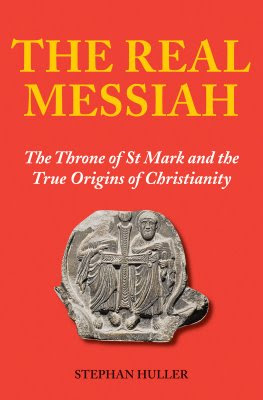 A sample of what appears in the Real Messiah order it here
 A sample of what appears in the Real Messiah order it here
Monday, May 5, 2008
On IV Baruch and Agrippa
The Fourth Book of Baruch is preserved in Greek. The Ethiopic version is a translation from the Greek. The book is often cited by its Greek name Paralipomena Ieremiou or The Rest of the Words of Jeremiah. If you look at how the editors assign some bits as Jewish and others as Christian, one little bit after the other again and again, you will see that the question of what can be Jewish and what can be Christian has not been grasped. Have another look using this insight. You might find it profitable. Don’t worry about the anachronism of fusing the two destructions of Jerusalem. The author did it deliberately.
A narrative and revelation of Baruch, concerning those ineffable things which he saw by command of God. Bless Thou, O Lord. 2 A revelation of Baruch, who stood upon the river Gel weeping over the captivity of 3 Jerusalem, when also Abimelech was preserved by the hand of God, at the farm of Agrippa. And he was sitting thus at the beautiful gates, where the Holy of holies lay.
Verily I Baruch was weeping in my mind and sorrowing on account of the people, and that Nebuchadnezzar the king was permitted by God to destroy His city, saying: Lord, why didst Thou set on fire Thy vineyard, and lay it waste? Why didst Thou do this? And why, Lord, didst Thou not requite us with another chastisement, but didst deliver us to nations such as these, so that they reproach us and say, Where is their God? And behold as I was weeping and saying such things, I saw an angel of the Lord coming and saying to me: Understand, O man, greatly beloved, and trouble not thyself so greatly concerning the salvation of Jerusalem, for thus saith the Lord God, the Almighty. For He sent me before thee, to make known and to show to thee all (the things), of God. For thy prayer was heard before Him, and entered into the ears of the Lord God. And when he had said these things to me, I was silent. And the angel said to me: Cease to provoke 7 God, and I will show thee other mysteries, greater than these. And I Baruch said, As the Lord God liveth, if thou wilt show me, and I hear a word of thine, I will not continue to speak any longer. God shall add to my judgement in the day of judgement, if I speak hereafter. And the angel of the powers said to me, Come, and I will show thee the mysteries of God.
I forgot to mention that IV Baruch is often called The History of the Rechabites. You might like to consider whether the historical sect of Rechabites in the time of Jeremiah are used as a coded symbol for a movement in 70 A.D..
A sample of what appears in the Real Messiah order it here
A narrative and revelation of Baruch, concerning those ineffable things which he saw by command of God. Bless Thou, O Lord. 2 A revelation of Baruch, who stood upon the river Gel weeping over the captivity of 3 Jerusalem, when also Abimelech was preserved by the hand of God, at the farm of Agrippa. And he was sitting thus at the beautiful gates, where the Holy of holies lay.
Verily I Baruch was weeping in my mind and sorrowing on account of the people, and that Nebuchadnezzar the king was permitted by God to destroy His city, saying: Lord, why didst Thou set on fire Thy vineyard, and lay it waste? Why didst Thou do this? And why, Lord, didst Thou not requite us with another chastisement, but didst deliver us to nations such as these, so that they reproach us and say, Where is their God? And behold as I was weeping and saying such things, I saw an angel of the Lord coming and saying to me: Understand, O man, greatly beloved, and trouble not thyself so greatly concerning the salvation of Jerusalem, for thus saith the Lord God, the Almighty. For He sent me before thee, to make known and to show to thee all (the things), of God. For thy prayer was heard before Him, and entered into the ears of the Lord God. And when he had said these things to me, I was silent. And the angel said to me: Cease to provoke 7 God, and I will show thee other mysteries, greater than these. And I Baruch said, As the Lord God liveth, if thou wilt show me, and I hear a word of thine, I will not continue to speak any longer. God shall add to my judgement in the day of judgement, if I speak hereafter. And the angel of the powers said to me, Come, and I will show thee the mysteries of God.
I forgot to mention that IV Baruch is often called The History of the Rechabites. You might like to consider whether the historical sect of Rechabites in the time of Jeremiah are used as a coded symbol for a movement in 70 A.D..
A sample of what appears in the Real Messiah order it here