I have worked out the intention of the verb vayehi. No need to assume a special reading of the verb. It say the sun had come just before Abraham’s vision. It means the ‘ayiṭ had started to hover and the sun was waiting below the horizon ready to afford protection for not only the period of the four empires but the period before that as well, the period when Abraham was a stranger in Canaan and the period in Egypt. The sun was waiting to rise at the end of the fourth empire.
From now on I mark accented syllables with an acute accent on the vowel.
There are three lines of interpretation of the sacrifices of the three animals and the pigeon in Midrash Bereshit Rabba. One is that they represent the Temple cult. The second is that they represent the rulers of the world. The third is that they represent Israel. The third is compatible with the first. In the first interpretation, the word tor is taken to be not the Hebrew word tor meaning a pigeon but the Aramaic word tor (= Hebrew shor) meaning a bull. This is not as fanciful as it sounds, because a verse of Daniel in Aramaic is quoted [VII:23]. In the second interpretation as it is in Bereshit Rabba, the sacrifices represent the Sanhedrin. The ‘ayiṭ is a hatchet used by Abraham to break up the carcasses.
I suppose Saadya’s interpretation assumes that they are Israel. He translates vayyéred “it came down” as if vayyóred “he put down”. Then ‘ayiṭ is translated as “bird”, which is the same as his translation of tsippor in the verse before. “He put the bird on the carcasses”. This means the ‘ayiṭ is the same as the young dove, which was not killed. He specifies that it is a young dove, as do the Targums and the PRE. The young dove can only be the Anointed. If the carcasses only partially come back to life, then some full resurrection of Israel must be expected in the future. The verb vav-yod-shin-bet seems to be read by Saadya as both vayyáshev, from shuv, taken to mean both (a) he budged them and implicitly (b) he enabled them to repent; as well as vayyashshév as in the Masoretic pointing, from the root nun-shin-bet, taken to mean both (c) he blew on them on them and (d) he made them breathe. He translates: “He put the bird on the carcases and stirred them and they moved”. This assumes an interpretation of vav-yod-shin-bet as vayyashshév, meaning both (b) he brought them back and (b) he made them breathe.
I leave out the line of interpretation in the PRE that finds five empires, including Ishmael, and makes the dove Edom.
There is one line of interpretation of the sacrifices in the PRE. They are the empires. The gozal is a young dove and is Israel. The gozal was not killed, since it says “He did not divide the bird”. The ‘ayiṭ is the Son of David, with a quote from Jeremiah XII:9. “When the sun had set, it [the ‘ayiṭ] wanted to light on them (the carcasses representing the empires) to scatter them and wipe them out. Abraham kept waving his headscarf over them so that it [the ‘ayiṭ] would not have power over them till evening, as it says ‘Abram fanned over them’ [vayyashshev]”. (I quote according to the Yemenite recension, which is clearer and more explicit). Note carefully. Now that the intention of the PRE has been disentangled, the ‘ayiṭ is certainly a bird of prey and can only be an eagle. The evening still needs to be explained. I suppose what could be meant is that the ‘ayiṭ will have some power over the four empires till the end of the night, and when the sun rises the ‘ayiṭ will end the fourth empire.
Midrash Bereshit Rabbati. The sun had set (Vayehi ha-shemesh bá’a, verse 17. Assuming the following words of the verse “and it was fully dark”, which is what is said when Judas went out). When the Anointed comes, of whom it is written ‘his throne is like the sun before me’ [Psalm LXXXIX:37], at that time there will be thick darkness for the nations of the world, as it is written ‘Darkness will cover the earth, and impenetrable darkness the nations, and upon you will rise [root zayin-resh-ḥet, translated by Aquila and Symmachus by the same Greek verb as the LXX uses for tsade-mem-ḥet in Zechariah] etc.’ [Isaiah LX:2. Assuming the full phrase ‘and God will rise (like the sun) over you’]”.
Midrash Aggada ‘al ha-Tora. “The sun was starting to set. (Vayehi ha-shemesh lavo, verse 12). This is the Anointed, the son of David, of whom it is written ‘His throne is like the sun before him [Psalm LXXXIX:37]”. (In the verse from the Psalm kenegdo meaning “before him” is quoted instead of kenegdi “before me”. This reading is attested in an important fragment of the Torah from the Cairo Geniza. The provenance means it is a reading that was once a possible alternative in the MT but was rejected by the Masoretes in the last stage of editing. I don’t think the difference matters here).
I prefer the reference to verse 12, as in the Midrash Aggada, rather than verse 17. There is no need to find a reference to complete darkness in the verse of Genesis, since the mention of the sun leads naturally to the quote from Isaiah. The place of the comment lies naturally with the verse traditionally taken to refer to the four empires. A scribal mistake in the lemma can easily happen in Bereshit Rabbati, which is made up of isolated scholia of paragraph length, rather than being a running commentary. This book is only concerned with transmitting single important items that might otherwise get lost, or have some special importance. (Its name is a deliberate variant on Midrash Bereshit Rabba, as if it were a set of supplementary notes to this book). Otherwise, the full form of the text as in Bereshit Rabbati is better. The full form is needed to understand why the Anointed is called the sun, or why the Anointed should be mentioned in this context.
Before this the Midrash Aggada quotes from the PRE. There is a remarkable divergence in one place. It says this. “The ‘ayiṭ came down on the carcasses. This is David the Son of Jesse who is called ‘ayiṭ [then Jeremiah XII:9]”. This is instead of Ben David, the Son of David. This might simply be a mistake. Then again it might be an error for an earlier Ben David ben Yishshai “the Son of David the son of Jesse”, with an implicit reference to the meaning of the name Jesse Yishshai yod-shin-yod, which is a diminutive of Yesha‘ya yod-shin-‘ayin-yod-he “God saves”. I favour the second explanation.
There are three esoteric explanations, the one in the PRE, Saadya’s and the one in Bereshit Rabbati. Saadya’s might be intended to take attention away from the other one. Notice how the reference to the sun is only preserved in two books each only surviving in a single ms. The Palestinian Targum covers the tradition up by acknowledging that the ‘ayiṭ is a bird of prey, but treating it as collective rather than singular and identifying it with the empires.
In the interpretation in Bereshit Rabba that identifies the sacrifices with the four empires, Edom is both the pigeon and the dove.


The Mystery I've Solved

50 cm Seat /147 cm Tall Throne


Ancient Witness to the Size of the Throne

The Relative Size of the Alexandrian Throne of St Mark

Ancient Confirmation of Mark's "Smallness"

Marcion and the Episcopal Throne

Where was Marcion's Throne?

Burning of Arian Books After Nicaea

Drawing on vellum. From MS CLXV, Biblioteca Capitolare, Vercelli, a compendium of canon law produced in Northern Italy ca. 825


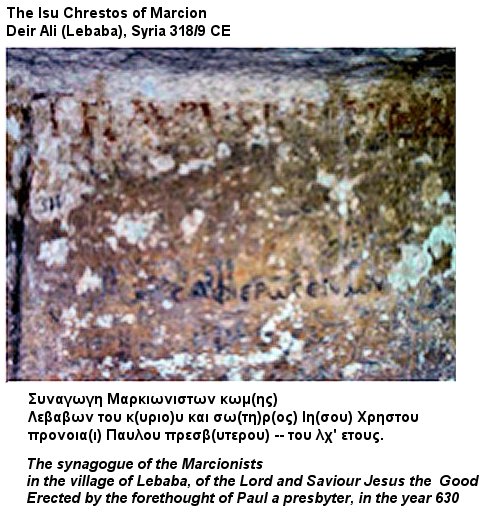
A Fourth Century CE Marcionite Synagogue in Syria

Adversus Marcionem 1.19 and Antoninus Pius's Alexandrian "Zodiac Coins" of 144/145 CE


First Argument for the Alexandrian Origins of Marcion

Second Argument for the Alexandrian Origins of Marcion

Third Argument for the Alexandrian Origins of Marcion

Fourth Argument for the Alexandrian Origins of Marcion

Fifth Argument for the Alexandrian Origins of Marcion

Conclusion

Bonus

First Piece of Evidence

Second Piece of Evidence


Third Piece of Evidence

Preliminary Conclusion

Overriding Point

Bottom Line


In Summa:

Last Word
