Origen Contra Celsum 6:17, 18
our Lord and Saviour, the Logos of God, manifesting that the greatness of the knowledge of the Father is appropriately comprehended and known pre-eminently by Him alone, and in the second place by those whose minds are enlightened by the Logos Himself and God, declares: "No man knows the Son, but the Father; neither knows any man the Father but the Son, and he to whomsoever the Son will reveal Him." For no one can worthily know the "uncreated" and first-born of all created nature like the Father who begat Him, nor any one the Father like the living Logos, and His Wisdom and Truth. By sharing in Him who takes away from the Father what is called "darkness," which He "made His secret place," and "the abyss," which is called His "covering," and in this way unveiling the Father, every one knows-- the Father who is capable of knowing Him.
I thought it right to quote these few instances from a much larger number of passages, in which our sacred writers express their ideas regarding God, in order to show that, to those who have eyes to behold the venerable character of Scripture, the sacred writings of the prophets contain things more worthy of reverence than those sayings of Plato which Celsus admires. Now the declaration of Plato, quoted by Celsus, runs as follows: "All things are around the King of all, and all things exist for his sake, and he is the cause of all good things. With things of the second rank he is second, and with those of the third rank he is third. The human soul, accordingly, is eager to learn what these things are, looking to such things as are kindred to itself, none of which is perfect. But as regards the King and those things which I mentioned, there is nothing which resembles them." I might have mentioned, moreover, what is said of those beings which are called seraphim by the Hebrews, and described in Isaiah, who cover the face and feet of God, and of those called cherubim, whom Ezekiel has described, and the postures of these, and of the manner in which God is said to be borne upon the cherubim. But since they are mentioned in a very mysterious manner, on account of the unworthy and the indecent, who are unable to enter into --the great thoughts and venerable nature of theology, I have not deemed it becoming to discourse of them in this treatise.
What seemed to be a difficulty was that the Seraphs seemed to be flying with all six wings, whereas in Isaiah VI it says with twain he covered his face and with twain he covered his feet and with twain he did fly. My first answer was that what is depicted on the throne is not a theophany. The answer given here is that it means with one pair he covered God’ s face and with one pair he covered God’ s feet and with one pair he flew. That means the Seraphs on the throne can be seen as doing the same. But how are we meant to imagine their position? How could all four do it? Has Origen got it right?
This is some information to supplement what Origen says about the Seraphs covering God’s face and feet.
Isaiah VI in the Targum. Verse 1. In the year in which King ‘ Uzziya was smitten with leprosy, the prophet said, “I saw the glory of the Lord sitting upon a throne, high and lifted up in the highest heavens, and the sanctuary building [hekhal] was filled with the brightness of his glory. Verse 2. Holy ministers were in the height before him: each had six wings; with one pair he was covering his face so as not to see, and with one pair he was covering his body so it could not be seen [feet interpreted as genitals, a common usage in Hebrew. RB], and with one pair he was ministering. Verse 3. They were calling out to each other and saying ‘Holy in the highest heavens, the house of his Shechina, Holy on earth, the work of his might [Gevura], holy for ever and ever is the Lord of Hosts: the whole earth is full of the brightness of his glory’. …. Verse 6. There flew to me one of the ministers, and in his mouth was the speech he had received from before him whose Shechina is on the Throne of Glory in the highest heaven, high above the altar”.
The translation is adapted from this. J. F. Stenning, The Targum of Isaiah, Oxford U. P., 1953. I have made it slightly more exact in a few places and have turned it into more natural English (as spoken correctly in Australia and New Zealand) here and there.
In the Old Greek (loosely called the LXX). Verse 1 is unremarkable. Verse i. … the house [oikos]. Verse 2. Seraphs were standing round him. Rest unremarkable.
Verse 1. Theodotion Aquila Symmachus. …. and what was before his feet filled the Sanctuary [Naos]. Verse 2. Theodotion Aquila Symmachus ho Hebraios [a Greek translation of unknown affiliation]. Seraphs were standing above him. Symmachus [readings of the others not known]. … his own face. Rest unremarkable.
The Rabbinic explanations have not been looked up. From memory it is stated definitely that each Seraph covers its feet, and there is no metaphorical meaning given.
It seems to me that there has been a process of attenuation of the meaning, on purpose.
What might be meant by the Targum in verse 2 is that each covered its face with one pair of wings so as not to see and with another pair covered the body of God. The wording might be deliberately ambiguous. In that case we have another step in the process of attenuation or obscuring.


The Mystery I've Solved

50 cm Seat /147 cm Tall Throne


Ancient Witness to the Size of the Throne

The Relative Size of the Alexandrian Throne of St Mark

Ancient Confirmation of Mark's "Smallness"

Marcion and the Episcopal Throne

Where was Marcion's Throne?

Burning of Arian Books After Nicaea

Drawing on vellum. From MS CLXV, Biblioteca Capitolare, Vercelli, a compendium of canon law produced in Northern Italy ca. 825


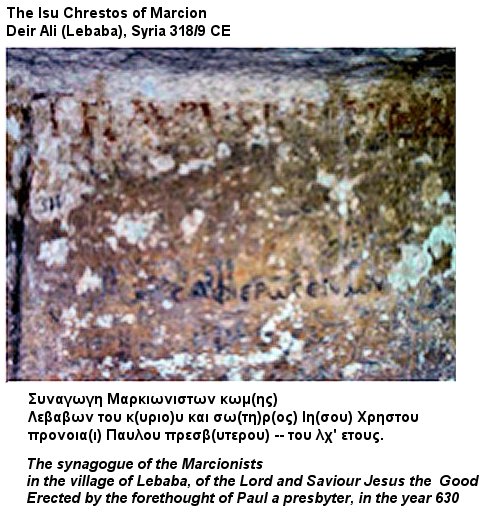
A Fourth Century CE Marcionite Synagogue in Syria

Adversus Marcionem 1.19 and Antoninus Pius's Alexandrian "Zodiac Coins" of 144/145 CE


First Argument for the Alexandrian Origins of Marcion

Second Argument for the Alexandrian Origins of Marcion

Third Argument for the Alexandrian Origins of Marcion

Fourth Argument for the Alexandrian Origins of Marcion

Fifth Argument for the Alexandrian Origins of Marcion

Conclusion

Bonus

First Piece of Evidence

Second Piece of Evidence


Third Piece of Evidence

Preliminary Conclusion

Overriding Point

Bottom Line


In Summa:

Last Word
