Tuesday, November 30, 2010

The Origins of Christianity in Egypt [Part One]

Rising like a beacon from the eastern shores of Alexandria, the Martyrium of St. Mark was the embodiment of Christiantiy in Egypt.  It was the most important landmark in all of Christianity in the pre-Nicene period yet no attempt is made in the surviving literature to even attempt to explain the origin of this massive structure.  Clement of Alexandria, writing from the late second century simply assumes that this large stone structure, fully equipped with a veiled inner sanctum was already functional by the time St. Mark brought the final edition of his gospel to the city c. 70 CE.  The tenth century Coptic historian Severus of Al'Ashmunein preserves a tradition that St. Mark actually found the financial means to build the church on his own.  This seems highly unlikely given that it was located in what must have been the most expensive piece of land in the densely populated Jewish quarter of the city. 

All of our early sources agree on one thing - this was the only building in all of Christian Egypt.  It must have been a massive structure because of the scale of the conversion even as witnessed by Clement at the beginning of the third century.  He tells us that the message had already brought "over to the truth whole houses, and each individual of those who heard it by him himself."  Severus goes so far as to make explicit that until the end of the third century, Christians outside of Alexandria "had celebrated the liturgy in caves and underground places and secret resorts."

Yet as Roger Bagnall has noted, the total Christian population in Egypt in 250 CE was likely to have been in excess of 100,000 souls (Early Christian Books p. 20).  One might even argue that these numbers are rather conservative.  How could a community with this size have functioned with just a single building?   The answer must be that the 'Church of St. Mark' was rather large.  Yet how and why would it be reasonable for Clement to have held that such a building was already established since the time of St. Mark? 

There can be only one answer and it is rather incredible at first blush.  The Christian community must have inherited its Church from a large building associated with the Jewish community living in the region called 'Boucolia' (Τὰ Βουκόλου) in the first century CE.  The writings of Clement scream out the answer but almost no one has heard what it has to say. The Christians of Alexandria must have taken over the great synagogue mentioned in the writings of Philo which stood as the beating heart of Jewish community until the revolts of 115 - 117 CE.

We know very little about these so-called 'Trajanic revolts' after the name of the Emperor who ruled at the time they swept through Egypt, north Africa and many other parts of the Empire.  All that is clear is that by the time the dust settled there were no more Jews living in the region where their great synagogue once stood.  Did Christians simply take over the building in the aftermath of this Egyptian holocaust and rededicate it to their patron saint?   It is perhaps the least controversial explanation of how this massive church seems to have simply 'fallen from the sky' into early Christian history in Egypt.  Yet there are few additional details to consider.

It isn't just that our earliest sources say that there was just one church in all of Egypt.  There seems also to have been a remarkable autocratism inherent in the structure of the Egyptian Church which separate it from all of its rivals.  Even though we have come to imagine the Roman Church as this autocratic force in history, it is curious to see that it seems to have been founded on two thrones - one associated with Peter and another associated with Paul.  Even though the canonical Acts of the Apostles does its best to paint some sort of picture of an original apostolic harmony between the pair, it is equally plausible to argue from the same evidence that the apostolic age ended with a rift between two separate communities associated with each apostle. 

To this end there are always conflicting stories about the succession of apostles in Antioch and signs of two competing apostolic thrones in Rome down into the third century.  In Alexandria by contrast we see no rival apostolic traditions, no challengers to the authority of St. Mark from the very beginning.   Moreover within body of the Egyptian Church no man could take the title of bishop or 'episkopos' for the whole of Egypt save for the representative of St. Mark.  The episkopos of the Alexandrian See of St. Mark was quite literally the 'guardian' or adoptive father of all who believed in the authority of the Evangelist.  There were no middlemen or 'fellow bishops' until the third century when the community was coming under the influence of foreign beliefs and practices.

The native custom of Christian Egypt was to have an Alexandrian centered faith which placed the Church of St. Mark as nothing short of a second temple of Jerusalem or a precursor to Mecca.  That some Christians felt a duty to visit the shrine of the Evangelist in Egypt is clear from the surviving evidence down through to the late Byzantine period.   It is impossible of course to now determine what the 'ancient demographic' of most of the pilgrims were to use modern American parlance.  One would presume that many were Egyptian but the site seems also to have attracted a number of 'foreign' visitors too. 

Indeed already from the time of Arius, the notious rebel cleric famous for his resistance to the 'reforms' of the Emperor Constantine at Nicaea, we hear of ascetics living in the environs of the shrine.  It would be difficult to imagine that these 'virgins' who accompanied the heretic presbyter of the church just decided on their own to 'flop' at the martyrium.  There must have been an established practice for some time that holy men wanted to live in close proximity to this holy site. 

And then there is staggering number of these ascetics - seven hundred - living in the environs of the Church of St. Mark in Alexandria who were eventually expelled with Arius at the dawn of the era of Nicaea.  As Christopher Haas notes that both Alexandrian asceticism and the Evangelist's martyrium continued to flourish side by side:

until the time of the Sassanian and Arab conquests, when both the shrine and its neighboring monasteries were burned.  Besides this link between ascetics and Saint Mark's Martyrium, it is worth remembering that many of Alexandria's earliest ascetics retired to the suburban regions just east of the city.  It was here that some of Alexandria's most extensive cemeteries were located, known today by the names of Chatby, Ibrahimiya and El Hadra.  As we have seen, in the middle years of the fourth century, these tombs became the herimtages of numerous Alexandrian ascetics.  The necropoleis in and around Boukolia continued to appeal to ascetics until the founding of Alexandria's suburban monasteries toward the end of the fourth century. Saint Anthony himself considered settling in the region of Boukolia before he withdrew to his inner mountain.  Boukolia also served as a recruiting ground for monasticism, as seen especially by the conversion of a young shepherd named Macarius, who murdered one of his comrades along the shore of Lake Mareotis and then fled to the desert as a hermit.  Given this context,  it is not surprising that Arius, the presbyter charged with the pastoral oversight of this region, was noted for his ascetic demeanor and even a style of dress characteristic of early Egyptian monks.  At the time of his excommunication, over seven hundred virgins were expelled along with him — a graphic testimony to the appeal of Arianism among Alexandrian ascetics. In addition, there is also the testimony of Bishop Alexander, who,  in a letter to his namesake in Thessalonica, speaks of Arians "troubling us in the lawcourts by the pleas of disorderly women whom they have duped and also discrediting Christianity by the way in which the younger women among them immodestly frequent every public street" — precisely the same immodest ascetic behavior addressed by the Alexandrian canons. [Alexandria in Late Antiquity p. 272]

The image that we have of the Church of St. Mark in the early fourth century is that of a kind of 'hippie commune' where ascetic followers of the representative of St. Mark "block up the gates, and sit like so many demons around the tombs." 

Indeed the other worldliness of this setting is almost difficult to imagine.  The massive physical structure of the church itself towering over a complex of official residences for various monks, presbyters and church officials and then set in a massive landscape of cemeteries and the physical remains of the former glorious Jewish quarter of the Common Era. The most important Christian landmark itself was literally situated on top of not mere 'graves' but the dead remains of Alexandrian Judaism.  This must have been a powerful metaphor in itself.  Christianity was literally seen rising up 'in glory' out of the ashes of the Law and prophets.  Yet this wasn't the only scriptural metaphor which would have come into the minds of believers. 

In order to properly imagine ourselves standing in front of the epicenter of Egyptian Christianity, we have to also hear the relentless pounding of the sea against the walls of the city and rocks which dotted the shore.  Even to this day the waters of the Chatby region are so violent that underwater examinations can be undertaken but once or twice a month.  So it is that in our earliest descriptions of the Church of St. Mark the pounding rhythm of the Mediterranean figures prominently in the imagery. 

Severus writes again that when St. Mark "found means to build a church in a place called the Cattle-pasture" he built it "near the sea, beside a rock from which stone is hewn."  For those who lived in monastic cells in the Chatby complex, it would have impossible not to connect this image with the relentless noise of the sea dashing the rocks scattered on the shore.  Indeed we should think that the words from the gospel were even originally being alluded to here:

As for everyone who comes to me and hears my words and puts them into practice, I will show you what they are like. They are like a man building a house, who dug down deep and laid the foundation (θεμέλιον) on rock. When a flood came, the torrent struck that house but could not shake it, because it was well built. But the one who hears my words and does not put them into practice is like a man who built a house on the ground without a foundation (θεμελίου). The moment the torrent struck that house, it collapsed and its destruction was complete.

I don't think we should stop here and merely argue that this passage from the gospel might have been understood to be connected with Mark's 'building' of a church in Alexandria.  I think we can even call our earliest Alexandrian witness - and the first to mention the Church of St. Mark - in support of the idea. 

Clement of Alexandria whispers to his hearers at one point in his writings that the concept of 'building on a foundation' (θεμέλιον) has a deep mystical signfiicance which is only known to 'gnostics' who have been initiated into the mysteries of perfection.  He references the words of the 'divine apostle' which not only contain a reference to himself as a 'wise master builder' but which declare that he has also "set the foundation and something else is built thereon with gold and silver, precious stones."  Clement explains that what the apostle is really speaking about is not some abstract theological concept but "the gnostic superstructure (built) on the foundation of faith in Christ Jesus." 

Of course Clement never once reference the name of his 'divine apostle' anywhere in this section of his work.  His identity is deliberately obscured throughout Clement's surviving writings.  It is customary for us to assume that Clement 'knew' that the apostle was named 'Paul' merely because his many of his Catholic contemporaries did.  Yet there is something unquestionably evasive about Clement's writings.  There are only five times in the writings which have come down to us where the names of the gospels of Matthew, Mark, Luke and John are explicitly mentioned even though he makes several hundred anonymous references to gospel passages.  Clement also seems to go out of his way to avoid the referencing the name of this apostle.   

Could all of this be explained by the fact that Clement is deliberately sheltering his community's traditional association with St. Mark?  A recently discovered text in the monastery of Mar Saba suggests exactly this motivation for Clement's obscurity.  He advises a certain Theodore with respect to a certain apocryphal text that one should never concede that it was "written by Mark, but should even deny it on oath."  Yet as we shall demonstrate shortly, the idea that the Alexandrian community had some 'secret text' which helped navigate Biblical waters and reveal their secrets is plainly evident from the writings of Clement and the earliest Alexandrian figures that followed him.

In other words, Clement felt reluctant to extol the authority of the Alexandrian Church and the apostolic authority on which its claims rested so he did so clandestinely, through lots of allegories and 'flowery' hidden language.  Instead of saying that the Jesus's message was properly preserved in the Church of St. Mark, Clement shrouds himself in ambiguity and speaks of a 'gnostic superstructure built on the faith in Jesus Christ.'  Of course Clement would certainly have known that the gospel declared that a rock was the firmest and surest of foundations to build a physical structure upon.  Clement also makes specific reference to Jesus being the rock mentioned metaphorically in Scripture.  Yet he couldn't make this proclamation 'out loud' because of the age he was living in, one in which the Alexandrian Church would ultimately find itself a victim of a full-scale Imperial sponsored persecution which would force him to leave the city he had learned to call him.

Christian Cemetery Discovered in Egypt Dating to the Late First Century

Original Story Here - The Bible says Joseph and Mary fled to Egypt for a time with the baby Jesus to escape Herod’s henchmen. About 50 years later, St. Mark supposedly established a church in Alexandria. But Christianity didn’t take root in the Land of the Pyramids for another three centuries.

Or so scholars have said.

But now, on the edge of the Fayum oasis south of Cairo, in a spot called Fag el-Gamous, or Way of the Water Buffalo, Brigham Young University researchers have unearthed evidence that plants Christianity in Egypt two centuries earlier than many scholars believe.

There, BYU diggers have found a necropolis in which the dead were buried in layerings of graves, leaving a record of how burial practices changed between 350 B.C. and A.D. 500.

As he and his colleagues burrowed into the cemetery, archaeologist C. Wilfred Griggs documented shifts in burials that he believes point to early Christian influences.

“All the burials we encountered were ‘head east’ burials, but, when we got to the bottom of the shaft, we found them ‘head west.’ What happened? Did someone miss the program? I became aware we had a pattern here,” says Griggs, a BYU professor of ancient scripture who has led the university’s Egypt excavations since 1981.

“Right around the end of the first century, the burial started changing. Was there a mass migration or revolution? It probably resulted from a change of religion, and the only change of religion was the arrival of Christianity.”

BYU crews have located 1,700 graves, yielding numerous artifacts that Griggs suspects are the oldest-known pieces of Christian iconography in the form of crosses, fish and figurines. His theories could upend, or at least complicate, accepted ideas for how Christianity spread through Egypt during the first centuries after Jesus’ crucifixion.

“If it’s true, that would be interesting, but I would be cautious,” warns Francois Gaudard, a researcher at the University of Chicago’s Oriental Institute who specializes in Coptic studies.

While his ideas have generated skepticism, Griggs says no one has offered an alternate interpretation of the Fag el-Gamous finds.

Other Christian signs • The BYU scholars believe the head orientation relates to beliefs about the afterlife.

A person buried with the head to the west would rise facing east, the direction from which the Christian Messiah is supposed to approach on Judgment Day, according to David Whitchurch, another professor of ancient scripture involved with BYU’s dig.

On the other hand, a person buried head east would rise facing west, a direction ancient Egyptians associated with death.

“Something is going on here, there is no question,” Whitchurch says. “We know Christianity spread to Egypt. How far it spread and how early is open to question.”

Whitchurch and Griggs led a recent conference at BYU’s Harold B. Lee Library, where faculty and students presented recent investigations into the textiles, dyes, DNA samples and figurines recovered from Fag el-Gamous.

The head orientation of the bodies was just one of many changes in burial custom documented by Griggs’ team.

Crews also found detailed linen textiles wrapping the bodies, terra cotta figurines depicting a maternal, possibly Mary-like figure, and crosses and wooden fish appearing as amulets on necklaces.

“We find wine amphorae and drinking cups only with head-west burials. These might represent a graveside Eucharist,” Griggs says. “Each of these adds up to a picture of Christianity. We’re building a case piece by piece, and we think the case is becoming quite compelling.”

Fayum is about 100 miles south of Alexandria, where St. Mark supposedly established a Christian church in the mid- to late-first century — a time when Egypt was under Roman political control and Hellenic cultural influences.

Not until the rule of Constantine in the fourth century did Christianity become a favored religion in the Roman Empire, according to the prevailing view. This is when the Coptic Christians rose to prominence in Egypt.

But Griggs argues the BYU team is finding Christian influence near the Nile long before the young faith won Constantine’s endorsement.

“It’s like a big jigsaw puzzle,” Griggs says. “One piece is the spread of Christianity around the ancient world. The new pieces are showing that it was a much grander thing than previously thought.”

A visiting scholar of early Christianity attended the BYU conference and voiced skepticism.

“It would radically change theories about Christianity and Egypt and Christian self-identification,” says Lincoln Blumell, who recently joined BYU’s department of ancient scripture from Tulane University.

Blumell suggests it would be safer to start with the assumption that the new burial practices were Egyptian, then later embraced by Christians.

Dating game • Crosses are not known to be associated with Christianity until Constantine’s rule in the early fourth century, but Griggs is certain the crosses he has recovered represent Christian iconography.

He noted that early Christians easily could have adapted the ankh — the ancient Egyptian symbol for life depicted as a circle atop a T — into a cross.

But the University of Chicago’s Gaudard, while not familiar with Griggs’ theories, doubts that burial-head orientation could be a reliable reflection of religious affiliation. After examining the photo of the crosses accompanying this story, he argued that they appear to be standard Roman-era burial pieces.

“I think that the items are actually ankh signs and not Christian crosses,” Gaudard writes in an e-mail. “Indeed, as these things are really small, making an ankh with a loop on top would be very hard to carve, and the artist often would take short cuts.”

A key step in shoring up the notion that Fag el-Gamous contains a late-first-century to early-second-century Christian cemetery is dating the pottery, woven textiles and ribbons, face bundles and other artifacts buried with the dead.

Scholars can date pottery to within 50 years by analyzing its style. Since pottery’s usefulness doesn’t last long, it can reliably date an associated grave.

Kristin South, a BYU anthropology student studying the textiles enshrouding the mummies, used potsherds to date some of the 132 graves to the second century.

South would like to perform carbon-14 analysis on the organic materials recovered from the graves, but scholars are not allowed to remove artifacts from Egypt. Only one lab in the country performs radio-carbon dating, she says, and it is backlogged and expensive.

Her results suggest the textile wrappings underwent a consistent change on the head-west mummies, indicating greater care in the preparation of the dead for burial. The faces were padded with folded bundles of cloth. Bodies were bound with tightly woven ribbons rather than torn strips of linen. Dyed threads were used to weave elaborate patterns into the ribbon.

“Do these innovations signify Christian identity?” she asks. “None of the head-east burials had face bundles.”

Meanwhile, the people buried at Fag el-Gamous were not racially homogenous, further evidence that Fayum was a melting pot, according to Paul Evans, a BYU professor of microbiology.

Scholars have yet to find the ruins of the population center served by cemetery, located off Fayum’s arable land in the desert. Hair types run the gamut from blond to black and straight to curly.

Evans compared the skeletons’ cranial features and drilled tiny holes in the teeth to extract DNA samples for genetic testing.

He searched for genetic signals of in-migration to determine whether a Christian population moved in or whether native Egyptians converted to the faith. Evans says the findings are consistent with both possibilities.

Monday, November 29, 2010

More Intimations that the Marcionites Did Not Identify Their Apostle by the Name 'Paul'

Should you, however, disapprove of these types, the Acts of the Apostles, at all events, have handed down to me this career of Paul, which you must not refuse to accept. From them I prove that the persecutor became an apostle, not from men, nor by a man: from them I am led even to believe him: by their means I dislodge you from your claim to him, and have no fear of what you say. Therefore you deny the Apostle Paul. [emphasis mine] I do not blaspheme him whom I defend. If I deny, it is to force you to prove. If I deny, it is to enforce my claim that he is mine. Otherwise, if you have your eye on our belief, accept the evidence on which it depends. If you challenge us to adopt yours, tell us the facts on which it is founded. Either prove that the things you believe really are so: or else, if you have no proof, how can you believe? Or who are you, to believe in despite of him from whom alone there is proof of what you believe? So then accept the apostle on my evidence, as as you do Christ: he is my apostle, as also Christ is mine.

I desire to hear from Marcion the origin of his apostle (Et ideo ex opusculi ordine ad hanc materiam devolutus apostoli quoque originem a Marcione desidero)

• Evans translation: I desire to hear from Marcion the origin of Paul the apostle.


• Holmes translation: I require to know of Marcion the origin of his apostles

I am a sort of new disciple, having had instruction from no other teacher (novus aliqui discipulus nec ullius alterius auditor).  For the moment my only belief is that nothing ought to be believed without good reason, and that that is believed without good reason which is believed without knowledge of its origin (qui nihil interim credam nisi nihil temere credendum, temere porro credi quodcunque sine originis agnitione creditor) and I must with the best of reasons approach this inquiry with uneasiness when I find one affirmed to be an apostle, of whom in the list of the apostles in the gospel I find no trace (quique dignissime ad sollicitudinem redigam istam inquisitionem, cum is mihi affirmatur apostolus quem in albo apostolorum apud evangelium non deprehendo)

So when I am told that he was subsequently promoted by our Lord, by now at rest in heaven, I find some lack of foresight in the fact that Christ did not know beforehand that he would have need of him (Denique audiens postea eum a domino allectum, iam in caelis quiescente, quasi inprovidentiam existimo si non ante scivit illum sibi necessarium Christus), but after setting in order the office of apostleship and sending them out upon their duties, considered it necessary, on an impulse [ex incursu] and not by deliberation, to add another, by compulsion so to speak and not by design (sed iam ordinato officio apostolatus et in sua opera dimisso, ex incursu, non ex prospectu, adiciendum existimavit, necessitate, ut ita dixerim, non voluntate)

So then, shipmaster out of Pontus, supposing you have never accepted into your craft any smuggled or illicit merchandise, have never appropriated or adulterated any cargo, and in the things of God are even more careful and trustworthy, will you please tell us under what bill of lading you accepted Paul as apostle (Quamobrem, Pontice nauclere, si nunquam furtivas merces vel illicitas in acatos tuas recepisti, si nullum omnino onus avertisti vel adulterasti, cautior utique et fidelior in dei rebus, edas velim nobis, quo symbolo susceperis apostolum Paulum) who had stamped him with that mark of distinction, who commended him to you, and who put him in your charge? Only so may you with confidence disembark him: only so can he avoid being proved to belong to him who has put in evidence all the documents that attest his apostleship (quis illum tituli charactere percusserit, quis transmiserit tibi, quis imposuerit, ut possis eum constanter exponere, ne illius probetur qui omnia apostolatus eius instrumenta protulerit)

He himself claims to be an apostle, and that not from men nor through any man, but through Jesus Christ (Ipse se, inquit, apostolum est professus, et quidem non ab hominibus nec per hominem, sed per Iesum Christum)
• Evans: He himself, says Marcion, claims to be an apostle, and that not from men nor through any man, but through Jesus Christ.


• Holmes: He professes himself to be "an apostle"----to use his own, words----"not of men, nor by man, but by Jesus Christ."

Clearly any man can make claims for himself: but his claim is confirmed by another person's attestation (Plane profiteri potest semetipsum quis, verum professio eius alterius auctoritate conficitur)

One person writes the document, another signs it, a third attests the signature, and a fourth enters it in the records (Alius scribit, alius subscribit, alius obsignat, alius actis refert).  No man is for himself both claimant and witness (Nemo sibi et professor et testis est)  Besides this, you have found it written that many will come and say, I am Christ (Praeter haec utique legisti multos venturos qui dicant, Ego sum Christus)

• Marcion is the subject cf Tert Against Marcion IV:39 “So then those people will come, saying I am Christ. You, will receive them: you have received one exactly like them. For this one too has come in his own name.”
If there is one that makes a false claim to be Christ, much more can there be one who professes that he is an apostle of Christ (Si est qui se Christum mentiatur, quanto magis qui se apostolum praedicet Christi)  Thus far my converse has been in the guise of a disciple and an inquirer: from now on I propose to shatter your confidence, for you have no means of proving its validity, and to shame your presumption, since you make claims but reject the means of establishing them (Adhuc ego in persona discipuli et inquisitoris conversor, ut iam hinc et fidem tuam obtundam, qui unde eam probes non habes, et impudentiam suffundam, qui vindicas, et unde possis vindicare non recipis)

Let Christ, let the apostle, belong to your other god: yet you have no proof of it except from the Creator's archives (Sit Christus, sit apostolus, ut alterius, dum non probantur nisi de instrumento creatoris) [Tertullian Against Marcion 5.1]

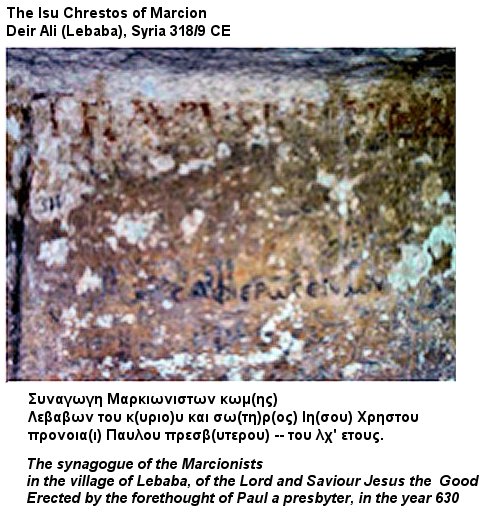
Is this a Third Century Marcionite Synagogue in Megiddo, Israel?

I am certain that the third century prayer house recently discovered in Megiddo is Marcionite.  The evidence is overwhelming.  I am writing a letter to the IAA which will mean that I will not finish this post until tomorrow.

The point here is that there is both a reference to 'the God IC XC' where the latter nomen sacrum could be read either 'Christos' or 'Chrestos' but more signficantly the spelling out of 'Chreste' (which could be a common female name too):

MNHMONEUSATE
PRIMILLHS KAI KURI
AKHS KAI DWROQEAS
ETI DE KAI CRHSTH

Translation: Remember / Primillê and Kuri- / -akê ("The Lord's") and Dôrothea ("God's gift") / and also Khrêstê ("The kind one"). (See also Henrickson in FR and 2.4.1.)

Transcription: MNÊMONEUSATE / PRIMILLÊS KAI KYRI- / AKÊS KAI DÔROTHEAS / ETI DE KAI KHRÊSTÊ.

Friday, November 26, 2010

I Think Origen Was Referencing a 'Mystical Hearing' (μυστιχωτέρων ἀκρόασιν) From Secret Mark in his Commentary on Matthew 14.14

I have been thinking about this all day.  I hjave been wondering whether the reading which has crept into the manuscript of is incorrect. Instead of Origen telling his readers that he is appealing to a 'mystical order' (μυστιχωτέρων ἀχρόασιν) in the beginning of Matthew chapter 19 he original said he was referencing a 'mystical hearing' of the material (μυστιχωτέρων ἀκρόασιν). 

Let's first cite the material in Matthew in context which Origen connects with some sort of mystical import:


Then Peter came to Jesus and asked, “Lord, how many times shall I forgive my brother or sister who sins against me? Up to seven times?”  Jesus answered, “I tell you, not seven times, but seventy-seven times. 


Therefore, the kingdom of heaven is like a king who wanted to settle accounts with his servants. As he began the settlement, a man who owed him ten thousand bags of gold was brought to him.  Since he was not able to pay, the master ordered that he and his wife and his children and all that he had be sold to repay the debt.  At this the servant fell on his knees before him. ‘Be patient with me,’ he begged, ‘and I will pay back everything.’ The servant’s master took pity on him, canceled the debt and let him go. But when that servant went out, he found one of his fellow servants who owed him a hundred silver coins. He grabbed him and began to choke him. ‘Pay back what you owe me!’ he demanded. His fellow servant fell to his knees and begged him, ‘Be patient with me, and I will pay it back.’ But he refused. Instead, he went off and had the man thrown into prison until he could pay the debt. When the other servants saw what had happened, they were outraged and went and told their master everything that had happened.  Then the master called the servant in. ‘You wicked servant,’ he said, ‘I canceled all that debt of yours because you begged me to.  Shouldn’t you have had mercy on your fellow servant just as I had on you?’  In anger his master handed him over to the jailers to be tortured, until he should pay back all he owed.  This is how my heavenly Father will treat each of you unless you forgive your brother or sister from your heart.”


When Jesus had finished saying these words, he left Galilee and went into the region of Judea to the other side of the Jordan

It will undoubtedly surprise many people to learn that Origen accords this section of the gospel with the highest honor.  Indeed it is even more peculiar that he concentrates upon its line - "And it came to pass when Jesus had finished (ἐτέλεσεν) these words."  Origen emphasizes that Jesus is 'completing' (ἐτέλεσεν) the words of the Old Testament.  Sure, that's easy for Origen to say - but how so?

Well, the first step to understand here is that Origen connects the original reference to 'seven times seven' in Matthew 18:23 to the parable that follows about the releasing of debts.  There can be no doubt that Origen connects the 'perfecting of the words' with the fulfilment of the expectation of the messianic Jubilee - "that the things spoken through the prophets might be fulfilled." But this isn't all there is here. 

Indeed Origen immediately goes on to reference what I am certain is the 'hearing' of the mystic gospel of Alexandria when he says:

And yet at this point, also, investigation might be made whether in the case of the things spoken by way of oracle the expression, “he finished,” is applied either to the things spoken by Moses, or any of the prophets, or of both together; for careful observation would suggest very weighty thoughts to those who know how “to compare spiritual things with spiritual,” and on this account “speak not in words which man’s wisdom teacheth, but which the Spirit teacheth.” (1 Cor 2.13) But perhaps some other one, attending with over-curious spirit to the word “finished,” which is assigned to things of a more mystical hearing (μυστιχωτέρων ἀκρόασιν), just as we say that some one delivered to those who were under his control, mysteries and rites of “perfecting” (τελετὰς) not in a praiseworthy fashion, and another delivered the mysteries of God to those who are worthy, and rites of “perfecting” proportionate to such mysteries, might say that having initiated them, he made a rite of “perfecting,” by which “perfecting” the words were shown to be powerful, so that the gospel of Jesus was preached in the whole world, and by virtue of the divine “perfecting” gained the mastery of every soul which the Father draws to the Son, according to what is said by the Saviour, “No one comes to Me except the Father which has sent Me draw him.” [Comm Matt 14.14]

Now I know there are those who want to somehow make Alexandrian Christianity and its religious mysteries a non-entity.  We are supposed to believe that St. Mark never had a real presence there.  We are somehow told that the same Christianity that Irenaeus promotes in Rome was 'already' established in Alexandria or being established there as Irenaeus was writing.

Of course the facts of the matter are that if you actually sit down and think about all this nonsense, you realize at once that this can't be true.  There was something fundamentally different about Alexandrian Christianity which was forcibly made to conform to the brand of orthodoxy being promoting at Rome.  That there were religious mysteries in Alexandria is made absolutely explicit everywhere in Origen's writings as we read:

And when those who have been turned towards virtue have made progress, and have shown that they have been purified by the word, and have led as far as they can a better life, then and not before do we invite them to participation in our mysteries. For we speak wisdom among them that are perfect ... And since the grace of God is with all those who love with a pure affection the teacher of the doctrines of immortality, whoever is pure not only from all defilement, but from what are regarded as lesser transgressions, let him be boldly initiated in the mysteries of Jesus, which properly are made known only to the holy and the pure. [Against Celsus 3.59 - 60]

And again:

Not to participation in mysteries, then, and to fellowship in the wisdom hidden in a mystery, which God ordained before the world to the glory of His saints, do we invite the wicked man, and the thief, and the housebreaker, and the poisoner, and the committer of sacrilege, and the plunderer of the dead, and all those others whom Celsus may enumerate in his exaggerating style, but such as these we invite to be healed. For there are in the divinity of the word some helps towards the cure of those who are sick, respecting which the word says, They that be whole need not a physician, but they that are sick; others, again, which to the pure in soul and body exhibit the revelation of the mystery, which was kept secret since the world began, but now is made manifest by the Scriptures of the prophets, and by the appearing of our Lord Jesus Christ, which appearing is manifested to each one of those who are perfect, and which enlightens the reason in the true knowledge of things. [ibid 3.61]

The point is that there is no way to make an Alexandrian mystery religion 'fit' with the notion of a virulently anti-heretical Roman Church.  What people usually do is just assume that Clement and Origen voluntarily submitted their tradition to the authority of Irenaeus's Church.  Why would one apostolic tradition give up its authority to another?   It makes no sense especially when Alexandria tends to embody everything that Rome despises. 

Now once you accept that there was this mystery religion in Alexandria, the obvious question is what gospel was its liturgical text?  The obvious answer is that it must have been a gospel of Mark.  St. Mark is the patron saint of Alexandria after all.  So why don't Clement and Origen ever mention Mark with any special reverence?  Well the argument cuts both ways.  The only answer that solves everything is that St. Mark was unknown to Alexandria at that time - and then what are you left with?  How are there mysteries in Alexandria without a mystagogue?

I won't cite from the Letter to Theodore again but it is my belief that this is the only workable answer.  St. Mark was the mystagogue of Alexandria.  But another question remains - how could our canonical gospel of Mark have been the liturgical text to the mysteries of any Christian community?   It is simply too short.  There isn't enough there for anything substantial.  There would have be another gospel of Mark - a mystic gospel of Mark - that filled in the gaps in the narrative.  But now I have tipped my hand ...

In any event, we have already noted that the Marcionites certainly must have read 1 Corinthians 2.1 - 3.10 as if it made reference to two gospels - one public and one private.  Not surprisingly Origen goes on to reference exactly this passage immediately after the 'mystical hearing' allusion:

Wherefore also “the word” of those who by the grace of God are ambassadors of the gospel, “and their preaching, is not in persuasive words of wisdom, but in demonstration of the spirit of power," (πνεύματος δυνάμεως 1 Cor 2.4) to those for whom the words of the doctrine of Jesus were finished. You will therefore observe how often it is said, “He finished,” and of what things it is said, and you will take as an illustration that which is said in regard to the beatitudes, and the whole of the discourse to which is subjoined, “And it came to pass when Jesus had finished these words, all the multitudes were astonished at His teaching." But now the saying, “Jesus finished these words,” is referred also immediately to the very mystical parable according to which the kingdom of heaven is likened unto a king, but also beyond this parable to the sections which were written before it. [Comm Matt 14.14]

Now people will argue that Origen is not referencing a 'mystic gospel' at all but only that which is referenced in Matthew 21 - 35.  I would counter that this only one of many places where Matthew's narrative has appropriated material from the mystic gospel.  The other obvious example is Matthew 20:20 - 27 is clearly the Marcionite reading of the passage.   Indeed the way to figure out which of the synoptic readings is the original is to consult Ephrem's Diatessaron. 

The point through all of this is that it is impossible to believe that Origen could have thought there were 'mystical passages' established in all four canonical gospels from the beginning.  Clearly there was a mystical text which managed to get into the hands of outsiders (cf. to Theodore II.4 - 9).  It is also my belief that Irenaeus, the editor of the final edition of our New Testament canon did whatever it took to foster 'peace' in the Church. 

The point is that when we go back to Origen's discussion of the parable which precedes his reference to the 'mystical hearing' there can be no doubt that he is NOT refering to Matthew alone.  He writes a little earlier in Book 14 of the Commentary on Matthew that:

next to the general conception of the parable, it is right to examine the whole of it more simply according to the letter, so that he who advances with care to the right investigation of each detail of the things previously written may derive profit from the examination of what is said. Now there is, as is probable, an interpretation, transcendental and hard to trace, as it is somewhat mystical (μυστιχωτέρα), according to which, after the analogy of the parables which are interpreted by the Evangelists, one would investigate each of the details in this ... But it is probable also that some other things could be added to the number by a more competent investigator, the exposition and interpretation of which I think to be beyond the power of man, and requiring the Spirit of Christ who spoke them in order that Christ may be understood as He spoke; for as “no one among men knows the things of the man, save the spirit which is in him,” and “no one knows the things of God, save the Spirit of God,” (1 Corinthians 2:11) so no one knows after God the things spoken by Christ in proverbs and parables save the Spirit of Christ. [Comm Matt 14.6]

How can we as serious scholars entertain the idea that Origen is only referencing a Holy Spirit that spoke through four evangelists when we know that Clement a generation earlier referenced a θεόπνευστος Gospel of Mark and indeed a 'more spiritual gospel'?  Indeed it takes nothing short of scholarly malpractice to turn a blind eye to the evidence from the Mar Saba document.

Indeed in the course of describing the heretical followers of Mark he makes explicit reference to his effort "to state the remainder of their mystical system (tes mystagogias auton), which runs out to great length, in brief compass, and to bring to the light what has for a long time been concealed"  [AH i.15.6]  He similarly makes reference to their"hidden" gospel [AH i.20.1] and adds that "these persons endeavour to set forth things in a more mystical (mustikoteron) style." [AH i.14.1] 

Clement of Alexandria who is connected with this Markan tradition makes a number of similar references about his own Alexandrian tradition:

[the Lord] allowed us to communicate of those divine mysteries, and of that holy light, to those who are able to receive them. He did not certainly disclose to the many what did not belong to the many; but to the few to whom He knew that they belonged, who were capable of receiving and being moulded according to them. But secret things are entrusted to speech, not to writing, as is the case with God. [Strom i.1]

And to him who is able secretly to observe what is delivered to him. that which is veiled shall be disclosed as truth; and what is hidden to the many, shall appear manifest to the few. For why do not all know the truth? why is not righteousness loved, if righteousness belongs to all? But the mysteries are delivered mystically, that what is spoken may be in the mouth of the speaker; rather not in his voice, but in his understanding. [ibid]

So that we may have our ears ready for the reception of the tradition of true knowledge; the soil being previously cleared of the thorns and of every weed by the husbandman, in order to the planting of the vine. For there is a contest, and the prelude to the contest; and them are some mysteries before other mysteries. [ibid]

But since this tradition is not published alone for him who perceives the magnificence of the word; it is requisite, therefore, to hide in a mystery the wisdom spoken, which the Son of God taught. [ibid i.12]

Now we have already mentioned the necessary Marcionite reading of this passage in the Apostlikon (1 Cor 2.6,7) and the fact that the Marcionites apparently had another - apparently hidden 'proevangelium' - besides their public gospel. That this gospel resembled Mark has already been established as well as it partaking of Matthew, Luke and John.

Is it possible then that the Alexandrian secret gospel was somehow connected with this heretical sect?  I certainly think so and I believe that Origen's association with Ambrose, a known heretic opens the door to that connection with the Marcionite tradition.  Yet there is sure to be a cry somewhere that all of this 'is a little speculative.'  After all, Origen never explicitly mentions such a secret gospel, nor do we normally think of the Marcionites as using Matthean narratives. 

Of course a few days ago I demonstrated from von Harnack's work that the Marcionite were indeed reported to have referenced a number of Matthean periscopes.  Indeed Tertullian's Against Marcion only makes sense if the original author of the anti-Marcionite report thought the Marcionite gospel resembled Matthew in some way (he accuse Marcion of taking things out of his gospel which only appear in Matthew). 

Yet here is the ultimate curveball.  When Origen makes reference to this section of Matthew it is almost universally recognized that he makes reference to Marcionite wrongly interpreting the material.  The Alexandrian makes this explicit when he explains the contents of the narrative:

and the king being moved with compassion released him and forgave him all the debt, but the servant did not wish even to pity his own fellow-servant; and the king before his release ordered him to be sold and what was his, while he who had been forgiven cast him into prison. And observe that his fellow-servants did not bring any accusation or “said,” but “told,”(cf. Matthew 18:31) and that he did not use the epithet “wicked” at the beginning in regard to the money lost, but reserved it afterwards for his action towards the fellow-servant. But mark also the moderation of the king; he does not say, You worshipped me, but You besought me; and no longer did he order him and his to be sold, but, what was worse, he delivered him to the tormentors, because of his wickedness. (cf. Matthew 18:34) But who may these be but those who have been appointed in the matter of punishments? But at the same time observe, because of the use made of this parable by adherents of heresies, that if they accuse the Creator of being passionate, because of words that declare the wrath of God, they ought also to accuse this king, because that “being angry,” he delivered the debtor to the tormentors. But it must further be said to those whose view it is that no one is delivered by Jesus to the tormentors,— pray, explain to us, good sirs, who is the king who delivered the wicked servant to the tormentors? And let them also attend to this, “So therefore also shall My heavenly Father do unto you;” (cf. Matthew 18:35) and to the same persons also might rather be said the things in the parable of the Ten Pounds that the Son of the good God said, “Howbeit these mine enemies which would not that I should reign over them,” Luke 19:27 etc. The conclusion of the parable, however, is adapted also to the simpler; for all of us who have obtained the forgiveness of our own sins, and have not forgiven our brethren, are taught at once that we shall suffer the lot of him who was forgiven but did not forgive his fellow-servant. [Comm Matt 14.13]

Now all of us know that the Marcionite gospel had the parable of the pounds from Luke.  Yet Origen makes explicit that their gospel also made reference to the current parable which appears only in Matthew in our canon.  There can be no doubt that the Marcionites are meant as both Migne and Robertson confirm it. 

Indeed a passage which appears a little earlier in the chapter connect the 'heretical interpretation' of Matthew 14.23 - 35 with other narratives that we know (through Irenaeus and Epiphanius) which the Marcionites took great interest.  Origen writes:

And these things will take place whenever that happens which is written in Daniel, “The books were opened and the judgment was set;” (Daniel 7:10) for a record, as it were, is made of all things that have been spoken and done and thought, and by divine power every hidden thing of ours shall be manifested, and everything that is covered shall be revealed, in order that when any one is found who has not “given diligence to be freed from the adversary,” he may go in succession through the hands of the magistrate, and the judge, and the attendant into the prison, until he pays the very last mite; (Luke 12:58-59) but when one has given diligence to be freed from him and owes nothing to any one, and already has made the pound ten pounds or five pounds, or doubled the five talents, or made the two four, he may obtain the due recompense, entering into the joy of his Lord, either being set over all His possessions, (Matthew 24:47) or hearing the word, “Have authority over ten cities,” (Luke 19:17) or “Have authority over five cities.” [Comm Matt 14.9]

The Church Fathers tell us that the Marcionites use these passages to demonstrae that the Creator was inferior to their god.  Now Origen tells us there is another passage - one that only appears in Matthew in our canon - but which was part of some hidden meta-gospel in the tradition. 

It is also interesting to note that Origen only attacks the Marcionite for criticizing the Creator for turning over souls to the 'prison' in the underworld.  Origen never says that the passage isn't about our redemption from the ruler of the world (which is the Marcionite interpretation).  Indeed the lengths he goes to refusing to admit what the proper understanding of the passage is becomes quite hilarious:

But it were indeed a hard task to tell according to the conception of Jesus who is the one fellow-servant who was found to be owing a hundred pence, not to his own lord, but to him who owed many talents, and who are the fellow-servants who saw the one taking by the throat, and the other taken, and were exceedingly sorry, and represented clearly unto their own lord all that had been done. But what the truth in these matters is, I declare that no one can interpret unless Jesus, who explained all things to His own disciples privately, takes up His abode in his reason, and opens up all the treasures in the parable which are dark, hidden, unseen, and confirms by clear demonstrations the man whom He desires to illumine with the light of the knowledge of the things that are in this parable, that he may at once represent who is brought to the king as the debtor of many talents, and who is the other one who owes to him a hundred pence, etc.; whether he can be the man of sin previously mentioned (2 Thessalonians 2:3) or the devil, or neither of these, but some other, whether a man, or some one of these under the sway of the devil; for it is a work of the wisdom of God to exhibit the things that have been prophesied concerning those who are in themselves of a certain nature, or have been made according to such and such qualities, whether among visible powers or also among some men, in whatever way they may have been written by the Holy Spirit. But as we have not yet received the competent mind which is able to be blended with the mind of Christ, and which is capable of attaining to things so great, and which is able with the Spirit to “search all things, even the deep things of God,” (1 Corinthians 2:10) we, forming an impression still indefinitely with regard to the matters in this passage, are of opinion that the wicked servant indicated by the parable who is here represented in regard to the debt of many talents, refers to some definite one. [Comm Matt 14.9]

The point is that the Marcionites had a meta-gospel; Origen suggests all these accounts are connected with by one 'key' (to borrow a metaphor from elsewhere in his writings) which unlocks a great mystic secret.  Sounds to me, like Origen knows about a 'secret meta-gospel.'

Does Origen Mean 'Mystic Gospel' When He Says 'Mystic Order' (Mystici Ordinis)?

Yesterday I brought forward a very important passage from Origen's Commentary on Romans which demonstrates that authenticity of Clement's Letter to Theodore.  Origen's writing makes clear that the heresies associated with a certain figure named 'Mark' (i.e. the Marcosians, the Marcionites) are really nothing more than hostile reports about Alexandrian Christianity in Roman Church Fathers from the late second and early third centuries.  That the Alexandrians had a different context for their baptism rituals is clear from many other sources.  What hasn't been widely recognized is the fact that Origen was associated with heretical practices ...

Really?  Do people think that Origen was somehow 'innocent' of all the charges of heresy which keep coming to the surface after the third century?  His patron was a Marcionite.  What do people think?  That one day Ambrose just woke up and decided that he wanted to be a Catholic and then decided to have a heretic like Origen guide him to orthodoxy?

I used to have a close friend who did nothing other than date strippers and hang out in brothels.  You can imagine when I used to tell my wife that I was going to go out on the town with him.  'He's reformed,' I used to tell her.  'Over my dead body,' she'd reply. 

In any event, I am particularly intrigued by the reference in Origen's Commentary on Romans to a 'mystici ordinis' with regards to the 'other' baptism of the Alexandrian community (i.e. one NOT based on the baptism of John by Jesus).  The original Greek text is lost to us.  It now only survives in a Latin translation so we have do some detective work to piece together what Origen was driving at through foreign terminology.

There can be no doubt that Origen was speaking about a 'mystic order' but the word ordo has a very deep importance in the Latin translations of Origen's writings.  The evidence is quite overwhelming that Origen's translator used ordo to describe a 'separate order of rank.'  In other words, that the 'mystic order' represented by the baptism of the dead represents a ritual of a higher 'spiritual rank' than what was carried out in the Catholic Churches in imitation of the 'repentance baptism' of John the Baptist.

Let's look again at the passage in the Commentary on Romans.

But attend yet more closely to this mystical order. It is necessary for thee first, to die to sin, that thou mayest be buried with Christ. Burial belongs to the dead. If thou dost yet live to sin, thou canst not be buried with Christ, Burial belongs to the dead. If thou dost yet live to sin thou canst not be buried with Christ, nor be placed in his new tomb, because thy old man lives and cannot walk in newness of life. The Holy Spirit has carefully taught that the tomb, in which Christ was buried, must be new; and that he was wrapped in clean linen, that every one who wishes to be buried with Christ, bring nothing of oldness to the new tomb, nothing of uncleanliness to the clean linen ... But observe how careful is the Apostle, for he says, ' Whosoever of us have been baptized into Christ.' Therefore our baptism is 'into Christ.' But Christ himself is said to have been baptized by John not with that baptism which is 'into Christ,' but with that Baptism, which is into the Law. For so he says himself to John, 'Suffer it to be so now, for thus it becometh us to fulful all righteousness.' By which it shews that the Baptism of John was the ending of the old, not the beginning of the new." [Comm. Rom 8.5]

As I noted in my last post, there is nothing in our canonical gospels which allows for the development of a 'death baptism.'  To be sure the 'new tomb' and the 'clean linen' come from Matthew chapter 26 but what does any of this have to do with baptism and especially Origen's interest in a 'baptism of the dead'?

So Origen goes on to write "it is necessary for you first, to die to sin, that you may be buried with Christ. Burial belongs to the dead. If thou dost yet live to sin, thou canst not be buried with Christ, Burial belongs to the dead" this clearly something 'mystical.'  Origen knows this as part of his mysteries, the Alexandrian mysteries.  Not just some reference in the 'writings of Paul' but something directly drawn from the gospel.  Again this reference can't be to the Passion narrative.  It doesn't make sense.

First of all the context in Romans is not to Jesus's death but the death of an initiate, the burial of an initiate and the union of the initiate with Jesus.  To argue that the Passion narrative is what the author of Romans has in mind is utterly unnatural.  The Passion is about Jesus's crucifixion, his burial and his resurrection.  I think that the 'mystical order' that is being described here has more to do with what Clement points us to the narrative which came just before Mark 10.37. 

Here an initiate has been newly placed in a tomb.  Jesus rolls away its stone and "straightaway, going in where the youth was, he stretched forth his hand and raised him, seizing his hand. But the youth, looking upon him, loved him and began to beseech him that he might be with him."  This is clearly the 'mystical context' referenced by the apostle - i.e. someone who 'died' and was buried and longs to become united with Jesus - "and going out of the tomb, they came into the house of the youth, for he was rich. And after six days Jesus told him what to do, and in the evening the youth comes to him, wearing a linen cloth over his naked body."

This is why it a μυστικόν εὐαγγέλιον.  It is 'of' or 'related to' the religious mysteries.  It isn't 'historical' in the normal sense of the word.  The narrative provides the context or the basis for the rites of the Alexandrian Church.  How can anyone deny that whatever these rites were, they would have had to have something to do with 'dying' and 'burial' and 'baptism'?  Are we so stuck on the questions about the survival of the manuscript that we find impossible to see how this ties together all sorts of things - mostly Marcionite 'things' - which Morton Smith couldn't possibly have figured out, couldn't possibly have known. 

Indeed we began this post by asking what Origen means by 'mystical order' in his Commentary on Romans we actually discover a parallel use of μυστιχωτέρων in his Commentary on Matthew Book 14 Chapter 14.  We read:

"And it came to pass when Jesus had finished (ἐτέλεσεν) these words." [Matt 19.1] He who gives a detailed and complete account of each of the questions before him so that nothing is left out, finishes his own words. But he will give a declaration on this point with more confidence who devotes himself with great diligence to the entire reading of the Old and New Testament; for if the expression, “he finished (ἐτέλεσεν)these words,” may be applied to no other, neither to Moses, nor to any of the prophets, but only to Jesus, then one would dare to say that Jesus alone finished His words, He who came to put an end to things, and to fulfil what was defective in the law, by saying, “It was said to them of old time," etc., and, again, “That the things spoken through the prophets might be fulfilled." But if it is written somewhere also in them, then you may compare and contrast the discourses finished by them with those finished by the Saviour, that you may find the difference between them.

And yet at this point, also, investigation might be made whether in the case of the things spoken by way of oracle the expression, “he finished,” is applied either to the things spoken by Moses, or any of the prophets, or of both together; for careful observation would suggest very weighty thoughts to those who know how “to compare spiritual things with spiritual,” and on this account “speak not in words which man’s wisdom teacheth, but which the Spirit teacheth.” (1 Cor 2.13) But perhaps some other one, attending with over-curious spirit to the word “finished,” which is assigned to things of a more mystical order (μυστιχωτέρων), just as we say that some one delivered to those who were under his control mysteries and rites of “perfecting” (τελετὰς) not in a praiseworthy fashion, and another delivered the mysteries of God to those who are worthy, and rites of “perfecting” proportionate to such mysteries, might say that having initiated them, he made a rite of “perfecting,” by which “perfecting” the words were shown to be powerful, so that the gospel of Jesus was preached in the whole world, and by virtue of the divine “perfecting” gained the mastery of every soul which the Father draws to the Son, according to what is said by the Saviour, “No one comes to Me except the Father which has sent Me draw him.”

Wherefore also “the word” of those who by the grace of God are ambassadors of the gospel, “and their preaching, is not in persuasive words of wisdom, but in demonstration of the spirit of power," (πνεύματος δυνάμεως 1 Cor 2.4) to those for whom the words of the doctrine of Jesus were finished. You will therefore observe how often it is said, “He finished,” and of what things it is said, and you will take as an illustration that which is said in regard to the beatitudes, and the whole of the discourse to which is subjoined, “And it came to pass when Jesus had finished these words, all the multitudes were astonished at His teaching." But now the saying, “Jesus finished these words,” is referred also immediately to the very mystical parable according to which the kingdom of heaven is likened unto a king, but also beyond this parable to the sections which were written before it (i.e. Matt 18.21 - 35)

The point then is that this is the exact passage which started our investigation.  We made clear that a Marcionite reading of the material in 1 Corinthians Chapter Two would imply the existence of two gospels after the description in Clement's Letter to Theodore.  Now we see Origen develop a very similar argument with regards to a 'mystical order' related to the ritual baptism of the dead in his Commentary on Romans.  In his Commentary on Matthew, the connection of 'mystical order' to a 'mystical gospel' is complete.

It would seem that the Alexandrian Church did indeed know of a 'mystical gospel' which explained the historical narrative of Jesus and his crucifixion in terms of some deeper and metaphysical meaning related to the mysteries.  I also strongly suspect that the 'Marcionites' were really unrepentant followers of St. Mark, anyone who revealed that they did not accept Petrine or Roman authority - Marcion being a diminutive of Mark as Hilgenfeld has already suggested. 

Wednesday, November 24, 2010

Origen Witnesses 'Another Baptism' Narrative Which Has to Be From Secret Mark

Epiphanius's testimony that the Marcionite gospel referenced something similar to Mark 10:37 - 41 is only part of the story.  Aside from utterly shattering all the stupid nonsense that gets promoted in books about the Marcionite gospel being a 'version of Luke' it makes one other point that gets lost in the mix.  Epiphanius makes clear that for some reason the followers of Marcion derived their distinct baptism rites from this passage.  Irenaeus says the same thing about 'those of Mark' but there is a problem here that no one seems to have noticed - the Mark 10:37 - 41 as it now stands can't be about baptism.

Oh of course, the word baptism is there in black and white.  After John and his brother ask about sitting to the left and right of Jesus - a concept that strangely appears 'out of the blue' in the narrative with no context whatsoever - Jesus offers up 'drinking and baptism' instead:

Jesus said. “Can you drink the cup I drink or be baptized with the baptism I am baptized with?”  “We can,” they answered. Jesus said to them, “You will drink the cup I drink and be baptized with the baptism I am baptized with.'

Yet strangely our narrative goes on to have Jesus confess that he is powerless to grant the privilege of enthronement.  Instead he can only confirm that they will 'drink from his cup' and 'baptized with his baptism.'  It is among the strangest narratives in the whole gospel.  Ask Jesus for a seat and he will offer you a Coke and a bath instead. 

So what is going on here?  The only answer which makes any sense is that Jesus must really talking about martyrdom.  The early Catholic tradition is fairly explicit about James's martyrdom.  Epiphanius even knows a tradition in the contemporary Syrian church that James is the naked neaniskos in Mark 14.52.  So it would make sense for us to simply close the book and say that Mark must have been talking about 'martyr thrones' and that a baptism of blood.  It might make sense in any other tradition, but this doesn't seem to have been the Alexandrian interpretation of the material, nor the Marcionite interpretation (assuming the two are different).

It is difficult to simply 'spell out' Origen's understanding of a given scripture.  Like Clement before him, he rarely just comes out and 'says' what is meant in a given passage.  Nevertheless it is important to note that Origen shows unmistakable affinity with what Irenaeus reports of the heretical sect associated with 'Mark' when he writes:


Thus there are as many schemes of "redemption" as there are teachers of these mystical opinions. And when we come to refute them, we shall show in its fitting-place, that this class of men have been instigated by Satan to a denial of that baptism which is regeneration to God, and thus to a renunciation of the whole faith.

They maintain that those who have attained to perfect knowledge must of necessity be regenerated into that power which is above all ... For the baptism instituted by the visible Jesus was for the remission of sins, but the redemption brought in by that Christ who descended upon Him, was for perfection; and they allege that the former is animal, but the latter spiritual. And the baptism of John was proclaimed with a view to repentance, but the redemption by Jesus was brought in for the sake of perfection. And to this He refers when He says, "And I have another baptism to be baptized with, and I hasten eagerly towards it." Moreover, they affirm that the Lord added this redemption to the sons of Zebedee, when their mother asked that they might sit, the one on His right hand, and the other on His left, in His kingdom, saying, "Can ye be baptized with the baptism which I shall be baptized with?" Paul, too, they declare, has often set forth, in express terms, the redemption which is in Christ Jesus; and this was the same which is handed down by them in so varied and discordant forms. [AH 1.21.2]

As Harvey notes, the surviving manuscripts of Against Heresies are very corrupt here. There are a number of variants.  The first time around it is the juxtaposition of the baptism for 'the remission of sins' by 'the visible Jesus' and the baptism of 'perfection' instituted by 'Christ,' while in the second take a sentence later the 'baptism of perfection' is compared with the repentance of 'the baptism of John.'

It is only when we get Origen's Commentary on Romans the real story starts to come together.  Origen tells us that there is another baptism other than that which was established by John.  All the clues in my mind point to the additional narrative in the 'mystic gospel of Mark' referenced in Clement's Letter to Theodore:
'Know ye not that so many of us as were baptized into Christ were baptized into his death?  For we were buried with him by baptism into ins death;' teaching by these things that if any one is first dead to sin, he is necessarily buried with Christ by baptism; but if any one is not first dead to sin, he cannot be buried with Christ by baptism; but, if any one is not first dead to sin, he cannot be buried with Christ. For no living person is ever buried.  But, if he is not buried with Christ, neither is he lawfully baptized.

But concerning the meaning of baptism, we have spoken to the best of our ability whatever was able to come or, rather, whatever the Lord freely granted, when we were explaining the Gospel according to John,  when it came to the passage where he says of Jesus, "He himself will baptize you in the Holy Spirit," and again where the Savior himself says, "Unless someone should be born anew of water and Spirit, he cannot enter into the kingdom of God."  In that passage we tried to reveal the force of that expression more profoundly, in which it is said, "unless someone should be reborn anew." For what we Latin speakers use as "anew," the Greeks say ἄνωθεν  which means both "anew" and "from above." In this passage, that whoever is baptized by Jesus is baptized in the Holy Spirit, it is suitable to be understood not so much as "anew," as "from above"; for we say "anew" when the same things which have already happened are repeated.  Here, however, the same birth is not repeated or done a second time, but this earthly one is laid aside and a new birth from above is received.  For that reason we would more accurately read the text in the Gospel as, "Unless someone has been reborn from above, he cannot enter into the kingdom of God."  For this refers to being baptized in the Holy Spirit. For this reason, that baptism is confirmed to be "from above," not unfittingly are even the waters, which are above the heavens and which praise the name of the Lord," linked to the Holy Spirit. And although all of us may be baptized in those visible waters and in a visible anointing, in accordance with the form handed down to the churches, nevertheless, the one who has died to sin and is truly baptized into the death of Christ and is buried with him through baptism into death, he is the one who is truly baptized in the Holy Spirit and with the water from above. [Comm. Rom. 8.5]

I don't know where to begin with this passage.  Scholarship has never recognized the connection between Origen and what Irenaeus attributes to 'those of Mark' in Against Heresies.  The context of this 'other baptism' has to be based on the same baptismal 'addition' to Mark referenced by Clement in his Letter to Theodore.

Origen clearly has something in mind which is not the Passion of Christ.  There simply is no baptismal context in the gospel Passion narratives.  It makes much more sense to imagine that this narrative is the liturgical context being referenced by Origen:

And they come into Bethany. And a certain woman whose brother had died was there. And, coming, she prostrated herself before Jesus and says to him, 'Son of David, have mercy on me.' But the disciples rebuked her. And Jesus, being angered, went off with her into the garden where the tomb was, and straightway a great cry was heard from the tomb. And going near, Jesus rolled away the stone from the door of the tomb. And straightaway, going in where the youth was, he stretched forth his hand and raised him, seizing his hand. But the youth, looking upon him, loved him and began to beseech him that he might be with him. And going out of the tomb, they came into the house of the youth, for he was rich. And after six days Jesus told him what to do, and in the evening the youth comes to him, wearing a linen cloth over his naked body. And he remained with him that night, for Jesus taught him the mystery of the Kingdom of God. And thence, arising, he returned to the other side of the Jordan.

 I will develop this at much greater length in coming posts.  I will also demonstrate that Origen is not alone in this understanding.  The Anonymous Treatise on Baptism also knows the context of this 'other' baptism which is not the baptism of Jesus by John.

In any event, let's close this post by continuing to cite what Origen goes on to say in his Commentary on Romans.  We read now a specific reference to a 'mystical order' or 'mystical sequence' (mystici ordinis; μυστικός = mysticus) in some ritual context which must be a 'secret gospel':
But attend yet more closely to this mystical order. It is necessary for thee first, to die to sin, that thou mayest be buried with Christ. Burial belongs to the dead. If thou dost yet live to sin, thou canst not be buried with Christ, Burial belongs to the dead. If thou dost yet live to sin thou canst not be buried with Christ, nor be placed in his new sepulcher, because thy old man lives and cannot walk in newness of life. The Holy Spirit has carefully taught that  the sepulchre, in which Christ was buried, must be new; and that he was wrapped in clean linen, that every one who wishes to be buried with Christ, bring nothing of oldness to the new sepulchre, nothing of uncleanliness to the clean linen ... But observe how careful is the Apostle, for he says, ' Whosoever of us have been baptized into Christ.' Therefore our baptism is 'into Christ.' But Christ himself is said to have been baptized by John not with that baptism which is 'into Christ,' but with that Baptism, which is into the Law. For so he says himself to John, 'Suffer it to be so now, for thus it becometh us to fulful all righteousness.'  By which it shews that the Baptism of John was the ending of the old, not the beginning of the new." [Comm. Rom 8.5]

Can everyone begin to see now the truth finally?  The heretical sect associated with Mark is the Alexandrian tradition of St. Mark.  Their 'other' baptism HAS TO HAVE some context in the gospel narrative.  The only clue that all of the Patristic sources say to us (i.e. Irenaeus, Hippolytus, the Anonymous Treatise on Baptism, Origen, Epiphanius etc.) is that this 'other baptism' is referenced at Mark 10:37 - 41!

Am I the only one that gets this?  Are we finally at the point where we can universally accept the authenticity of To Theodore?  What is it going to take for these people to accept that Alexandrian Christianity was a wholly separate Christian tradition?

Tuesday, November 23, 2010

On Human Relationships

There is always the lover and the loved, and then there's marriage ...

The Marcionite Interpretation of Mark 10:37 - 41 and Mystic Mark [Part One]

I have been going through von Harnack's Das Evangelium vom fremden Gott once again (I think you could spend your life going through this near 800 page book and always find something new).  It actually brings me joy to see how many of my own observations are confirmed by uncle Adolph.  In any event, I stumbled upon something I have written about a number of times at this blog.  For those who are new to my observations, it will hopefully be quite shocking and even for those who heard me mention it the last time it might be worth repeating it knowing that von Harnack noticed much the same thing. 

Let me start with where von Harnack and I differ.  Harnack accepts the claims of the Church Fathers with regards to the Marcionite gospel being a corruption of Luke.  I don't buy into this claim mostly because I think that it doesn't make much sense.  There are too many references to the Marcionite gospel being a variant of the Gospel of Mark.  There are too many references to other narratives (not only from Mark but also from Matthew and John) being present in the Marcionite gospel.

So where did von Harnack go wrong in my opinion?  Why did he push the evidence for some kind of 'Diatessaronic Mark' in favor of Irenaeus's claims about the Gospel of Luke?  I think it comes down to something simple.  I think that his faith and his veneration of the Church Fathers put him in a bind.  It prevented him from scruntizing the evidence with enough criticism.  As a result he always sought away out to explain away evidence which refuted the claims of Irenaeus and Tertullian such as:


Aber es sind auch aus andern NTlichen Büchern Zusätze zur Bibel gemacht worden. Johanneische Stellen werden vom Marcioniten Markus (Dial. II, 16 u. 20: Joh. 13,34 u. 15, 19) zitiert; nach Isidor von Pelusium (s. S. 369*) war das Wort : "Ich bin gekommen, das Gesetz und die Propheten aufzulösen", in das Evangelium eingerückt. Nach Epiphanius (haer. 42, 3) muß man annehmen, daß Mark. 10,37 f. (bzw. die Matthäusparallele) in einem Marcionitischen Evangelien exemplar gestanden hat, und das ist auch nach Origenes wahrscheinlich (s. S. 252*). Ephraem scheint Matth. 23,8 bei den Marcioniten gelesen zu haben (s. S. 359*)

But there are also other New Testament books were additions made to the Bible. The Marcionite Markus (Dialogue II, 16f, 20: John 13.34f; 15.19) quotes from John's words.  According to Isidore of Pelusium (cf. Epist. 1 .371 = PG 78, 393; Adamantius, Dial 2.15 = GCS 4, 88) was the word: "I have come destroy the law and the prophets" found in the Gospel [i.e. an inversion of Matt.5.17]. According to Epiphanius (Haer. 42, 3) one can assume that Mark. 10.37 (or the Matthew parallel) was in a Marcionite gospel exemplar, and that is likely also referenced in Origen (Hom Luc. XXV T. V p. 181 f.). Ephraem seems to have read Matt 23.8 in the Marcionite text  ... (p. 81)

The point of citing this short section in his near 800 page work merely to demonstrate once again that the Marcionite gospel cannot have been simply based on the Gospel of Luke.  Rather, it is to spur an investigation into the presence of Mark 10:35 - 41 in the Marcionite gospel. 

As most of you, this narrative is found only in Mark and Matthew in our canon.  Yet Clement of Alexandria tells us that this passage:

And they come into Bethany. And a certain woman whose brother had died was there. And, coming, she prostrated herself before Jesus and says to him, 'Son of David, have mercy on me.' But the disciples rebuked her. And Jesus, being angered, went off with her into the garden where the tomb was, and straightway a great cry was heard from the tomb. And going near, Jesus rolled away the stone from the door of the tomb. And straightaway, going in where the youth was, he stretched forth his hand and raised him, seizing his hand. But the youth, looking upon him, loved him and began to beseech him that he might be with him. And going out of the tomb, they came into the house of the youth, for he was rich. And after six days Jesus told him what to do, and in the evening the youth comes to him, wearing a linen cloth over his naked body. And he remained with him that night, for Jesus taught him the mystery of the Kingdom of God. And thence, arising, he returned to the other side of the Jordan

appeared in a 'mystic' version of the gospel originally written by St. Mark described in its relative positioning between two narratives relative to two passages which appear back to back in our 'public' gospel of Mark 10:32 - 41. 

I want to go through things step by step so that we don't fall into the same traps as many other commentaries on the discovery.

There are two - possibly three - texts alluded to in Clement's Letter to Theodore.  There is a 'mystic gospel' secretly written by Mark in Alexandria which helps 'explain' the secret meaning of a 'public' gospel allegedly written in Rome by Mark while Peter was still preaching there and then there is Theodore's gospel of Mark which Clement uses to explain the relative location of the new material.  If the public gospel written which Clement says was written by Mark before the 'mystic' text is the same as the canonical gospel of Mark that Theodore used (and which Clement was referencing to orient Theodore to the location of the new material) then there are two gospels of Mark described in to Theodore.  If they are different, then there are three texts associated with Mark - and then there is the false mystic gospel of Mark in the hands of the Carpocratians ...

The point for the moment is that Clement tells us that the aforementioned material appears just after something like Mark 10:32 - 34:

And they were in the road going up to Jerusalem, and Jesus was walking on ahead of them; and they were amazed, and those who followed were fearful. And again He took the twelve aside and began to tell them what was going to happen to Him, saying, "Behold, we are going up to Jerusalem, and the Son of Man will be delivered to the chief priests and the scribes; and they will condemn Him to death and will hand Him over to the Gentiles.  They will mock Him and spit on Him, and scourge Him and kill Him, and three days later He will rise again.

and just before something like Mark 10:35 - 41:

James and John, came up to Jesus, saying, "Teacher, we want You to do for us whatever we ask of You."  And He said to them, "What do you want Me to do for you?"  They said to Him, "Grant that we (AH)may sit, one on Your right and one on Your left, in Your glory."  But Jesus said to them, "You do not know what you are asking. Are you able to drink the cup that I drink, or to be baptized with the baptism with which I am baptized?"  They said to Him, "We are able." And Jesus said to them, "The cup that I drink you shall drink; and you shall be baptized with the baptism with which I am baptized" ...

The reason of course that I say 'something like' what appears in our canonical Gospel of Mark chapter ten is because Clement only cites part of the first and last sentence of the former and part of the first sentence of the latter section and there are already slight differences.  It is well known that there are significant variations in many of Clement's gospel citations in his other works.  We simply don't know about the exact wording of what appears in the 'mystic gospel' of Mark outside of what is explicitly referenced in the Letter to Theodore and I think that not enough caution has been exercised in previous discussions regarding the relationship between 'public Mark' and 'mystic Mark.' 

All of this leads us back to von Harnack's acknowledgement that the Marcionite gospel happened to reference the same section of material which appears after the additional 'baptism reference' in mystic Mark.  This even though Luke - the gospel that Irenaeus and Tertullian tell us the Marcionite gospel was developed from - does not contain these words. 

The reality is again that the Marcionite gospel made reference to periscopes outside of Luke and in this case in particular - as Epiphanius makes clear - the Marcionites argued that their version of Mark 10:35 - 41 supported their heretical understanding of baptism which varied greatly from the familiar Catholic sacrament.  Indeed Epiphanius tells us that the Marcionites had 'another baptism.'  Epiphanius seems to frame this in terms of a practice of 'multiple baptisms' in the Marcionite tradition  However this is obviously not the case.  The Marcionites had some other context for their baptism rituals.  Why so?  The point is made explicit by von Harnack over and over again in this work - the Marcionite gospel did not contain the baptism of Jesus by John periscope.  As such Epiphanius's discussion is ultimately not what it first appears to be.  It is, as we shall see, an adaptation of a lost older report which was far more representative of the actual beliefs and practice of the Marcionites. 

The Marcionites did not practice 'repeated' baptisms nor were there really any such controversies in the third century.  A careful reading of documents like the so-called Anonymous Treatise on Baptism and a letter from Dionysius of Alexandria to the bishop of Rome reveals that the issue was a rival form of baptism connected to heretical documents.  In any event here is the original reference in Epiphanius:

But to start his ridicule anew, to show that he was cleansed again after his transgression and from then on ranks among the guiltless, he cites a text which he falsely claims will prove the point — a potentially deceptive one, but it does not mean what he says.  He says that after the Lord's baptism by John he told the disciples, "I have a baptism to be baptized with, and why do I wish to if I have already accomplished it?" And again, "I have a cup to drink, and why do I wish to if I already fulfilled it?" And because of this he decreed the giving of more baptisms. [Panarion 42.3]

It is admittedly difficult to piece together what the original source that Epiphanius had before him actually reports about the Marcionites.  Yet I think we can piece together a lot more than you might think at first glace. 

The first thing that we should mention is that almost the exact same report is now found in Irenaeus's Against Heresies albeit attributed to a group identified as 'those of Mark':

And when we come to refute them, we shall show in its fitting-place, that this class of men have been instigated by Satan to a denial of that baptism which is regeneration to God, and thus to a renunciation of the whole [Christian] faith ...  And the baptism of John was proclaimed with a view to repentance, but the redemption by Jesus was brought in for the sake of perfection. And to this He refers when He says, "And I have another baptism to be baptized with, and I hasten eagerly towards it." Moreover, they affirm that the Lord added this redemption to the sons of Zebedee, when their mother asked that they might sit, the one on His right hand, and the other on His left, in His kingdom, saying, "Can ye be baptized with the baptism which I shall be baptized with?"  Paul, too, they declare, has often set forth, in express terms, the redemption which is in Christ Jesus; and this was the same which is handed down by them in so varied and discordant forms. [AH 1.21.1,2]

There is certainly no doubt a common point of contact between these two traditions.  The only objection that can be put forward is that Epiphanius 'mistook' a report dealing with the heretical 'followers of Mark' and 'wrongly applied' it to 'those of Marcion.' 

Of course many scholars would stop right there and take the most convenient road to explaining away the similarity.  Yet there are a number of reasons that won't work.  The first is that Epiphanius also happens to cite Irenaeus's full report on the Marcosians word for word (Panarion 34.20).  The second is that Epiphanius, while faithfully reporting the original information which still appears in our copies of Irenaeus's Against Heresies breaks with Irenaeus in terms of first (a) identifying the followers of Heracleon as having the same redemption baptism and (b) attributing AH 1.21.3 - 5 to the Heracleonites (again the existing manuscripts of Irenaeus do not reflect this tradition).  Indeed everywhere throughout his account of Heracleon, Epiphanius treats his sect as an offshoot of the Marcosian tradition.

Yet it immediately becomes obvious that Epiphanius veneration of Irenaeus is responsible for this reconciliation of what must be two conflicting reports.  At the end of his citation he writes "the blessed elder Irenaeus composed this whole searching inquiry, and gave every detail of all their false teaching in order. Hence, as I have already indicated, I am content with his  diligent work and have presented it all word for word, as it stands in his writings.  They will be refuted by the very things the holy man has said in opposition to their wickedness." (Panarion 34.21)  And indeed, as the Philosophumena reports, the followers of Mark did indeed take exception to Irenaeus's original report.

To this end, it is worth asking - what if our surviving copies of Against Heresies are fundamentally inaccurate in terms of detailing what appear to be two separate sects associated with some named 'Mark' (Marcion being taken to be the Greek diminutive of Marcus)?  The reason we have to ask this is that it has generally been acknowledged that at least some - if not all - of the reports which follow Irenaeus's account of the Marcosians come from Justin's Syntagma.  Why is it so certain that Irenaeus was responsible for the 'final edition' of his own writings of the heresies?

Indeed Tertullian's Against the Valentinians seems to be a transcription of a loose but more original account of Irenaeus's original 'lecture' against the Valentinians (see Photius's description of surviving Irenaean 'lectures' on various topics). In this anti-Valentinian treatise the account the material on the Marcosians which follows in Against Heresies is not included (even though Marcus there is presented as a 'Valentinian'). 

It is also worth noting that just as in Irenaeus where the Valentinians and the Marcosians are lumped together, elsewhere in the writings of later Church Fathers (Origen in particular) 'the Marcionites and Valentinians' are connected.  I think there is very good reason to believe that the sect which Irenaeus identified as 'those of Mark' later became identified as 'those of Marcion' (owing to the habit of the sectarians themselves to address Mark in the diminutive.  In the fourth century, where various reports were beginning to get lumped together from a variety of sources, we come across the same report being attributed to a number of different groups.  Aas we have noted many times one of the most rational voices in the history of the fourth century Church - Gregory Nazianzen - treats the Marcionites and the Marcosians as one and the same- because he could clearly see this pattern emerging from the surviving literature.    

Yet how do we know for certain that the Marcionites did indeed develop some of their doctrines from a narrative like Mark 10:37 - 41?  In this particular case von Harnack proves to be very astute when he notes that this is certainly the source (or the equivalent in Matthew) of the statement of Origen in Homilies on Luke explained by the Marcionites as:

that which has been written 'to sit on the right hand and the left hand of the Savior, was spoken of Paul and of Marcion: that Paul should sit on the right hand, Marcion should sit on the left. (Hom. XXV in Luc. T. V p. 181)


So now Mark 10:37 - 41 is absolutely confirmed as a part of the Marcionite gospel.  The question remains, why would it be argued by Marcionites to be the basis to their baptism rituals when it is clear from our surviving gospels that 'baptism' cannot be what Jesus has in mind.  After all, Jesus's baptism by John already happened at the beginning of the gospel. 

Oh, what was that, Adolph von Harnack just said?  The baptism by John narrative didn't appear in the Marcionite gospel (p. 145).  So Mark 10:37 - 41 was the only baptism reference in the Marcionite gospel besides the other saying referenced in the report - I have a baptism to be baptized with, and why do I wish to if I have already accomplished it.  Could it be then, that the Marcionites knew about the first addition to the longer gospel of Mark (LGM 1) referenced in Clement's Letter to Theodore

I certainly think so.  I have said so in writing many times now ...

Monday, November 22, 2010

Why Scholarship Always Misunderstands Marcion

Most of the stuff that is written about Marcion and Marcionitism is little more than a reaction to the work of the great German Protestant scholar Adolph von Harnack.  There can be no doubt that von Harnack is very well informed.  Yet von Harnack lived and wrote in a culture which strongly influenced his presuppositions about who and what Christianity was originally and how Marcion fit within that existing paradigm.

It has been noted long before me that Marcion comes across looking like a predecessor of Martin Luther.  In other words, the Catholic Church was pre-existent and Marcion had a new interpretation of Christ's message which essentially came from his own imagination. 

I don't think that this is necessarily historically accurate.  Marcionitism represents our first systematic theology.  The Catholic Church seems by contrast more a reaction against Marcionitism than it does a preservation of something original.  But I don't wish to get too deeply involved in these issues. 

I would rather note that in spite of a number of unfortunate prejudices that come with being a German Protestant writing about a figure like Marcion, known for his rejection of the Jewish religion, von Harnack is informed enough and intelligent enough to reference other ancient Marcionite witnesses which contradict his assumptions about the religion.  As such, in spite of the general incorrectness of his understanding about who and what Marcionitism was, von Harnack's work is so invaluable.

It might be useful for us to cite the most important 'fork in the road' in the study of Marcionitism and where von Harnack can be demonstrated to have taken the wrong path.  It comes up with regards to the consistent report in the Patristic literature that the Marcionites possessed a gospel they claimed was written by the apostle who wrote the Apostolikon, the man we call 'St. Paul.'

After assembling an unbelievable amount of information about the Marcionites and their gospel, von Harnack had the difficulty of deciding which sources to give more weight than others.  Since von Harnack believed in and accepted the surviving canon, von Harnack essentially accepted the reports of the Church Fathers that Marcion tampered with the Gospel of Luke.  Yet von Harnack is the first to admit in order to explain what the Marcionite gospel was he had to ignore a great number of things said by the same Patristic writers. 

Here is the original passage in Das Evangelium von frenden Gott.  I have provided only a rough English translation (I simply don't have the time to do a better job).  Nevertheless I think the reader will find it quite useful:

Unzweideutig sagt Paulus, daß er ein von Christus selbst direkt berufener Apostel, daß sein Evangelium nicht durch menschliche Vermittlung an ihn gekommen sei, daß er es vielmehr durch Offenbarung erhalten habe und zwar durch eine Entrückung in den dritten Himmel, d. h. in einen Himmel, der hoch über dem Weltenhimmel liegt. Hieraus schloß Marcion, daß Paulus als der Apostel von Christus berufen worden sei, um der falschen Predigt entgegenzuwirken, und ferner, daß ein Evangelium vorhanden sein müsse, das von keinem Menschen geschrieben, sondern direkt von Christus dargereicht sei - wie, darüber scheint sich Marcion keine deutliche Vorstellung gemacht zu haben. Die Schüler haben bald an Christus selbst als Verfasser gedacht, bald an Paulus (Adamant., Dial. I, 8; II, l3f.; Carmen adv. Mare. II, 29); aber Tert. berichtet nur IV, 2: "M. evangelio suo nullum adscribit auctorem." Bemerkenswert ist hier vor allem,daß Marcion es für selbstverständlich gehalten haben muß, (indem er gewisse Äußerungen des Paulus so deutete), daß Christus für ein authentisches geschrieben es Evangelium gesorgt hat - so verlassen war er von aller geschichtlichen Kunde und so gewaltsam machte er selbst Geschichte. (p. 39)

Paul says unequivocally that he himself was called apostle directly from Christ, that his gospel did not come to him by human agency, that he had rather receive it by revelation and through a rapture to the third heaven, that is, in a heaven that was high above the heavenly world. Hence Marcion concluded that Paul had been called as the apostle of Christ, to counter the false preaching, and further that a gospel must have been given there, not written by anyone, but given directly by Christ - how it seems to have made, Marcion had no clear idea.  His students even soon thought of Christ as the author, later given to St. Paul (Adamant., Dial I, 8, II, l3f;. Carmen adv Mare II, 29..).  But Tertullian reported only IV, 2: "Marcion evangelio suo nullum adscribit auctorem (Marcion to his gospel attaches no author's name). Remarkable is, above all, that Marcion must have taken for granted, (by certain comments of Paul so indicated), that Christ has provided an authentic written gospel - he was thus forsaken by any historical character and so forcibly he made history for himself.

I am the furthest thing from a reliable translator of German and unfortunately this very important book has never been rendered into English. Nevertheless the underlying sense is clearly that von Harnack is very aware that a conflict exists between the way we want to interpret the Marcionite literature (i.e. that they said it was produced by 'Paul') and what the Marcionites themselves revealed about their religion.

The most likely formula then is not that the Marcionites held that 'Paul' was the name of the author of the gospel but rather that 'Christ' wrote it and that their Christ was not Jesus but Marcion himself.  There are just too many references from the Church Fathers where it is obvious that Marcion (= the diminutive form of 'Mark') was the Christ of the tradition.  Here is just a couple of examples of Tertullian's reference to this idea during the course of his discussion of Mark 13.6/Luke 21.8:

then those people will come, saying I am Christ. You, will receive them: you have received one exactly like them. For this one too has come in his own name. What then of the fact that there is still to come the real owner of the names, the Christ and Jesus of the Creator? Shall you reject him? [ibid]

No man is for himself both claimant and witness. Besides this, you have found it written that many will come and say, I am Christ. If there is one that makes a false claim to be Christ, much more can there be one who professes that he is an apostle of Christ. [5.1]

There are at least two dozen other references that we can bring forward which demonstrate that, long before the coming of Mani, Marcion was conceived as the apostle and paraclete of Jesus. 

The difficulty for traditional scholarship is that it is apparently very difficult for believers to examine the writings of the early Fathers critically.  When Polycarp began the habit of referencing Marcion as the 'antichrist' he was almost certainly reacting to the pre-existent cult of Mark the Christ (which still remains in early Coptic homiles). 

As F F Bruce notes antichristos has a wider range of meaning than pseudochristos.   It may mean "a substitute Christ," "a rival Christ" or "an opponent of Christ."  It is impossible to escape the meaning of 'substitute' or 'rival Christ' in Polycarp's use of the terminology especially when we see that it was connected with a rejection of the idea that Jesus was the predicted messiah of the Jews.  So we read in Polycarp:

Everyone who does not confess that Jesus Christ has come in the flesh is antichrist. And whosoever does not confess the testimony of the cross is of the devil; and whosoever perverts the oracles of the Lord to his own lusts, and says that there is neither resurrection nor a judgment, — he is the first-born of Satan. 

Bruce explains the terminology as follows:

"the testimony of the cross" he probably means the witness which our Lord's suffering and death bore to his real manhood (cf. John 19:35; 1 John 5:8). And the reference to "Satan's firstborn" reminds us of Polycarp's retort to Marcion, several years later, when Marcion invited the aged bishop to recognize him: "I recognize— Satan's firstborn!  Any heretic in Polycarp's eyes was an antichrist; but a heresiarch like Marcion was the Antichrist himself, the firstborn of Satan as Christ was the first-begotten of the Father. (A Mind For What Matters p. 182)

Yet the underlying assumption here again certainly is that Marcion was raised up as a substitute Christ by the Devil.  We see this over and over again in the literature that depends on Polycarp's understanding:

Now, the more firmly the antichrist Marcion had seized this assumption, the more prepared was he, of course, to reject the bodily substance of Christ [AM 3.8]

the abortive Marcionites, whom the Apostle John designated as antichrists, when they denied that Christ was come in the flesh [ibid]

the devils put forward Marcion of Pontus, who is even now teaching men to deny that God is the maker of all things in heaven and on earth, and that the Christ predicted by the prophets is His Son, and preaches another god besides the Creator of all, and likewise another son. And this man many have believed, as if he alone knew the truth, and laugh at us, though they have no proof of what they say, but are carried away irrationally as lambs by a wolf, and become the prey of atheistical doctrines, and of devils. For they who are called devils attempt nothing else than to seduce men from God who made them. [Apology 58]

It is thus almost certain in my mind that when the Marcionites referenced 'the gospel of Christ' they already recognized Mark (dim. 'Marcion') as that figure rather than Jesus.  All the evidence from the anti-Marcionites points to this unshakable conclusion. 

And then there is the reference to the St. Mark as Christ concept in the surviving Homilies of St. Mark attributed to Severus of Al'Ashmunein, the Passio Petri Sancti, the Coptic Papacy and much more.

Why then don't scholars see these other possibilities?  Why persist in wrongly understanding that the Marcionite identified their apostle, paraclete and christ as 'Paul'?  I think the Letter to Theodore will finally change all of this once and for all ...
 
Stephan Huller's Observations by Stephan Huller
is licensed under a
Creative Commons Attribution 3.0 United States License.