Thursday, March 31, 2011

Proving Stephen Carlson Wrong Again About Secret Mark

I happened to have remembered two comments made in passing by Andrew in a discussion at the freeratio.org discussion group while reading Athanasius's Arian History. The first was made on March 16, 2011 where Andrew said that 'agape' would never have been linked with homoerotic love by an ancient Christian:
uses agape words in all three cases. This argues against any idea of sublimated eroticism here
The second was that I had mischaracterized Stephen Carlson's position regarding the homoerotic overtones in the Letter to Theodore. I had implied incorrectly I think, that Carlson was saying that the 'love' mentioned in the Mar Saba document between disciple and Jesus was homoerotic. Criddle not only reiterated that agape could never be taken as homosexual love but that the two references to agape in Secret Mark (LGM 1) would never be mistaken as homosexual love:
Stephen Carlson's argument at least is that the passage from Secret Mark as allegedly quoted by Clement (as distinct from the supposed Carpocratian version) would not in itself be seen by an ancient reader as potentially homoerotic. 'Clement's' concerns about the passage and its use by the Carpocratians does however indicate that 'Clement' regards the passage as at least potentially homoerotic. This is how a modern reader with modern preconceptions tends to read Secret Mark but not how an ancient reader would understand it.
If anyone should know what Carlson was trying to say in his Gospel Hoax, Criddle would be that guy.

Interestingly enough, I happened to notice that in Athanasius's propaganda against George the Arian bishop of Alexandria that the parallel reference to Jesus's love for the rich youth is developed exactly into this type of insulting reference:
Again he transferred from Cappadocia to Milan one Auxentius an intruder rather than a Christian, whom he commanded to stay there, after he had banished for his piety towards Christ Dionysius the Bishop of the place, a godly man. But this person was as yet even ignorant of the Latin language, and unskilful in everything except impiety. And now one George, a Cappadocian, who was contractor of stores at Constantinople, and having embezzled all monies that he received, was obliged to fly, he commanded to enter Alexandria with military pomp, and supported by the authority of the General. Next, finding one Epictetus a novice, a bold young man, he loved him perceiving that he was ready for wickedness; and by his means he carries on his designs against those of the Bishops whom he desires to ruin. For he is prepared to do everything that the Emperor wishes; who accordingly availing himself of his assistance, has committed at Rome a strange act, but one truly resembling the malice of Antichrist. (History of the Arians Part 8)
The Greek for the 'he loved him' reference is ᾽Επικτητόν τινα…νεώτερον…ἠγάπησεν, ὁρῶν, κ. τ. λ. So in the account of the νεανίσκος, ῾Ο δὲ ᾽Ιησοῦς ἐμβλέψας αὐτῷ, ἠγάπησεν αὐτόν. Mark 10. 21. Epictetus is elsewhere called a ὑποκρίτης, which Montfaucon translated ‘stage-player.’ It is a question whether more than ‘actor’ is meant by it, alluding to the mockery of an ordination in which he seems to have taken part. The point of course is that not only is LGM 1 'right beside' this reference - the same word for love is used ἠγάπησεν making it absolutely certain that such a reference was indeed possible to misconstrue into a homosexual relationship.

It must be acknowledged that we are getting some insight into the original cult of St. Mark at his martyrium (which was the Arian stronghold in Alexandria, Arius himself having been presbyter of the church before being deposed by Alexander). George as Pope is the representative of Christ and Epictetus the disciple loved by Jesus who must clearly be St. Mark given the provenance of the tradition. It would certainly argue for a connection between Arianism and the native cult of St. Mark in Alexandria. It would be hard to argue against the idea that this pair had great significance in the native Alexandrian See and that something like Secret Mark - which augmented the importance of the rich youth - was firmly entrenched there.

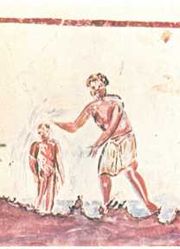
Clement's Identification of the Rich Youth as a Tax Gatherer

I have noted that Quis Dives Salvetur implies that the Zacchaeus narrative 'explains' the true meaning of Mark 10:17 - 31. I have made the argument that Clement must have been using a Diatessaronic gospel to develop this argument (because the equivalent of Luke 19:1 - 10 always follows Mark 10:17 - 31 in those narratives. I have also speculated that Zacchaeus (a name which means 'pure' or 'righteous') is indeed the very same 'rich youth' who appears in the earlier narrative only now 'purified' or 'made righteous' through baptism. I want to make a 'mental note to self' that Clement implies as much in Stromata 5:5 when he writes "Wherefore also the Word says that the tax-gatherers shall be saved with difficulty." The text actually only says 'rich.' The specific profession of the rich youth must have been implied from the connection with the Zacchaeus narrative (see Quis Dives Salvetur for a lengthy development of this argument).

Jerome's Nudus Nudum Motto Was Derived From Alexandria and its Original Devotion to Secret Mark

I think we have single-handedly changed the course of the debate with respect to the authenticity of the Letter to Theodore discovered by Morton Smith in the Mar Saba monastery. It was Stephen Carlson who effectively marshaled the suspicions of those who - let's be frank - were jealous of Smith's great discovery. He did so by taking the worst possible photos of the original document and claimed to have discovered a 'forger's tremor' a claim which has effectively been discredited by two recent studies.

The 'forger's tremor' argument was the 'respectable proof' as it were which secretly brought in the room a scurrilous claim that Morton Smith was nothing short of a diabolical agent of Satan. Now all we are left with is foundation-less theories about Morton Smith's personal life, sexual orientation and 'hatred' for the Church, academic tradition and the like. For many that is enough to convict the document of being a forgery. Moreover, given the complete lack of imagination on the part of those who argue for authenticity (God seems to have given all the creative flights of fancy to those of the hoax hypothesis) we have stepped forward with much more compelling argument - Jerome preserved the original Alexandrian interpretation from Secret Mark witnessed in the Letter to Theodore.

I don't want to continue repeating this breakthrough over and over again in each post that I write. Indeed I will end up loosing the faithful readership who come here everyday to provide them with what this 'Secret Mark conference in Toronto' will not - i.e. a decision as to the authenticity of the document. New readers are free to go back into the archives and see all the work we have already accomplished.

The bottom line is that Jerome says that the entire Christian message is summed up by a 'naked disciple with naked Christ' which follows from the commandment that Jesus gives to the rich youth in Mark 10:17 - 31. I have demonstrated at least ten occasions where Jerome betrays knowledge of the formula of the Letter to Theodore. Now we are continuing to show that the same 'naked with naked' formula is actually also present in the accepted writings of Clement - you just need the Letter to Theodore and knowledge of Jerome's preservation of the same Alexandrian formula to lay bare the original testimony.

Let's start with a reference to the nakedness of the ideal disciple after Clement's citation of the Alexandrian version of Mark 10:21 in Quis Dives Salvetur - a work which explains the proper understanding of Mark 10:17 - 31. We should pay close attention to the 'naked' reference at the end of the cited section:
But Christ is the fulfilment “of the law for righteousness to every one that believeth;” and not as a slave making slaves, but sons, and brethren, and fellow-heirs, who perform the Father’s will. “If thou wilt be perfect." Consequently he was not yet perfect. For nothing is more perfect than what is perfect. And divinely the expression “if thou wilt” showed the self-determination of the soul holding converse with Him. For choice depended on the man as being free; but the gift on God as the Lord. And He gives to those who are willing and are exceedingly earnest, and ask, that so their salvation may become their own. For God compels not (for compulsion is repugnant to God), but supplies to those who seek, and bestows on those who ask, and opens to those who knock. If thou wilt, then, if thou really willest, and art not deceiving thyself, acquire what thou lackest. One thing is lacking thee,—the one thing which abides, the good, that which is now above the law, which the law gives not, which the law contains not, which is the prerogative of those who live. He forsooth who had fulfilled all the demands of the law from his youth, and had gloried in what was magnificent, was not able to complete the sale (πραθῆναι) with this one thing which was specially required by the Saviour, so as to receive the eternal life which he desired. But he departed displeased, vexed at the commandment of the life, on account of which he supplicated. For he did not truly wish life, as he averred, but aimed at the mere reputation of the good choice. And he was capable of busying himself about many things; but the one thing, the work of life, he was powerless, and disinclined, and unable to accomplish. Such also was what the Lord said to Martha, who was occupied with many things, and distracted and troubled with serving; while she blamed her sister, because, leaving serving, she set herself at His feet, devoting her time to learning: “Thou art troubled about many things, but Mary hath chosen the good part, which shall not be taken away from her.” So also He bade him leave his busy life, and cleave to One and adhere to the grace of Him who offered everlasting life.

What then was it which persuaded him to flight, and made him depart from the Master, from the entreaty, the hope, the life, previously pursued with ardour?—“Sell thy possessions.” And what is this? He does not, as some conceive off-hand, bid him throw away the substance he possessed, and abandon his property; but bids him banish from his soul his notions about wealth, his excitement and morbid feeling about it, the anxieties, which are the thorns of existence, which choke the seed of life. For it is no great thing or desirable to be destitute of wealth, if without a special object,—not except on account of life. For thus those who have nothing at all, but are destitute, and beggars for their daily bread, the poor dispersed on the streets, who know not God and God’s righteousness, simply on account of their extreme want and destitution of subsistence, and lack even of the smallest things, were most blessed and most dear to God, and sole possessors of everlasting life.

Nor was the renunciation of wealth and the bestowment of it on the poor or needy a new thing; for many did so before the Saviour’s advent,—some because of the leisure (thereby obtained) for learning, and on account of a dead wisdom; and others for empty fame and vainglory, as the Anaxagorases, the Democriti, and the Crateses.

Why then command as new, as divine, as alone life-giving, what did not save those of former days? And what peculiar thing is it that the new creature (ἡ καινὴ κτισις) the Son of God intimates and teaches? It is not the outward act which others have done, but something else indicated by it, greater, more godlike, more perfect, the stripping off (γυμνῶσαι) of the passions from the soul itself and from the disposition, and the cutting up by the roots and casting out of what is alien (ἀλλότρια) to the mind. [Quis Dives Salvetur 10 - 12]
The original Greek for the last sentence here is:

τὸ τὴν ψυχὴν αὐτὴν καὶ τὴν διάθεσιν γυμνῶσαι τῶν ὑπόντων παθῶν καὶ πρόρριζα τὰ ἀλλότρια τῆς γνώμης ἐκτεμεῖν καὶ ἐκβαλεῖν.
which it might be noted is render in the French translation as:

Dépouillez-vous de vos vices, arrachez-les de votre âme, détruisez-les, rejetez-les loin de vous; tel est son commandement et sa doctrine, bien dignes des fidèles et de lui-même!

Strip off your flaws, tear them from your soul, destroy them, throw them away from you, such is his command and his doctrine, though worthy of the faithful and of itself!

I would like to take some time to demonstrate that the Greek clearly alludes to a castration ritual in Alexandria. But for the moment let's be content to notice that what is being said explicitly here with respect to the ritual nudity of the ideal disciple is exactly what is obscurely hinted at in the next reference to Mark 10:21 in Clement's writings:
“Sell what thou hast, and give to the poor, and come, follow Me” —that is, follow what is said by the Lord. Some say that by what “thou hast” He designated the things in the soul, of a nature not akin to it, though how these are bestowed on the poor they are not able to say.

«Vendez ce que vous possédez et donnez-le aux pauvres ; puis venez et suivez moi»

c'est-à-dire suivez les préceptes du Seigneur. Il en est qui veulent que ce mot ce que vous possédez (ta hyparchonta) désigne tout ce qui est étranger à l'âme.

« Πώλησόν σου τὰ ὑπάρχοντα καὶ δὸς πτωχοῖς, καὶ δεῦρο ἀκολούθει μοι,»

τουτέστιν τοῖς ὑπὸ τοῦ κυρίου λεγομένοις ἕπου. Ὑπάρχοντα δέ φασί τινες αὐτὸν εἰρηκέναι τὰ ἐν τῇ ψυχῇ ἀλλότρια, καὶ πῶς τοῖς πτωχοῖς ταῦτα διανέμεται, οὐκ ἔχουσιν εἰπεῖν

There can be no doubt now that Jerome got his notion of ritual nudity from an Alexandrian tradition related to Secret Mark - undoubtedly through the agency of Origen or one of his disciples. We cited the most explicit reference to ritual nudity which closely approximates Jerome's own references to the tradition in yesterday's post:
Wherefore also the Lord says, “Sell what thou hast, and give to the poor; and come, follow me.” Follow God, naked of arrogance (γυμνὸς ἀλαζονείας), naked of fading display (γυμνὸς ἐπικήρου πομπῆς), possessed of that which is thine, which is good, what alone cannot be taken away—faith towards God, confession towards Him who suffered, beneficence towards men, which is the most precious of possessions.

Διὰ τοῦτο καί «Πώλησόν σου τὰ ὑπάρχοντα», λέγει κύριος, «καὶ πτωχοῖς δός, καὶ δεῦρο ἀκολούθει μοι·» ἕπου τῷ θεῷ γυμνὸς ἀλαζονείας, γυμνὸς ἐπικήρου πομπῆς, τὸ σόν, τὸ ἀγαθὸν τὸ ἀναφαίρετον μόνον, τὴν εἰς τὸν θεὸν πίστιν, τὴν εἰς τὸν παθόντα ὁμολογίαν, τὴν εἰς ἀνθρώπους εὐεργεσίαν κεκτημένος, κτῆμα τιμαλφέστατον. [Paed. 2.3]

The 'hoax hypothesis' has effectively been overturned, don't you think?

Clement of Alexandria is Confirmed as Jerome's Ultimate Source for the Naked Youth Following the Naked Jesus After Mark 10:21

I don't know if the rest of you know how my evenings typically develop. I am tired. The kids are in bed. My wife is watching something on television involving judges and people cooking meals. I am sitting in my chair pretending to watch all the excitement when a thought related to the mysteries of the godhead comes into my head.

Tonight it was - I wonder if Jerome's references to ritual nakedness and the command to "go sell what you have and give to the poor" can be traced to Clement of Alexandria? I know some of you might be distracted watching Keeping Up With the Kardashians right now so I will try and explain the significance of all of this in very simple terms.

We have this letter that was discovered by Morton Smith in the Mar Saba monastery that purports to be from Clement of Alexandria. There really is no reason to doubt the authenticity of the document other than the fact that Smith seemed to have made a lot of enemies in his lifetime. Smith was a very good scholar so his enemies had to make personal attacks on the man, most of them after his death.

In a way that I have never really figured out, the critics of the Mar Saba document develop their case from the idea that Morton Smith must have been gay because he never got married. Morton Smith's alleged homosexuality now explains his 'hostility to the Church' which in turn provides need information for why he not only claimed that Jesus was a magician but that he ended up forging a text developed around the idea that a longer version of the gospel of Mark once existed in Alexandria a long time ago which had a naked Jesus baptizing a naked disciple.

All of this - the discovered letter, the lost gospel, Jesus naked with a naked disciple in the water - is supposed to be part of some diabolical plot on Smith's part to destroy Christianity or something like that. Like I said, I can't make sense of it. I get the silly ideas of one author mixed with the silly ideas of another.

The bottom line with these all these people claiming they are sure that Smith forged this otherwise unremarkable letter is that there is something horribly wrong with the idea of a naked Jesus appearing with a naked disciple immediately after the Question of the Rich Youth (Mark 10:17 - 31) narrative in Mark. Yet all of these scholars know full well that Jerome and the western monastic tradition had just such a motto for most of the last two millenia - nudus nudum or nudum Christum nudus setjuere or some such related terminology.

The bottom line is that the letter to Theodore and the saying of Jerome are identical. Jerome repeatedly connects the idea with baptism. Baptism was performed in the nude in antiquity with naked men standing beside one another 'in the bath' as Celsus refers to it. There isn't a single aspect of the formulation that is bizarre or unseemly.

So why do all these experts like Craig Evans, Larry Hurtado, Bart Ehrman and the like all have a problem with the Letter to Theodore? Oh, if you ask these windbags this question they will go on and on with what amounts to being utter nonsense. Like children who refuse to admit the truth, the facts of the matter here is that it's Morton Smith and his attempt to tie the letter to his crazy theory about magic and sexual libertines that's the issue.

If someone like Jacques-Paul Migne or a host of other acceptable scholars had uncovered the text, we wouldn't be sitting here making reference to any controversy. The letter really is a letter by Clement of Alexandria and aside from making reference to the idea that St. Mark decided to add something to his gospel, there really isn't anything that is utterly earth shattering about the text - other than the fact that it now lays bare how utterly subjective and mendacious Biblical scholarship is these days.

The thing we can't lose sight of here is the fact that Jerome clearly connects his 'naked with naked' concept with Mark 10:17 - 31 and Mark 10:21 in particular. Where did he get this idea? It simply can't have come from his own imagination because we see Clement make the exact same reference about two hundred years before him:
Wherefore also the Lord says, “Sell what thou hast, and give to the poor; and come, follow me.” Follow God, naked of arrogance (γυμνὸς ἀλαζονείας), naked of fading display (γυμνὸς ἐπικήρου πομπῆς), possessed of that which is thine, which is good, what alone cannot be taken away—faith towards God, confession towards Him who suffered, beneficence towards men, which is the most precious of possessions.

Διὰ τοῦτο καί «Πώλησόν σου τὰ ὑπάρχοντα», λέγει κύριος, «καὶ πτωχοῖς δός, καὶ δεῦρο ἀκολούθει μοι·» ἕπου τῷ θεῷ γυμνὸς ἀλαζονείας, γυμνὸς ἐπικήρου πομπῆς, τὸ σόν, τὸ ἀγαθὸν τὸ ἀναφαίρετον μόνον, τὴν εἰς τὸν θεὸν πίστιν, τὴν εἰς τὸν παθόντα ὁμολογίαν, τὴν εἰς ἀνθρώπους εὐεργεσίαν κεκτημένος, κτῆμα τιμαλφέστατον. [Paed. 2.3]
This is yet another home run, my friends. It confirms that not just Jerome but Clement understood that Mark 10:21 was connected with the ritual nudity of Christian ascetics. They were not only following the command to sell all they had but clearly also something more.

There is absolutely nothing in Mark 10:17 - 31 to infer that the rich youth or anyone else in the narrative for that matter was a 'naked follower' of Jesus. It makes absolutely no sense to assume that St. Mark was trying to say 'those reading my gospel are the first 'naked disciples'" for the Church had to have been founded on some apostolic foundation. Clement and Jerome are clearly part of an Alexandrian tradition which assumed that at least one follower of Jesus ended up naked with Jesus in the baptismal waters. Given that Alexandria is clearly the point of origin for this tradition, it is more likely than not that the 'rich youth' figure was St. Mark himself.

If I can return to issue of the obtuseness of modern scholarship for a minute, the situation we find ourselves in academia is very similar to contemporary politics. People like Evans, Hurtado and the like all pretend to be 'conservatives' who - in their own mind at least - are attempting to defend the inherited tradition of their ancestors. Yet Jerome's nudus nudum motto is the very beating heart of Catholic mysticism. These men by contrast are anglo-evangelicals, who really have no connection to the apostolic Church other than in their own imagination. They are conservatives in name only.

If we really want to preserve and strengthen the true roots of Christianity and the mystical flame which keeps faith alive we should embrace the Letter to Theodore. It represents nothing short of the original grounding of Jerome, Maximus of Turin, Gregory the Great, Thomas a Kempis, Francis of Assisi and all the popes, mystics and thinkers of Catholic tradition who marched under the nudum Christum nudus setjuere banner.  It is the modern evangelical heresy with its advocates Craig Evans, Larry Hurtado and their ugly minions who represent the real break with tradition.

Let's condemn the heretics once and for all in Toronto, April 29!

Wednesday, March 30, 2011

The Testimony of Maximus of Tyre

We have already delivered the knock out punch to the claims that the Letter to Theodore is a fake in our discovery of the 'nudus nudum' formula of Jerome and the western monastic tradition. Jerome always seems to connect this saying with Mark 10:17 - 31 and thus is certainly witnessing the survival of knowledge of 'Secret Mark' in the West. Yet this is only the beginning of our efforts. In the coming days we will start to develop a case that Maximus of Tyre's formula 'the naked to the naked, the loving to the loved, and the free to the free' (γυμνὸν γυμνῷ, φίλον φίλῳ, ἐλεύθερον ἐλευθέρῳ) was ultimately also connected with the Letter to Theodore.

I have been reading a great deal about this remarkable historical figure. It will be very easy to connect him with the pagan critic Celsus as there are remarkable similarities in their world view. But it should be pointed out that many of Maximus's statements sound very Christian such as:
That beauty which eye has not seen in its fulness, and of which no tongue may tell, may yet gleam for moments on those who break through the veil of flesh; but thou shalt see it in its fulness only when God calls thee to Him.
Compare this to the apocryphal statement in 1 Corinthians 2.9:
No eye has seen, no ear has heard, and no mind has imagined what God has prepared for those who love him
I can't believe that Maximus has just happened to have written something which sounds like scripture. Is it really that impossible that the Platonist came into contact and appropriated Christian writings?

In the coming days we will examine we will examine the arguments that 'the naked to the naked, the loving to the loved, and the free to the free' is somehow a citation of a psalm or hymn developed by the Alexandrian tradition from its 'secret gospel.'

There Are Indeed References to the 'Naked With Naked' Concept in the Accepted Writings of Clement - You Just Need to Make the Connection With Jerome's 'Nudus, Nudum' Concept In Order to See Them

Of course you're asking yourselves - how is it that I have never heard of these references?  I found myself asking the same question when I stumbled upon them.  I kept wondering why I couldn't find any 'naked' references in Clement and then behold, I found this speech at the end of the Exhortation to the Greeks put into the mouth of Jesus:

For I want, I want to impart to you this grace, bestowing on you the perfect boon of immortality; and I confer on you both the Word and the knowledge of God, My complete self. This am I, this God wills, this is symphony, this the harmony of the Father, this is the Son, this is Christ, this the Word of God, the arm of the Lord, the power of the universe, the will of the Father; of which things there were images of old, but not all adequate. I desire to restore you according to the original model, that ye may become also like Me. I anoint you with the ungent of faith, by which you throw off corruption, and show you the naked form of righteousness (καὶ γυμνὸν δικαιοσύνης) by which you ascend to God. [Exhort. 121]

While there is no specific reference to the initiate also being naked, the context is clearly baptism and the early Christian rite was certainly performed with the participants naked.

We have already seen in our study of the nudus, nudum concept in Jerome and the monastic tradition in the West that motto is rooted in a restoration of Eden. This idea is also clearly present here in the concluding words of the Exhortation and one can make a very persuasive case that Clement is Jerome's ultimate source for the conception, perhaps by way of the 'naked Logos' of Origen.

In short, what Clement is really saying when you think about it, is that baptism restores the state of grace lost with Adam's fall. This is clearly achieved by Jesus (or his ecclesiastic representative) exposing his nakedness while the already naked initiate enters the water. There is an underlying mystic concept here that we haven't fully delineated yet but this is coming. We can be certain that it explains why Jesus wasn't naked when he was walking around on the earth the rest of the time of his ministry.

It is enough however to also demonstrate to our readership that if we look carefully at what follows in the Exhortation that it is impossible not to also be aware of the 'loving God' metaphor of LGM 1 and the underlying context of Mark 10:17 - 31 as with the Latin preservation of the nudus, nudum concept:

Let us haste, let us run, my fellowmen--us, who are God-loving and God-like images of the Word. Let us haste, let us run, let us take His yoke, let us receive, to conduct us to immortality, the good charioteer of men. Let us love Christ ... Let us aspire, then, after what is good; let us become God-loving men, and obtain the greatest of all things which are incapable of being harmed--God and life. Our helper is the Word; let us put confidence in Him; and never let us be visited with such a craving for silver and gold, and glory, as for the Word of truth Himself. For it will not, it will not be pleasing to God Himself if we value least those things which are worth most, and hold in the highest estimation the manifest enormities and the utter impiety of folly, and ignorance, and thoughtlessness, and idolatry ... we must with all our might follow God, and in the exercise of wisdom regard all things to be, as they are, His; and besides, having learned that we are the most excellent of His possessions, let us commit ourselves to God, loving the Lord God, and regarding this as our business all our life long. And if what belongs to friends be reckoned common property, and man be the friend of God-for through the mediation of the Word has he been made the friend of God--then accordingly all things become man's, because all things are God's, and the common property of both the friends, God and man. [Exhort. 122]

I think that it is safe to say that there is enough here to argue that Clement is the ultimate source of the nudus, nudum material. Of course, this understanding would have been impossible to untangle if Morton Smith hadn't found the Mar Saba document. The references are deliberately obscure on Clement's part ...

And Now For a Complete Paradigm Shift With Regards to LGM 1...

I should have recognized this before of course; yet the human mind works in strange ways.  Sometimes I think to myself that the whole reason that I investigate the problem of the origins of Christianity is that I like to observe the inner workings of my attempt to solve a mental problem.  In any event, when you strip down so to speak the 'naked with naked' concept from to Theodore and see that it had a life independent of Clement of Alexandria, continuing to beat throughout the ages (especially in the West), it is only natural that we attempt to find out whether it was preserved in other cultures, in other languages.

What language would be the primal source of the expression?  Most New Testament scholars will of course tell you that the gospel was written in Greek.  Yet there was certainly a powerful and very early Aramaic speaking Christian community which was at least as old - if not older - than the Greek Church.  What would the 'naked with naked' motto look like in Aramaic, the presumed language of Jesus and the apostles?  Here is where things get very, very interesting.

For when I started to work the problem out in my mind I realized at once that the Aramaic word for 'naked' would at once itself be a core concept of the Christian religion. שלח is one of many words in Aramaic that has two seemingly unrelated meanings.  It means at once 'stripped' or 'naked' and is at the same time 'to send' - the root of the title 'the apostle.'  Here is a link to the page in Sokoloff's Jewish Aramaic Dictionary so that the reader can see for his or herself.

In other words, 'nakedness' might well have added significance in LGM 1 if we assume with Morton Smith that Secret Mark itself derives from an Aramaic or Hebrew gospel.  As it turns out we don't need to do a lot of imaginative speculation because the early Syriac writers like Ephrem the Syrian consistently develops a play on words on the shared meaning of the term in his writings. Robert Murray in his Symbols of Church and Kingdom: a Study in Early Syriac Tradition brings forward an important example here:

The principal passage on the Holy Spirit in all Ephrem's works is HFid. 74-2 The Spirit is symbolized mainly as warmth, emitted by the sun as the Spirit is sent by the Father. The Spirit warms the naked and clothes them as Adam was clothed with glory; and then, passing to the Apostles by means of an untranslatable play on shlikha which means both 'naked' and 'sent' (apostle), Ephrem continues:

[Warmth] is dear to all who are naked/sent,
sending them forth as eager workers for all [sorts of] tasks.

Even so the Spirit clothed the naked/Apostles,
as it sent them forth to the four winds [lit. directions] upon their tasks.

By means of warmth all things ripen,
as by the Spirit all are sanctified, a transparent symbol!
[p. 80]

The point of course is that this is only one of many such references in the writings of Ephrem where it would appear that the 'apostles' are so called because they received baptism (i.e. that 'naked' they were clothed by the Holy Spirit).

This concept becomes a little clearer from other references in Ephrem's writings. In Rhythm the Fifth Jesus is likened to a pearl for whom men strip off their clothes to seek and find:

Men with their clothes off dived and drew thee out, pearl! It was not kings that put thee before men, but those naked ones who were a type of the poor and the fishers and the Galileans; for clothed bodies were not able to come to thee; they came that were stript as children; they buried their bodies and came down to thee, and thou didst much desire them, and thou didst aid them who thus loved thee.

Glad tidings did they give for thee : their tongues before their bosoms did the poor [fishers] open, and produced and showed the new riches among the merchants : upon the wrists of men they put thee as a medicine of life. The naked ones in a type saw thy rising again by the sea-shore ; and by the side of the lake they, the Apostles1 of a truth, saw the rising again of the Son of thy Creator.

By thee and by thy Lord the sea and the lake were beautified. The diver came up from the sea and put on his clothing ; and from the lake too Simon Peter came up swimming and put on his coat ; 1 clad as with coats, with the love of both of you, were these two.

And since I have wandered in thee pearl, I will gather up my mind, and by having contemplated thee, would become like thee, in that thou art all gathered up into thyself; and as thou in all times art one, one let me become by thee!

The point I am trying to make here is that we have I think finally confirmed that Morton Smith was absolutely right to identify LGM 1 as a baptism ritual. Yet more than this, it obviously suggests that the rich youth was more than just 'some guy' that he decided to initiate; he is undoubtedly 'the apostle' - i.e. the head of the Alexandrian Church whose experience with Jesus led to the establishment of the ritual we know from other sources was called the 'apolutrosis' i.e. the 'redemption.'

I think it is again quite reasonable to imagine that Secret Mark developed from an Aramaic source or may well have been itself preserved in Aramaic or Hebrew.  The 'nakedness' metaphor here must have been connected to 'apostleship.'  The difference between the culture of Ephrem and that of Clement of course is that the Alexandrian Church undoubtedly only had one apostle originally.  The power of the 'nudus, nudum' metaphor now is clearly that the 'rich youth' is clearly being transformed into an 'apostle' from his nakedness taking on the person of Jesus who was after all an angelic 'apostle' sent for by the Father.

Jerome and the Preservation of Ancient Alexandrian Gnosis

St. Jerome, in one of his writings, puts the following words into the mouth of a Stoic, named Cheremon, who is describing the life of the ancient priestsof Egypt : "Their priests have no commerce with women from the time they attach themselves to the service of the divinities ; in order to quench the flames of unlawful desire, they abstain entirely from flesh and wine, and the ministers of Cybele were all eunuchs." Jerome appears to insinuate, that priests and monks, who rashly take upon themselves vows of chastity, and engage to guard a virginal purity, should use the infallible process of the pagan ministers when they discovered that the spirit was too weak to arrest the desires of the flesh. [Louis Marie DeCormenin A Complete History of the Popes of Rome p. 66]

Another example of Jerome secretly maintaining the ancient traditions of Alexandria. This is Marcionitism, folks.

Getting to Checkmate in the 'Secret Mark Debate'

As anyone with any objectivity can plainly see, Jerome's nudus nudum motto and its consistent connection with Mark 10:17 - 31 in his writings tips the scales in favor of authenticity with respect to the authenticity of the Mar Saba document.  Instead of participating in a debate with scholars (who won't listen to what I or anyone else has to say anyway if it is contrary to their established position) it is time to approach things in a way that finally and forever changes the playing field.

And what is that you ask?  

The nudus nudum formula may be news to you and I but it represents the very heart of the real Catholic faith for centuries.  Up until the discovery of the Mar Saba document Jerome's dictum seemed to be just that - Jerome's invention.  That is all about to change.  Jerome and the Franciscan Order can now be argued to have preserved nothing short of the truest of Christian traditions.  This is not a mere 'motto' developed out of the imagination of an influential fourth century scholar, translator and theologian.  It is now certainly a tradition which goes back to the earliest of sources - viz. the very interpreter of Peter, St. Mark himself.

The Catholic Church has never come out with an official position on the authenticity of the Mar Saba find.  Most of the major figures who promote the hoax hypothesis are evangelical scholars (save for the music teacher).

My guess is that they will take Jerome's word over all of them.  Such an endorsement would completely transform the playing field.  Does anyone take these evangelicals seriously besides themselves?

Did Knowledge of Secret Mark Ever Completely Leave Christianity?

I know people will find this line of inquiry puzzling because in a sense we 'rediscovered' the existence of Secret Mark when Morton Smith found the Letter to Theodore. Yet this letter really amounts to being a formal recognition of a concept - embodied by the nudus nudum slogan of Jerome - which has been at the very heart of monasticism in the West to this very day. I happened to be reading just now a passage in Thomas à Kempis's Imitation of Christ which bears a striking similarity to the significance that LGM 1 (= the first addition to the longer gospel of Mark) must have had for Alexandrian Christians at the time of Clement of Alexandria:
Give all for all, look for nothing, ask nothing in return: rest purely and trustingly in Me, and you shall possess Me. Then you will be free in heart, and no darkness will oppress your soul. Strive for this, pray for this, desire this one thing - that you may be stripped clean of all selfishness,and naked follow the naked Jesus, dying to the self that you may live to Me for ever. Then will all vain fantasies be put to flight, and all evil disorders and groundless fears vanish. Then will all fear and dread depart, and all disordered love die in you. [The Imitation of Christ, Book III, Chapter XXXVII: How Surrender of Self Brings Freedom of Heart]
Many of you may be aware that I discovered a very old tradition which survives in the early medieval rabbinic literature about Marcus Julius Agrippa being the true messiah of Israel and especially of Daniel 9:26. I inevitably find myself confronted with idiots who tell me that it is impossible that any of these remembrances could be anything other than inventions of later Jewish interpretation. Yet I don't believe that for a minute because we find Origen making specific reference to Jewish historical chronologies (clearly Justin of Tiberias's lost Chronicle) that say the same thing.

I am beginning to think that the same thing might have been at work in Christian monasteries with respect to 'Secret Mark' from the time of Jerome onward.

The facts are that it might be possible that Thomas is here just collating and expanding upon traditions that date back to Jerome. Yet even this is not completely worthless information. He might have brought into the mix texts and traditions which are no longer available to us. We simply don't know other than it is impossible to believe that Thomas or Jerome simply 'invented' the nudus nudum concept. Organized religion doesn't work that way. Innovation is tantamount to heresy (except in the American evangelical Church it would seem). What find instead is an endless recycling of old theological ideas in new languages and new dressings.

The bottom line is that Thomas's ideas here sound strikingly similar to the literary context of LGM 1. It should not surprise us that if we went through the chain of transmission of the nudus nudum concept that many of the ideas represented here could be traced back to the fourth century and Jerome. Standing here we are only a few steps away from Origen and his 'naked Logos' concept and with Origen, his teacher Clement of Alexandria.

Tuesday, March 29, 2011

Jerome, Nakedness and the Lost Concluding Narrative to the Question of the Rich Youth (Mark 10:17 - 31)

I think we have solved the fifty year old question of whether the Mar Saba document (i.e. the Letter to Theodore) represents an authentic correspondence of the Church Father Clement of Alexandria.  We have noticed that Jerome, the cautious Origenist, is clearly drawing from some ancient source for his most famous motto 'nudus nudum Christum sequi' which went on to inspire the western monastic tradition into modern times.  Yet it is impossible to argue that Jerome just 'made up' the connection between ritual 'nakedness' and monastic path.  Already in his Life of Paul the Hermit we see the association already established:

He, though naked, kept the garment of Christ; you, clothed in silk, have lost Christ's robe. Paul lies covered with the meanest dust, to rise in glory;  you are crushed by wrought sepulchres of stone, to burn with all your works. Spare, I beseech you, yourselves; spare, at least, the riches which you love.  Why do you wrap even your dead in golden vestments ? Why does not ambition stop amid grief anil tears? Cannot the corpses of the rich decay save in silk? 1 beseech thee, whosoever thou art that readest this, to remember Jerome the sinner, who, if the Lord gave him choice, would much sooner choose Paul's tunic with his merits, than the purple of kings with their punishments. [Conclusion to the Life of Paul the Hermit]
What is so critical about this reference is that Jerome is not merely 'making up' the naked monastic ideal nor the association with Mark 10:17 - 31 (which we have discussed at length elsewhere).  For all these elements are clearly already in place in his report on Paul the Hermit.

Indeed the important thing to see is that Jerome has deliberately taken the time to write this biography to upstage or correct the impression that readers might get from reading Athanasius's Life of Anthony as we read from Jerome's own hand:

There is a good deal of uncertainty abroad as to which monk it was who first came to live in the desert ... Yet Athanasius, who buried the body of his master, and Macerius, both of them Antony's disciples, now affirm that a certain Paul of Thebes was the first to enter on the road.

The point now is that Paul is only said to be the first hermit not because he 'invented monasticism' but because he represented a type of celibacy and communal living that was completely cut off from humanity.  There are clear intimations that 'virgins' lived on the environs of the Church of St. Mark in Alexandria and in the surrounding tombs.  Yet Paul is said to have fled the common intercourse of Christians and pagans to the relative safety of the Theban desert during the persecution of Decius and Valerianus around 250 CE.

Why is this dating significant?  Because it is the very same period in which Origen and Ambrose were tortured - Origen living only another four years after his abuse and dying in the year 254 CE.  The naked Paul represents something of a preservation of the original ascetic ideal associated with Alexandria perfectly preserved in the isolation of the desert.  The stories that Jerome tells reinforce the interest in the 'perfect state' of nudity in his own writings.  Paul is said to have lived in the mountains of this desert in a cave near a clear spring and a palm tree, the leaves of which provided him with raiment and the fruit of which provided him with his only source of food till he was 43 years old, when a raven started bringing him half a loaf of bread daily. He would remain in that cave for the rest of his life, almost a hundred years.

The point again is that it is impossible not to suspect now that this 'nudus nudum' in ultimately connected with the Alexandrian monastic tradition and the Alexandrian gospel of Mark referenced in the Letter to Theodore - a document developed from an original question from an unknown Theodore to Clement about a saying he has heard from the mouths of certain Alexandrian Christians 'γυμνὸς γυμνῷ' (Theod. III.13) and also known to their contemporary, the Platonic philosopher Maximus of Tyre in a speech direct presumably at similar groups of Christians (Dissertation 41).

If we go back to our previous discussions of this tradition we noted that Maximus of Tyre (c. 170 CE) preserves the full Alexandrian sorites as:

naked with naked, friend with friend, freeman with freeman
γυμνὸς γυμνῷ, φίλος φίλῳ, ἐλεύθερος ἐλευθέρῳ

It should be argued here that Paul would have been exposed to this original initiation which made men gods - or if you prefer - a ritual process by which Jesus continued to empty himself by means of a never ending succession of 'incarnations' into willing vessels.  There was undoubtedly a sense at the beginning of this tradition that those who underwent this mystic baptism were not only restoring the original purity of Adam in the garden but moreover 'freeing' themselves from the enslavement to the Jewish Law.  It is unknown what the exact complexion of the Alexandrian tradition looked like at the beginning of the Decian persecutions.

Nevertheless it is not impossible to see that the origins of this saying undoubtedly go back to some early Christian formula developed from Alexandrian Judaism and the true LXX known to Philo (the text which pretends to be the Septuagint is clearly different than the one known to the Alexandrian Jew). As we have noted in a previous post, 'friend with friend' (φίλον φίλῳ) appears as a formula twice in the writings of Clement of Alexandria - once as a direct citation of his LXX reading of Exodus 33:11 (where Moses is said to have been the 'friend of God) and again in a discussion of the true disciple as the 'friend' of God. The two understandings are undoubtedly related and certainly go back to the idea that LGM 1 (= the first addition to the longer gospel of Mark) was developed from notions of purification established in Judaism at the end of the Second Commonwealth period (i.e. when the temple was standing).

So it is very important to also note that when scholars attempt to uncover where Jerome got his 'naked with naked' motto, they inevitably also go back to Alexandrian Judaism and Philo in particular. Stephen R. L. Clark in his paper 'Naked in the Shrine' (in S. Hutton and D. Hedley (eds), Platonism at the Origins of Modernity (Dordrecht: Springer, 2007 pp. 45 - 61) in discussing the motto notes that:

the association of nakedness and the sacred goes back at least to Philo of Alexandria's (fl. 40) allegory whereby the high priest must strip of the soul's tunic of opinion and imagery to enter the Holy of Holies, and 'enter naked with no coloured borders or sound of bells, to pour out as a libation the blood of the soul and to offer as incense the whole mind to God our Saviour and Benefactor [p. 45]

Clark ultimately connects the tradition with Platonism, yet it is important not to lose sight of the fact that these ideas were ultimately rooted in the contemporary Jewish practices at the end of the Second Commonwealth period and preserved through Christians writers like Clement of Alexandria.

I think it might be useful to cite the whole passage in Philo which is alleged to be the source of Jerome's formulation in order for us to see that Jerome (and Paul the hermit) can't have merely been 'freely associating' Philo's writings with existing monastic ideals.  The 'naked' ideal of the third, fourth and fifth centuries must itself go back to a lost gospel like 'Secret Mark' given Jerome's consistent connection of this concept with Mark 10:17 - 31.  First the reference in Philo's Allegorical Interpretation:

'And the two were naked, Adam and his wife, and were not ashamed' (Gen 2:25). 'Now the serpent was the most subtle of all the beasts that were upon the earth, which the Lord God had made' (Gen 3:1). The mind that is clothed neither in vice nor in virtue, but absolutely stripped of either, is naked, just as the soul of an infant, is bared and stripped of coverings: for these are the soul's clothes, by which it is sheltered and concealed. Goodness is the garment of the worthy soul, evil that of the worthless.

Now there are three ways in which a soul is made naked. One is when it continues without change and is barren of all vices, and has divested itself of all the passions and flung them away. ... What this means is this. The soul that loves God, having disrobed itself of the body and the objects dear to the body and fled abroad far away from these, gains a fixed and assured settlement in the perfect ordinances of virtue ... This is why the high priest shall not enter the Holy of Holies in his robe (Lev 16:l ff.), but laying aside the garment of opinions and impressions of the soul, and leaving it behind for those that love outward things and value semblance above reality, shall enter naked with no colored borders or sound of bells, to pour as a libation the blood of the soul and to offer as incense the whole mind of God our Savior and Benefactor.

There can be no doubt that there are at least some points of contact between what Philo writes and Jerome preserves with regards to the role of nakedness in the mystical initiation process with God. Yet there are clear missing links which cannot be explained by assuming that Jerome simply developed his 'nudus nudum' motto on his own.  The first and most obvious is that Jerome envisions a scenario where initiate and Jesus are naked together somewhere presumably undergoing some sort of ritual baptism. It is also clear that this understanding is rooted in the Question of the Rich Youth pericope (Mark 10:17 - 31) for it inevitably introduces the 'nudus nudum' formula - indeed even doing this specifically in reference to Paul the Hermit's monastic life. Further to this point is the fact that Jerome can also substitute the concept of 'Cross' for 'Jesus' which makes sense given that the Question of the Rich Youth is immediately followed by Jesus prediction of his Passion (Mark 10:32 - 34). As such there can then be no doubt that Jerome is not merely thinking of 'ritual nudity' but a ritual involving two naked men immediately following Mark 10:34.

So the question now of course is why can't Clement and Origen make reference to the ritual context of LGM 1 - i.e. a nude Jesus standing with a nude disciple - while Jerome can?  This is of course a loaded question because the circumstances associated with Clement's silence might well have been different than those of Origen.  I prefer to see the problem as something of a historical onion.  We have to peel back the various layers of the problem, the most obvious being the fact that the writings of Clement and Origen have likely not survived 'accidentally.'  There are many who argue that those who preserved Origen's writings (Pamphilus, Eusebius and Jerome) did so by 'purifying' the texts of heretical references.  A similar process can be argued to have taken place with respect to Clement's writings given that the man credited with preserving the exemplar of most of the surviving manuscripts - Arethas of Commagne - did not preserve the Hypotyposeis which was deemed so heretical that his teacher Photius of Byzantium denied it was authored by Clement.

The situation on the ground in Egypt was certainly hostile to the writings of Clement and Origen.  People often overlook the fact that most of the works of these early Alexandrian writers only survive because of the efforts of those outside of Alexandria.  There is also the curious concentration of former 'Origenists' (= 'Alexandrianists') in Italy in the late fourth century which may have contributed to the transplantation of native Alexandrian ideas such as the celibate priesthood, the Papacy as well as various pre-Nicene written traditions from Egypt by the fifth century. All that we can really say for certain is that there were many features of the Alexandrian religion which Clement and Origen must have felt responsible to 'cover up' in an age of persecution.  Origen for instance never explicitly alludes to his castrated state in his writings.  One may think of the silence about the γυμνὸς γυμνῷ metaphor as somehow related to all of this.

It is worth noting that Clement is much more receptive report other parts of the Alexandrian formula preserved by Maximus - i.e. that an initiate draws close to God as a friend with friend (φίλος φίλῳ).  We will ultimately argue in a subsequent study of Origen that the Alexandrian does indeed develop this notion of loving God with a ritual prohibition on seeing the 'naked Logos' until the initiate is sufficiently prepared through instruction.

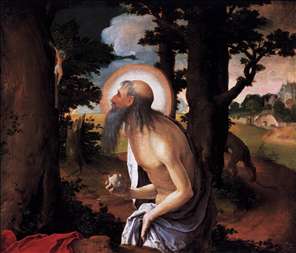
The Image of 'Secret Mark' - Jerome is Almost Always Depicted as the 'Naked Disciple' of Christ Because of his 'Nudus Nudum' Motto


Of course, no one sees 'hints of homosexuality' when the image is of a elderly man.  Yet I wonder if the same images depicted a young, naked Jerome depicted literally following a naked Jesus?   Here is a story from Christian antiquity which might serve as a guide:

A noteworthy example (of a contemporary paranoia against the 'nudus nudum' slogan) is the case of the four Franciscan friars arrested (in Venice) for infraction of the antisodomy law in 1420. What had the friars done to call down such a charge upon themselves? In what I assume was emulation of their founder and his literal enactment of Jerome's famous ascetic adage "Naked to follow the naked Christ" (nudus nudum Christum sequi), they had marched naked through the streets of the city, carrying a large cross and followed by a large crowd. After due judicial inquiry into the matter, the friars were eventually exonerated; however, to the superiors of these friars a stern warning was issued by the Council, which was "greatly displeased" by this naked procession: the unclothed gang of four, though acquitted, was nonetheless to be given some form of in-house punishment as an object lesson to them and their fellow Franciscans. [Franco Mormando, The Preacher's Demons p.161]

There is always going to be something about seeing two naked men or a group of naked men together which leads to the assumption of homosexuality. Another, more recent, example:

Maximus of Turin (Fifth Century CE) on the Reason Jesus Commanded the Rich Youth to Strip Naked

Now then, we are born naked in the world, naked we come to be washed, and naked also and unencumbered let us hasten to the gate of heaven. But how incongruous and absurd it is that one whom his mother begot naked and naked was received by the Church should wish to enter heaven rich! Consequently the Savior said to the young man in the Gospel who saw himself as righteous and holy and as one who had fulfilled all the commandments of the law: If you wish to be perfect, sell all that you have and give to the poor. To such an extent is bare virtue fitting for heaven that, no matter how righteous or holy someone possessing gold or riches is, he is unable to be perfect. For the Lord wanted that young man to return to paradise in the same state that Adam had been when he was cast down from paradise's height, for Adam was nude when he was a dweller in Paradise. But after the sin, seeing his own nudity, he covered his shameful parts with a leaf; before he had sinned, however, he was clothed in the condition of virtue. And thus it was not nature that created nudity as something vicious but criminal sin that revealed it to be so. Are the holy angels who are splendidly adorned clothed in tunics and mantles? Yet, although they are bereft of anything material by reason of their origin, they appear to be clothed because they are holy. So therefore Adam, maintaining the dignity of angelic virtue, was indeed unclothed as far as earthly apparel was concerned, but he was covered with the splendor of immortality. His eyes looked upon nothing evil, nor did his heart consider anything base; to virtuous minds nudity was itself clothed. For, as among wicked persons a vile thought is not kept from wanton desire by garments, so among holy men virtuous simplicity is not drawn to wanton desire by nudity [Sermon 58]

Monday, March 28, 2011

Jerome Consistently Connects the 'Naked with Naked' Motto With Mark 10:17 - 31 in His Letters

There must be a twenty or so references to the Question of the Rich Youth in the Letters of Jerome. There are many interesting things to be found in these allusions. Yet we will focus only on those which (a) intimate that a ritual state of nudity was somehow connected with this pericope and (b) that Plato's understanding of a sublimated form of pederastic love will ultimately grow wings for the initiate into the divine mysteries and carry him up to heaven:

if you will be perfect, go out with Abraham from your country and from your kindred, and go whither you know not. If you have substance, sell it and give to the poor. If you have none, then are you free from a great burden. Being yourself naked, follow a naked Christ [nudum Christum, nudus sequere]. The task is a hard one, it is great and difficult; but the reward is also great.[Letter 125]
For the present I will content myself by suggesting to your discretion that you should bear in mind the apostle's words: Are you bound unto a wife? Seek not to be loosed. Are you loosed from a wife? Seek not a wife that is, seek not that binding which is contrary to loosing. He who has contracted the obligations of marriage, is bound, and he who is bound is a slave; on the other hand he who is loosed is free. Since therefore you rejoice in the freedom of Christ, since your life is better than your profession, since you are all but on the housetop of which the Saviour speaks; you ought not to come down to take your clothes, you ought not to look behind you, you ought not having put your hand to the plough, then to let it go. Rather, if you can, imitate Joseph and leave your garment in the hand of your Egyptian mistress, that naked you may follow your Lord and Saviour [ut nudus sequaris Dominum Salvatorem]. For in the gospel He says: Whosoever does not leave all that he has and bear his cross and come after me cannot be my disciple. Cast from you the burden of the things of this world, and seek not those riches which in the gospel are compared to the humps of camels. Naked and unencumbered fly up to heaven; masses of gold will but impede the wings of your virtue. I do not speak thus because I know you to be covetous, but because I have a notion that your object in remaining so long in the army is to fill that purse which the Lord has commanded you to empty. For they who have possessions and riches are bidden to sell all that they have and to give to the poor and then to follow the Saviour. Thus if your worship is rich already you ought to fulfil the command and sell your riches; or if you are still poor you ought not to amass what you will have to pay away.[Letter 145]
As for you, when you hear the Saviour's counsel: if you will be perfect, go and sell that you have, and give to the poor, and come follow me, you translate his words into action; and making yourself naked to follow the naked cross [nudam crucem nudus sequems] you mount Jacob's ladder the easier for carrying nothing [Letter 58]
Once upon a time a rich young man boasted that he had fulfilled all the requirements of the law, but the Lord said to him (as we read in the gospel): One thing you lack, if you will be perfect, go your way, sell whatsoever you have, and give to the poor; and come and follow me. [Mark 10:21] He who declared that he had done all things gave way at the first onset to the power of riches. Wherefore they who are rich find it hard to enter the kingdom of heaven, a kingdom which desires for its citizens souls that soar aloft free from all ties and hindrances. Go your way, the Lord says, and sell not a part of your substance but all that you have, and give to the poor; not to your friends or kinsfolk or relatives, not to your wife or to your children. I will even go farther and say: keep back nothing for yourself because you fear to be some day poor, lest by so doing you share the condemnation of Ananias and Sapphira; but give everything to the poor and make to yourself friends of the mammon of unrighteousness that they may receive you into everlasting habitations. Obey the Master's injunction follow me, and take the Lord of the world for your possession; that you may be able to sing with the prophet, The Lord is my portion, and like a true Levite may possess no earthly inheritance. I cannot but advise you thus if you wish to be perfect, if you desire to attain the pinnacle of the apostles' glory, if you wish to take up your cross and to follow Christ. When once you have put your hand to the plough you must not look back; when once you stand on the housetop you must think no more of your clothes within; to escape your Egyptian mistress you must abandon the cloak that belongs to this world. Even Elijah, in his quick translation to heaven could not take his mantle with him, but left in the world the garments of the world. Such conduct, you will object, is for him who would emulate the apostles, for the man who aspires to be perfect. But why should not you aspire to be perfect? Why should not you who hold a foremost place in the world hold a foremost place also in Christ's household? Is it because you have been married? [Letter 118]
But you will hear the Lord reply: “The one who is able to perform such a thing, let him do so,” “If you want to be perfect, go, sell all that you possess,” etc. In saying, “If you want to be perfect,” He does not make this burden a requirement, but allows freedom to pursue either course regarding children. Do you want to be perfect and raise yourself to the highest level of virtue? Imitate the apostles, sell everything you have, give to the poor, and follow the Lord. Separated from all creatures and stripped of everything that you own in the world, follow Him bare, with only a cross. Or, are you content not to be perfect, and to remain in the second-highest level of virtue? Then abandon everything you have, and give it to your children and parents. No one will rebuke you, if you follow this lesser way, provided that you also agree that it is fair that you defer to one whose way tends toward perfection.

You will want to tell me that such sublime virtue is for the men and apostles, but it is impossible for a refined woman, who needs a thousand things to maintain her way of life. Hear therefore what the apostle Paul says: “I do not mean that others are helped and that you are overburdened, but that, to relieve inequality, your abundance compensates for their poverty, so that your poverty is also relieved by their abundance.” That is why the Lord says in the Gospel, “Whoever has two coats, let him give to him who has none.”

Now, if we lived among the ice of Scythia and the snow of the Alps, where not only two and three coats, but even the animal-skins are scarcely sufficient protection from the harsh cold climate, would we be obliged to strip ourselves to clothe others? We must understand “coat” to mean all that is necessary to clothe us and provide what is naturally required, since we are born naked.
And by “the provisions of a single day” is meant, whatever is necessary to feed ourselves. In this sense we fathom the commandment in the Gospel, “Do not worry about tomorrow,” that is, about the future, and the apostle’s statement, “While we have food and covering, we must be content.” [Letter 120]
When Nepotian laid aside his baldrick and changed his dress, he bestowed upon the poor all the pay that he had received. For he had read the words: if you will be perfect, sell that you have, and give to the poor and follow me, and again: ye cannot serve two masters, God and Mammon. He kept nothing for himself but a common tunic and cloak to cover him and to keep out the cold. [Letter 60]
I think it unnecessary to warn you against covetousness since it is the way of your family both to have riches and to despise them. The apostle too tells us that covetousness is idolatry, and to one who asked the Lord the question: Good Master what good thing shall I do that I may have eternal life? He thus replied: If you will be perfect, go and sell that you have and give to the poor, and you shall have treasure in heaven; and come and follow me. Such is the climax of complete and apostolic virtue— to sell all that one has and to distribute to the poor, and thus freed from all earthly encumbrance to fly up to the heavenly realms with Christ. [Letter 130]

It is important to note that this association between Mark 10:17 - 31 and 'naked with naked' continues into the Middle Ages. I am certain if we dig deeply enough in the monastic literature of the time we will continue to find interesting things. Giles Constable, writing in his Nudus Nudum Christum Sequi and Parallel Formulas in the Twelfth Century notes of only one such example "in the commentary on 1 John by Hugh of St Cher, who, after citing the injunction to "go sell what thou hast and give to the poor and come follow Me ... added, as if it were part of the Gospel text, 'nudus scilicet nudum.' This conflation exemplifies the association of the formula nudus nudum with the Biblical commands to follow Christ and helps to explain its popularity and prominence in the new evangelical piety of the twelfth and thirteenth centuries."

Who knew there was a St. Cher?

The Letter to Theodore is Officially Authenticated - Whenever Jerome Makes Reference to the 'Nudus Nudum' Concept He Does So Specifically in the Context of Mark 10:17 - 31

I have written already about this at length in my previous post but now we have uncovered the key to unlock the door and prove once and for all that the Mar Saba document is authentic. One of Jerome's most recognizable theological concepts is the saying nudus nudum christum sequi - 'naked following the naked Christ.' I have argued that previously that the Latin nudus nudum is related to the γυμνὸς γυμνῷ concept in Clement's Letter to Theodore discovered in 1958 by Morton Smith at the Mar Saba monastery. Now I want to show that Jerome himself explicitly consistently (some might say ritually) connects the 'nudus nudum' formula to Mark 10:17 - 31.

Whenever you come across a discussion of his use of nudus nudum christum sequi scholars will direct you to Letter 125 in Jerome's collection in which a clear reference to Mark 10:17 - 31 introduces the formula:

In his steps follow closely and in those of others like him in virtue, whom the priesthood makes poor men and more than ever humble. Or if you will be perfect, go out with Abraham from your country and from your kindred, and go whither you know not. If you have substance, sell it and give to the poor. If you have none, then are you free from a great burden. Naked yourself, follow a naked Christ. The task is a hard one, it is great and difficult; but the reward is also great.
This isn't the only example of this contextual grounding of the 'nudus nudum' concept. I will bring other examples from the letters of Jerome.

In any event, I'd say that was better than a home run! Grand slam? Inside the park grand slam? If you don't understand the significance for the understanding of the Letter to Theodore, please read the last five posts. The point is that Jerome was connected to Alexandria through Origen, whose works he zealously preserved in Latin. If you still don't get it, buy Stephen Carlson's book the Gospel Hoax ...

The Preservation of the γυμνὸς γυμνῷ Formula of the Letter to Theodore in Jerome and Other Early Latin Fathers

I want to thank Philippe for his comments on my last post. Believe it or not - truly no BS here - but getting help like that can make all the difference in the world.

I had been using the same source as he pointed me to - remacle.org - but I hadn't bothered to check the notation to the passage. It confirmed my own sense from the passage, that is - the line cited 'naked with naked, friend with friend, freeman with freeman' doesn't quite fit with what precedes it in Maximus's Dissertation 41.

The French translator gives the explanation that it might be a copyist error. Yet this was written before the discovery of the Mar Saba document were the beginning of the formula is cited by Clement of Alexandria. I think that a much more reasonable explanation is that Maximus, Theodore and Clement are all engaged in discussing an Alexandrian Christian formula related to heretical baptism.

I might have time tomorrow to bring forward Celsus's attack against the Christian interest in the preservation and perfection of the human body to bolster my argument that Maximus is attacking a pre-existent Christian belief. However, what I really want to thank Philippe for is the Latin translation of the original passage in Maximus. This is because it gave me the idea to do some searches for the preservation of the Mar Saba formula among Latin Church Fathers. And guess what I found?

I can't believe that scholars like Larry Hurtado can argue that the 'naked with naked' formula doesn't fit with the earliest monastic traditions in Christianity. I mean, I am just some crazy Jew learning about these things for the first time. He is supposed to be some 'defender of the faith' who is an expert on the earliest traditions of Christianity. You'd think the Latin Fathers and the earliest moastic traditions preserved in the Latin language would be right up his alley.

Indeed you'd think he would know all about the fact that the formulas 'nudus nudum Christum sequi' and 'nudus nudam crucem sequi' in the writing of Jerome. How isn't this an exact preservation of the original Alexandrian formula γυμνὸν γυμνῷ and γυμνὸς γυμνῷ preserved in the writings of Maximus, Clement and Theodore? It is impossible to argue that Jerome was not connected with Alexandrian Christianity given that Jerome was among the most active in preserving the writings of Clement's successor Origen. The point is that we know almost nothing about the development of monastic formulas from the time of Clement to that Jerome. It is absolutely conceivable that Jerome is actually preserving the same formula as cited in to Theodore.

All of which leads me to the next point - why the hell is γυμνὸς γυμνῷ so controversial? Theodore has obviously heard the very same formula as Maximus and later witnessed by Jerome. He has written Clement to ask if the saying appears in the Alexandrian gospel and Clement replies 'no, but there is this ...' and proceeds to cite LGM 1 (= the first addition to the longer gospel of Mark).

For those who are interested, I am providing a link to an article on the preservation of the nudus, nudum formula in Latin monastic writings. The question now is why haven't people like Larry Hurtado, who clearly know about these things brought this up in their 'studies' of the Mar Saba document. Could it be that modern scholarship is so driven by personality and popularity that experts like Hurtado are driven to shoot the message (i.e. the Mar Saba document) because of their hatred for the messenger (Morton Smith)?

I think we should close all the theology departments and start over again.

BTW Philippe, my mother asked me the same question about the election last night. Good luck!

More on the Christian Sorites in Maximus of Tyre Originally Cited By Theodore in Clement's Recently Discovered Correspondence

I have been very busy thinking about what I think is a Christian sorites cited in the mid-second century Platonic philosopher Maximus of Tyre. I think it might finally break the stalemate which exists in scholarship related to Morton Smith's controversial discovery at Mar Saba. Here is the saying as quoted in Maximus (who lived slightly before the time the letter to Theodore was written):

naked with naked, friend with friend, free with free

γυμνὸν γυμνῷ, φίλον φίλῳ, ἐλεύθερον ἐλευθέρῳ

I strongly suspect now that it is the saying transmitted from Theodore to Clement immediately before the Letter to Theodore was written. Maximus is here talking about bodies being naked, loved and freed. If we transform the original saying to its original context to what Theodore and Clement seemed to have known - viz. 'men' - the formula would read:

naked with naked, friend with friend, freeman with freeman

γυμνὸς γυμνῷ, φίλος φίλῳ, ἐλεύθερος ἐλευθέρῳ

Already to Theodore cites the first part of this expression - γυμνὸς γυμνῷ (Theod. III.13) in this form. Yet more interestingly now the second part of the formula - φίλος φίλῳ - is established in the LXX as a formula for God adopting a human being as a disciple.

We see Clement of Alexandria cite these very words in the very context that Maximus uses them - i.e. the need for the perfection of the flesh:

"Thou madest him a little lower than the angels." For some do not interpret this Scripture of the Lord, although He also bore flesh, but of the perfect man and the gnostic, inferior in comparison with the angels in time, and by reason of the vesture [of the body]. I call then wisdom nothing but science, since life differs not from life. For to live is common to the mortal nature, that is to man, with that to which has been vouchsafed immortality; as also the faculty of contemplation and of self-restraint, one of the two being more excellent. On this ground Pythagoras seems to me to have said that God alone is wise ... and that he himself was a philosopher, on account of his friendship with God. Accordingly it is said, "God talked with Moses as a friend with a friend" (Διελέγετο Μωυσεῖ ὁ θεὸς ὡς φίλος φίλῳ). [Strom. 4.3]

Chrysostom similarly identifies Adam's relationship with God as φίλος φίλῳ in his commentary on Genesis. Yet it has to be stressed that Clement is not citing from our LXX. The φίλος φίλῳ formula is completely absent.

The point is that everything will now come down to our ability to argue that Maximus's dissertation was originally directed against the Christian mysteries. The formula cited above must then have been connected with the Alexandrian ritual associated with LGM 1 (= the first addition to the longer Gospel of Mark). 'Naked with naked' is the preparation of baptism, 'friend with friend' identifies a state equal to Moses, 'freeman to freeman' represents the heretical ideal of escaping the bonds of the Law and thus being one 'greater than Moses.'

Sunday, March 27, 2011

Is Maximus of Tyre Citing a Second Century Alexandrian Christian Sorites That Was the Subject of Theodore's Original Question to Clement?

Of course the first question most people are going to have is 'what is a sorites?' The answer is that is a polysyllogism, or as Wikipedia notes 'a string of any number of propositions forming together a sequence of syllogisms such that the conclusion of each syllogism, together with the next proposition, is a premise for the next, and so on. Each constituent syllogism is called a prosyllogism except the very last, because the conclusion of the last syllogism is not a premise for another syllogism.'

One of the most famous sorites in early Christian literature is the second logia of the Gospel of Thomas, which was known to Clement of Alexandria:

Let the one seeking not stop seeking until he finds. And when he finds he will marvel, and marveling he will reign, and reigning he will rest.

I have been wondering all weekend why Clement's reference to 'naked to naked' (or 'naked man with naked man' as it is usually cited) seems to be known to Maximus of Tyre in a longer form:

the naked to the naked, the loving to the loved, and the free to the free

γυμνὸν γυμνῷ, φίλον φίλῳ, ἐλεύθερον ἐλευθέρῳ

I have been wondering whether Clement, Theodore and Maximus - all contemporaries living and writing in the age of Commodus - could have just arrived at the same citation 'by accident.' In other words, is Maximus's reference here just something 'he made up' as part of a speech against those who which to purify and perfect the body, or is Maximus citing something that he heard from Christians.

I am beginning to give serious consideration to the latter possibility.

The first thing I did in this series of posts is to compare Clement's γυμνὸς γυμνῷ Theod. III.13) with Maximus's γυμνὸν γυμνῷ. My working hypothesis would be that Maximus has adapted something that Christians say about the manner in which their mysteries 'perfect' the human body. Theodore may have heard this same saying - perhaps from Maximus or a hearer of Maximus's dissertation - and, after becoming aware of a 'secret gospel' associated with Mark, asking him whether the sorites appeared in the gospel. Clement's answer, which is preserved in the Letter to Theodore, makes clear that the saying does not appear in the gospel after Mark 10:34.

Yet notice at once that every part of the sorites forms a part of the fabric of the Letter to Theodore. At the very beginning, Clement makes some kind of reference to the Carpocratian claim that 'they are free':

and boasting that they are free (και καυχωμενοι ελευθερους), they have become slaves of servile desires

This would correspond to the conclusion of the sorites (ἐλεύθερον ἐλευθέρῳ). The manuscript ends with a segue to Clement's explanation of what the 'true love of God' (την αληθη φιλοσοφιαν εξηγησις where 'sophia' is a title of Jesus). This would correspond to the φίλον φίλῳ reference. And of course the citation of LGM 1 (= the first addition to the longer gospel of Mark) explains γυμνὸν γυμνῷ with Clement actually citing this, the first line of the sorites in his letter.

I have already demonstrated that Clement makes reference to the φίλον φίλῳ concept as being central to the mystery of Alexandrian Christianity in Strom 7.10. I have consistently demonstrated that all of these ideas appear in Plato originally. It can be noted that φίλον φίλῳ is drawn from a discussion in Lysias 916c. Now the reader should look at Plato's original use of ἐλεύθερον ἐλευθέρῳ in the Laws 9.857d:

You have reminded me of a previous reflection of mine, how that none of the attempts hitherto made at legislation have ever been carried out rightly—as in fact we may infer from the instance before us. What do I mean to imply by this remark? It was no bad comparison we made when we compared all existing legislation to the doctoring of slaves by slaves. For one should carefully notice this, that if any of the doctors who practice medicine by purely empirical methods [857d] devoid of theory, were to come upon a free-born (doctor) conversing with a free-born (patient) [ἐλεύθερον ἐλευθέρῳ], and using arguments, much as a philosopher would, dealing with the course of the ailment from its origin and surveying the natural constitution of the human body,—he would at once break out into a roar of laughter, and the language he would use would be none other than that which always comes ready to the tongue of most so-called “doctors”: “You fool,” he would say, “you are not doctoring your patient, but schooling him, so to say, as though what he wanted was to be made, not a sound man, [857e] but a doctor.”

We are rapidly approaching holy ground here - viz. an Alexandrian messianic tradition developed from Philo's fusion of Platonism and Judaism which gave birth to a gospel, the 'secret' gospel of Mark.

It will take some time to sort all these ideas out on paper and present them in a coherent systematic manner. But the next step is to demonstrate how similar Maximus's dissertation against an unnamed group is to Clement's attack against the Christian interest in perfecting the flesh of the human body. The reader should take the time to read Maximus's original argument (for which I provided a link in my last post).

Discovering the Original Source For to Theodore's γυμνὸς γυμνῷ Reference (Theod. III.13)

I wrote what I thought was just another speculative post last night about a possible source for the Letter to Theodore's γυμνὸς γυμνῷ - i.e. 'naked to naked' (Theod. III.13). I noticed that Maximus of Tyre has almost the exact same reference:

Or do you think that a man who has been well exercised, and who has strenuously laboured with his body, would be disturbed in consequence of his garments being torn; and that he would not willingly throw them away, and deliver his body to the air, the naked to the naked (γυμνὸν γυμνῷ), the friend to the friend, and the free to the free? what else, then, do you think this skin, these bones, and this flesh are to the soul than a diurnal robe and slender and effeminate rags? [Maximus of Tyre, Dissertation 13]

But then I did a search in Clement's writings for the next phrase which immediately follows 'naked to naked' in Tyre - i.e. φίλον φίλῳ - which is translated by Thompson as 'friend to friend':

and that he would not willingly throw them away, and deliver his body to the air, the naked to the naked, the friend to the friend (φίλον φίλῳ), and the free to the free?

ἀλλ´ οὐκ ἂν ἀπορρίψαι αὐτὰ ἄσμενον, καὶ παραδοῦναι τὸ σῶμα τῷ ἀέρι, γυμνὸν γυμνῷ, φίλον φίλῳ, ἐλεύθερον ἐλευθέρῳ

Most interestingly, the exact same phrase appears in Clement as a description of the initiate's love for Jesus in a ritual setting:

Knowledge is therefore quick in purifying, and fit for that acceptable transformation to the better. Whence also with ease it removes [the soul] to what is akin to the soul, divine and holy, and by its own light conveys man through the mystic stages of advancement; till it restores the pure in heart to the crowning place of rest; teaching to gaze on God, face to face, with knowledge and comprehension. For in this consists the perfection of the gnostic soul, in its being with the Lord, where it is in immediate subjection to Him, after rising above all purification and service.

Faith is then, so to speak, a comprehensive knowledge of the essentials; and knowledge is the strong and sure demonstration of what is received by faith, built upon faith by the Lord's teaching, conveying [the soul] on to infallibility, science, and comprehension. And, in my view, the first saving change is that from heathenism to faith, as I said before; and the second, that from faith to knowledge. And the latter terminating in love, thereafter gives the loving to the loved (φίλον φίλῳ), that which knows to that which is known. And, perchance, such an one has already attained the condition of "being equal to the angels." Accordingly, after the highest excellence in the flesh, changing always duly to the better, he urges his flight to the ancestral hall, through the holy septenniad [of heavenly abodes] to the Lord's own mansion; to be a light, steady, and continuing eternally, entirely and in every part immutable.[Clement Strom. 7.10]

The whole sentence here is:

And the latter terminating in love, thereafter gives the loving to the loved, that which knows to that which is known

ἣ δέ, εἰς ἀγάπην περαιουμένη, ἐνθένδε ἤδη φίλον φίλῳ τὸ γιγνῶσκον τῷ γιγνωσκομένῳ παρίστησιν

Is there something here beyond a strange set of coincidences? Could one author be citing the author or perhaps a Platonic text known to both (and presumably Theodore)? This is getting very, very interesting ...

Theodore's Original Reference to γυμνὸς γυμνῷ Doesn't Have to Be a Sexual Allusion

In the Letter to Theodore Clement is apparently responding to something that Theodore has asked about the γυμνὸς γυμνῷ Theod. III.13). Charles Hedrick has noted that there are two possibilities for this passage - i.e. something regarding 'naked with naked' or 'naked on naked.' Yet there is another possibility which no one else has considered - 'naked to naked' and it doesn't have to be a sexual reference.

Cassius Maximus Tyrius was an influential Platonist who flourished under the rule of the Antonines and Commodus. In short he was active while Clement was writing and he happened to write an influential dissertation where the concept of 'naked to naked' - γυμνὸν γυμνῷ - is explicitly referenced.

Maximus is talking about the disposing of the body - τὸ σῶμα - which is a neuter noun in Greek. This is why 'naked' is spelled like this γυμνὸν rather than γυμνὸς which is presumably connected with the Greek word for 'man' which is of course a masculine noun.

The dissertation in question can be found here. It is a response to a group who argued in some way that one should take the body seriously and help protect against its corruption. Reiske has proposed that the Cyrenaics, the earliest Socratic school founded by Aristippus the Elder, are the group being attacked here. I wonder whether Maximus has the Christian resurrection in mind with its attainment of a 'perfect body' after death. In any event here is the passage in question:
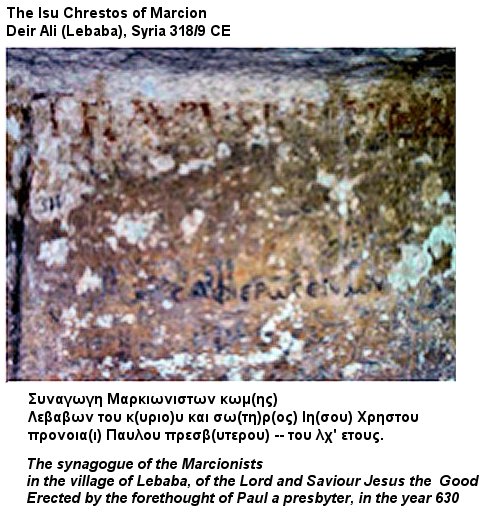
The dissertation begins with a citation of a popular prayer for 'health' or hygene (ὑγεία) and Maximus says that we should hope this is bestowed upon the soul rather than the mind. The section of text we are interested in begins:
The body is diseased, disturbed, and corrupted, but if you place over it as a ruler a robust soul it will pay no attention to the disease and will despise the evil. In this manner Pherecydes despised it when lying in Syrus, his flesh, indeed, being in a corrupt state, but his soul standing erect, and expecting the liberation from this cumbersome vestment.

I, indeed, should say, that neither is the corruption of the body unpleasing to the generous soul. Just as if you conceive a man in chains, who, while he sees the wall of his prison decaying and crumbling in pieces, waits for the egression and liberation from his bonds, that, from the abundant and profound darkness in which he has hitherto been buried, he may survey the aetherial regions and be filled with splendid light. Or do you think that a man who has been well exercised, and who has strenuously laboured with his body, would be disturbed in consequence of his garments being torn; and that he would not willingly throw them away, and deliver his body to the air, the naked to the naked (γυμνὸν γυμνῷ), the friend to the friend, and the free to the free? what else, then, do you think this skin, these bones, and this flesh are to the soul than a diurnal robe and slender and effeminate rags? these the sword cuts, fire liquifies, and ulcers consume. Hence the worthy soul, that has been inured to labour and exercise, desires to be divested of these with the utmost celerity ; so that some one, on surveying a generous man diseased in body, may exclaim, in the language of the suitors to Ulysses, "See what a hip the old-man's rags disclose!"

But the degenerate soul being buried in body, as' some sluggish reptile in its place of retreat, loves its den, and is never willing to be liberated from, nor to creep out of it ; but when the body is burnt' it burns with it, is dilacerated when it is torn in pieces, is pained when it is in pain,; and when it bellows exclaims: "Must I, O foot ! then leave thee? says Philoctetes. Leave it, O man ! and do not bellow, nor revile your dearest friends, nor disturb the land of the Lemnians : " O death !' of evils the physician +." If you thus speak, being about to exchange evil for evil, I do not accept the prayer : but if you think in reality that death is the physician of, and liberator from, this evil, insatiable, and diseased thing the body, you think well pray and invoke the physician.

It is worth noting that the 'naked with naked' is only taken to be a homosexual reference because it is assumed that it refers to 'naked man with naked man.' If Theodore was somehow citing Maximus's dissertation, it really only deals with a dead body being thrown naked to the air. Even if this isn't true, it is possible to envision an original reference to γυμνὸς γυμνῷ or γυμνὸν γυμνῷ (Clement may have changed the original reference from 'body' to 'man' consciously, unconsciously, deliberately, accidentally etc.) in something Theodore wrote (now lost) which has nothing to do homosexuality or sex. It might have been a reference to metempsychosis or to Maximus's original treatise.

The point is that we just don't know; it's just a two word citation of an unknown text now forever lost.

Saturday, March 26, 2011

Nakedness in Ancient Baptism Rituals

I have been thinking all day about the 'naked (man) on naked (man)' (γυμνὸσ γυμνῷ Theod. III.13) reference in Secret Mark. I think I have a very interesting insight into the ritual but I will try and take things one step at a time here. Let's first establish that the ancient Christians were naked together in the water.

Clement denies the Carpocratians' claim that the Secret Gospel included the phrase "naked man on naked man." Some scholars see in Clement's letter a reference to nude nocturnal baptism, since baptism originally involved disrobing (Gal. 3:27; Eph. 4:20-24; Col. 3:9-14) and was commonly performed by immersion at night or dawn (Acts 16:33; Hippolytus, Trad. ap. 21). Yet a better reference is Cyril of Jerusalem's On the Mysteries. II. which deals with baptism (and Romans 6. 3–14) in particular.

I have never understood how people reconcile the 'baptism into Christ's death' interpretation of the baptism ritual. To be sure, by Cyril's time it was standard to understand that baptism was somehow connected with the Passion. Yet it doesn't make any sense. The apostle references the crossing of the sea (1 Cor. 10:2) by the ancient Israelites which was understood to have taken place as the seventh day was 'going out' into the eighth. But this only has a superficial connection with Easter Sunday. It can't be the original understanding.

So it is I think that the apostle is referencing LGM 1 - the first 'addition' to the longer gospel of Mark mentioned in the Letter to Theodore. I happen to think that the apostle we have learned to call 'Paul' through our Catholic tradition was identified as 'Mark' among the early Alexandrians. But that is another story.

Let us establish that even in Cyril's age, the initiates were totally naked in the water. We read:

Know ye not, that so many of us as were baptized into Jesus Christ, were baptized into His death? for ye are not under the Law, but under grace.

These daily introductions into the Mysteries, and new instructions, which are the announcements of new truths, are profitable to us; and most of all to you, who have been renewed from an old state to a new. Therefore, I shall necessarily lay before you the sequel of yesterday’s Lecture, that ye may learn of what those things, which were done by you in the inner chamber, were symbolical.

As soon, then, as ye entered, ye put off your tunic; and this was an image of putting off the old man with his deeds. Having stripped yourselves, ye were naked; in this also imitating Christ, who was stripped naked on the Cross, and by His nakedness put off from Himself the principalities and powers, and openly triumphed over them on the tree. For since the adverse powers made their lair in your members, ye may no longer wear that old garment; I do not at all mean this visible one, but the old man, which waxeth corrupt in the lusts of deceit. May the soul which has once put him off, never again put him on, but say with the Spouse of Christ in the Song of Songs, I have put off my garment, how shall I put it on?

O wondrous thing! ye were naked in the sight of all, and were not ashamed; for truly ye bore the likeness of the first-formed Adam, who was naked in the garden, and was not ashamed.

Of course Cyril sees a parallel in the naked initiates and the naked Christ - but now he is already connected this 'nudity' with the crucified Jesus. I don't think this was so originally. I think there was just 'naked man on naked man' from the beginning. I will explain the 'on' part in my next post.

It is enough now to see that Cyril consistently attempts to connect the entire baptism ritual to the Passion - and it really doesn't seem to be the original understanding. Let's just look at the conclusion to see what I mean:

For in Christ’s case there was death in reality, for His soul was really separated from His body, and real burial, for His holy body was wrapt in pure linen; and everything happened really to Him; but in your case there was only a likeness of death and sufferings, whereas of salvation there was not a likeness but a reality.

Having been sufficiently instructed in these things, keep them, I beseech you, in your remembrance; that I also, unworthy though I be, may say of you, Now I love you, because ye always remember me, and hold fast the traditions, which I delivered unto you. And God, who has presented you as it were alive from the dead, is able to grant unto you to walk in newness of life: because His is the glory and the power, now and for ever. Amen.

I think the rich youth in the water with Jesus was the Christ and Jesus the God who made him divine. I think the two on top of one another wasn't actually sexual in any way but a reenactment of what happened to the ancient Egyptians as the sun sank into the sea at the beginning of the eighth day. But more on that tomorrow ...
 
Stephan Huller's Observations by Stephan Huller
is licensed under a
Creative Commons Attribution 3.0 United States License.