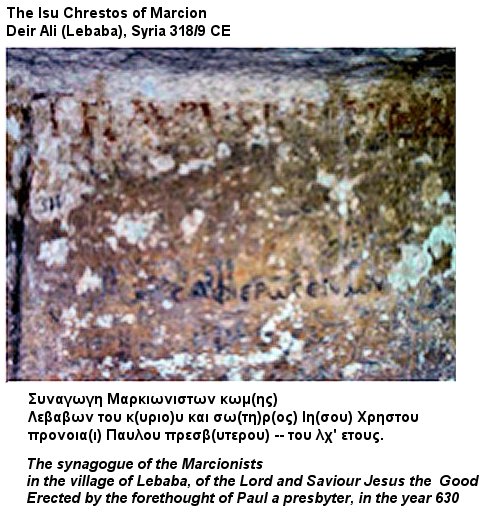
When early Christian authors talk about or reference Romulus becoming the god Quirinus, they are not indulging in antiquarian trivia. They were, I believe, recasting an original "heretical" narrative about Jesus descending to earth without witnesses through the lens of established Roman cultural memory. Of course I am ultimately assuming that the Marcionite gospel narrative was the original. Mark doesn't begin with a birth narrative - virgin or otherwise. Without getting into the complexities of the actual evidence it is enough to say that by the time Tertullian preserved what is now Book Four of Adversus Marcionem, we see the collision of Marcionism with the established Roman "pagan" culture. We aren't used to approaching this "heresy" from this perspective. We prefer to limit ourselves to imagining that Tertullian had before him the actual Marcionite canon and was faithfully preserving the contours of that document for us.
Nevertheless I think the "Romanization" of Christianity is under appreciated. Again, we just imagine or accept that "our religion" was "meant" to be Roman. That it was meant to be rooted in "the capital of the world." God just "destined it" for that role. Most of us are European. Most of us have an imperceptible smugness about the "superiority" of our cultural heritage. "It only makes sense that God would choose Rome because the West is the best" or something to that effect.
Most of us believe or accept (I see my own wife's struggle to come to terms with a historical sensibility when we visit European monuments). "This is old." How old? "I don't know." If you want to believe that the four gospels, the Acts of the Apostles, the Letters of Paul and the rest of the New Testament canon came from the first century, there are innumerable scholars and pieces of scholarship that will support that notion. But its not really true. There may have been gospels, letters of Paul and other early Christian writings that date from the first century CE but they are all lost. What we have instead is a collection of pseudo-first century writings that were significantly altered before being collected in a canon of writings.
Our Christianity doesn't date from the first century but from some period in the late second century CE which looks back another period in the middle of that century and reacts to the events of that period with anger. There was a very important text called or referred to as "the Outlines," written by someone whose name was remembered by later Church Fathers as "Hegesippus" which was likely just a Latin rendering of the Greek version of the Hebrew name "Joseph." This Joseph was a chronographer who wrote a historical chronology which must have superficially resembled the "Jewish Antiquities" of another, more familiar Joseph, "Josephus the Jew," the man who wrote our history of the Jewish War of 70 CE.
The early period of Christianity is very confusing and even more uncertain. Professional historians tend to "smooth over" the uncertainties to make their expertise seem more discernable. The truth is that this Joseph remembered as "Hegesippus" wrote his chronology in the "tenth year of the Emperor Antoninus Pius" that is 147 CE, which was at once the 900th anniversary of the founding of the city of Rome. I am of the opinion that our Josephus and this Josephus bear some relation to one another. Our "Josephus the Jew" wrote a "Jewish Antiquities" which is clearly based on Dionysius of Halicarnassus's Roman Antiquities. It has long been questioned how a Jewish general like Josephus would have developed sufficient mastery of Attic Greek to write this essential "knock off" of Dionysius's original. I won't get into all of that other than to say, I think there were two Joseph's one of the first century, another of the second who ultimately became one person according to later Christian literature.
The second century Joseph (= Hegesippus) wrote a massive historical chronology which must have resembled our surviving Jewish Antiquities except that it was carried down to the mid-second century CE. This "Jewish Antiquities" made reference to Jesus, the early disciples and a chronology of the various (fictitious) heads of the Jerusalem Church from James to the aforementioned "tenth year of Antoninus Pius." Alongside this original "Jerusalem chronology" a parallel list of bishops of the Roman Church along with references to heretical groups who came to the capital from Alexandria.
The significance of this "Joseph" (Hegesippus) is that his chronology was dedicated on the 900th anniversary of the founding of Rome, referenced Rome itself as having twin bishops - "Peter and Paul." It has long been noted that this specific formulation - "Peter and Paul" - was meant to invoke Romulus and Remus.
The Roman Story Everyone Knew
According to the standard Roman foundation narrative, Romulus, the founder of Rome, vanished during a public assembly. In the confusion that followed, rumors spread that he had been killed. At that point, a respected Roman citizen named Proculus Julius swore an oath that Romulus had appeared to him. Romulus, Proculus said, declared that (a) he was now divine, (b) he was to be worshipped under the name Quirinus, and (c) a temple was to be dedicated in his honor. This story is preserved in multiple classical authors—most notably Livy, Cicero, Plutarch, Ovid, and Dionysius of Halicarnassus. By the late Republic, it was not a fringe myth but a civic aetiology explaining why Rome had a god named Quirinus and why Romulus mattered not just historically, but religiously.
What matters for our purposes is not whether Romans literally believed this happened, but how the story functioned: Romulus’ divinization was anchored to a named witness, a sworn testimony, and public cult.
Cicero’s Use: Myth as Cultural Memory
In De legibus 1, Cicero brings up Romulus-as-Quirinus in a discussion about truth, poetry, and history. His interlocutor presses him on whether a poetic story about Marius and a sacred oak is “true.” Cicero replies indirectly, asking whether Atticus really believes that Romulus appeared to Proculus Julius and declared himself a god, or whether Boreas truly abducted Orithyia in Athens.
Cicero’s point is not to debunk these stories. It is to establish a category. Some narratives are handed down by tradition (traditum), embedded in civic memory, ritual, and identity. They are not judged by the standards of courtroom history, but neither are they dismissed as lies. They function symbolically, politically, and culturally.
Romulus becoming Quirinus is Cicero’s prime example of such a story: respected, meaningful, but not historically verifiable. He invokes it to say, in effect: don’t interrogate poetry as if it were sworn testimony.
Tertullian’s Use: Myth as a Legal Standard
Now fast-forward two centuries to Tertullian, writing Adversus Marcionem. Here the same story appears—but for the opposite reason. Marcion claimed that Christ suddenly descended from heaven in the fifteenth year of Tiberius, fully formed, without birth, preparation, or witnesses. Tertullian attacks this by appealing to Roman expectations of evidence.
His argument is interesting:
Even Romulus, he says, had Proculus Julius to testify to his ascent into heaven.
But Marcion’s Christ descended from heaven with no announcer, no witness, no orderly account.
The implication is devastating for a Roman audience. Tertullian is not praising the Romulus story; he is saying that even pagan myth knows better than to dispense with witnesses. If Rome demanded sworn testimony for the apotheosis of its founder, how much more should Marcion be expected to offer for a cosmic descent of God?
In one sharp line, Tertullian mocks both stories simultaneously, saying that Romulus ascended “by the same ladders of falsehood” by which Marcion’s Christ descends—but insists that Marcion’s version is worse, because it lacks even the minimal narrative discipline pagan religion maintained.
Why This Comparison Matters
What emerges from placing Cicero and Tertullian side by side is worth noting.
-
Cicero invokes Romulus–Quirinus to relax demands for historical proof.
-
Tertullian invokes the same story to tighten them.
That only works because the story itself was universally recognizable, culturally authoritative, and structurally clear: disappearance → witness → divine claim → cult.
This also explains why early Christian polemicists so often returned to Roman foundation myths. They were not arguing about gods in the abstract. They were arguing about how stories are authorized:
Who saw this?
Who testified?
Who preserved the account?
Why should anyone believe it?
The Deeper Point
Romulus-as-Quirinus is not invoked because Christians secretly admired Roman religion. It is invoked because it represents Rome’s own minimum standard for believing that a man became divine.
By invoking Proculus Julius, both Cicero and Tertullian reveal something fundamental about ancient thought: Divine claims without witnesses are suspect—even in myth. That insight sits quietly beneath early Christian debates about incarnation, descent, and revelation. And it explains why a story about Rome’s first king continued to haunt arguments about Christ centuries later.
But all of this leads to the greater point that Joseph/Hegesippus began the ball rolling on transforming this "foreign" religious expression (= the gospel and Christianity) and transforming it into a Roman cult. It did so by the conscious effort to mold "Peter and Paul" into a kind of "Romulus and Remus" of Christianity. That Peter and Paul were celebrated together on the day Romulus was confirmed as Quirinus.
And it is more than that.
The Marcionite gospel began with the descent of Jesus from heaven. The Gospel of Luke is - from the Marcionite perspective - an expansion of an original gospel that began much later. It adds (among other things) the following detail:
In those days Caesar Augustus issued a decree that a census should be taken of the entire Roman world. (This was the first census that took place while Quirinius was governor of Syria.) And everyone went to their own town to register.
The likely source of this information is Josephus the Jew:
Quirinius, a Roman senator … came at this time into Syria, with some others, sent by Caesar to judge that nation and assess their property. A man of equestrian rank, Coponius, was sent with him, to take full charge of the Jews, though Quirinius came into Judea too, which was now annexed to Syria, to assess their property and dispose of Archelaus’s money.
While Tertullian argues or implies that Marcion tampered with the Gospel of Luke and removed the beginning and mentions a census references Jesus, it is interesting that the line about Quirinus was not in his Gospel of Luke. Instead he references a census by C. Sentius Saturninus, consul 19 B.C., afterwards proconsul of Africa (Tertullian, de pallio 1), legate of Syria 9-6 B.C. Tertullian connects him with the Judaean census of Luke 2:1:
Also it is well known that a census had just been taken in Judaea by Sentius Saturninus, and they might have inquired of his ancestry in those records.
It is impossible that Tertullian edition of the Gospel of Luke referenced Quirinus. What I see happening instead is an ever expanding effort to make Christianity more Roman. Someone, already noting that the beginning of the Marcionite gospel was like Romulus narrative involving 'Quirinus' picked up the name in Josephus and developed an account where "mystically" perhaps Romulus/Quirinus was referenced in the gospel.