Wednesday, December 7, 2011

To My Reddit Readers

I have never had as many hits on my blog so I feel almost like visitors have come over to my house when its messy.  The mass visitation seems to have been caused by my response to a redditor raising certain questions about my book the Real Messiah.  That's cool.  Even people who like me don't necessarily like the book.  The fact that I Google my own name on a weekly - the truth is almost daily - basis has less to do with me being an egomaniac as it is the boring nature of my life. By checking that people are talking about me I can pretend that I have a life.

I was very lucky to have someone publish anything I had written given that I have little in the way of expertise or fame.  My point is that despite the fact that I feel quite fortunate to have had anyone want to publish anything I have written, the deal that I struck with the publishers has left me open to criticism.  I am obviously responsible ultimately for my acceptance of those editorial decisions.  Yet it is difficult to stop a speeding train especially if you have no experience as a conductor let alone it being your first time traveling by rail.

As to the question of why I have done more to provide footnotes for the book.  It isn't that simple.  There are some significant typos in the work which I have mentioned here before.  Yet I must also take personal responsibility for writing the book in a way which wasn't necessarily the best way to approach matters.

It's a lot like having sex really.  When your a virgin - like I was up until last Thursday - you have no frame reference.  You just think it's just these people engaged in a certain physical activity.  It's hard to put the whole experience together until you go through it a couple of times.  That's also the logic behind having an age of consent.

With respect to book publishing I stumbled through the experience like I did most things in my life - not really paying much attention to anyone but me.  To this end, my publisher had a difficult job turning something which was only meant for me into something which was meant for everyone but me.  To that end, they worked miracles even getting something to print.

Now with all of that said, that is with me being a virgin and my 'first experience' being a publisher of New Age books, I ended up with the product that you see before you.  Are there shortcomings to the book?  Certainly.  Is it 'me'?  Well, it's a heavily edited version of 'me' - which isn't always a bad thing.  For instance, the 'me' in 2009 would have been a book that started in the middle and went nowhere and was written for one person - i.e. 'me' - or at least 'me' at that time.

I think writing a blog every day and engaging people other than 'me' in various social media has helped developed me into a better writer.  I still don't know how the hell to turn this idea into something that would be compelling reading for a million readers.  Some might say that this shouldn't be the point of writing a book.  "You should write something to enlighten the world."  Yet the two ideas aren't entirely antithetical to one another.

It would have been nice if I could have started some massive discussion across all media platforms about whether or not the last king of Israel was the original author of the gospel.  Yet this seems highly fanciful.  On the one hand, it sounds like an outlandish conspiracy theory which some hippy might tell you after one too many bong hits.  On the other hand, even if it were true, the world is too busy being stupidly busy to even consider its truthfulness.

It is what it is until someone finds something buried in what was the Judean wilderness ...

PS - It's a real bummer the Reddit site is down, I would have ended up with even more readers. I also could have corrected some of the typos in my comments ...


New Information About Marcion and a New Quote From an Epistle of the Apostle to the Jews

I was reading Roger Pearse's newly commissioned fragment of De Lepra (which I inspired him to undertake after a conversation at the Freethought and Rationalism site).  The translation is here.  The original author is the shadowy figure of Methodius of Olympius, the work survives in Old Russian and has never before been translated into English (only German).  It is only a partial translation and Roger has placed it here.  In any event notice the reference to Marcion below and the citation of the letter of Paul to the Jews is below (is this from the Epistle to the Hebrews?).  I am busy at work and just posting this without doing too much analysis:

The holy Methodius, bishop of Olympus, to Sistelius, about leprosy.

I. [1] From where, o Eubulius? Apparently not from trying to understand how divine scripture should be interpreted?

For in the early morning someone belonging to Sistelius knocked on the door and when a boy opened it, he reported that Sistelius was summoning us to him. [2] And after I arose, I immediately departed. And when we were close to the dwelling, Sistelius walked towards me, embraced me and said: Having temporarily departed from us, you robbed us of the understanding of the scripture. For as a cloud that covers the sun prevents us from seeing the sun clearly, so as well, when good instruction goes away, the soul becomes dark and the meaning eclipsed. – And I answered him: You said (reported) this well.

And after we entered the house, we sat down. [3] And Sistelius said: Now then, let us see in the scripture truth itself! With a healing herb we remove this bad leprosy, with words and with medications reducing the damage, saying: “Stand up, you, who are sleeping, and stand up from the dead, and Christ will illuminate (enlighten) you.” [4] Now then is the time, he said, to raise your voice, that is to say explaining about the leprosy that is in the law, wherein the Lord commands us to interpret much in the law allegorically, to inform the one thirsting for the gift of God of . . . an ungrudging gift.

II. [1] At the same time, do not think that I will rebuff one who wishes to receive this gift of mercy, even if I am weak in deed and word; but he, who plants the words (thoughts (?) ) into the soul of each of us, will pull the bad roots out of our hearts and plant all virtues into our souls. [2] For when the nettle-like weed has dried out, then the flower of virtue blossoms. Which Christ now also compares allegorically to the “grain of mustard seed”, saying that it will bring a large stock to the of heaven. [3] For to begin with, descending to our weaknesses the divine seed of faith becomes small; once it falls into the furrows of the soul, it grows to greatness, it proceeds to the height of piety by spiritual contemplation. [4] And the Lord justifiably calls his father the planter of such a planting, for “every single plant”, he says, “which my father did not plant, will be (pulled out?)”. For understand, that he speaks not because of the plurality of souls, as some thought, but of the proper teachings and of god-fearing thoughts (words), which the industrious planter planted invisibly into our hearts, weeding out the improper plantings from our hearts, i.e., the bad thoughts and deeds. [5] For if we do not believe such, then we become the successors of the very lawless Marcion, who says that another is the good one instead of the true God, and therefore the souls of the creator of the world could not receive the promised good life, they were without the planting of the good. However, we do not want to take that into consideration now, for it is not time for this proceeding now.

III. [1] For you are right to say, that one shouldn’t hesitate and, now that the spiritual estate is being prepared by God, one should have strong fruits of wisdom, according to the words of the Apostle who says: “We are God’s field.” [2] For in order to keep the disease from spreading and to reveal it to everyone, we ought “to heal” through the songs of the gospel and see “if there is someone, who lacks God’s mercy, whether there is an upward growing root causing damage and whether many are becoming defiled”, the Apostle says, writing to the Jews.
BTW there are a great number of these old Russian texts of Methodius some of which give us more information about many of the heresiarchs including Valentinus.  Thanks again Roger!

Did Justin Represent a Christian Tradition Which Rejected or Did Not Know Paul?

The Fifth Book of the Against Marcion series begins quite unusually.  The initial declaration about the nature of ‘origins’ in Adversus Marcionem only serves as a transition to a most unexpected question – that of the actual identity of the author of the Pauline letters. The voice of the narrator returns telling us that we have reached the end of the five books and curiously declares that it is time to address the origins of the Marcionite apostle:

As then I have now in the ordering of my treatise reached this part of the subject, I desire to hear from Marcion the beginning of Paul the apostle. I am a sort of new disciple, having had instruction from no other teacher. For the moment my only belief is that nothing ought to be believed without good reason, and that that is believed without good reason which is believed without knowledge of its origin

Apparently the Marcionites said very little about the origins of their apostle. The tactic again is very similar to the tactic used in Book Four when Tertullian sought to exploit the fact that Marcion “attaches to his gospel no author's name.” In that book Tertullian proceeded to argue that the lack of author’s name is proof of Marcion been involved in criminal activity – i.e. ‘stealing’ the Catholic gospel of Luke and deleting passages he found objectionable. As Andrew Gregory notes:

Whereas very little information may be gleaned from Irenaeus as to why Marcion chose Luke, Tertullian appears at first sight to be a more promising source of information … [Yet] it is possible and plausible that Tertullian's whole argument that Marcion chose one gospel from out of the fourfold Gospel canon is an anachronism. Just as Irenaeus provides no real reason as to why Marcion used Luke, neither does Tertullian. All that is known to Tertullian is the fact that Marcion did use a Gospel which Tertullian recognises as a shorter form of Luke than that to which he himself is accustomed, and this empirical evidence alone is sufficient to make it necessary for Tertullian to explain as to why Marcion used only one Gospel whereas the church used four. Thus Tertullian adds nothing that is not found already in Irenaeus.

In Book Five however the Marcionite silence about the name of their apostle is used to infer that Marcion engaged in a different sort of illegal activity – smuggling:

So then, shipmaster out of Pontus, supposing you have never accepted into your craft any smuggled or illicit merchandise, have never appropriated or adulterated any cargo, and in the things of God are even more careful and trustworthy, will you please tell us under what bill of lading you accepted Paul as apostle, who had stamped him with that mark of distinction, who commended him to you, and who put him in your charge?

This line of attack is unlike anything in Irenaeus and likely develops from Tertullian’s background as a lawyer. There are similar examples in Adversus Valentinianos. In each case he has taken some kernel of information about the Marcionite tradition and attempted, in his ‘opening argument’ to demonstrate that the unreliability of that tradition. Yet the original source of this statement quite clearly goes back to Irenaeus once again.

Indeed it is Irenaeus who argues in Book Three of Adversus Haereses, immediately following a discussion of the Marcionites, that:

It follows then, as of course, that these men must either receive the rest of his [i.e. Luke’s] narrative, or else reject these parts also [which they accept]. For no persons of common sense can permit them to receive some things recounted by Luke as being true, and to set others aside, as if he had not known the truth. And if indeed Marcion's followers reject these, they will then possess no Gospel; for, curtailing that according to Luke, as I have said already, they boast in having the Gospel. But the followers of Valentinus must give up their utterly vain talk; for they have taken from that [Gospel] many occasions for their own speculations, to put an evil interpretation upon what he has well said. If, on the other hand, they feel compelled to receive the remaining portions also, then, by studying the perfect Gospel, and the doctrine of the apostles, they will find it necessary to repent, that they may be saved from the danger [to which they are exposed] But again, we allege the same against those who do not recognise Paul as an apostle (eadem autem dicimus iterum et his, qui Paulum apostolum non cognoscunt): that they should either reject the other words of the Gospel which we have come to know through Luke alone, and not make use of them; or else, if they do receive all these, they must necessarily admit also that testimony concerning Paul, when he (Luke) tells us that the Lord spoke at first to him from heaven: Saul, Saul, why do you persecute Me? I am Jesus Christ, whom you persecute, Acts 22:8, Acts 26:15 and then to Ananias, saying regarding him: Go your way; for he is a chosen vessel unto Me, to bear My name among the Gentiles, and kings, and the children of Israel. For I will show him, from this time, how great things he must suffer for My name's sake. Acts 9:15-16 Those, therefore, who do not accept of him [as a teacher], who was chosen by God for this purpose, that he might boldly bear His name, as being sent to the forementioned nations, do despise the election of God, and separate themselves from the company of the apostles. For neither can they contend that Paul was no apostle, when he was chosen for this purpose; nor can they prove Luke guilty of falsehood, when he proclaims the truth to us with all diligence. It may be, indeed, that it was with this view that God set forth very many Gospel truths, through Luke's instrumentality, which all should esteem it necessary to use, in order that all persons, following his subsequent testimony, which treats upon the acts and the doctrine of the apostles, and holding the unadulterated rule of truth, may be saved. His testimony, therefore, is true, and the doctrine of the apostles is open and steadfast, holding nothing in reserve; nor did they teach one set of doctrines in private, and another in public.

Many simply assume that Irenaeus has suddenly – and inexplicably - ‘switched gears’ and started discussing the Ebionites in the middle of a discussion of the Marcionites and Valentinians. Yet this is particularly absurd given that everything before and after the reference points to the Marcionites who alone of all the heretical groups are consistently identified as using only ‘part’ of Luke’s writings – i.e. only a portion of the gospel and rejecting Acts, which is clearly the point here.

Indeed as Gregory C Findley “If Irenaeus was discussing the Ebionites here, why then did he seem to indicate that they have gathered some information available only from the Gospel of Luke? Since he had earlier said that the Ebionites used the Gospel of Matthew only, this is an unusual reference … All the surrounding material seems to be concentrated against Marcionites and Valentinians, who were specifically named in the preceding and subsequent paragraphs, and who used selected portions of the Gospel of Luke. In my view, the best explanation of this passage is that Irenaeus was not speaking of the Ebionites, but was less than precise in his use of language.” Findley goes one step further and adds that the Sources chretiennes also gives some support to the idea that Irenaeus was speaking of some Marcionite or Valentinian group that does not recognize Paul as in Book 3. 14.3, Irenaeus discussed ideas that have come to us from Luke alone and further mentioned "heretics," whom the Sources Chretiennes editors indicated were to be identified with Marcion or Valentinus. Sources chretiennes, Irenee De Lyon, Contre Les Herisies Livre III (ed. Rousseau and Doutreleair, SC 210 and 211; Paris: Cerf, 1974)

Findley’s solution to the problem is to assume that Irenaeus is speaking about the Encratites, which opens a number of interesting possibilities with respect to the original context of the strange statement in what survives of the beginning of Book Five of Adversus Marcionem:

Nihil sine origine nisi deus solus. Quae quantum praecedit in statu omnium rerum, tantum praecedat necesse est etiam in retractatu earum, ut constare de statu possit, quia nec habeas dispicere quid quale sit, nisi certus an sit, cum cognoveris unde sit

When the text goes on to declare:

Et ideo ex opusculi ordine ad hanc materiam devolutus apostoli quoque originem a Marcione desidero, novus aliqui discipulus nec ullius alterius auditor, qui nihil interim credam nisi nihil temere credendum, temere porro credi quodcunque sine originis agnitione creditur, quique dignissime ad sollicitudinem redigam istam inquisitionem, cum is mihi affirmatur apostolus quem in albo apostolorum apud evangelium non deprehendo

one wonders whether we stand on the oldest stratum of the original work. In other words, that Justin was indeed an Encratite and passed on those beliefs to his disciple Tatian only to have his works ‘purged’ of his authentic beliefs. In other words, by this assumption that Irenaeus was indeed intimately aware of such a group who shared the gospel with the Marcionites but did not recognize the apostolic writings associated with him.

At the very least then, the opening words of Adversus Marcionem Book Five reflect the same difficulty with the Marcionite understanding of the apostle that is referenced in Adversus Haereses – he is unknown and the only way to understand his true identity is by referencing the canonical Acts of the Apostles. If the author’s lack of knowledge of Paul is acknowledged to be related to the lack of citations of Pauline material in Justin’s works - i.e. that the work was originally developed by Justin as a rejection of the Apostolikon – then we can immediately see that a considerable amount of material and especially orthodox scriptural readings were added to the text as it passed through the hands of Irenaeus.

For the crux of the whole discussion in the first three chapters of Adversus Marcionem is that the Catholic text of Galatians is authenticated by Acts. The argument is very closely related to things that Irenaeus says in the same section of text that our last citation is drawn from (i.e. Adversus Haereses 3:14,15). Irenaeus makes clear in this same section that the aforementioned heretical group related to the Marcionite which doesn’t know Paul uses only parts of Luke but rejects Acts. This closely parallels what scholarship has determined about the canon of Justin. Justin's use of Luke is all but certain, but scholars generally reject the idea that Justin knew and used Acts. Justin seems to fit the kind of person Irenaeus was criticizing in Adversus Haereses 1.15.1. If Justin is acknowledged to have written the oldest strata of material in Adversus Marcionem Book Five - Photius identifies many anti-Marcionite treatises by Justin – then the subsequent layering of material from Acts on top of his original confession of ignorance about Paul seems to indicate Irenaeus ‘rehabilitative’ efforts.

Tuesday, December 6, 2011

Why Do We Continue to Give Special Treatment to Evangelical Scholars

There are various possibilities. First, Justin may not have known of Paul or have had very little knowledge of him. If this were correct, then there would be significant implication for the status of Paul in certain Christian circles in the first half of the second century. This may also imply that a collection of Pauline letters may not have been readily available to Justin. In regard to the collection of Paul's writings, Justin's contemporary Marcion appears to be aware of and to use a collection of ten Pauline letters as the basis to his Apostolikon. It may be the case that Justin is reacting against Marcion and his ultra-Pauline version of Christianity. If so, his solution might have been simply to avoid drawing upon Pauline material, not so much as a critique of Paul but of Marcion, who had created a negative impact on the Roman church. [Michael Bird, Paul in the Second Century p. 124]

What the hell does 'ultra-Pauline' mean?  Does Bird really believe that the apostle meant his writings to be taken lightly?  Bird has stumbled upon a major difficulty - what does the lack of Pauline references in Justin's writings mean for the state of Christianity in the mid-second century?  There were the so-called Marcionites who wholly devoted to the apostle and Justin who ignored him.  There is so little for us to go on here to develop an understanding of this strange set of affairs.  Having Bird throw around a meaningless term like 'ultra-Pauline' is an unnecessary distraction.

Yet the idea that the Marcionites were 'ultra-Pauline' isn't Bird's invention.  It goes back at least as far as Neander in the early 19th century.  The idea here is that being exclusively devoted to Paul was somehow 'strange' and 'extremist.'  But how do we know that this isn't the kind of devotion the apostle wanted from his devotees?  Jesus seems to have demanded such devotion (or at least Paul seems to have argued for it especially when he speaks of his initiates entering into an exclusive marriage arrangement with Christ).  How do we continue to work from the Catholic tradition - which is clearly a later attempt at ecumenism between the polar distinctions of Justin (= Paul is not an apostle) and Marcion (Paul is the only apostle).

Why do we continue to pimp the orthodox compromise as pre-dating the things it was seeking to harmonize?

Someone inevitably whispers at this point - Bird is an evangelical scholar.  What does that have to do with anything?  Is that supposed to mean that the rules of logic don't apply for him?  That I am not to expect him to have basic common sense?  I am tired of the political correctness that abounds in this field.  Either someone is being truthful or someone is deceiving themselves and other people.  You can't throw around a term like 'ultra-Pauiline' when comparing Marcion to someone who never cites Paul at all and get away with it.

Maybe the earliest period of Christianity was characterize by these stark choices.

Monday, December 5, 2011

Jesus Was Either Man or God, He Can't Have Been Both

Why do all Christians seem to start with the idea that Jesus was a man when they attempt to make sense of their faith?  This is the one thing that everyone seems to agree on - i.e. that there was this 'Jew' named Jesus who preached and healed people 'proving' that he was the awaited messiah of his people.

Ah, this sounds too much like the scratching of nails on a blackboard to anyone who knows anything about these matters!

Why are these people so utterly predictable?  Why not start with the idea that Jesus was originally understood to be God come down from heaven?  It's almost like all these believers secretly suspect that the claims of divinity associated with their Savior might all be attributable to the stupidity of the ancients and their tendency to exaggerate. 

While it is true that a similar thing happened with Muhammad (i.e. that 'exaggerators' came along) I am not so sure that Christianity was developed around a historical person.  In the end it doesn't matter of course.  It is impossible to conceive of Christianity without these divine 'exaggerators.'  Christianity begins with Jesus's death and it assumes - perhaps from its very beginnings - that this event had profound theological significance.  Indeed, that it was the most significant event in the history of the world.  

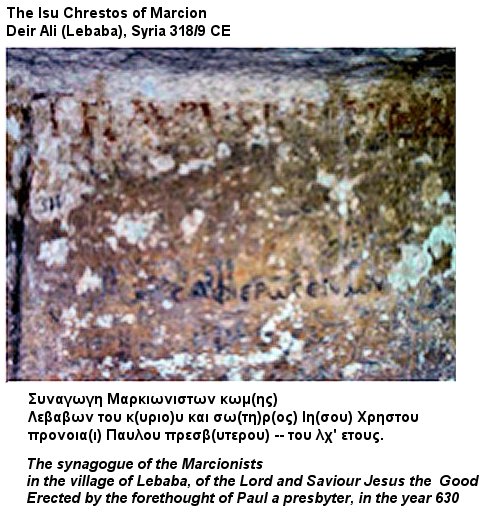
Yet doesn't a historical event require a historical Jesus?  Not necessarily.  It all comes down to why Ephem insists the Marcionite identified Jesus by the name Isu.  Is Ephem imitating the fact the Marcionites spoke Greek or went out of their way to preserve the Greek Jesus in Syriac (i.e. Isu = Iesous)?  Or is it because the Marcionites refused to identify him as someone named Joshua?  Even Clement denies this identification so it wasn't just the Marcionites.  

The bottom line is that I am certain that by the second century at least there were a large number of Christians who understood Jesus to be 'all God' with absolutely no humanity.  I am also certain that for every Catholic writer who assumes that Jesus was both God and man there was lurking in the background two hostile heretical traditions he was very aware of - one who assumed that Jesus was exclusively human and the other which assumed that Jesus was all God.  The Catholic tradition is necessarily secondary because it begins with an ecumenical compromise between these two antithetical poles.  

Even though I recognize that there was a 'Jesus was man' tradition and that it may well have been 'Jewish' (the evidence indicates this is so) I also admit that there isn't enough information out there for us to even begin to understand what this tradition actually believed.  It is far removed from everything associated with Paul, which make us at first suspect that it is associated with Justin Martyr who doesn't seem to be aware of the Pauline writings or rejected them as spurious.  More on this later.  

As such we are left with the 'Jesus is God' traditions which are necessarily pre-Catholic (owing to the fact that the Catholic tradition is as aforementioned an ecumenical compromise between this and the other tradition) and necessarily Pauline.  The 'Jesus is God' tradition included the Marcionites, the Valentinians and possibly the Basilideans.  In other words, traditions within Christianity which seemed to be identified with 'real' historical Christian teachers (with the Ebionites, Carpocratians, Ophites, Elkasites and the like the identification isn't always as certain).  

Yet can we take matters one step further?  Can we finally stop using meaningless terms like 'Jewish Christian' and 'Ebionite' and identify Justin Martyr as the earliest historical opponent of the 'Jesus is God' tradition?  Look carefully at Irenaeus's statement in Book Four of his Refutation:

But if Christ did then [only] begin to have existence when He came [into the world] as man, and [if] the Father did remember [only] in the times of Tiberius Caesar to provide for [the wants of] men, and His Word was shown to have not always coexisted with His creatures; [it may be remarked that] neither then was it necessary that another God should be proclaimed, but [rather] that the reasons for so great carelessness and neglect on His part should be made the subject of investigation. For it is fitting that no such question should arise, and gather such strength, that it would indeed both change God, and destroy our faith in that Creator who supports us by means of His creation. For as we do direct our faith towards the Son, so also should we possess a firm and immoveable love towards the Father. In his book against Marcion, Justin does well say: "I would not have believed the Lord Himself, if He had announced any other than He who is our framer, maker, and nourisher. But because the only-begotten Son came to us from the one God, who both made this world and formed us, and contains and administers all things, summing up His own handiwork in Himself, my faith towards Him is steadfast, and my love to the Father immoveable, God bestowing both upon us." [Irenaeus AH 4.6.2]


It is only because all of us are so used to projecting our own assumptions on the Patristic material we study that we assume that Justin is saying that Jesus was the Creator.  Yet the text doesn't say this.  It only reinforces that the 'only begotten Son' came from the Creator rather than to announce another god beside the Creator.

We assume that Justin must also have assumed that Jesus was also the Creator.  Yet 'only-begotten Son' isn't usually a divine title in the Jewish religion.  Indeed Hebrews 11:17 uses it as a title for Isaac.  Justin may well have only assumed that the Jesus was a wholly mortal spokesman for the Creator.  It is well established that Marcionitism is the assumption that Jesus announced that his father was unknown and not the Creator.  Yet if the Marcionites assumed that Jesus was wholly divine, how is it possible that they held that the Marcionites held the existence of two unknown Gods - i.e. the Father and the Son?  Why isn't the most likely scenario that the Marcionites envisioned Jesus as the repentant Creator announcing his acceptance of a God higher than himself?

Eusebius Helps Demonstrate WHY All the References to Jesus's Presence At Sinai Have Disappeared

I am certainly in the minority of course when I argue that the Marcionites have been completely misunderstood by scholarship.  I think the tradition was rooted in Alexandria and was likely related to or identical with the tradition of Clement of Alexandria.  I am not convinced about the way scholars understand the Marcionite relationship to the Creator.  At bottom the question comes down to whether or not the Marcionites thought that Jesus was 'stranger God' or rather - were they instead speaking about the Father?

In other words, couldn't it be that the Marcionites accepted that Jesus was the Logos (as with the rest of the Alexandrian tradition), that Jesus was 'the Son' that elders of Israel had seen Jesus at Sinai but were ignorant of the Father?  The starting point of this understanding is the fact that the early Church Fathers explain which god was seen by the elders of Israel.  Did the ancient Israelites see the Father?  No certainly not.  As Eusebius explains:

In the Book of Numbers Moses prays, saying: "Since thou art the Lord of this people that art seen of them face to face."  For which Aquila substitutes: "Since thou art the Lord in the hearts of this people, which sees thee, O Lord, face to face." And Symmachus: "Since thou art, O Lord." And it is said in Exodus: "And Moses, and Aaron, and Nadab, and Abihu, and seventy of the elders of Israel went up, and saw the place where the God of Israel stood." Instead of which Aquila says: "And they saw the God of Israel." And Symmachus: "And they saw in a vision the God of Israel." From the text: "No man has seen God at any time," perhaps it might be thought that the above quotation contradicts the Saviour's words, as implying that the invisible is visible. But if they be understood, like our former quotations, of the Word of God, Who was seen by the fathers "in many ways and in sundry manners," no contradiction is involved. [Preparation for the Gospel 5.18]

If you really think about it, the god who was seen by the elders sitting on the throne was anthropomorphic.  Jesus was a man.  The Gospel of John begins with the idea that the Logos had come to his own but that the Jews didn't recognize him.  At the very least it seems sensible to put forward that Jesus was on the throne in Exodus 24 as Eusebius argues.  The Marcionites might even have accepted this understanding and argued that he was a repentant Creator and that the Father was unknown.

For how would the Marcionites have read Exodus 24?  That the Jewish god was sitting on the throne at Sinai?  Certainly they would have agreed.  But would they have held that both Jesus and his Father were unknown?  Really?  Why come to the Jews?  It sounds like the whole family was alien.  Why the connection to the Old Testament stories?  Why cite the scriptural references in the Apostolikon if they whole divine family was from out of town?

I am beginning to sound like Tertullian ...

Why Is There is a Single Reference to the Ancient Israelites Seeing Jesus Seated on the Throne at Sinai Anywhere in the Writings of the Early Church Fathers?

The history of the Christian religion is perhaps the most interesting field of study there is.  Many people assume that I have an interest in this stuff because of some personal 'spiritual need' on my part.  The simple answer is - no, this is not what draws me to the early literature of Christianity.  The real reason is that what began as a mystery (= something which only a few people understood) has now become something that no one understands.  No one knows the answer but people pretend that there are these 'experts' who have something useful to contribute - and many of them do (in the way a good cleaning person can really scrub a house that needs scrubbing).  Yet talking to any of these experts about putting the whole puzzle of early Christianity together is often times about as useful as asking the maid.

At least the maid doesn't pretend to understand.

Here's my latest interest - Exodus chapter 24.  The story is that the elders of Israel actually saw God and he looked like a man ('almighty God is a living man' as Bunny Wailer once wrote). Rastas are cool with that and you'd think that everyone else would be cool with that.  Yet it is utterly amazing to see how few references there are in the ante Nicene Church Fathers to this critical chapter.

Here is the chapter:

1 Then the LORD said to Moses, “Come up to the LORD, you and Aaron, Nadab and Abihu, and seventy of the elders of Israel. You are to worship at a distance,

2 but Moses alone is to approach the LORD; the others must not come near. And the people may not come up with him.”

3 When Moses went and told the people all the LORD’s words and laws, they responded with one voice, “Everything the LORD has said we will do.”

4 Moses then wrote down everything the LORD had said. He got up early the next morning and built an altar at the foot of the mountain and set up twelve stone pillars representing the twelve tribes of Israel.

5 Then he sent young Israelite men, and they offered burnt offerings and sacrificed young bulls as fellowship offerings to the LORD.

6 Moses took half of the blood and put it in bowls, and the other half he splashed against the altar.

7 Then he took the Book of the Covenant and read it to the people. They responded, “We will do everything the LORD has said; we will obey.”

8 Moses then took the blood, sprinkled it on the people and said, “This is the blood of the covenant that the LORD has made with you in accordance with all these words.”

9 Moses and Aaron, Nadab and Abihu, and the seventy elders of Israel went up

10 and saw the God of Israel. Under his feet was something like a pavement made of lapis lazuli, as bright blue as the sky.

11 But God did not raise his hand against these leaders of the Israelites; they saw God, and they ate and drank.

12 The LORD said to Moses, “Come up to me on the mountain and stay here, and I will give you the tablets of stone with the law and commandments I have written for their instruction.”

13 Then Moses set out with Joshua his aide, and Moses went up on the mountain of God.

14 He said to the elders, “Wait here for us until we come back to you. Aaron and Hur are with you, and anyone involved in a dispute can go to them.”

15 When Moses went up on the mountain, the cloud covered it,

16 and the glory of the LORD settled on Mount Sinai. For six days the cloud covered the mountain, and on the seventh day the LORD called to Moses from within the cloud.

17 To the Israelites the glory of the LORD looked like a consuming fire on top of the mountain.

18 Then Moses entered the cloud as he went on up the mountain. And he stayed on the mountain forty days and forty nights.


And here are all the references including Philo of Alexandria:

Exodus 24, 1

Philo Alexandrinus De migratione Abrahami (2) Date: ca.1 - ca.50 Genre: Treatise Theme: Exegesis, Scripture Commentaries Clavis: 0 Biblio: CAZEAUX J., Les oeuvres de Philon d'Alexandrie, 14, Paris 1965, 94-242. § 168 (p.202, l.3 - <) BP8 § 201 (p.224, l.6) BP8

Philo Alexandrinus De mutatione nominum (1) Date: ca.1 - ca.50 Genre: Treatise Theme: Exegesis, Scripture Commentaries Clavis: 0 Biblio: ARNALDEZ R., Les oeuvres de Philon d'Alexandrie, 18, Paris 1964, 32-158. § 126 (p.88, l.22) BP8

Philo Alexandrinus Quaestiones in Exodum I-II (1) Date: ca.1 - ca.50 Genre: Questions and Responses Theme: Exegesis, Scripture Commentaries Clavis: 0 Biblio: PETIT F., Les oeuvres de Philon d'Alexandrie, 33, Paris 1978, 233-306. 2 § 28 (p.263, l.6) BP8 239

Origenes (1 work(s)) Origenes In Iesu Nave homiliae XXVI (latine Rufino interprete) (1) Date: ca.239 - ca.242 Genre: Homily Theme: Exegesis, Scripture Commentaries Clavis: 1420 Biblio: BAEHRENS W.A., GCS 30 (1921), 286-463. 1 2 (p.289, l.10) BP3

Exodus 24, 2 

Philo Alexandrinus (1 work(s)) Philo Alexandrinus De uita Mosis (1) Date: ca.1 - ca.50 Genre: Life Theme: Biography Clavis: 0 Biblio: ARNALDEZ R., MONDESERT C., POUILLOUX J., SAVINEL P., Les oeuvres de Philon d'Alexandrie, 22, Paris 1967, 26-320. 2 § 163 (p.264, l.1) BP8 248

Origenes Contra Celsum (3) Date: ca.248 - ca.249 Genre: Controversy Theme: Faith and Christian Reflection Clavis: 1476 Biblio: BORRET M., SC 132 (1967) : livres 1-2 ; SC 136 (1968) : livres 3-4 ; SC 147 (1969) : livres 5-6 ; SC 150 ( 1969 ) : livres 7-8. 2 55 (p.416, l.42 - <) BP3 4 96 (p.424, l.20 - <) BP3 6 17 (p.220, l.25 - <) BP3

Exodus 24, 3 

Philo Alexandrinus (1 work(s)) Philo Alexandrinus De specialibus legibus (1) Date: ca.1 - ca.50 Genre: Treatise Theme: Exegesis, Scripture Commentaries Clavis: 0 Biblio: DANIEL S., Les oeuvres de Philon d'Alexandrie, 24, Paris 1975, 12-394 : livres 1 et 2 ; MOSES A., Les oeuvres de Philon d'Alexandrie, 25, Paris, 1970, 52-348 : livres 3 et 4. 2 § 14 (p.244, l.3 - >) BP8

Exodus 24, 4 

Philo Alexandrinus (1 work(s)) Philo Alexandrinus De mutatione nominum (1) Date: ca.1 - ca.50 Genre: Treatise Theme: Exegesis, Scripture Commentaries Clavis: 0 Biblio: ARNALDEZ R., Les oeuvres de Philon d'Alexandrie, 18, Paris 1964, 32-158. § 126 (p.88, l.20) BP8

Exodus 24, 5 

Origenes (1 work(s)) Origenes In Genesim homiliae XVI (latine Rufino interprete) (1) Date: ca.239 - ca.242 Genre: - Theme: Exegesis, Scripture Commentaries Clavis: 1411 Biblio: BAEHRENS W.A., GCS 29 (1920), 1-144. 8 4 (p.80, l.17 - >) BP3

Exodus 24, 6

Philo Alexandrinus (1 work(s)) Philo Alexandrinus Quis rerum diuinarum heres sit (2) Date: ca.1 - ca.50 Genre: Treatise Theme: Exegesis, Scripture Commentaries Clavis: 0 Biblio: HARL M., Les oeuvres de Philon d'Alexandrie, 15, Paris 1966, 166-326. § 182 (p.254, l.9 - <) BP8 § 184 (p.256, l.1) BP8

Exodus 24, 7

Philo Alexandrinus (2 work(s)) Philo Alexandrinus De confusione linguarum (1) Date: ca.1 - ca.50 Genre: Treatise Theme: Exegesis, Scripture Commentaries Clavis: 0 Biblio: KAHN J.G., Les oeuvres de Philon d'Alexandrie, 13, Paris 1963, 40-154. § 148 (p.124, l.2) BP8

Philo Alexandrinus De specialibus legibus (1) Date: ca.1 - ca.50 Genre: Treatise Theme: Exegesis, Scripture Commentaries Clavis: 0 Biblio: DANIEL S., Les oeuvres de Philon d'Alexandrie, 24, Paris 1975, 12-394 : livres 1 et 2 ; MOSES A., Les oeuvres de Philon d'Alexandrie, 25, Paris, 1970, 52-348 : livres 3 et 4. 2 § 14 (p.244, l.3 - /) BP8

Exodus 24, 9 

Origenes (?) (1 work(s)) Origenes (?) Fragmenta e catenis in Psalmos C (1) Date: ca.201 - ca.300 Genre: Fragment Theme: Exegesis, Scripture Commentaries Clavis: 1426 Biblio: PITRA J.B., Analecta sacra, 3, Venetiis 1883, passim 4-364. (p.233, l.29 - /) BP3

Exodus 24, 10 

Philo Alexandrinus (3 work(s)) Philo Alexandrinus De confusione linguarum (2) Date: ca.1 - ca.50 Genre: Treatise Theme: Exegesis, Scripture Commentaries Clavis: 0 Biblio: KAHN J.G., Les oeuvres de Philon d'Alexandrie, 13, Paris 1963, 40-154. § 96 (p.92, l.7 - <) BP8 § 99 (p.94, l.6) BP8

Philo Alexandrinus De somniis (2) Date: ca.1 - ca.50 Genre: Treatise Theme: Exegesis, Scripture Commentaries Clavis: 0 Biblio: SAVINEL P., Les oeuvres de Philon d'Alexandrie, 19, Paris 1962, 22-242. 1 § 61 (p.48, l.23 - <) BP8 2 § 222 (p.214, l.8 - <) BP8

Philo Alexandrinus Quaestiones in Exodum I-II (1) Date: ca.1 - ca.50 Genre: Questions and Responses Theme: Exegesis, Scripture Commentaries Clavis: 0 Biblio: PETIT F., Les oeuvres de Philon d'Alexandrie, 33, Paris 1978, 233-306. 2 § 37 (p.264, l.1 - >) BP8

Origenes (?) (1 work(s)) Origenes (?) Fragmenta e catenis in Psalmos C (1) Date: ca.201 - ca.300 Genre: Fragment Theme: Exegesis, Scripture Commentaries Clavis: 1426 Biblio: PITRA J.B., Analecta sacra, 3, Venetiis 1883, passim 4-364. (p.233, l.29 - /) BP3

Exodus 24, 11 

Philo Alexandrinus (3 work(s)) Philo Alexandrinus De confusione linguarum (1) Date: ca.1 - ca.50 Genre: Treatise Theme: Exegesis, Scripture Commentaries Clavis: 0 Biblio: KAHN J.G., Les oeuvres de Philon d'Alexandrie, 13, Paris 1963, 40-154. § 56 (p.70, l.19 - <) BP8

Philo Alexandrinus De mutatione nominum (1) Date: ca.1 - ca.50 Genre: Treatise Theme: Exegesis, Scripture Commentaries Clavis: 0 Biblio: ARNALDEZ R., Les oeuvres de Philon d'Alexandrie, 18, Paris 1964, 32-158. § 109 (p.80, l.22 - < >) BP8

Philo Alexandrinus Quaestiones in Exodum I-II (2) Date: ca.1 - ca.50 Genre: Questions and Responses Theme: Exegesis, Scripture Commentaries Clavis: 0 Biblio: PETIT F., Les oeuvres de Philon d'Alexandrie, 33, Paris 1978, 233-306. 2 § 38 (p.264, l.15) BP8 2 § 38 (p.265, l.1 - <) BP8

Exodus 24, 12 

Anonyma Oracula Sibyllina (1) Date: ca.1 - ca.300 Genre: Poetry Theme: Apocrypha Clavis: 1352 Biblio: GEFFCKEN J., GCS 8 (1902). 3 (p.61, l.257 - P) BP1

Tertullianus Aduersus Marcionem (1) Date: ca.207 - ca.213 Genre: Treatise Theme: Faith and Christian Reflection Clavis: 14 Biblio: KROYMANN Aem., CCL 1 (1954), 441-726. 5 19 § 11 (p.723, l.14) BP1


Origenes (1 work(s)) Origenes Fragmenta in Lamentationes in catenis (1) Date: ca.222 - ca.252 Genre: Fragment Theme: Exegesis, Scripture Commentaries Clavis: 1439 Biblio: KLOSTERMANN E., GCS 6 (1901), 235-278. (p.271, l.16 - P) BP3 239 (1 pole(s)) Alexandria (1 ancient author(s))

Origenes Homiliae in Ieremiam (gr.) (3) Date: ca.239 - ca.242 Genre: Homily Theme: Exegesis, Scripture Commentaries Clavis: 1438 Biblio: HUSSON P., NAUTIN P., SC 232 (1976) : homélies 1-11 ; SC 238 (1977) : homélies 12-20.39. 18 2 (p.180, l.15 - <) BP3 18 2 (p.182, l.33) BP3 18 2 (p.184, l.61) BP3 


Origenes In librum Iudicum homiliae IX (latine interprete Rufino) (1) Date: ca.239 - ca.242 Genre: Homily Theme: Exegesis, Scripture Commentaries Clavis: 1421 Biblio: BAEHRENS W.A., GCS 30 (1921), 464-522. 1 5 (p.471, l.14 - P) BP3


Origenes Commentarii in Matthaeum, libri XII-XIII (lat.) (1) Date: ca.248 - ca.249 Genre: Commentary Theme: Exegesis, Scripture Commentaries Clavis: 1450 Biblio: KLOSTERMANN E., BENZ E., GCS 38 (1933). 33 (p.61, l.3 - >) BP3

Exodus 24, 13 

Origenes In Iesu Nave homiliae XXVI (latine Rufino interprete) (1) Date: ca.239 - ca.242 Genre: Homily Theme: Exegesis, Scripture Commentaries Clavis: 1420 Biblio: BAEHRENS W.A., GCS 30 (1921), 286-463. 1 2 (p.289, l.13 - <) BP3

Exodus 24, 15 

Origenes (?) Fragmenta e catenis in Psalmos C (1) Date: ca.201 - ca.300 Genre: Fragment Theme: Exegesis, Scripture Commentaries Clavis: 1426 Biblio: PITRA J.B., Analecta sacra, 3, Venetiis 1883, passim 4-364. (p.184, l.34) BP3

Origenes Homiliae in Ieremiam (gr.) (1) Date: ca.239 - ca.242 Genre: Homily Theme: Exegesis, Scripture Commentaries Clavis: 1438 Biblio: HUSSON P., NAUTIN P., SC 232 (1976) : homélies 1-11 ; SC 238 (1977) : homélies 12-20.39. 18 2 (p.182, l.34) BP3

Exodus 24, 16 

Philo Alexandrinus (1 work(s)) Philo Alexandrinus Quaestiones in Exodum I-II (2) Date: ca.1 - ca.50 Genre: Questions and Responses Theme: Exegesis, Scripture Commentaries Clavis: 0 Biblio: PETIT F., Les oeuvres de Philon d'Alexandrie, 33, Paris 1978, 233-306. 2 § 45 (p.267, l.1 - <) BP8 2 § 46 (p.268, l.5 - <) BP8

Exodus 24, 17

Philo Alexandrinus Quaestiones in Exodum I-II (2) Date: ca.1 - ca.50 Genre: Questions and Responses Theme: Exegesis, Scripture Commentaries Clavis: 0 Biblio: PETIT F., Les oeuvres de Philon d'Alexandrie, 33, Paris 1978, 233-306. 2 § 47 (p.269, l.8) BP8 2 § 47 (p.270, l.1) BP8

Exodus 24, 18 

Philo Alexandrinus Quaestiones in Exodum I-II (2) Date: ca.1 - ca.50 Genre: Questions and Responses Theme: Exegesis, Scripture Commentaries Clavis: 0 Biblio: PETIT F., Les oeuvres de Philon d'Alexandrie, 33, Paris 1978, 233-306. 2 § 49 (p.270, l.22 - >) BP8 2 § 49 (p.271, l.1 - >) BP8

Origenes (?) Fragmenta e catenis in Psalmos C (2) Date: ca.201 - ca.300 Genre: Fragment Theme: Exegesis, Scripture Commentaries Clavis: 1426 Biblio: PITRA J.B., Analecta sacra, 3, Venetiis 1883, passim 4-364. (p.184, l.34) BP3 (p.185, l.21) BP3

Tertullianus De ieiunio (aduersus psychicos) (1) Date: ca.213 - ca.217 Genre: Treatise Theme: Undetermined Clavis: 29 Biblio: REIFFERSCHEID A., WISSOWA G., CCL 2 (1954), 1257-1277. 6 § 5 (p.1262, l.1) BP1


What's so amazing about this is that if you ignore the references preserved in the catenae (which are dubious at the best of times) all we are left with is the most superficial sorts of allusions to this material.  For instance, that Origen makes reference to Ex 24.1 and 2 only confirms that Moses went up to see God, not what god he saw or that he saw God and 'almighty God is a living man' and what theological implications an anthropomorphic God has on Christianity.  Origen's single reference to Ex 24.5 is of course that bulls were sacrificed - hardly a controversial statement either.  The references to Ex 24, 12 and 13 are equally uneventful.  They only confirm the basic details of the narrative - i.e. that Moses went up to see God not what implications we can draw from him having seen an anthropomorphic God.  The reference to Ex 24, 15 is unusual in that it argues that Moses and Joshua - like all the heavenly hosts - were clouds.  Yet the pattern of avoiding the implications of the anthropomorphic god on the throne seen by the elders of Israel continues here too.  Our final reference - that of Tertullian - again only confirms that Moses saw God not what he saw.

Now I am sure there are many scholars who will tell us that we shouldn't be surprised that no mention is ever made of God being an anthropomorphic being, yet I disagree.  I think that given that the same claims were made about Jesus (= a god man) and the consistent objections of Jews - and later Muslims - that God can't be human - would be effectively blunted by this chapter.  In other words, since the elders of Israel themselves saw that God was a man the idea that Jesus was God isn't really that outlandish.  Of course all the nonsense about Jesus being a child of Mary and having brothers and the like becomes a difficulty, yet the earliest Christians like the Marcionites and even Clement of Alexandria either didn't accept this or avoided speaking about it.

So we are now in a dilemma insofar as Jesus coming to earth as a man God in the way that the Marcionites presented the gospel narrative is far more in keeping with the traditional Jewish understanding of their God and the covenant that was established through him by Moses than any of the nonsense developed by the Catholics.  In other words, it is easy to ridicule the Catholic version of the gospel story but the Marcionite narrative actually seems to be something which one could imagine a Jewish sect - even one of the communities whose literature is preserved at Qumram - might have believed.
 
Stephan Huller's Observations by Stephan Huller
is licensed under a
Creative Commons Attribution 3.0 United States License.