The two main groups of meanings of tsemaḥ in Hebrew and anatolê in Greek are sprouting and first appearing over the horizon. The two verbs tsamaḥ and anatellein have the same range of meaning as the noun. I think the word applies to eyes of potatoes in both languages. (Imagine what Rowan Atkinson could do with this. “Behold a man whose name is Sprout. Well, behold a man whose name is the eye of the potato”). These are not exactly two meanings in themselves, but applications of the meaning, which is to appear as the start of a process or start of an event, with NOTHING before except an apparently inert bud or the time by the clock in the case of sunrise. Aquila and Symmachus translate correctly. The Bible de Jérusalem and the Traduction Ecuménique de la Bible both translate correctly as “germe”. The NRSV and NEB with their translation “branch” are right off track. Note carefully that the Hebrew of the phrase following has been misunderstood. The Hebrew of the words following is ומתחתיו יצמח meaning “and he will appear over the horizon or show the first sprout”. More literally “and he will rise from where he is”. Even what I have given as the literal meaning is still slightly paraphrastic. It is literally “from under himself”. It means the place where someone is before any movement. It would be used to speak of a cat pouncing from a waiting position. Jastrow gives the example of someone saying that money from the treasury is to be counted in his presence here in the treasury, rather than being taken out and then counted in his presence. These words in Zechariah, combined with the concept of the return of Moses, lie behind the words in John VII:27 “When the Messiah comes, no-one will know where he comes from”. The NRSV and NEB translate “branch out”, but this translation shows absence of feeling for Hebrew. Any branching out would have to be after the sprouting.
Here is what the Targum has for verses 12 and 13. “And you shall say … “Behold a man whose name is Meshiḥa [the Anointed]. He will be revealed. He will become great [not “will be great”] and will build the Temple of the Lord. He will build the Temple of the Lord and will bloom. He will sit and rule on his throne. [The blooming is not the first event]. The High Priest will be on his throne. The King of Peace will be between them”.
In Genesis XXII:8 the words meaning that God himself will provide are a special syntactic use of a word meaning to see. The LXX and Peshitta recognise this usage. In verse 14 there is the same usage. “Abraham called the place ‘The Lord Provides’. As it is said to this day “On the mount of the Lord it is provided [or will be provided]”. The Targums are surprisingly specific in verse 8. Targum Onkelos says “the sheep for the offering has been revealed”. Targum Yonatan has “God will choose a sheep himself for the offering”. The Fragmentary Targum has “God will provide me with a sheep, or otherwise you will be the offering”. In verse 22, all the Versions have some variant on the concept of seeing and being seen.


The Mystery I've Solved

50 cm Seat /147 cm Tall Throne


Ancient Witness to the Size of the Throne

The Relative Size of the Alexandrian Throne of St Mark

Ancient Confirmation of Mark's "Smallness"

Marcion and the Episcopal Throne

Where was Marcion's Throne?

Burning of Arian Books After Nicaea

Drawing on vellum. From MS CLXV, Biblioteca Capitolare, Vercelli, a compendium of canon law produced in Northern Italy ca. 825


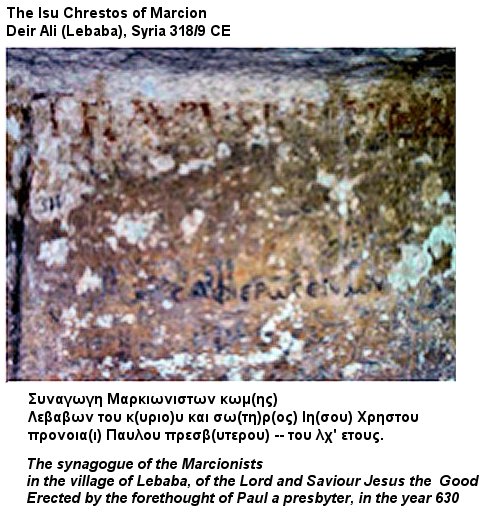
A Fourth Century CE Marcionite Synagogue in Syria

Adversus Marcionem 1.19 and Antoninus Pius's Alexandrian "Zodiac Coins" of 144/145 CE


First Argument for the Alexandrian Origins of Marcion

Second Argument for the Alexandrian Origins of Marcion

Third Argument for the Alexandrian Origins of Marcion

Fourth Argument for the Alexandrian Origins of Marcion

Fifth Argument for the Alexandrian Origins of Marcion

Conclusion

Bonus

First Piece of Evidence

Second Piece of Evidence


Third Piece of Evidence

Preliminary Conclusion

Overriding Point

Bottom Line


In Summa:

Last Word
