Thanks for following this up. Some important data. (a) It is essential to
bear in mind that the top-piece is not original. This seems to have been
proven, but I will have to find the reference again. The difference in style
between the top-piece and the rest is unmistakeable. The original top-piece
was not broken off by accident, but cut off professionally with a saw. As
there are still some indications of what would have been there, the act
would have been political, as said in previous messages. (b) I remarked some
time ago that the correspondence with the book of Revelation is much closer
than previously thought. I can now add that correspondence does not extend
to all details, meaning that the object and the book are in the same
tradition, but it would be precarious to say that either copies the other.
(c) As said before, the sheep in prominent position on the front is not a
lamb but a young ram. The Samaritan exegetical tradition on Genesis XXII:13
specifies a ram in its second year. (The Passover lamb or kid is a lamb or
kid in its first year. See Exodus XII:5. Or look at any pictures of the
Samaritan Passover). I expect to find this tradition in other sources as I
look further. (d) My previous tentative identification of the ninth vision
with the second half of Daniel XII, the last verses of the book, won't work.
These verses are all part of the eighth vision. What I thought was the right
solution, Zechariah VI, has no connection with the picture. Also, the words
"the ninth vision" must mean the ninth in the Torah, unless there is clear
indication otherwise. The ninth vision in the Torah is Genesis XXII:13. This
is the verse referred to in the Aramaic words "The Ninth Vision" H.ezva
Tish'ana indicated numerically as 8 7 6 5 9. As to why there was any need to
specify this in words, there are two reasons. First, in the depiction the
ram stands in front of the tree. It is not obviously caught. The
identification is thus not immediate. Second, I think the word (singular)
"the vision" is meant exactly. The ram and the bush are the vision. (Note
that the Hebrew word sechach in verse 13 does not have to mean a thicket. It
also means thick foliage and twigs. The traditional identification is a
myrtle bush. If you look at pictures of the native variety you will see what
is meant. The vegetation starts a few feet off the ground, which could
plausibly be just at head height for a sheep). Both the ram and the bush or
tree are EQUALLY prominent. I think I know the reason, but will explain when
I have some textual evidence from elsewhere of the line of thought lying
behind this depiction.


The Mystery I've Solved

50 cm Seat /147 cm Tall Throne


Ancient Witness to the Size of the Throne

The Relative Size of the Alexandrian Throne of St Mark

Ancient Confirmation of Mark's "Smallness"

Marcion and the Episcopal Throne

Where was Marcion's Throne?

Burning of Arian Books After Nicaea

Drawing on vellum. From MS CLXV, Biblioteca Capitolare, Vercelli, a compendium of canon law produced in Northern Italy ca. 825


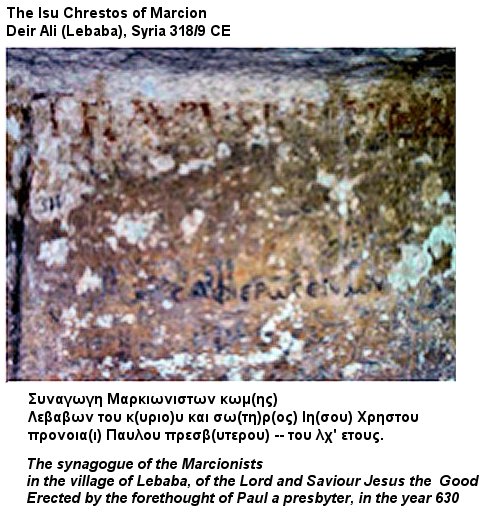
A Fourth Century CE Marcionite Synagogue in Syria

Adversus Marcionem 1.19 and Antoninus Pius's Alexandrian "Zodiac Coins" of 144/145 CE


First Argument for the Alexandrian Origins of Marcion

Second Argument for the Alexandrian Origins of Marcion

Third Argument for the Alexandrian Origins of Marcion

Fourth Argument for the Alexandrian Origins of Marcion

Fifth Argument for the Alexandrian Origins of Marcion

Conclusion

Bonus

First Piece of Evidence

Second Piece of Evidence


Third Piece of Evidence

Preliminary Conclusion

Overriding Point

Bottom Line


In Summa:

Last Word
