I couldn’t find an exact parallel to Saadya’s interpretation, but I did find the ingredients. If you have access to them, look at the Pirke de-Rabbi Eli‘ezer ch. 28. supplemented by Bereshit Rabba on Gn XV:10 and 11. Here are the ingredients. Remember all these are mixed in with alternatives, so you will have to read carefully. The pigeon is not linked with the gozal. The gozal is taken as being a young dove in this place, even though it can be a young bird of any kind. The three animals in their third year are three empires, and the pigeon is the fourth. The young dove bar-yonah is the Anointed Davidic king. The tsippor is the young dove. The dove was not killed. The ‘ayiṭ is the dove and is the anointed Davidic king. The verse from Isaiah about the ‘ayiṭ tsavua is quoted, but ‘ayiṭ is taken to be a messianic title of the dove. The dove wanted to bring the sacrifices back to life. Implicit here is the identification of all the sacrifices with Israel, contrary to the interpretation of them being empires. Perhaps they are those killed by the empires. Abraham stopped it from doing so because the time had not come. The verb vayyashshév is interpreted as vayyáshev, meaning “made it go back”, in this context meaning to stop doing what it was doing. I think the dove will be able to do this at the end of the fourth empire, but I will have to look again. This meaning of the verb is in the Samaritan sources, though these take the ‘ayiṭ as being a bird of prey. In an alternative explanation, vayyáshev is taken to have two meanings, first “he (Abram) enabled them (future generations) to repent” and second “he brought them (the future generations) back”, that is, back to life.
Saadya agrees that the tsippor and ‘ayiṭ is the gozal are the same, and that they are a young dove. It is unclear whether the dove was killed or not. It is explicit that the sacrifices came back to life. This is somehow connected with the dove being on top of them. The start of verse 11 is not “the ‘ayiṭ came down’, but “he put the ‘ayiṭ on top”. The verb vayyashshév is apparently taken in its literal meaning. “he blew on them” or “blew into them”, but is given a double interpretation. The translation is “he stirred them and they started to move”. This is a double interpretation of the causative sense of the hif‘il. Notice that the implicit subject can equally well be Abram or the dove in its guise of ‘ayiṭ. Implicit is the causative use of shuv, as if the verb is read as vayyáshev, he brought them back. I think the literal intention would be that Abram blew on them and they started breathing, and at the same time the dove brought them back. Reread what is said about bringing Jairus’s daughter back to life, about how Jesus did it. Then note Jesus’s words “She isn’t dead, only sleeping” and compare the statement that when Israel seems to have been killed the merit of Abraham which enables them to repent makes them come back to life. The resurrection of the sacrifices is a sign of future recovery from the empires, caused both by Abram (as explained above) and the dove. This explanation is deduced from a careful reading of Saadya’s translation and my interpretation of the implications of a summary of the mediaeval parallels given by the editor of Saadya’s translation.
I think you will see that an explicit doctrine has been made obscure by being broken up into parts, with some of the parts being modified. The modifications can be picked up by putting similar but contradictory versions of each element together and finding the explicit original version. The doctrine had to be preserved but had to be hidden from the profane reader.
There are two interpretations of the sign of Jonah, one being that he came out of the fish alive and one being that the Ninevites repented. Both are correct, but deliberately superficial. The full meaning comes out when you see the implicit reference. The sign of Jonah is the enactment by both Jonah and the Ninevites of the repentance and resurrection made possible by Abram and the dove, the bar-yonah.
Some of what I quoted from the PRE might only be in the Yemenite recension. I haven’t had time yet to compare the European recension in detail. The explicit identification of the ‘ayiṭ in Gn XV:11 with the anointed Davidic king, and the obscure statement that Abram told it to delay its act of bringing about full resurrection till the right century, might be two of the differences. I will include a comparison in my systematic summary, but this will take a while.
The Yemenite recension of many midrashim is superior. There are some midrashim of the time of the Tanna’im that only survived in the Yemen.
I quote the Yemenite recension of the PRE from the Midrash ha-Gadol, which is a very big anthology. I think it is longer than the Yalquṭ Shim‘oni on the Torah.
I still have to look at another Yemenite collection and a few other sources.
I still say this is an old teaching that had to be kept but was deliberately obscured by breaking it up into components each of which on its own seemed unimportant or
fanciful.
When I said Isaiah is quoted, I meant Jeremiah. It say the ‘ayiṭ is the Ben David, quoting Jeremiah XII:9 as proof. Then it says the ‘ayiṭ which is again said to be the Ben David wanted to light on the carcases representing the four empires to disperse them and wipe them out, but Abraham waved his sash over the bodies to keep the áyiṭ away, saying that he (subject unclear) could not have power over them (object unclear) till the evening. I think something is missing. Reconstruction. The ‘ayiṭ wanted to light on the carcases representing the empires to wipe them out. Abraham told him each must have its turn to end. Then in a return to a different set of symbolism from another source which was brought in just before, the ‘ayiṭ which is Edom (Rome) is told it will have no power over Israel (the carcases) till the evening.
An observation. I have said this before. If the four empires are seen during the full darkness of night, then the end of Edom ought to be when the sun first rises.
The last empire is identified as Edom and Ishmael in two contradictory interpretations from two different periods. There is a quote from Psalm CXXXII:17-18 in connection with Ishmael, so I don’t know if the quote is original. But note that the end of the last empire comes when the sun has first risen.
Midrash Bereshit Rabbati [NOT Midrash Bereshit Rabba]. Gn XV:17. The words “Then the sun started to set” are reread literally. The verb bo bet-vav-alef means to come, except that when applied to the sun it means to set. (This is because the verb can mean to go inside). Here it is reread in the meaning of coming. The verb vayehi vav-yod-he-yod (from the root haya he-yod-he) which is a marker of sequence in past time is reread as vihi (same spelling) a marker of future time. “When the Anointed comes, of whom it is written ‘his throne is like the sun before me’ [Psalm LXXXIX:37], at that time there will be thick darkness for the nations of the world, as it is written ‘Darkness will cover the earth, and impenetrable darkness the nations, and upon you will rise etc.” [Isaiah LX:2].
Midrash Aggada ‘al ha-Tora. Instead of ba’a bet-alef-he meaning setting or coming, it quotes lavo the infinitive meaning in the construction with vihi “will be arriving [at some implicit time]” or “will have arrived”. This might only be a mistake, but it might not. “The sun will have come. This is the Anointed, the son of David, of whom it is written ‘His throne is like the sun before him”. In the verse from the Psalm kenegdo meaning “before him” is quoted instead of kenegdi “before me”. This reading is attested in an important fragment of the Torah from the Cairo Geniza. The provenance means it is a reading that was once a possible alternative in the MT but was rejected by the Masoretes in the last stage of editing.
Before this the Midrash Aggada quotes from the PRE. There is a remarkable divergence in one place. It says this. “The ‘ayiṭ came down on the carcases. This is David the Son of Jesse who is called ‘ayiṭ [then Jeremiah XII:9]”. This is instead of Ben David, the son of David. This might simply be a mistake. Then again it might be an error for an earlier Ben David ben Yishshai “the Son of David the son of Jesse”, with an implicit reference to the meaning of the name Jesse Yishshai yod-shin-yod, which is a diminutive of Yesha‘ya yod-shin-‘ayin-yod-he “God saves”. I favour the second explanation.
I will explain the date and origin and importance of these two books in detail later on. It’s very late. Just take it that they both preserve ancient content not transmitted later on, probably on purpose. There is only one extant ms. of each. The first was written in Narbonne (Catalonia, but currently in France) under Islamic rule. The ms. of the second comes from Aleppo. They both bypass European editing, like the Yemenite recension of the PRE.


The Mystery I've Solved

50 cm Seat /147 cm Tall Throne


Ancient Witness to the Size of the Throne

The Relative Size of the Alexandrian Throne of St Mark

Ancient Confirmation of Mark's "Smallness"

Marcion and the Episcopal Throne

Where was Marcion's Throne?

Burning of Arian Books After Nicaea

Drawing on vellum. From MS CLXV, Biblioteca Capitolare, Vercelli, a compendium of canon law produced in Northern Italy ca. 825


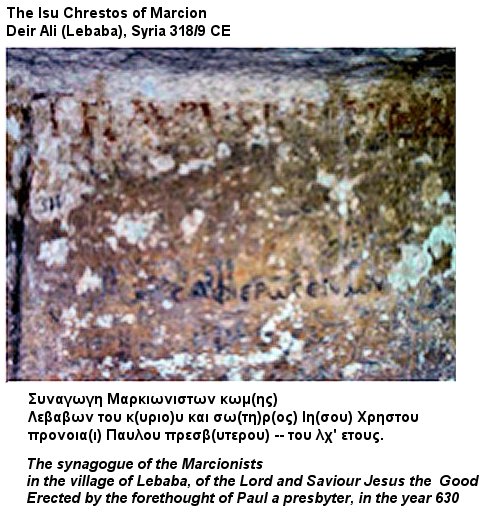
A Fourth Century CE Marcionite Synagogue in Syria

Adversus Marcionem 1.19 and Antoninus Pius's Alexandrian "Zodiac Coins" of 144/145 CE


First Argument for the Alexandrian Origins of Marcion

Second Argument for the Alexandrian Origins of Marcion

Third Argument for the Alexandrian Origins of Marcion

Fourth Argument for the Alexandrian Origins of Marcion

Fifth Argument for the Alexandrian Origins of Marcion

Conclusion

Bonus

First Piece of Evidence

Second Piece of Evidence


Third Piece of Evidence

Preliminary Conclusion

Overriding Point

Bottom Line


In Summa:

Last Word
