Friday, December 2, 2011

Secret Mark and the Substitution of Jesus


I am not 'on the side' of the Islamic tradition when I say that I despise Christians who discount its claim that Jesus wasn't really crucified.  It is these sorts of imbeciles who refuse to accept the authenticity of the Letter to Theodore. Why?  Because it 'contradicts' what Mommy and Daddy told them about Jesus.

I for one find it suspicious that the Catholic tradition pays so much gory attention to God being crucified.  There is something bizarre about the idea that the Creator set about to embark on a suicide mission while up in the clouds.  Why provoke the Jews to crucify you, destroy their temple and banish them to eternal galut?  It doesn't make sense.

Yet Irenaeus garbles the heretical traditions belief that:

Those, again, who separate Jesus from Christ, alleging that Christ remained impassible, but that it was Jesus who suffered, preferring the Gospel by Mark, if they read it with a love of truth, may have their errors rectified. [Irenaeus AH 3.11.7]

It should be clear to anyone that we are not only standing on the very ground upon which the Secret Gospel of Mark developed but moreover the tradition, reported by Al-Tabari, about a certain Wahab b. Munabih (c. 700 CE) that:

They brought him [Jesus] to the gibbet on which they intended to crucify him, but God raised him up to Himself and a simulacrum was crucified in his place. He remained there for seven hours, and then his mother and another woman whom He had cured of madness came to weep for him. But Jesus came to them and said, "God has raised me up to Himself, and this is a mere simulacrum. "

Another example of the growth of this legendary tradition is the view of Thalabi, who lived some 300 years after Munabih. "The shape of Jesus was put on Judas who had pointed him out, and they crucified him instead, supposing that he was Jesus. After three hours God took Jesus to himself and raised him up to heaven" .(Bruce, Jesus., p. 178, 179)

The same tradition is reported as early as R. Meir and these morons refuse to let themselves by 'tricked' by the facts:

Rabbi Meir used to say, What is the meaning of (Deut 21:23), “For a curse of God is he that is hung?” [It is like the case of ] two brothers, twins, who resembled each other. One ruled over the whole world, the other took to robbery. After a time the one who took to robbery was caught, and they crucified him on a cross. And everyone who passed to and fro said, “It seems that the king is crucified.” Therefore it is said, “A curse of God is he that is hung.” (Tosefta Sanhedrin 9.7)

Of course if you won't listen to anything which doesn't confirm your inherited presuppositions it is no wonder that these same people reject the Islamic apocryphal literature.  Yet isn't it obvious to anyone but me what Secret Mark is all about?  (see next post)


Secret Mark and Samaritan Mark


Yes, I wrote a stupid book.  But sometimes the messenger isn't up for the task of delivering the message.  As Jesus once said "I have often desired to hear one of these words, and I had no one who could utter it."  It is because people aren't aware of what Mark says in the Samaritan tradition that they don't my book.  All these people debating 'Secret Mark' but listen to what Mark says in his preserved writings among the Samaritans:

When God made His voice heard at Mount Sinai, all of Israel were listening and fearful. They said to Moses, “Draw near and listen, for we are afraid to do so." So Moses drew near to the holy deep darkness where the Divine One was, and he saw the wonders of the unseen, a sight no one else could see. God's image dwelt on him, the very face of God. How terrifying to anyone who beholds it, for no one is able to stand before it. With his hands Moses received the signature of God, and it was a treasure-house of all knowledge. His body mingled with the angels above and he dwelt with them, being worthy of doing so. His speech was like the speech of the Lord. His voice mingled with the voice of the Lord, and he was magnified above all the human race. [Mimar Marqe (loosely quoted by Howard Schwartz) 5.3]

This is the origin of Simon Magus and it is the reason Jesus was initiating the youth in the Alexandrian gospel.

Let him who has ears, let him hear ...

Did Christians Originally Believe that Jesus was the God of the Old Testament Who Descended to Jerusalem to Crucify Himself?


Yes, I think so and to follow the running thread of questions here started by my son, the one thing I have never been able to solve is - why, if many Christians believed that Jesus was God rather than man, was he named 'Jesus'?  

The Pentateuch Tells Us that God Had Hands and Feet

I really don't know how modern religionists get around this.  Even Bob Marley makes reference to it in 'Get Up Stand Up' - 'we know and we understand/mighty God is a living man' (of course the reference is here to Emperor Haile Salessi I but the point is still the same).  We are said to be made in God's image (which can only  literally mean that God is anthropomorphically shaped despite the nonsense developed by Philo to the contrary).

All of sudden the Christian belief in Jesus as God doesn't seem like an 'appropriation' from paganism. In fact, the idea that God was going to come down and visit humanity is found in the texts of Qumran.  How could God come down to a particular place unless he capable of having form?  Look also at the Song of Songs which is said to have been particularly influential in the first centuries of the Common Era.  Notice also that the community at Edessa is particularly taken with the same material in the same period as Bar Kochba (or shortly thereafter).

The Shiur Komah (literally, the measurement of the Height of the Creator) was regarded in the Middle Ages as the worst and most embarrassing example of ancient Jewish anthropomorphism. The text of the Shiur Komah is based on verses 5:10-16 of the Song of Songs, which describe the physical appearance of the Lover. It includes a list of the divine limbs, a list of their names, which are a long series of Hebrew letters, most of them completely unpronounceable and unintelligible, and a third list detailing the measurements of each limb.

As embarrassing as this might be, there is something absolutely authentic bubbling under the surface of these texts.

More On My Son's Questioning Why He Can't See God

I find this whole discussion quite interesting - not merely because my son is at its center - but because this is a young mind hasn't been trained to distract his eyes from the truth yet.  Whenever the topic of God comes up, the question inevitably follows that is 'why can't I see God?' which reminds me a lot of Celsus's statement (preserved in Book Seven of Origen's Contra Celsum):

As Celsus supposes that we uphold the doctrine of the resurrection in order that we may see and know God, he thus follows out his notions on the subject: After they have been utterly refuted and vanquished, they still, as if regardless of all objections, come back again to the same question, 'How then shall we see and know God? How shall we go to Him?'

Christians today don't behave in the way Celsus describes of course.  Yet the interest in seeing first what you are supposed to believe in is of course quite natural.

Moreover it is noteworthy that the subject under discussion here is the resurrection.  For even to this day the Coptic tradition understands 'the Incarnation' as something which happens in the Church. Athanasius, for instance, presents Christ's body cosmological meeting point between God and the world: through the Incarnation, we are corporeally 'joined to the Word who is from heaven'. For Athanasius our deifying participation in the Word reaches its consummation only in the Resurrection to come.  Yet I don't think this is what Celsus is describing.  Celsus is aware of something older and more heretical.

Origen gives us a sense of Celsus's original argument in what follows:

Seeking God, then, in this way, we have no need to visit the oracles of Trophonius, of Amphiaraus, and of Mopsus, to which Celsus would send us, assuring us that we would there see the gods in human form, appearing to us with all distinctness, and without illusion. For we know that these are demons, feeding on the blood, and smoke, and odour of victims, and shut up by their base desires in prisons, which the Greeks call temples of the gods, but which we know are only the dwellings of deceitful demons. To this Celsus maliciously adds, in regard to these gods which, according to him, are in human form, they do not show themselves for once, or at intervals, like him who has deceived men, but they are ever open to intercourse with those who desire it. From this remark, it would seem that Celsus supposes that the appearance of Christ to His disciples after His resurrection was like that of a spectre flitting before their eyes; whereas these gods, as he calls them, in human shape always present themselves to those who desire it. But how is it possible that a phantom which, as he describes it, flew past to deceive the beholders, could produce such effects after it had passed away, and could so turn the hearts of men as to lead them to regulate their actions according to the will of God, as in view of being hereafter judged by Him? And how could a phantom drive away demons, and show other indisputable evidences of power, and that not in any one place, like these so-called gods in human form, but making its divine power felt through the whole world, in drawing and congregating together all who are found disposed to lead a good and noble life?

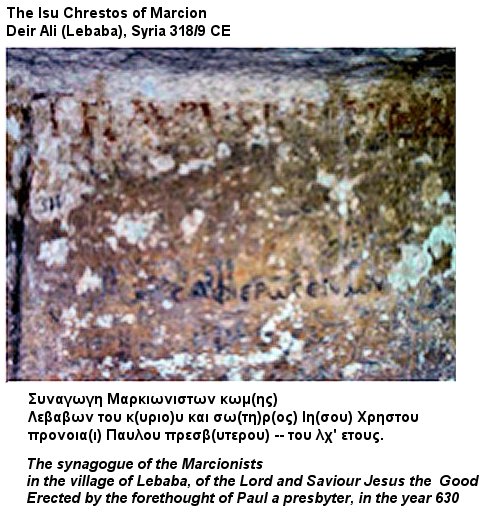
The question of course is how does the Marcionite phantom Jesus (being described here by Celsus) connect to the concept of 'seeing God' through the resurrection?  The heretics did not believe in the future resurrection to come.  The implication that Celsus was making was that the Christians he knew believed in the pre-Athanasian Incarnation - i.e. of assembled Christians embodying (quite literally) the resurrected Christ in the here-and-now.

On the Implications of My Son's Questions About God

If God was originally conceived as something which could indeed be seen with human eyes, why the change?  Why transform the original beliefs of the Pentateuch and its author?  The answer is very simple - Plato.  Plato changed everything for Judaism.  I have long argued that Christianity = Judaism + Plato.  Plato made it impossible for Jews to claim that their elders "saw God and they ate and drank."

Marqe read Plato and he reads 'glory' for God in Exodus 24.  Philo much the same thing by implication.  Yet when you really think about it, Christianity takes matters to the other extreme doesn't it?  Instead of hiding God and saying that all the Israelites saw was an angel, the Christian myth presents God as getting more in our faces.  He comes down to earth, walks around, bothers everyone.  What's up with that?

The answer has to be that the author of this myth is going along fully with Marqe (assuming the Christian Mark was someone else) and saying, the god of the ancient Israelites was a living man.  Isn't it also strange that the modern religionist doesn't even see divine apparitions any more.  It's amazing how no one notices that the religious experience keeps changing.

No one sees anything divine any more.  The religious world of even our recent ancestors was so filled with divine apparitions - and yet everyone is supposed to still believe even though the signs that there is a God have all disappeared (first God, now the neo-Platonists take away even the signs of his being).

It's going to be very hard for my son and his generation to be religious.

Thursday, December 1, 2011

Theological Questions From My Son

I am still working on my paper demonstrating how Schmid and Clabeaux's reconstruction of the Marcionite Apostolikon is worthless (as well as being up to my eyeballs with work).  Yet I thought I would start sharing some of my son's theological and philosophical questions because I have to admit, I find them refreshingly honest after spending weeks reading academic papers.

My son asked me the other day what God looks like.  The easy answer of course is to say that God doesn't exist or that he can't be seen.  Given the fact that I never like to live within politically correct points of view (this in not what the Bible teaches despite the opinions of apologists) I start to think about the question (it beats dwelling endlessly on the question of why superheroes never age and the like).

So what does the Bible really teach?

The proper starting point of course is Exodus chapter 24 which shuts up all the idiotic claims that God can't be seen with the human eye:

Moses and Aaron, Nadab and Abihu, and the seventy elders of Israel went up and saw the God of Israel. Under his feet was something like a pavement made of lapis lazuli, as bright blue as the sky. But God did not raise his hand against these leaders of the Israelites; they saw God, and they ate and drank.

The Hebrew here is impossible to misunderstand - Moses and the elders saw God with their own eyes (and he looked like he was made of sapphire).  The only way that Marqe the Samaritan gets around this is to say that this wasn't the highest God but his lieutenant 'the Glory' (= kavodah):

All that is above and below is obedient to the Glory ... a sapphire stone is a throne for the Glory

There are three other places where Marqe infers that Moses and the Israelites were in the presence of the Glory in spite of what the actual words of the Pentateuch says and of course everyone else who has ever studied these words fails to see what I get from this switch - Marqe was already proto-Marcionite.  For when you turn this around, he is implying that there was a higher god than the God revealed in the Torah ...


Stephan Huller's Observations by Stephan Huller
is licensed under a
Creative Commons Attribution 3.0 United States License.