Sunday, October 26, 2008

A Marcionite revolt in Alexandria c. 170 CE?

A sample of what appears in the Real Messiah order it here

The people called the Bucoli began a disturbance in Egypt and under the leadership of one Isidorus, a priest, caused the rest of the Egyptians to revolt. At first, arrayed in women's garments, they had deceived the Roman centurion, causing him to believe that they were women of the Bucoli and were going to give him gold as ransom for their p19husbands, and had then struck down when he approached them. They also sacrificed his companion, and after swearing an oath over his entrails, they devoured them. 2 Isidorus surpassed all his contemporaries in bravery. Next, having conquered the Romans in Egypt in a pitched battle, they came near capturing Alexandria, too, and would have succeeded, had not Cassius been sent against them from Syria. He contrived to destroy their mutual accord and to separate them from one another (for because of their desperation as well as of their numbers he had not ventured to attack them while they were united), and thus, when they fell to quarrelling, he subdued them. [Dio Cassius 72:9]

Saturday, October 25, 2008

Proof that the Orthodox thought Mark was a child-disciple of Jesus

A sample of what appears in the Real Messiah order it here

Troparion - Tone 4
From your childhood the light of truth enlightened you, O Mark, and you loved the labor of Christ the Savior.

Tuesday, October 14, 2008

The significance of Arius' alleged relationship with Miletius (c. 306 CE)

A sample of what appears in the Real Messiah order it here

In February 303, Diocletian initiated what was to prove the most serious and sustained persecution the Christian Church has so far endured. In eastern parts of the Empire and in Africa, martyrdom became common; though in the West Diocletian's colleague Maximian and Maximian's junior coadjutor Constantius, father of Constantine did virtually nothing to further the persecution in their territories. When in 305 Diocletian abdicated in favour of his fanatically anti-Christian second-in-command, the Caesar Galerius, the situation in the East deteriorated further from the Church's point of view. Galerius' protege Maximin was given the rank of Caesar and put in charge of Egypt and Syria (the civil diocese of 'the East,' Oriens); under his supervision, the persecution continued with hardly any interruption until 313 when Licinius seized power in the eastern empire. These eight years were a costly time for the Church in Egypt in more sense than one.

Several bishops suffered in the persecution ... and the prolonged imprisonment of a bishop would create obvious problems for his diocese ... [A]t some point late in 305 or early in 306, four Egyptian bishops, Hesychius, Pachomius, Theodorus and Phileas, wrote from prison to [Melitius] the newly appointed bishop of Lycopolis to complain that he had entered their diocese and performed ordinations, contrary to established laws and customs ... Miletius of Lycopolis has not consulted with the imprisoned bishops, nor it appears, has he referred the alleged problems of the orphaned diocese to [Pope] Peter of Alexandria: he has ordained unsuitable and factious persons and caused grave divisions in the church.

Peter we gather was absent from Alexandria, in flight or in hiding ... he is unlikely to have been outside of Egypt. This is reinforced by the fragment of narrative that follows the bishops letter in the codex which preserves the text:

After he had received and read the letter, he [Miletius] did not reply nor did he visit them in prison, nor did he go to blessed Peter: but when all these bishops, presbyters and deacons had been martyred in the prison in Alexandria, he immediately entered Alexandria. There was a man called Isidore in the city, a regular troublemaker, eager to be a teacher and also a certain Arius, who had an outward appearance of piety and he too was eager to be a teacher. When they had discovered what Miletius wanted and what it was that he required, they lost no time joining up with him (being envious of the authority of blessed Peter); and - when the result that Miletius' aims became publicly known - they pointed out to him where the presbyters to whom blessed Peter had delegated the power to visit the districts of Alexandria were hiding. Melitius notified them of a charge against them, excommunicated them, and himself ordained two persons, one to work in prison, the other to work in the mines.

Arius in the Church of Baukalis

A sample of what appears in the Real Messiah order it here

From Rowan Williams Arius: Heresy and Tradition

Epiphanius tells us that Arius was born in Libya: and a number of other smaller pieces of evidence tend to bear this out. Arius' two most consistent episcopal supporters in later years were Secundus and Theonas, bishops respectively of Ptolemais (or 'the Pentapolis' in some texts) and Marmarica: Ptolemais was the chief city of western or 'upper' Libya, the older Cyrenaica and the finas Alexandriae, the border of the urban area of Alexandria at the western end of the Mareotis ... The same picture is suggested in a letter from the Emperor Constantine to Arius, written around 333. Arius has been given permission to return from exile to his 'native territory' (unspecified) in 327 or 328, and Constantine writes as though Arius is currently in Libya. Evidently Arius is enjoying widespread popular support, since Constantine shows signs of panic at the idea of schism. A little earlier (331 or 332)we find Athanasius visiting Libya, and the Emperor's letter clearly suggests that it was becoming a very troubled area from the point of view of the Alexandrian see. Once again the whole pattern makes excellent sense in terms of partisanship for a local celebrity against intrusive foreign prelates.

If Epiphanius is to be relied on as regards Arius' place of birth, is he also to be trusted when he describes Arius as an 'old man' geron at the time of the outbreak of the controversy? Here we have no collateral evidence, though Constantine's letter of 333 contains a passage describing, in most insulting fashion, Arius' wasted and lifeless appearance - a passage which certainly fits a man well-advanced in years.

... The only clue we have as to Arius' education is the single word sulloukianista which occurs in his letter to Eusebius, bishop of Nicomedia, appealing for help in the first years of the controversy. Historians have generally taken 'fellow-Lucianist' pretty literally, and assumed a period of study with the martyr Lucian of Antioch. Ever since Newman this has produced some very questionable reconstruction of Arius' intellectual background ... we should not assume from the one word in Arius' letter that he had actually been Lucian's student. Wallace-Hadrill notes that Arius is not named by Philostorgius in his lists of Lucian's pupils and supposes that the Lucianists formed a coherent political and theological grouping quite independently of Arius. Certain if Philostorgius is to be believed, there were real theological divergences between this group and Arius and the later 'neo-Arians' of the mid-century traced their theological ancestry back to the Lucianists rather than Arius ... the anti-Nicene theological tradition evidently preserved the memory of a certain distance between Arius and some of his allies; it cannot be taken for granted that Arius was a disciple of Lucian in the sense that others such as Eusebius of Nicomedia claimed to be, even if he had attended lecturers by the martyr. 'Fellow-Lucianist' may be no more than a captatio benevolentaie - laying claim to a common ground with potential supporters ...

Whatever the nature and extent of his putative earlier travels the Arius who at last emerges into clear historical light at the end of the second decade of the fourth century is firmly anchored in Alexandria, presbyter of an important church and a popular preacher with a reputation for asceticism. Epiphanius pen-portrait is worth reproducing:

He was very tall in stature, with downcast countenance - counterfeited like a guileful serpent and well able to deceive any unsuspecting heart through its cleverly designed appearance. For he was always garbed in a short cloak (hemiphorion) and sleeveless tunic (kolobion); he spoke gently and people found him persuasive and flattering.

The sleeveless tunic is reminiscent of the exomis worn by both philosophers and by ascetics: Philo mentions that the contemplative Therapeutae of his day were dressed thus. Arius' costume would have identified him easily as a teacher of the way of salvation - a guru we might almost say. It is not surprising to find that Epiphanius also notes that he had the care of of seventy women living a life of ascetic seclusion presumably attached to his church. What we do know is precisely how long Arius occupied this influential post; as already noted he is said to have been ordained by Achillas and according to Theodoret Achillas' successor Alexander gave him authority to 'expound the Scriptures in church.' So we can perhaps trace Arius' public career back as far as 313, and assume that, for most of this decade he ministered at the Church Epiphanius calls 'Baucalis' - a respected cleric of some seniority, with a high reputation as a spiritual director. Before 313 nothing is clear; however one story emerges in the middle of the fifth century which has been widely believed ... that Arius was involved in the most serious internal disruption of Egyptian church life prior to the controversy over his own teachings: the schism initiated in 306 by Miletius bishop of Lycopolis.

Saturday, October 11, 2008

Tracing the Cult of St. Mark in Alexandria (part 1)

A sample of what appears in the Real Messiah order it here

Birger Pierson(Gnosticism and Christianity in Roman and Coptic Egypt p. 106 quoting the Acts of St. Peter Patriarch of Alexandria c. 311 CE)

"Of interest here is the connection between [the Patriarch] Peter and the Martyrium of St. Mark in the story. The two published Greek versions agree in providing the following details that are relevant to our discussion. The tribunes take Peter out of his prison to "the place called Boukolou" where St. Mark had been martyred. With the permission of the tribunes, Peter goes down into the tomb of Mark and addresses the holy evangelist asking for his intercession, that he might enter martyrdom joyously. Rising from the tomb of Mark, Peter offers up a prayer to Jesus Christ ... Peter presents himself to the tribunes, who station him to the south of the martyr chapel (martyrion) in a depression by the tombs and there he is beheaded ... Some want to take the body to the Church of Theonas (in the western part of Alexandria) but others spirit him away in a ship for the place was near the sea. Sailing around [the lighthouse] Pharos they arrive at the cemetery that Peter himself had established in a suburban area to the west of the city. There he is finally buried.

The topographical references in this account match those of the Acts of Mark with additional amplifications. Ta boukolou where the Martyrium of Mark was located is specified as a suburban area but also near the sea. There are also tombs in the area. The tombs in question are clearly those now known as the Shatby Necropolis (fourth-third centuries BCE), part of the eastern necropolis that had been covered over during the city's eastward expansion and no longer in use by the first century

... There can be no doubt as to the location of the area our texts refer to as ta boulokou. By the fourth century CE after massive destructions suffered by the city in the second and third centuries this area was suburban located well outside the city. It could very well have been used for cow pastures (if this is what ta boulokou means). The cliffs referred to in the Acts of Mark are probably one of the hillocks that rose inland from the seacoast east of the city in the area around Shatby, long since obliterated by the cutting and filling associated with construction projects in the modern city of Alexandria but known from old maps.

The church associated with the tomb of Mark was probably abandoned in the fifth century and replaced by another church dedicated to St. Mark that was closer to the center of the city. No trace of the church in Boukolou remains nor can its exact location be known, but it was probably located at or near the site of the present College of St. Mark built in the 1920's by the Christian Brothers order of the Roman Catholic Church.

One other site which is mentioned in the Acts of Mark "the so-called Angeloi" where the mob tried to burn Mark's body. If there is such a place, it can be assumed that it was located near Boukolou. But the Bollandist editors of the Acts of Mark are likely correct in their suggestion that the Greek text is corrupted at this point. The text reads in both recensions - the corruption thus goes back to a common source used by both - eis tous kaloumenous aggelous. The reading suggested by the editors is eis ton aigialon (to the seashore). I tentatively suggest, instead, eis tous aigialous the plural form (which essentially means the same) corresponding more closely to the plural occurring in the corrupted text of the Acts of Mark. The corruption in the transmission of the text would have taken place under the influence of the name given to a sixth century church in Alexandria, the Angelion, and probably under the influence of the reference in the text to the worship of the god Serapis ...

The place-name Angeloi having disappeared from our text, we read instead that the mob ignited a fire 'on the beaches' near Boukolou and there attempted to burn the martyr's body. By coincidence the same phrase eis (tous) aigialous occurs in an important passage in Philo's treatise Against Flaccus, in the context of a report on a vicious pogrom perpetrated by the Alexandrian Greeks against the Jews of Alexandria 37 - 38 CE.

The Martyrium of St. Mark

A sample of what appears in the Real Messiah order it here

Arius was the presbyter at the martyrium of St. Mark, Boukolou (pasture near northeastern cliffs beside the sea)

The Cultus of Mark in Alexandria

A sample of what appears in the Real Messiah order it here

Thanks to a paper I am now writing on the Throne of St. Mark I have stumbled upon an important piece of information. The traditional scholarly mindset can't get around their inherited assumptions about the Church being founded on the authority of St. Peter. Yes, they would acknowledge, the Church Fathers speak of various 'heresies' existing contemporaneously with the Catholic Church. Yet they also go along with the underlying assumptions in these reports that these 'heretical' communities were little more than a bunch of 'freaks' who no one need to take too seriously.

Irenaeus and his successors warn the presbytery against these variant forms of Christianity while at the same time making them seem as ridiculous as possible.

To this end these academics who rely upon these ancient Catholic authorities naturally fall into the trap of simply taking their word at face value that no other form of early Christianity had any substance. These traditions were founded on men like 'Marcion,' 'Valentinus' and other essentially secondary sources. They are always portrayed as being removed from individuals who actually saw and heard Jesus.

I can't believe that scholars can even imagine such a ridiculous situation. I mean one would expect that even if someone was making up a tradition about Jesus they would have put in the mouth of an actual eyewitness. Even the texts of the Catholic Church - i.e. the gospel of Luke for example - make reference to this 'eyewitness' reporting. How could it be imagined that the heretics even if they are assumed to have been 'faking it' didn't do the exact same thing?

To this end, when we come across the ultimate survival of a rival Christian tradition from Alexandria which claims that Mark was of a status equal to or greater than Peter academics have to find a way to dismiss it as a way of getting back to the 'safety' of a one tradition universe. It is always about 'absolute' truth. There is no relativity here.

The unconscious argument essentially goes something like this. God is absolutely true and good THEREFORE there can only be an absolute truth about his religion. There can't have been any corruption of his doctrine because this would imply weakness on the part of God as the original transmitter of that message.

Even when these arguments aren't made explicit they lurk somewhere in the depths of the actual dismissal of the Coptic tradition and its traditional emphasis of the authority of St. Mark. Yes to be certain the word Copt was originally intended to signify that it was the 'Egyptian' faith, the tradition of native born Egyptians as opposed to the Greek 'Melkite' faith associated with Constantinople in the sixth and seventh centuries. Yet the development of this faith must have went back many more centuries than that.

I have already noted that Clement and Origen seem to have been odds with the official Catholic faith of Irenaeus. Yes to be certain they accepted the canon. However it is equally clear that this canon was imposed on them. There is no way to avoid the fact that Demetrius was an outsider to this tradition and came as an enforcer of a foreign doctrine that was secretly resisted by men such as these. Clement and Origen were attached to Mark - my argument would go - while Irenaeus and Demetrius were of Peter.

Of course for scholars this seemed over-simplistic and worse yet there seems to be little proof that this 'alternative tradition of Mark' ever existed before the establishment of the Coptic faith. Yes, there is the Letter to Theodore - but isn't this a 'disputed' epistle? I needn't go into the question of whether Origen 'hid' his heresy. It is acknowledged that he was eventually anathematized for holding heretical views. His existing texts were censored. And look at the anti-Petrine argument in large parts of his Commentary on Matthew.

Yet the elusive thing has always been finding 'the cult of Mark' as the Copts present it to us now before the sixth or seventh centuries. I think I have found it in the example of Alexandria's most famous heretic - Arius.

Sunday, October 5, 2008

Tertullian of Carthage on Psalm 45 (third century CE)

A sample of what appears in the Real Messiah order it here

a1) Against the Jews 9 - Moreover, this our interpretation will be supported while (we find that) elsewhere as well the Scriptures designate Christ a warrior, as we gather from the names of certain weapons, and words of that kind. But by a comparison of the remaining senses the Jews shall be convicted. “Gird thee,” says David, “the sword upon the thigh.” [Ps. xlv. 3] But what do you read above concerning the Christ? “Blooming in beauty above the sons of men; grace is outpoured in thy lips.” [Ps. xlv. 2] But very absurd it is if he was complimenting on the bloom of his beauty and the grace of his lips, one whom he was girding for war with a sword; of whom he proceeds subjunctively to say, “Outstretch and prosper, advance and reign!” And he has added, “because of thy lenity and justice.” [Ps. xlv. 4] Who will ply the sword without practising the contraries to lenity and justice; that is, guile, and asperity, and injustice, proper (of course) to the business of battles? See we, then, whether that which has another action be not another sword,—that is, the Divine word of God, doubly sharpened with the two Testaments of the ancient law and the new law; sharpened by the equity of its own wisdom; rendering to each one according to his own action. [comp. Ps. lxii. 12; Rom. ii. 6]. Lawful , then, it was for the Christ of God to be precinct, in the Psalms, without warlike achievements, with the figurative sword of the word of God; to which sword is congruous the predicated “bloom,” together with the “grace of the lips;” with which sword He was then “girt upon the thigh,” in the eye of David, when He was announced as about to come to earth in obedience to God the Father’s decree. “The greatness of thy right hand,” he says, “shall conduct thee” [see Ps. xlv. 5] —the virtue to wit, of the spiritual grace from which the recognition of Christ is deduced. “Thine arrows,” he says, “are sharp,” [Ps. xlv. 5]—God’s everywhere-flying precepts (arrows) threatening the exposure of every heart, and carrying compunction and transfixion to each conscience: “peoples shall fall beneath thee,” [Ps. xlv. 5] —of course, in adoration. Thus mighty in war and weapon-bearing is Christ; thus will He “receive the spoils,” not of “Samaria” alone, but of all nations as well. Acknowledge that His “spoils” are figurative whose weapons you have learnt to be allegorical. And thus, so far, the Christ who is come was not a warrior, because He was not predicted as such by Isaiah.

“But if the Christ,” say they, “who is believed to be coming is not called Jesus, why is he who is come called Jesus Christ?” Well, each name will meet in the Christ of God, in whom is found likewise the appellation Jesus. Learn the habitual character of your error.

a2) Tertullian Against Marcion 3:14 This interpretation of ours will derive confirmation, when, on your supposing that Christ is in any passage called a warrior, from the mention of certain arms and expressions of that sort, you weigh well the analogy of their other meanings, and draw your conclusions accordingly. “Gird on Thy sword,” says David, “upon Thy thigh.” [Ps. xlv. 3] But what do you read about Christ just before? “Thou art fairer than the children of men; grace is poured forth upon Thy lips.” [Ps. xlv. 2] It amuses me to imagine that blandishments of fair beauty and graceful lips are ascribed to one who had to gird on His sword for war! So likewise, when it is added, “Ride on prosperously in Thy majesty,” the reason is subjoined: “Because of truth, and meekness, and righteousness.” [Ps. xlv. 4] But who shall produce these results with the sword, and not their opposites rather—deceit, and harshness, and injury—which, it must be confessed, are the proper business of battles? Let us see, therefore, whether that is not some other sword, which has so different an action. Now the Apostle John, in the Apocalypse, describes a sword which proceeded from the mouth of God as “a doubly sharp, two-edged one.” [Rev. i. 16] This may be understood to be the Divine Word, who is doubly edged with the two testaments of the law and the gospel—sharpened with wisdom, hostile to the devil, arming us against the spiritual enemies of all wickedness and concupiscence, and cutting us off from the dearest objects for the sake of God’s holy name. If, however, you will not acknowledge John, you have our common master Paul, who “girds our loins about with truth, and puts on us the breastplate of righteousness, and shoes us with the preparation of the gospel of peace, not of war; who bids us take the shield of faith, wherewith we may be able to quench all the fiery darts of the devil, and the helmet of salvation, and the sword of the Spirit, which (he says) is the word of God.” [Eph. vi. 14–17] This sword the Lord Himself came to send on earth, and not peace. [Matt. x. 34] If he is your Christ, then even he is a warrior. If he is not a warrior, and the sword he brandishes is an allegorical one, then the Creator’s Christ in the psalm too may have been girded with the figurative sword of the Word, without any martial gear. The above-mentioned “fairness” of His beauty and “grace of His lips” would quite suit such a sword, girt as it even then was upon His thigh in the passage of David, and sent as it would one day be by Him on earth. For this is what He says: “Ride on prosperously in Thy majesty” —advancing His word into every land, so as to call all nations: destined to prosper in the success of that faith which received Him, and reigning, from the fact that He conquered death by His resurrection. “Thy right hand,” says He, “shall wonderfully lead Thee forth,” [Ps. xlv. 4] even the might of Thy spiritual grace, whereby the knowledge of Christ is spread. “Thine arrows are sharp;” [Ps. xlv. 5] everywhere Thy precepts fly about, Thy threatenings also, and convictions of heart, pricking and piercing each conscience. “The people shall fall under Thee,” [Ps. xlv. 5] that is, in adoration. Thus is the Creator’s Christ mighty in war, and a bearer of arms; thus also does He now take the spoils, not of Samaria alone, but of all nations. Acknowledge, then, that His spoils are figurative, since you have learned that His arms are allegorical. Since, therefore, both the Lord speaks and His apostle writes such things in a figurative style, we are not rash in using His interpretations, the records of which even our adversaries admit; and thus in so far will it be Isaiah’s Christ who has come, in asfar as He was not a warrior, because it is not of such a character that He is described by Isaiah.

b) Tertullian Against Marcion 2:5 In this good work God employs a most excellent minister, even His own Word. “My heart,” He says, “hath emitted my most excellent Word.” Let Marcion take hence his first lesson on the noble fruit of this truly most excellent tree. But, like a most clumsy clown, he has grafted a good branch on a bad stock.

c) Tertullian Against Marcion 4:14 - “because theirs is the kingdom of heaven.” [Luke vi. 20]. Now this very fact, that He begins with beatitudes, is characteristic of the Creator, who used no other voice than that of blessing either in the first fiat or the final dedication of the universe: for “my heart,” says He, “hath indited a very good word.” [Ps. xlv. 1] This will be that “very good word” of blessing which is admitted to be the initiating principle of the New Testament, after the example of the Old.

d) Tertullian Against Marcion 5:18 “He led captivity captive,” says the apostle [Eph. iv. 8]. With what arms? In what conflicts? From the devastation of what country? From the overthrow of what city? What women, what children, what princes did the Conqueror throw into chains? For when by David Christ is sung as “girded with His sword upon His thigh,” [Ps. xlv. 3] or by Isaiah as “taking away the spoils of Samaria and the power of Damascus,” [Isa. viii. 4] you make Him out to be really and truly a warrior confest to the eye. Learn then now, that His is a spiritual armour and warfare, since you have already discovered that the captivity is spiritual, in order that you may further learn that this also belongs to Him

e) Tertullian Against Hermogenes 18
On this principle, then, if evil is indeed unbegotten, whilst the Son of God is begotten (“for,” says God, “my heart hath emitted my most excellent Word” [Ps. xlv. 1] I am not quite sure that evil may not be introduced by good, the stronger by the weak, in the same way as the unbegotten is by the begotten

f) Tertullian Against Praxeas 7 Thus does He make Him equal to Him: for by proceeding from Himself He became His first-begotten Son, because begotten before all things [ Col. i. 15] and His only-begotten also, because alone begotten of God, in a way peculiar to Himself, from the womb of His own heart—even as the Father Himself testifies: “My heart,” says He, “hath emitted my most excellent Word.” [Ps. xlv. 1] The Father took pleasure evermore in Him

g) Tertullian Against Praxeas 11 Father and the Son are demonstrated to be distinct; I say distinct, but not separate: for as on my part I produce the words of God Himself, “My heart hath emitted my most excellent Word,” [Ps xlv. 1] so you in like manner ought to adduce in opposition to me some text where God has said, “My heart hath emitted Myself as my own most excellent Word,” in such a sense that He is Himself both the Emitter and the Emitted, both He who sent forth and He who was sent forth, since He is both the Word and God.

h) Tertullian Against Praxeas 13 Well then, you reply, if He was God who spoke, and He was also God who created, at this rate, one God spoke and another created; (and thus) two Gods are declared. If you are so venturesome and harsh, reflect a while; and that you may think the better and more deliberately, listen to the psalm in which Two are described as God: “Thy throne, O God, is for ever and ever; the sceptre of Thy kingdom is a sceptre of righteousness. Thou hast loved righteousness, and hated iniquity: therefore God, even Thy God, hath anointed Thee or made Thee His Christ.” [Ps. xlv. 6, 7] Now, since He here speaks to God, and affirms that God is anointed by God, He must have affirmed that Two are God, by reason of the sceptre’s royal power.

Saturday, October 4, 2008

Clement of Alexandria on Psalm 45 (c. 190 CE)

A sample of what appears in the Real Messiah order it here

Instructor 2:8 Wherefore also the Lord Himself is anointed with an ointment, as is mentioned by David: “Wherefore God, thy God, hath anointed thee with the oil of gladness above thy fellows; myrrh, and stacte, and cassia from thy garments.” Ps. xlv. 7, 8. But let us not unconsciously abominate unguents, like vultures or like beetles (for these, they say, when smeared with ointment, die); and let a few unguents be selected by women, such as will not be overpowering to a husband. For excessive anointings with unguents savour of a funeral 255and not of connubial life. Yet oil itself is inimical to bees and insects; and some men it benefits, and some it summons to the fight; and those who were formerly friends, when anointed with it, it turns out to deadly combat.

Stromata 6:15 And, in truth, the kingly man and Christian ought to be ruler and leader. For we are commanded to be lords over not only the wild beasts without us, but also over the wild passions within ourselves. Through the knowledge, then, as appears, of a bad and good life is the Gnostic saved, understanding and executing “more than the scribes and Pharisees.” [Matt. v. 20]. “Exert thyself, and prosper, and reign” writes David, “because of truth, and meekness, and righteousness; and thy right hand shall guide thee marvellously,” [Ps. xlv. 4] that is, the Lord.

Stromata 6:11 Such David describes the Church: “The queen stood on thy right hand, enveloped in a golden robe, variegated;” [Ps. xlv. 9] and with Hellenic and superabundant accomplishments, “clothed variegated with gold-fringed garments.” [Ps. xlv. 14]

Theophilus of Antioch on Psalm 45 (c 180 CE)

A sample of what appears in the Real Messiah order it here

Ad Autolycus 2:10 - And first, they taught us with one consent that 98God made all things out of nothing; for nothing was coeval with God: but He being His own place, and wanting nothing, and existing before the ages, willed to make man by whom He might be known; for him, therefore, He prepared the world. For he that is created is also needy; but he that is uncreated stands in need of nothing. God, then, having His own Word internal within His own bowels, begat Him, emitting Him along with His own wisdom before all things. He had this Word as a helper in the things that were created by Him, and by Him He made all things. He is called “governing principle” [ἁρκή], because He rules, and is Lord of all things fashioned by Him. He, then, being Spirit of God, and governing principle, and wisdom, and power of the highest, came down upon the prophets, and through them spoke of the creation of the world and of all other things.

Irenaeus of Rome/Lyons on Psalm 45 (c. 180 CE)

a) Haer 3:6 1 Irenaeus attacks the idea promoted by some heretical groups that Christ was someone other than Jesus and refutes their interpretation of select Scriptures with what he puts forward as ‘the correct’ interpretation including - “The LORD said unto my Lord, Sit Thou at my right hand, until I make Thine enemies Thy footstool.” [Ps. cx. 1].Here the [Scripture] represents to us the Father addressing the Son … And again, referring to the destruction of the Sodomites, the Scripture says, “Then the LORD rained upon Sodom and upon Gomorrah fire and brimstone from the LORD out of heaven.” [Gen. xix. 24]. For it here points out that the Son, who had also been talking with Abraham, had received power to judge the Sodomites for their wickedness. And this [text following] does declare the same truth: “Thy throne, O God, is for ever and ever; the sceptre of Thy kingdom is a right sceptre. Thou hast loved righteousness, and hated iniquity: therefore God, Thy God, hath anointed Thee.” [Ps. xlv. 6] For the Spirit designates both [of them] by the name, of God—both Him who is anointed as Son, and Him who does anoint, that is, the Father.

(b) Haer 3:22 - And it has, in fact, happened that the first compact looses from the second tie, but that the second tie takes the position of the first which has been cancelled. For this reason did the Lord declare that the first should in truth be last, and the last first. [Matt. xix. 30, Matt. xx. 16] And the prophet, too, indicates the same, saying, “instead of fathers, children have been born unto thee.” [Ps. xlv. 17]. For the Lord, having been born “the First-begotten of the dead,” [Rev. i. 5] and receiving into His bosom the ancient fathers, has regenerated them into the life of God, He having been made Himself the beginning of those that live, as Adam became the beginning of those who die.


(c) Haer 4:5 But our Lord is Himself the resurrection, as He does Himself declare, “I am the resurrection and the life.” [John xi. 25]. But the fathers are His children; for it is said by the prophet: “Instead of thy fathers, thy children have been made to thee.”[Ps. xlv. 16] Christ Himself, therefore, together with the Father, is the God of the living, who spake to Moses, and who was also manifested to the fathers.

(d) Haer 4:33:11 begins as a discussion of various wrongheaded heretical opinions starting with Marcion and then progress to the idea that:

For some of them, beholding Him in glory, saw His glorious life (conversationem) at the Father’s right hand [Isa. vi. 1; Ps. cx. 1] others beheld Him coming on the clouds as the Son of man [Dan. vii. 13] and those who declared regarding Him, “They shall look on Him whom they have pierced,” [Zech. xii. 10] indicated His [second] advent, concerning which He Himself says, “Thinkest thou that when the Son of man cometh, He shall find faith on the earth?” [Luke xviii. 8]. … There are also some [of them] who declare, “Thou art fairer than the children of men;” [Ps. xlv. 2] and, “God, Thy God, hath anointed Thee with the oil of gladness above Thy fellows;” [Ps. xlv. 7] and, “Gird Thy sword upon Thy thigh, O Most Mighty, with Thy beauty and Thy fairness, and go forward and proceed prosperously; and rule Thou because of truth, and meekness, and righteousness.” [Ps. xlv. 3, 4] And whatever other things of a like nature are spoken regarding Him, these indicated that beauty and splendour which exist in His kingdom, along with the transcendent and pre-eminent exaltation [belonging] to all who are under His sway, that those who hear might desire to be found there, doing such things as are pleasing to God.

Justin of Neapolis on Psalm 45 (early second century CE)

(a) Dial 36f - Then he replied, “Let these things be so as you say—namely, that it was foretold Christ would suffer, and be called a stone; and after His first appearance, in which it had been announced He would suffer, would come in glory, and be Judge finally of all, and eternal King and Priest. Now show if this man be He of whom these prophecies were made”

… Accordingly, in the forty-fourth [forty-fifth] Psalm, these words are in like manner referred to Christ: ‘My heart has brought forth a good matter. I tell my works to the King. My tongue is the pen of a ready writer. Fairer in beauty than the sons of men: grace is poured forth into Thy lips: therefore hath God blessed Thee for ever. Gird Thy sword upon Thy thigh, O mighty One. Press on in Thy fairness and in Thy beauty, and prosper and reign, because of truth, and of meekness, and of righteousness: and Thy right hand shall instruct Thee marvellously. Thine arrows are sharpened, O mighty One; the people shall fall under Thee; in the heart of the enemies of the King. Thy throne, O God, is for ever and ever: a sceptre of equity is the sceptre of Thy kingdom. Thou hast loved righteousness, and hast hated iniquity; therefore God, thy God hath anointed Thee with the oil of gladness above Thy fellows with myrrh and oil, and cassia, from Thy garments; from the ivory palaces, whereby they made Thee glad. Kings’ daughters are in Thy honour. The queen stood at Thy right hand, clad in garments embroidered with gold. Hearken, O daughter, and behold, and incline thine ear, and forget thy people and the house of thy father: and the King shall desire thy beauty; because He is thy Lord, they shall worship Him also. And the daughter of Tyre [shall be there] with gifts. The rich of the people shall entreat Thy face. All the glory of the King’s daughter [is] within, clad in embroidered garments of needlework. The virgins that follow her shall be brought to the King; her neighbours shall be brought unto Thee: they shall be brought with joy and gladness: they shall be led into the King’s shrine. Instead of thy fathers, thy sons have been born: Thou shalt appoint them rulers over all the earth. I shall remember Thy name in every generation: therefore the people shall confess Thee for ever, and for ever and ever.’ [Dial 38]

(b) Dial 56 - “It is not on this ground solely,” I said, “that it must be admitted absolutely that some other one is called Lord by the Holy Spirit besides Him who is considered Maker of all things; not solely [for what is said] by Moses, but also [for what is said] by David. For there is written by him: ‘The Lord says to my Lord, Sit on My right hand, until I make Thine enemies Thy footstool,’ [Ps. cx. 1] as I have already quoted. And again, in other words: ‘Thy throne, O God, is for ever and ever. A sceptre of equity is the sceptre of Thy kingdom: Thou hast loved righteousness and hated iniquity: therefore God, even Thy God, hath anointed Thee with the oil of gladness above Thy fellows [Ps. xlv. 6, 7] If, therefore, you assert that the Holy Spirit calls some other one God and Lord, besides the Father of all things and His Christ, answer me; for I undertake to prove to you from Scriptures themselves, that He whom the Scripture calls Lord is not one of the two angels that went to Sodom, but He who was with them, and is called God, that appeared to Abraham.”

(c) Dial 63 - “And Trypho said, “… Prove also clearly, that after this He rose again and ascended to heaven.”
I answered, “This, too, has been already demonstrated by me in the previously quoted words of the prophecies, my friends; which, by recalling and expounding for your sakes, I shall endeavour to lead you to agree with me also about this matter … And speaking in other words, which also have been already quoted, [he says]: ‘Thy throne, O God, is for ever and ever: a sceptre of rectitude is the sceptre of Thy kingdom. Thou hast loved righteousness, and hast hated iniquity: therefore God, even thy God, hath anointed Thee with the oil of gladness above Thy fellows with myrrh, and oil, and cassia from Thy garments, from the ivory palaces, whereby they made Thee glad. Kings’ daughters are in Thy honour. The queen stood at Thy right hand, clad in garments embroidered with gold. Hearken, O daughter, and behold, and incline thine ear, and forget thy people and the house of thy father; and the King shall desire thy beauty: because he is thy Lord, and thou shalt worship Him.’ [Ps. xlv. 6–11]. Therefore these words testify explicitly that He is witnessed to by Him who established these things as deserving to be worshipped, as God and as Christ. Moreover, that the word of God speaks to those who believe in Him as being one soul, and one synagogue, and one church, as to a daughter; that it thus addresses the church which has sprung from His name and partakes of His name (for we are all called Christians), is distinctly proclaimed in like manner in the following words, which teach us also to forget [our] old ancestral customs, when they speak thus ‘Hearken, O daughter, and behold, and incline thine ear; forget thy people and the house of thy father, and the King shall desire thy beauty: because He is thy Lord, and thou shalt worship Him.’

Here Trypho said, “Let Him be recognised as Lord and Christ and God, as the Scriptures declare, by you of the Gentiles, who have from His name been all called Christians; but we who are servants of God that made this same [Christ], do not require to confess or worship Him.”

(d) Dial 86 And when I had quoted this, I added, “Hear, then, how this Man, of whom the Scriptures declare that He will come again in glory after His crucifixion, was symbolized by the tree of life, which was said to have been planted in paradise … He [Jacob] said he had seen a ladder, and the Scripture has declared that God stood above it. But that this was not the Father, we have proved from the Scriptures. And Jacob, having poured oil on a stone in the same place, is testified to by the very God who appeared to him, that he had anointed a pillar to the God who appeared to him. And that the stone symbolically proclaimed Christ, we have also proved by many Scriptures; and that the unguent, whether it was of oil, or myrrh or of any other compounded sweet balsams, had reference to Him, we have also proved inasmuch as the word says: ‘Therefore God, even Thy God, hath anointed Thee with the oil of gladness above Thy fellows.’ [Ps. xlv. 7] For indeed all kings and anointed persons obtained from Him their share in the names of kings and anointed: just as He Himself received from the Father the titles of King, and Christ, and Priest

Thursday, October 2, 2008

Pek Ethronos

The music on that other blog is an ancient Coptic hymn that many members of the faith claim goes back to the Therapeutae (you know that first century Jewish messianic sect which St. Mark was supposed to have founded in Alexandria)! In any event I am certain that Psalm 45 [44] which happens to provide the words for this hymn is intimately associated with the Throne of St. Mark. I think 'his throne' means St. Mark's throne.

I also think that the description in Irenaeus of the heretical community of Mark contains in it a development of the content of Psalm 45. More on that later.

Wednesday, October 1, 2008

The Throne of St. Mark

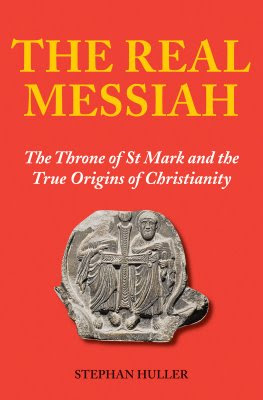
Haven't been posting much owing to the fact that I have been busy proving that my discovery the cattedra di San Marco is in fact the earliest surviving artifact from the Passion of Christ. It sounds absurd I know but I think its true. Here is a picture of my beloved object www.therealmessiahbook.blogspot.com
 
Stephan Huller's Observations by Stephan Huller
is licensed under a
Creative Commons Attribution 3.0 United States License.